Pseudofolliculitis Barbae: The Evidence-Based Treatment Ladder for Razor Bumps
Published on September 26, 2026
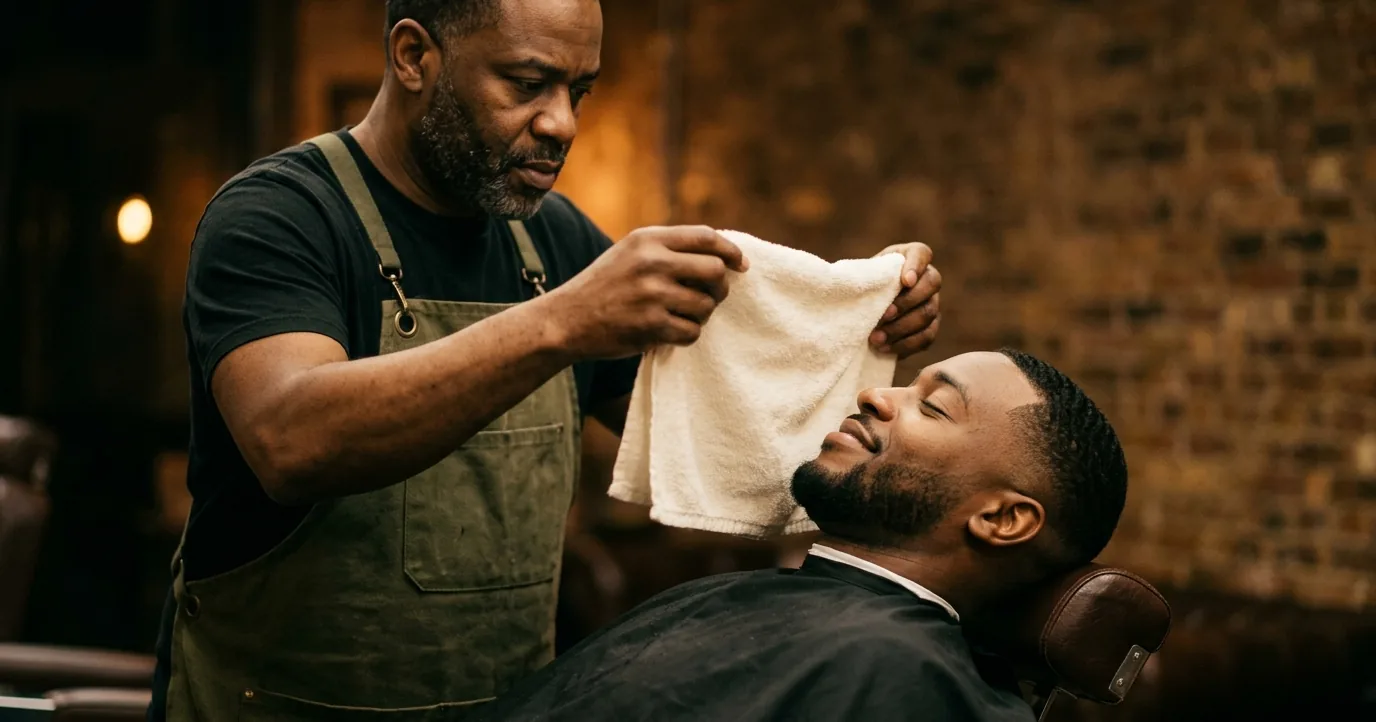
Every barber hears the question at least once a week. The cape comes off, the client runs his fingers along his jaw and asks what he should be putting on these bumps. Usually he has already tried a new razor, two aftershaves and a cousin’s advice, and the bumps along his neck are still there, with dark marks where the last round healed.
The condition is pseudofolliculitis barbae (PFB). In September 2026, a panel of board-certified US dermatologists published consensus recommendations for managing it in JAMA Dermatology, and they put first what dermatologists have long advised: change how the hair comes off. The prevention basics are in our grooming guide. This is the full ladder, from free fixes to prescription creams and laser, and the point where a dermatologist should take over.
What Is Actually Happening Under the Skin
PFB is not acne, and at first it is not an infection. It is a mechanical problem with an immune reaction attached. A tightly curved follicle grows a tightly curved hair, and when that hair is cut very short, its sharp new tip can get back into the skin by one of two routes.
- Extrafollicular penetration. The hair leaves the follicle, curls back and pierces the skin a few millimeters away. It happens often on the front of the neck, where hair grows at a low angle to the skin.
- Transfollicular penetration. The hair is pulled up before it is cut, by stretching the skin, shaving against the grain or dragging a dull blade. The cut end snaps back below the surface and, because it is curved, pushes through the wall of its own follicle.
Either way, the body treats the buried hair like a splinter. Itching or tenderness comes a day or two after the shave, then firm bumps and sometimes pustules. On dark skin they often leave dark marks behind, and people prone to keloids can scar.
Genes load the dice. A 2004 study traced part of the risk to a variant in K6hf, a keratin in the follicle wall, and carriers are about six times as likely to develop PFB. Each rung below breaks a different link in the chain: the cut, the sharp tip, the thickened skin at the follicle opening, the inflammation, or the hair itself.
Razor Bumps, Razor Burn, Acne or Infection?
Much of what sits on the pharmacy shelf treats the wrong problem, so check what you have first.
- Razor burn appears right after a close shave and usually clears within 24 to 48 hours.
- Razor bumps arrive a day or two after the shave, where the blade went: most often the front of the neck, then the cheeks and chin, especially under the jawline, where hairs grow in several directions. You can often see a hair curving back into the bump. The mustache, where hair is finer and less coiled, is usually spared.
- Acne brings blackheads and whiteheads, and shows up on the forehead and nose, where no razor has been.
- Bacterial folliculitis looks similar but is an infection, usually with Staphylococcus aureus, and a deep one becomes a painful boil. It can sit on top of PFB, since follicles damaged by ingrown hairs infect easily, and a swab sent for culture tells them apart.
- Tinea barbae, a fungal infection, makes raised, scaly rings with clearer centers, often on one side of the face.
- Bumps at the nape and the back of the scalp are more often acne keloidalis nuchae, with its own scarring risk.
- Small, even bumps that never itch or change need a dermatologist’s eye, because sarcoidosis can mimic PFB on dark skin.
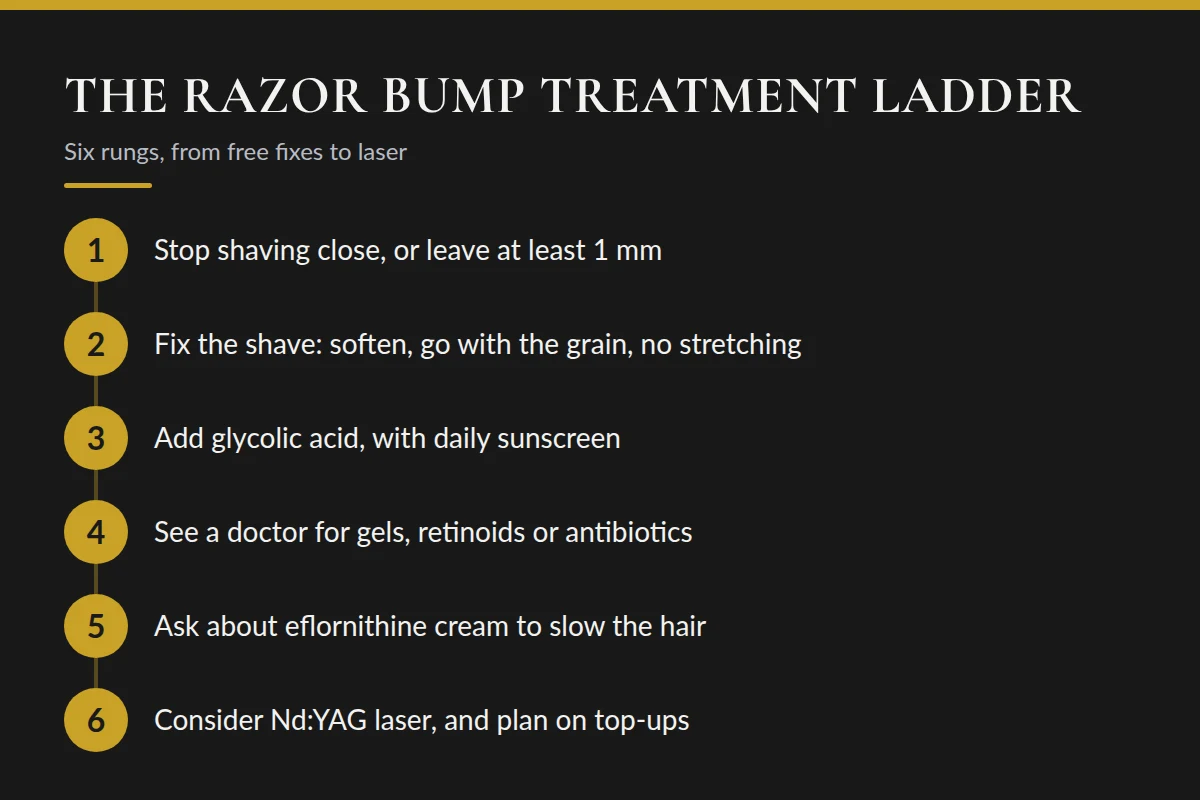
Rung 1: Put the Razor Down, or Leave Some Stubble
Nothing on this list works as reliably as letting the hair grow. Once a trapped hair reaches about 10 millimeters, it pulls free and the bump settles. A 2023 review in American Family Physician calls at least eight weeks without shaving the best first treatment.
It can look worse before it looks better, because hairs cut by the last shave still have to grow past the curl. The American Academy of Dermatology (AAD) says to expect fewer bumps within a month and clear skin by about three months.

Stopping the razor does not have to mean a full beard. Clippers or a trimmer that leave at least a millimeter of hair keep the tip above the skin.
Leave the bumps alone while you wait. A sterile needle can lift a looped hair free, but do not pluck it: the AAD warns that plucking inside a bump causes new ones, and a pulled hair can leave a fragment behind.
Rung 2: If the Job Requires a Clean Face, Change the Shave
For men whose work, faith or taste calls for a clean face, the goal is a shave that leaves a blunt tip above the surface. The AAD and that review describe nearly the same routine:
- Soften first. Hold a warm, damp washcloth on the beard for five minutes, or shave at the end of a shower, so the hair swells and cuts to a blunter tip.
- Never dry shave. Let a moisturizing shaving cream sit for a minute or two.
- Go with the grain and do not stretch the skin. Short strokes, light pressure, as few passes as possible. One dermatology reference suggests keeping your free hand behind your back.
- Keep the blade sharp. Replace a single blade after five to seven shaves. A dull blade stretches the hair before it cuts, and the recoil starts transfollicular bumps.
- Cool down with a cool, damp cloth for five minutes.
- Shave every one to three days, so the hair never grows long enough to curve back.
The razor argument, honestly. The most repeated advice, use a single blade, is also the least proven. A 2016 review found no robust trial evidence for it, and in a 12-week trial of 90 African American men, daily shaving produced no more papules or pustules than shaving two or three times a week, though the less frequent shavers had fewer ingrown hairs. The 2026 panel could not agree on multiblade razors either. If a single blade keeps you clear, keep it, but technique matters more than the blade count.
Or skip the blade. The American Family Physician review prefers an electric razor set to leave one to three millimeters. In the shop, the same logic is why a foil shaver, which cuts at the surface, leaves fewer ingrown hairs than a razor pass. Chemical depilatories dissolve the hair and leave a soft, blunt tip. They cause fewer bumps than a razor but more irritation, and they must be washed off completely.
Rung 3: Glycolic Acid and Other Exfoliating Acids
When bumps keep coming despite a better shave, target the skin at the follicle opening. PFB thickens the outer layer there, and exfoliating acids thin it back down so a growing hair has an easier way out.
The best evidence is for glycolic acid. In two placebo-controlled trials involving 35 men, published in 1993, a glycolic acid lotion cut bumps by more than 60 percent and let the men shave daily with little irritation. The trials are small and old, but they had a placebo comparison, which most shaving advice lacks. Salicylic acid works on the same principle.
Two cautions come from the FDA. In its research, four weeks of glycolic acid raised the skin’s sensitivity to UV reddening by 18 percent, and its adverse event reports for these acids include burning, rashes and pigment changes, the more serious ones mostly from the strongest peeling products. On dark skin, sun and irritation both deepen the marks PFB leaves, so start gently and wear sunscreen.
In-office chemical peels go further, with mixed support. The 2026 panel reached no agreement on superficial peels, and in a small head-to-head trial, laser beat peels on bump counts.
Rung 4: Prescription Gels, Creams and Pills
When bumps are inflamed or full of pus, a doctor has several tools. A 2019 review found the best results come from pairing them with better shaving habits, rather than relying on either alone.
- Benzoyl peroxide with clindamycin. In a 10-week trial, 88 men who kept shaving at least twice a week used a gel of benzoyl peroxide 5% and clindamycin 1%, or an inactive gel. The active gel cut papules and pustules significantly more over the first six weeks, and the gains were largest among the Black participants, 77 percent of the trial.
- Retinoids such as tretinoin reduce the build-up of skin around the follicle.
- A mild steroid cream calms a flare, but only briefly. Prolonged use can thin Black skin and leave light patches, so do not borrow a stronger cream from the medicine cabinet.
- Oral antibiotics from the tetracycline family are for flares dominated by pustules.
- The aftermath has its own fixes. Hydroquinone 4% is the standard treatment for dark marks, and injections into the scar are the standard for keloids.
None of these changes the hair itself, which is why, until lasers arrived, a cure was considered impossible for anyone who wanted a clean-shaven face.
Rung 5: Eflornithine, the Cream That Slows the Hair
Eflornithine targets the hair. It blocks ornithine decarboxylase, an enzyme hair cells need to divide, so the hair grows more slowly. The 13.9 percent prescription cream is best known as a treatment for unwanted facial hair in women, and for PFB dermatologists use it alongside a hair removal method, not instead of one.
Its best evidence comes paired with laser. In a 2012 military trial, 27 men had laser on the bearded neck every four weeks for 16 weeks, with eflornithine on one side of the neck and an inactive cream on the other. The eflornithine side lost a median 99.5 percent of its hair against 85 percent, with fewer inflamed bumps, sooner. A 2021 trial of 40 men in Cairo found cream plus laser beat either one alone, and the lead held, somewhat reduced, 12 weeks after treatment ended. Both trials were small and short.
Rung 6: Laser Hair Reduction
Laser is the only rung that goes after the follicle itself. A 2004 review said it had made a cure possible for the first time, for men who can accept a beardless face where it is treated.
The laser aims at pigment in the hair bulb. On dark skin the skin’s own pigment competes for that energy, so laser hair removal was long considered suitable only for lighter skin, until longer wavelengths, longer pulses and better cooling arrived. A review from the same year named the long-pulsed Nd:YAG laser, at 1,064 nanometers, and long-pulsed diode lasers as the types best suited to dark skin, used at conservative settings over several sessions.
In a Navy study of 37 patients with skin types IV to VI whose PFB had resisted conservative care, a treated patch under the chin averaged one bump after 90 days, against almost seven on an untreated patch beside it.
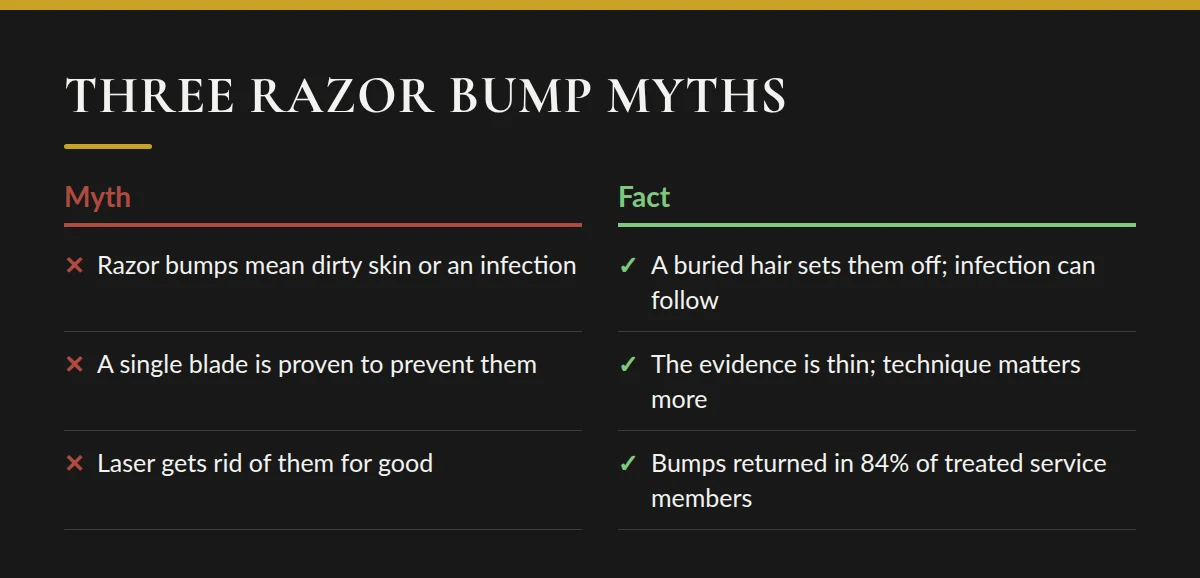
Real-world results are good but not permanent. A 2026 follow-up of 50 active-duty service members treated at Walter Reed, 74 percent of them Black, found that after four to six sessions, 70 percent saw their bumps fall by at least three quarters, 96 percent could shave again and 88 percent were satisfied. But the bumps came back for 84 percent, more than half of them within six months, and 64 percent had patchy regrowth that evened out over time. Plan on top-up sessions.
Several of these trials treated only the neck and under the chin, where bumps cluster, so the whole face is not the only option. And lasers carry a higher risk of pigment changes and scarring on skin of color, so choose someone experienced with dark skin.
When a Dermatologist Should Take Over

The AAD’s rule is simple: if the bumps keep coming after you have changed your shaving technique, see a dermatologist, because men who keep getting razor bumps can develop permanent deep grooves and raised scars. Go sooner for any of these:
- Pustules that spread, or a bump that turns into a painful boil, which suggests infection.
- Firm, raised scars that grow past the edge of the original bump, the start of a keloid.
- Dark marks that are not fading. A dermatologist has stronger options than the drugstore.
- Scaly rings, bumps on one side only, or bumps that never change, which may not be PFB at all.
- Bumps at the nape or on the scalp.
- A job that requires a clean shave. A documented diagnosis matters when you need an accommodation, and the military rules on shaving waivers tightened sharply in 2025.
- You want eflornithine or laser. Both need a clinician.
What a Barber Can Do From the Chair
A barber cannot prescribe anything and should not try. But the chair is often where the conversation starts, and a few habits make the shop part of the fix:
- Finish at the surface. On clients who get bumps, a trimmer or foil shaver beats a razor pass.
- Keep the razor off active bumps. Edge the neckline with a trimmer instead.
- Use the towels. The warm compress dermatologists recommend before a shave and the cool one after are towels every shop already has.
- Go with the grain and never stretch the skin, with a sharp, sanitized blade every time.
- Leave ingrown hairs alone. Digging or plucking in the chair makes new bumps.
- Say something. “Those have been there three visits, get them looked at” may be the most useful sentence a client hears all month.
The Bottom Line
Razor bumps are not a hygiene problem or a product problem. They happen when a curved hair is cut too close to the skin, and every treatment that works either prevents that or repairs the damage. Start at the bottom of the ladder, where letting the hair grow or fixing the shave costs almost nothing and helps many men on its own. Climb when you need to, from glycolic acid to a doctor’s gels and pills to eflornithine and laser. And once the bumps are scarring, stop climbing alone.
Further reading (sources)
- Alomary and colleagues on the 2026 expert consensus for diagnosing and managing PFB
- Ogunbiyi with a full review of what causes PFB, its look-alikes and its treatments
- Winter and colleagues for the K6hf keratin variant behind part of the risk
- DermNet on the features and look-alikes of pseudofolliculitis barbae
- DermNet for how infected and irritant folliculitis differ
- American Family Physician with a review of common skin conditions in skin of color, including PFB
- American Academy of Dermatology on razor bump remedies for men with darker skin tones
- Gray and McMichael for the thin evidence behind single-blade advice
- Daniel and colleagues with a 12-week trial of daily versus less frequent shaving
- Perricone on two placebo-controlled trials of glycolic acid lotion
- U.S. Food and Drug Administration for alpha hydroxy acids, sun sensitivity and adverse event reports
- Amer, Elsayed and Gharib with laser compared with chemical peels for PFB
- Nussbaum and Friedman on combining shaving changes with topical treatment
- Cook-Bolden and colleagues for a benzoyl peroxide and clindamycin gel trial
- Bridgeman-Shah with medical therapy and laser as the first real cure
- Xia and colleagues on eflornithine added to laser in a split-neck trial
- Shokeir, Samy and Taymour for eflornithine, laser and the two combined
- Battle and Hobbs with laser hair removal for darker skin types
- Ross and colleagues on long-pulsed Nd:YAG laser for PFB in skin types IV to VI
- Kravitz and colleagues for laser outcomes and recurrence in service members