The Complete Guide to Scalp Health for Black Hair
Published on September 6, 2026
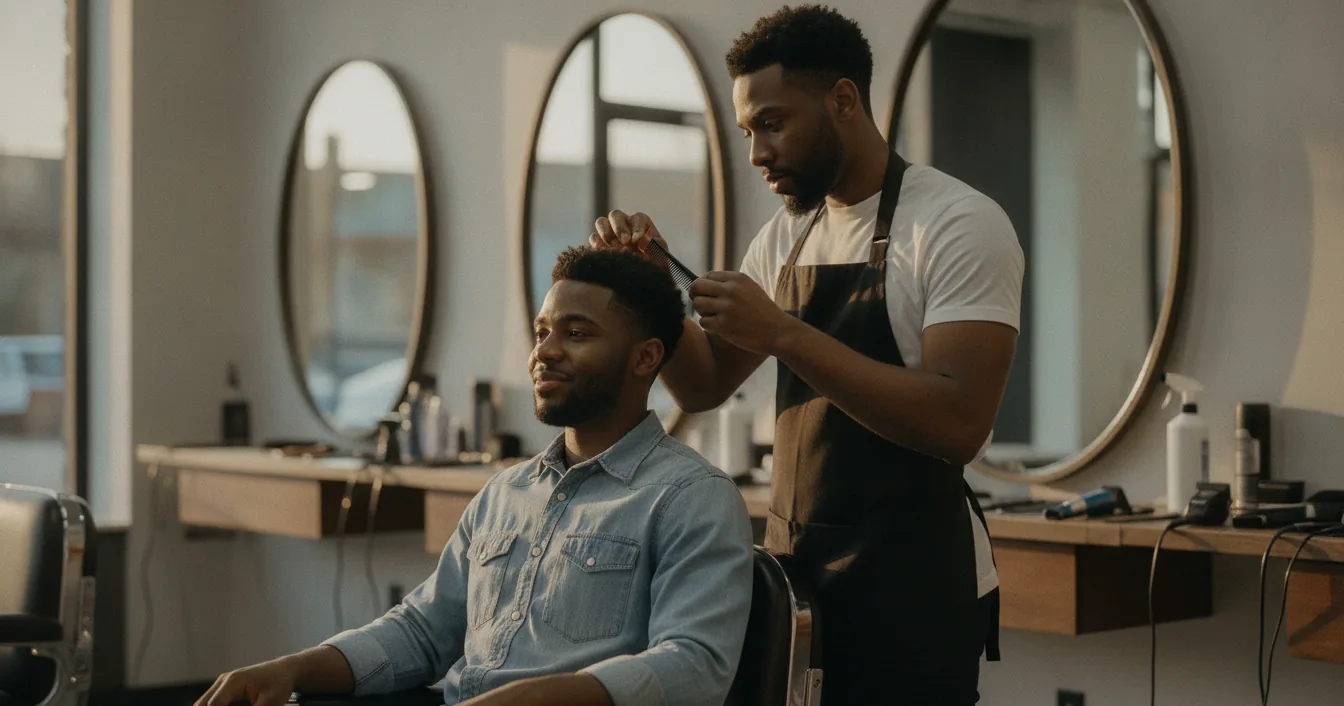
Your scalp is skin. That sounds obvious until you notice how rarely anyone treats it that way. We buy products for the hair, style around the hair, and worry about the hair, while the surface it grows out of gets a jar of grease and no further thought. Then it itches on a Tuesday for no reason, or flakes onto a dark shirt, or stings under the clippers, and suddenly it has our full attention.
This is a guide to the everyday scalp, not to hair loss. Alopecia has its own coverage, and if hair is actually coming out you should start there instead. What follows is the other category: the itching, flaking, bumps, buildup, and burn that most people live with quietly and could usually fix. It is written for anybody whose scalp is bothering them, and for the barber who has a clear view of it every two weeks and needs to know what is worth mentioning.
What a Healthy Scalp Feels Like
A healthy scalp is quiet. It does not itch, sting, or announce itself. Run a finger along a part and the skin should feel smooth and slightly supple, not tight, not tacky, not gritty. Color is harder to read on melanin-rich skin than the textbooks suggest, because inflammation that would look pink or red on pale skin often shows up as a deeper brown, a violet or grey cast, or as nothing visible at all. That is exactly why symptoms matter more than appearance here. Itch, tenderness, and flaking are the real instruments.
The one thing a Black scalp is entitled to do that others are not is stay a little drier at the surface. Sebum has to travel down the hair shaft to spread, and on a Type 4 coil it barely clears the first few bends, which is why textured hair behaves so differently from straight hair at every stage of care. Mild surface dryness is normal. Persistent itch is not.
Dry Scalp and Dandruff Are Two Different Problems
People use the words interchangeably and then buy the wrong bottle. The difference is worth thirty seconds of your time because the treatments point in opposite directions.
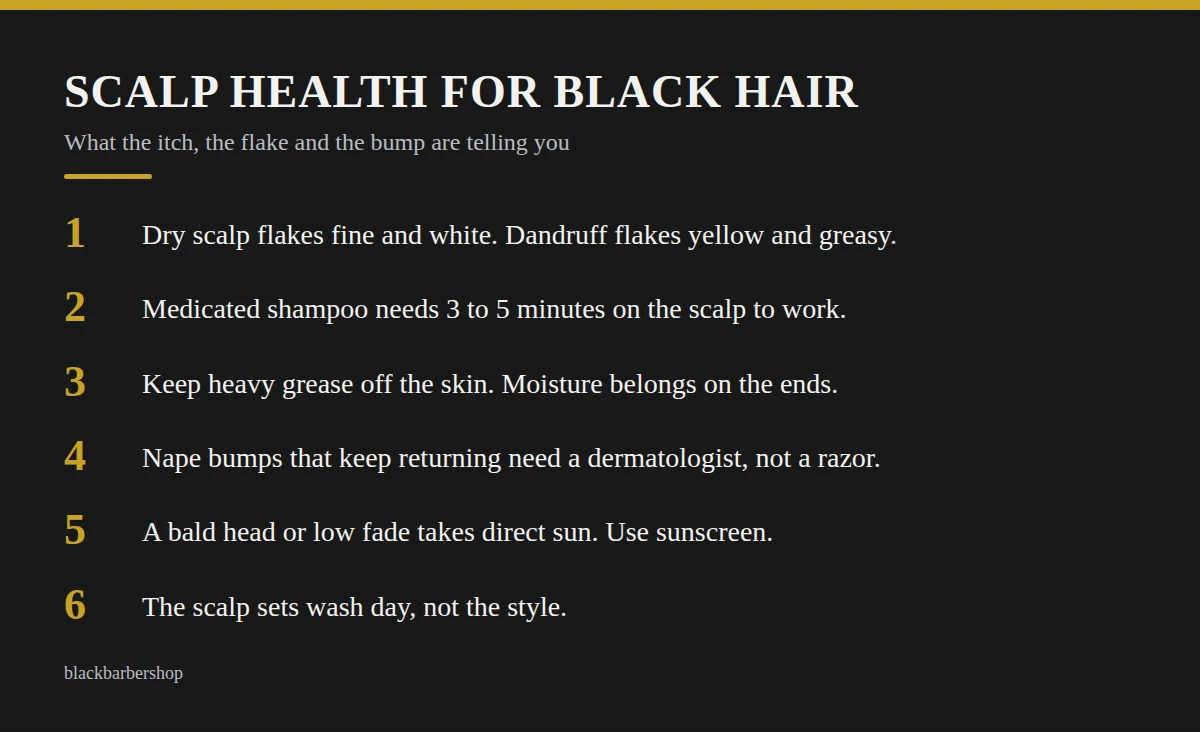
Dry scalp produces small, fine, white flakes that scatter. The skin underneath feels tight, sometimes rough, and the same dryness usually shows up elsewhere, on the shins or the backs of the arms. It responds to moisture and to gentler cleansing.
Dandruff and seborrheic dermatitis produce larger flakes that are yellowish and slightly greasy, sitting in patches rather than spread evenly. They cling. The scalp underneath is often itchy and sometimes tender, and it can extend past the hairline to the eyebrows, the sides of the nose, or behind the ears. It responds to a medicated shampoo, and it gets worse if you treat it with oil.
That last point is the whole reason to tell them apart. Adding grease to seborrheic dermatitis feeds the problem. Adding medicated shampoo to a genuinely dry scalp strips it further. Same symptom, opposite fix.
Seborrheic Dermatitis: The Common One
Seborrheic dermatitis is driven by an overgrowth of Malassezia, a yeast that lives on everyone’s skin, feeding on scalp oils and triggering an inflammatory response in people who react to it. It is not a hygiene failure and it is not contagious. It is one of the conditions dermatology consistently flags as more frequent in Black patients, and it flares with stress, cold weather, illness, and long stretches between washes.
The fix is a medicated shampoo used correctly, which most people do not do. Look for ketoconazole, zinc pyrithione, selenium sulfide, or ciclopirox on the label. Then apply it to the scalp itself rather than to the hair, work it in with fingertips (not nails), and leave it on for three to five minutes before rinsing. Contact time is the active ingredient’s whole job. Thirty seconds and a rinse does nothing. Follow with conditioner on the lengths only, so the medicated wash does not leave the hair parched.
Used once or twice a week during a flare, then dropped back to maintenance, that usually settles it. What should not happen is a fifth product joining the shelf. If flaking, itch, or tenderness persist after four to six weeks of consistent treatment, that is a dermatologist visit, and it is worth pushing for one who treats textured hair regularly.
Buildup: When the Products Become the Problem
Grease, gels, waxes, holding sprays, dry shampoo, and leave-ins do not fully rinse away. On tightly coiled hair, worn in a style meant to last, they layer. Add sweat and shed skin cells and you get a film across the scalp that blocks nothing dramatic but keeps everything underneath damp and irritated.
You can usually feel buildup before you see it. The scalp is tacky under a finger, hair near the root looks dull or coated, and there is a low-grade itch that improves for a day after a wash and returns. In the chair, a barber sees it as a grey-white residue collecting along part lines and around the crown.
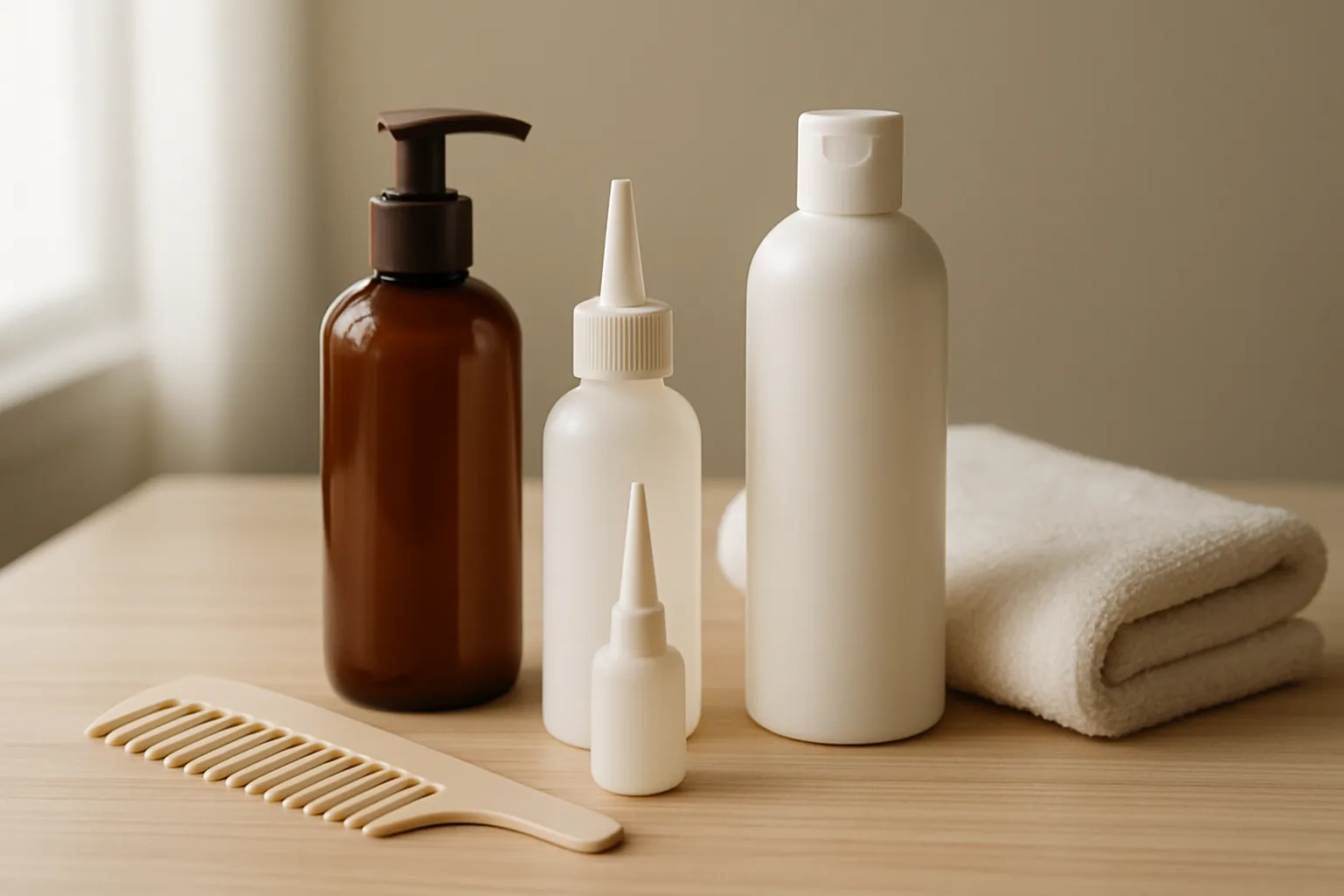
The correction is straightforward. Use a clarifying shampoo roughly once a month, not weekly, because clarifying formulas are strong. Cut back on the heaviest occlusives, the petrolatum and mineral oil products applied straight to the skin, and move moisture down to the mid-lengths and ends where the hair actually needs it. Greasing the scalp for growth is one of the most persistent myths in Black hair care, and buildup is the bill it eventually delivers.
Bumps at the Nape
The back of the neck is barbershop territory, and it is where the most consequential scalp problem in Black men starts. Ordinary folliculitis is an infected follicle: a small tender pustule that comes and goes, common after a close cut, a sweaty week, or a hat worn daily.
Acne keloidalis nuchae is the version that does not go away. It shows up as firm bumps and pustules along the nape and occiput that can merge into raised keloid-like plaques and destroy the follicles underneath. A survey of 874 African adults in Cape Town, published in the British Journal of Dermatology, found AKN in 10.5 percent of men compared to 0.3 percent of women. The same study found that AKN was not associated with whether clippers or blades were used, but was associated with haircut symptoms, and 37 percent of the men reported at least one episode of transient pimples or crusts after a haircut while 18.9 percent reported bleeding, however small.
That number deserves to be uncomfortable. Bleeding at the nape is not proof of a sharp lineup, it is broken skin, an infection risk, and a hygiene concern for the next person in the chair. The practical response is shared between barber and client: sanitize between every client, ease off the pressure on the neckline, avoid repeatedly shaving the same irritated area, and stop when skin breaks rather than pushing through. For the client, early bumps that keep returning are worth a dermatology visit while they are still soft, because once they thicken into plaques the follicle damage is permanent.
Sun on a Bald Head or a Low Cut
Melanin provides some protection and nowhere near enough. The top of the head takes the most direct sun of any surface on the body, and on a bald head or a fresh skin fade there is nothing between the sun and the skin. Scalp skin cancers get caught later than most, partly because nobody is looking there.
Sunscreen on the scalp is the answer and the formats have gotten better. A spray or a light gel works on a shaved head without the greasy film of a face lotion, and a stick is easy to run along an exposed part line. A hat covers it entirely. This belongs in the same routine as the rest of the grooming a fade or bald head requires, which is different maintenance, not less of it.
Sensitivity is worth a note too. Scalps recovering after chemotherapy, and skin under a very fresh bald fade, both burn faster than expected. During regrowth after treatment, sun protection and gentle products matter more than usual for a while.

After Sweat, and How Often to Actually Wash
Salt sits on the scalp after it dries, and salt is an irritant. That is most of the post-workout itch, and it is why the useful move is not a full wash but a rinse. Plain water at the scalp, or a diluted cleanser worked along the parts, gets the salt off without triggering a whole styling day. Then dry properly, because a damp scalp under a bonnet or a wig cap all night is an invitation to everything above. The rest of the workout-and-hair problem, which is real and heavily documented, is covered in our guide to training without wrecking your style.
On washing frequency, here is the honest answer: every one to two weeks suits most Type 4 hair, weekly if the scalp is oily, flaring, or under a lot of product, and longer only if the scalp is genuinely calm. There is no fixed number that fits everyone, but there is a rule that does. The scalp sets the schedule, not the style. If it itches, flakes, or smells, it is time, regardless of what the calendar or the install says. In long-term braids or a sew-in, a diluted cleanser in an applicator bottle along the parts, followed by real drying, keeps the scalp livable without taking the style down.

What a Barber Should Flag
A barber sees more scalps in a week than most dermatologists see in a month, and sees the same scalp repeatedly, which is the part that matters. You are not diagnosing anything. You are noticing change and saying something. The short list worth a word: bumps at the nape that are still there next visit, a patch that is scaling or crusting, tenderness when you have not pressed hard, a widening part or a shifting hairline, a sore that has not healed, and any spot that looks different from the skin around it.
The script is simple and it is not alarming. “This spot back here has been the same three visits running. Worth having someone look at it.” That is the entire intervention, and in a trade built on trust it lands harder than anything a poster in a waiting room will ever do.
The Bottom Line
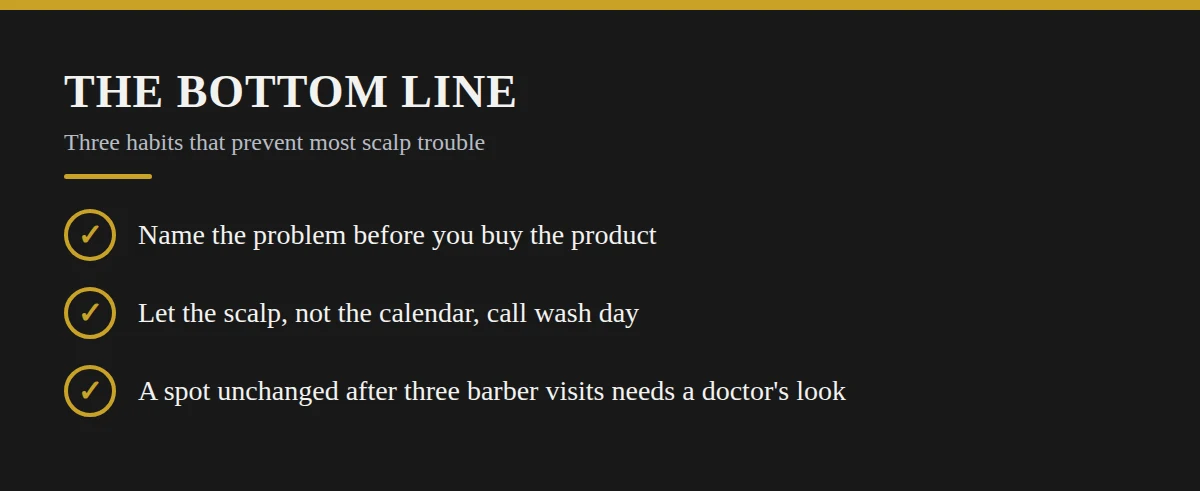
Treat the scalp as skin with its own needs and most of this gets simple. Learn whether you are dealing with dryness or dandruff before you buy anything. Give medicated shampoo the contact time it needs. Keep the heavy grease off the skin and put the moisture on the ends. Let the scalp, not the style, decide when it is wash day. Cover the top of your head in the sun. And when something at the nape or the crown has not changed in three visits, get eyes on it, because almost every scalp condition that becomes permanent was reversible earlier.
Sources
- British Journal of Dermatology on scalp disease prevalence and haircut symptoms in 874 African adults
- American Academy of Dermatology for everyday hair and scalp care built around textured hair
- American Academy of Dermatology with how dermatologists treat seborrheic dermatitis and dandruff
- Journal of the American Academy of Dermatology covering hair care practices and measured scalp differences in African American women
Further reading
- Skin of Color Society for how inflammation reads differently on melanin-rich skin
- Campaign for Safe Cosmetics for what is in the products going onto your scalp