Clippers, Blades, and Sanitation: The Complete Tool Guide for Black Barbers
Published on September 13, 2026
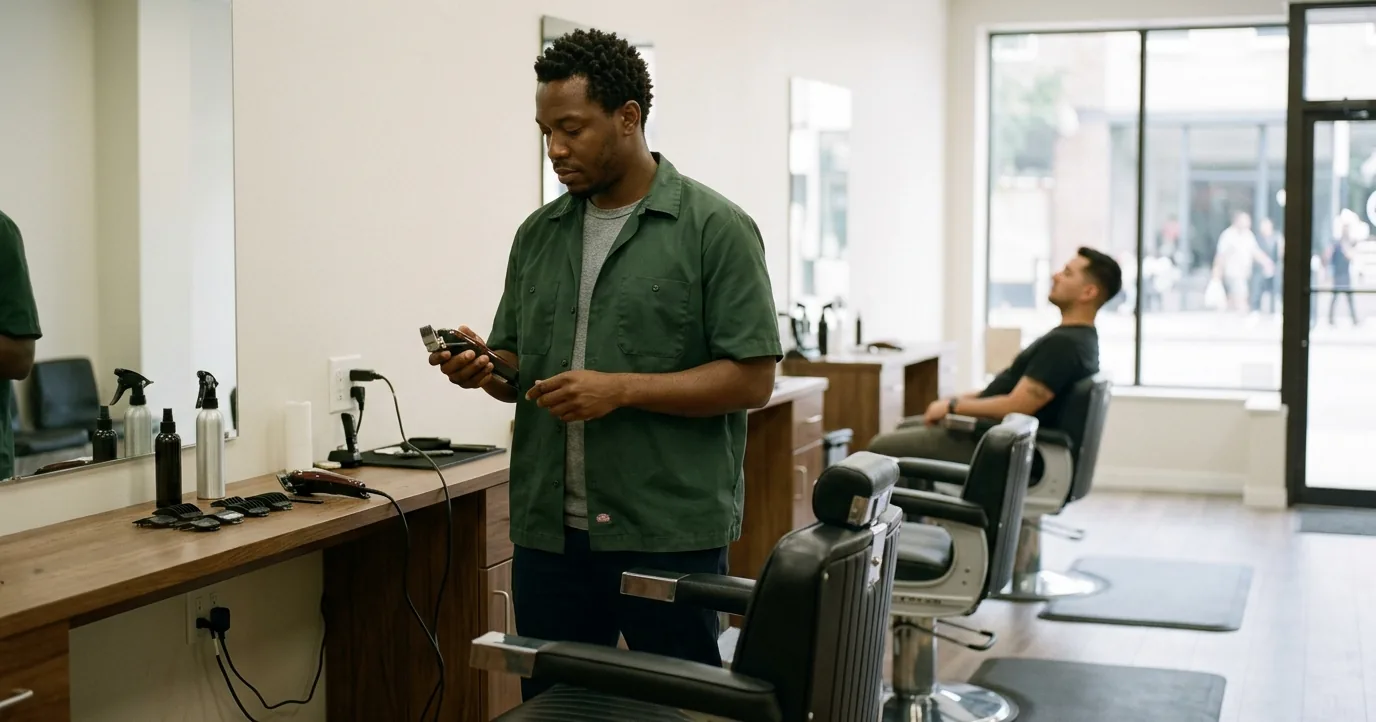
Ask a barber what he cuts with and he names a clipper. Ask him why his fades blend and his lines land, and the honest answer is something much smaller than a clipper: a blade set right, oiled every head, and cool enough to cut instead of drag. Tools are the half of this trade nobody romanticizes. They are also the half the state has opinions about, because the exam that licenses you and the inspection that follows you for the rest of your career are mostly about what is in your disinfectant jar, not what is on your fade.
So here is the equipment side, front to back. What to buy and what it costs, which motor actually matters on dense coily hair, how to gap and align a blade without cutting anybody, the three minute routine that keeps a blade cutting, and the sanitation rules that get shops written up.
Clipper, Trimmer, Foil Shaver: Three Tools, Three Jobs
Most kit mistakes come from asking one tool to do another tool’s work.
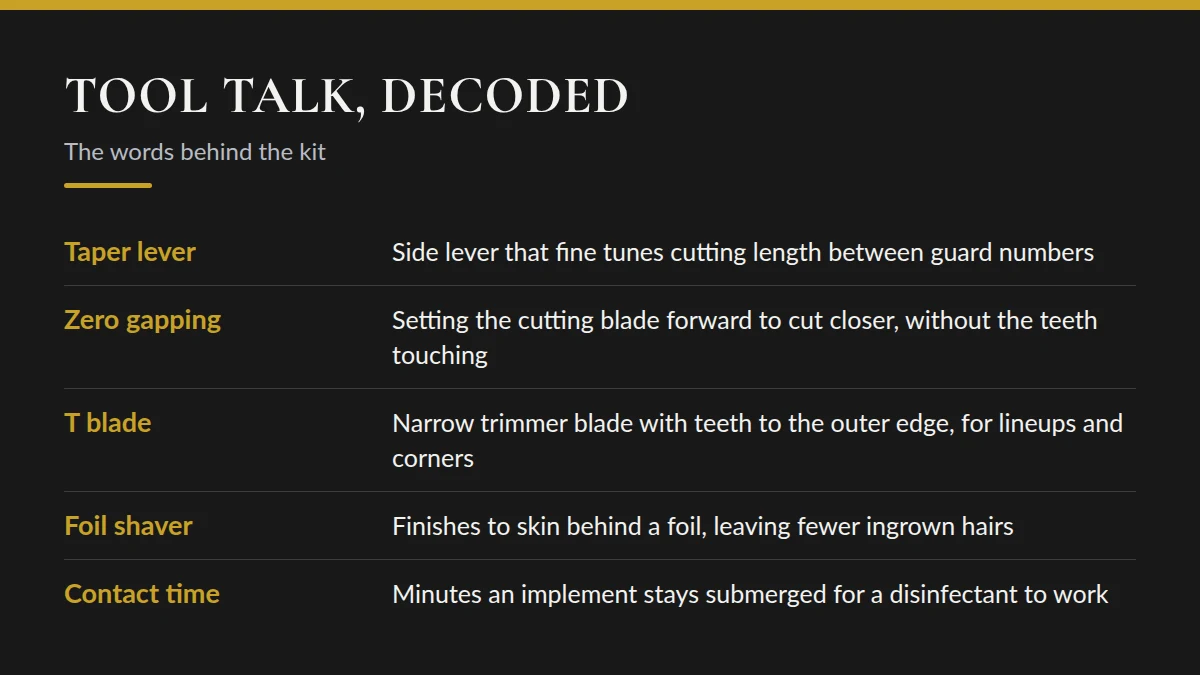
The clipper removes bulk and builds the gradient. It is the tool that wears guards, it has a taper lever on the side, and its blade is built to cut a set length off the head rather than at the skin. Everything from a #4 down to a near bald 0 happens here.
The trimmer, also called an outliner or an edger, wears a narrow T blade whose teeth run all the way to the outer edge, so you can cut right into a corner. It exists for the perimeter: the lineup, the edge up, the beard outline, the part. It is not a bulk removal tool, and asking it to take down a full head of dense hair will cook the motor and pull the client.
The foil shaver finishes to skin. Its cutting element sits behind a thin foil, so the blade never touches the scalp directly, which is what makes it safe to run over the same patch repeatedly while chasing a skin fade down to nothing. It matters for a second reason too. A foil shaver cuts at the surface rather than below it, so it leaves far fewer ingrown hairs than a close razor pass on curl prone hair. For clients who fight razor bumps along the jaw and neck, that difference is the whole service.
Motors: What Actually Matters on Dense Coily Hair
There are three motors in professional clippers, and the marketing rarely tells you which one you are holding.
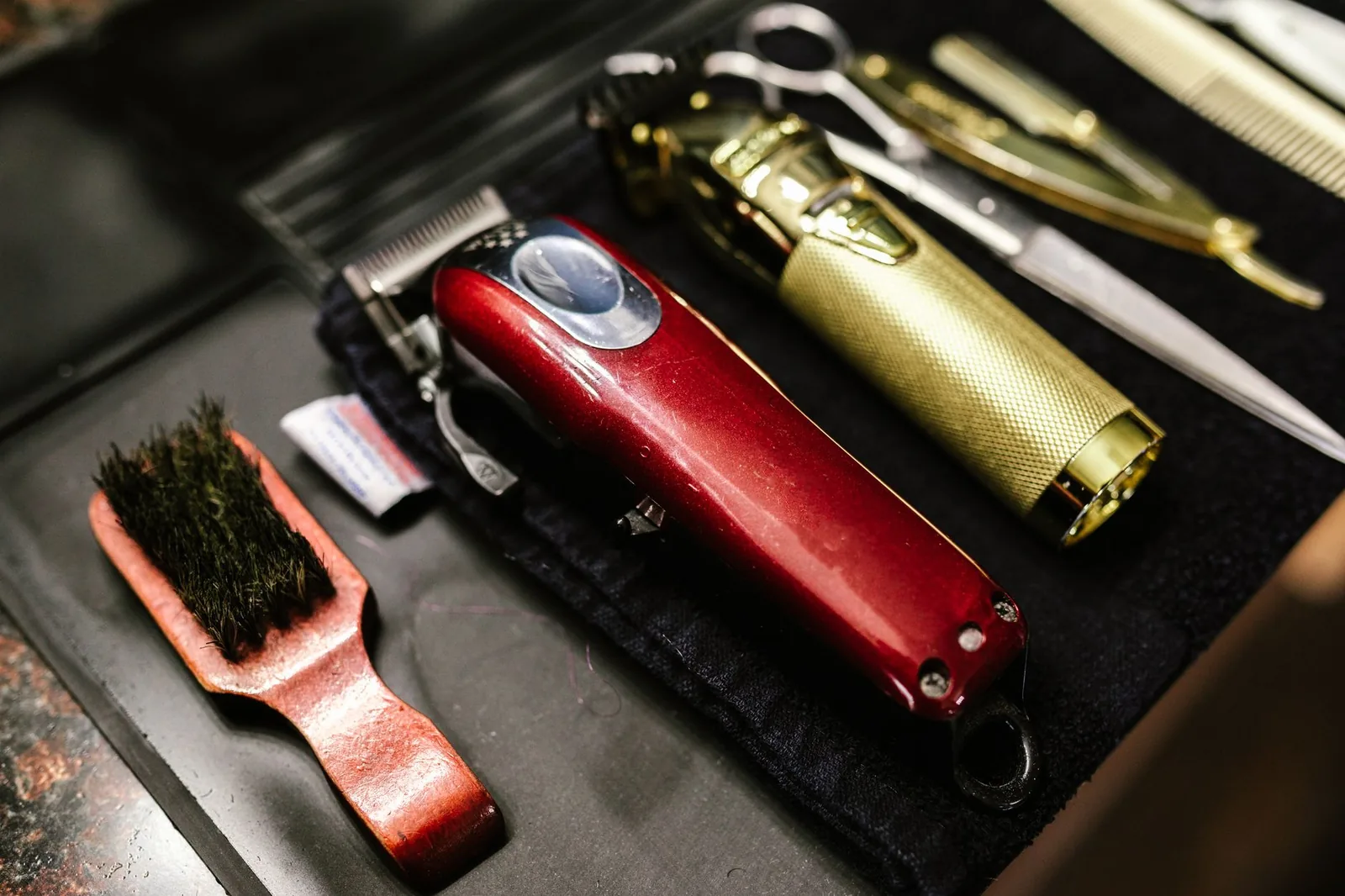
Magnetic motors use a spring and an electromagnet to drive a fast blade stroke. Light, loud, plenty of speed, modest power. They shine on outlining and detail work.
Pivot motors trade stroke speed for roughly double the cutting power. This is the motor that does not stall when you push it into a thick, damp, coarse section at the crown.
Rotary motors spin an armature and land in the middle, generally the most versatile of the three and the platform most cordless professional clippers are built on.
Here is the part that matters in a Black barbershop: strokes per minute sells clippers, but torque cuts hair. A clipper that sounds busy and then bogs the instant it meets the thick part of the head is fast with no power, and on Type 4 hair you will feel that in the client’s flinch before you see it in the blend. Coily hair grows from a curved follicle and packs tightly at the perimeter even though overall follicular density on the head runs lower than in other hair types. What your blade meets at the nape is a dense, springy mass that pushes back. Buy for power under load, not for the number on the box.
Corded or cordless is a smaller question than it looks. A corded clipper never dies mid fade. A cordless one lets you walk around the chair. Most working barbers carry both, and the real reason is heat: two clippers in rotation means neither one gets hot enough to start pulling.
The Blade Is the Cut
Standard blades are carbon steel. Steel takes a keen edge, resharpens many times, and rusts the moment you put it away damp. Ceramic runs noticeably cooler, because ceramic does not carry heat the way steel does, and it holds an edge longer. It is also brittle. Drop it once on a tile floor and it can chip.
Zero gapping means sliding the cutting blade forward so its teeth sit as close as possible to the still blade, which is what lets a clipper cut nearly to skin and lay a hard line. Loosen the two blade screws, ease the cutting blade forward, tighten. Two rules keep it from going wrong. The teeth must never actually touch, and the cutting blade must never sit past the still blade. Blades that kiss chip each other and shed metal into the cut, and a cutting blade sitting proud of the still blade has nothing at all between its edge and your client’s scalp. Leave a gap you can barely see, and test it on your own arm before you test it on a head.
Alignment is the other half of the same job, and it is the one barbers skip. Teeth parallel. Cutting blade set slightly behind the still blade, never flush and never past. Blade square in the housing with the screws snug and even. A blade that drags at one corner and cuts clean at the other is almost always misaligned rather than dull. Plenty of good blades get thrown out when all they needed was to be reseated.
Oil, Brush, Cool: The Three Minute Routine
Between clients, the whole maintenance program takes about as long as sweeping the floor, and skipping it is the number one reason blades pull.
Brush first. Hair packed down between the blades is what makes a clipper run hot and drag, and no amount of oil fixes a clogged blade.
Then oil. Three drops across the teeth, one at each end and one in the middle. Run the clipper ten seconds to work it in, then wipe the excess with a towel. Every client, not every week. Oil is the only thing keeping two pieces of steel from grinding on each other thousands of times a minute.
Then let it cool. Clipper spray is a coolant and, on the right product, a disinfectant. It is not a lubricant. Barbers who spray and never oil are the ones replacing blades twice a year.
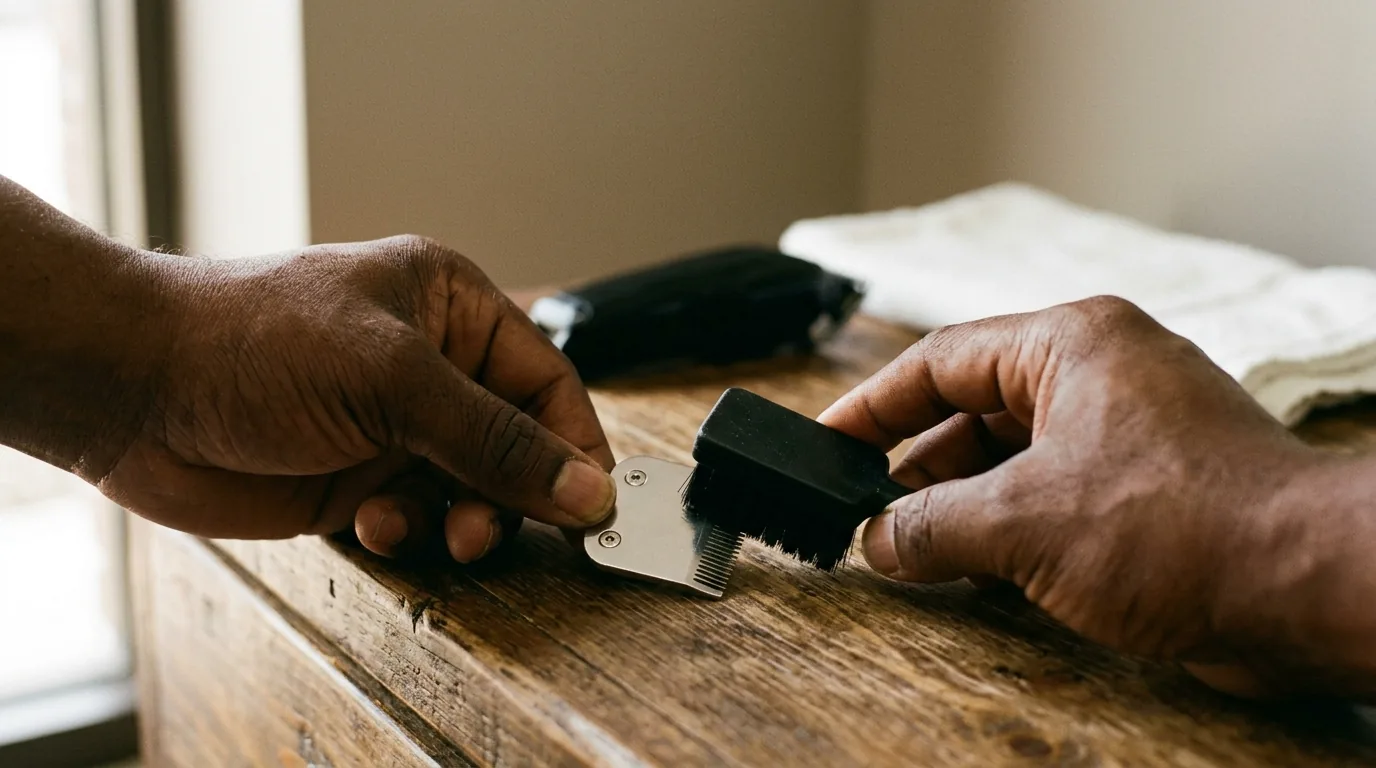
Once a week, take the blade off entirely, brush out the housing, check the blade drive and spring for wear, and look for rust on the flats. When a blade starts pulling, run the causes in order: packed with hair, dry, misaligned, dull. Three of those four cost nothing to fix.
Sharpening or Replacing
A steel blade set can be professionally sharpened many times over, usually for well under $20 a set, and a properly honed blade cuts like it just came out of the box. Sharpening is a flat lapping process done on a machine by someone who does it all day. It is not a whetstone job, and your working blades are not where you learn it.
Ceramic generally gets replaced rather than sharpened. Steel reaches the end of its life when the teeth have been ground too short or the bevel is gone, and at that point you are buying new regardless.
The math usually favors sharpening, and not only on price. A broken in blade in a housing you already know behaves predictably, and predictability is worth more at the hairline than a fresh edge is.
Cleaning, Disinfecting, and Sterilizing Are Three Different Words
State boards test this distinction because barbers blur it constantly.
Cleaning is the physical removal of hair, skin, and product with soap and water. It is not optional, and no chemical is strong enough to skip it. A disinfectant cannot reach through a layer of hair and pomade to touch anything.
Disinfecting kills pathogens on a hard, nonporous surface using an EPA registered product. Your board specifies the level. Most require hospital grade with bactericidal, virucidal, and fungicidal claims, and many require tuberculocidal as well.
Sterilizing destroys all microbial life including spores, which takes an autoclave. Barbering rarely requires it.
Contact time is the rule everybody breaks. The blue jar on the counter is not a rinse. Barbicide at its labeled dilution needs a full ten minutes of complete immersion to make its claims, and a quick dip accomplishes nothing except a wet comb. Because disinfectants are regulated as pesticides under federal law, the directions printed on that label are legally enforceable rather than advisory. Whatever sits in your jar, its label sets your contact time.
The jar rules follow from that. Solution changed daily, and immediately if it clouds or catches hair. Container labeled and covered. Implements fully submerged, not floating. Clean implements stored in a closed clean container, dirty ones in a separate marked container until they are processed. Porous items cannot be disinfected at all, which is why neck strips, wooden sticks, and razor blades are single use with no exceptions. Clipper blades follow the manufacturer’s instructions rather than the jar, and the clipper body never goes in liquid.
What the Inspector Actually Checks
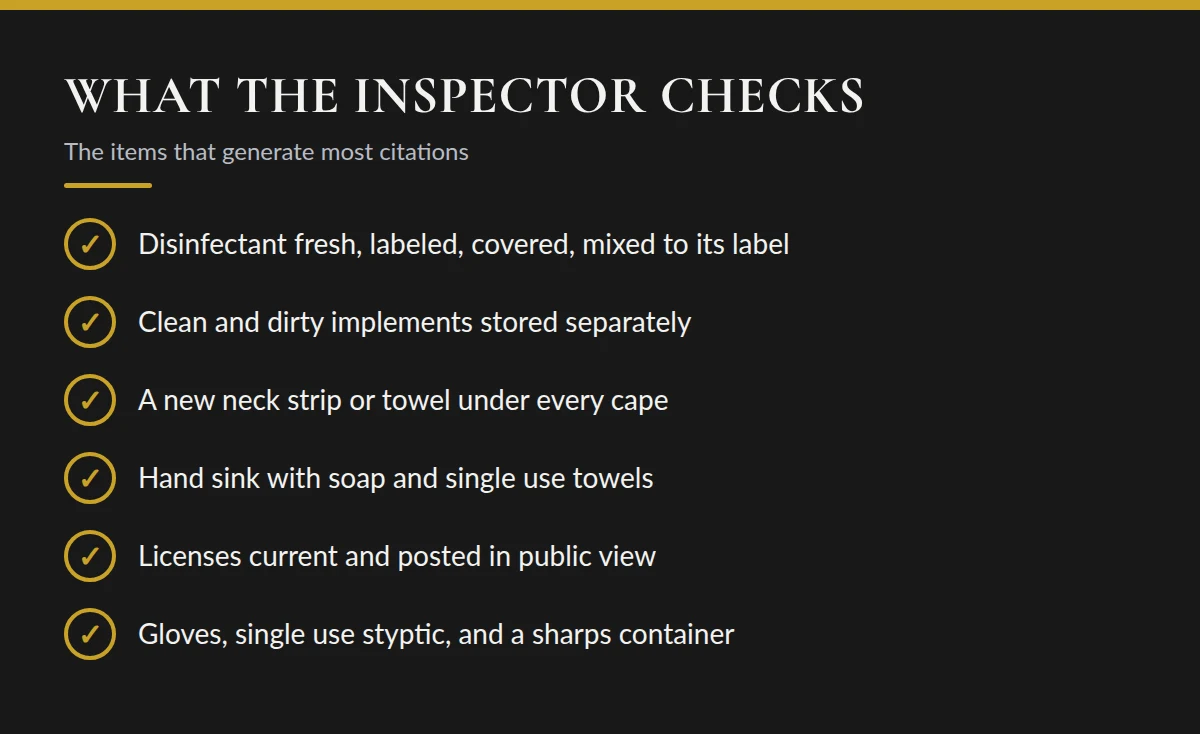
Inspections are unannounced and largely checklist driven, and the items that generate citations are boring and repetitive rather than dramatic. Disinfectant fresh, labeled, covered, and mixed to its label. Clean and dirty implements physically separated. A fresh neck strip or towel between the cape and the client’s skin, every single client. A hand washing sink with soap and single use towels, and hands actually washed between services. Licenses current and posted where the public can see them. Hair swept and disposed of after each cut. No food or drink at the stations. A bloodborne exposure kit on hand and a barber who can describe the procedure without reading it.
None of that is a national standard. Required disinfectant levels, contact times, and station rules vary by state and get amended more often than most barbers notice, so your own board’s current rule book is the only authority on your shop. Anyone still working toward that first license should know the board exam is weighted toward exactly this material, not toward the haircut.
Blood, Nicks, and the Rules That Get Shops Cited
Cut long enough and you will nick somebody. What separates a routine nick from a violation is procedure.
Stop the service. Put gloves on. Stop the bleeding with a single use product, a powdered or liquid styptic applied with a disposable applicator. A shared alum block or styptic pencil touched to broken skin on client after client is one of the fastest ways to fail an inspection and a genuine transmission risk besides. Cover the cut. Anything disposable with blood on it goes into a sealed bag. Any implement involved gets cleaned and then disinfected with a product rated for bloodborne pathogens, or gets discarded. Used razor blades go in a sharps container, never in the trash under the station.
Sitting behind those rules is OSHA’s bloodborne pathogens standard, written for employees and folded into most state board regulations one way or another. A shop that stocks gloves, a styptic nobody shares, single use blades, and a real sharps container is already most of the way there.
Building a First Kit, and What It Costs
A working kit runs roughly $500 to $1,500, and it is the best money a new barber spends.
- Two clippers, $150 to $300 each at professional grade, so one is always cool and charged
- A trimmer with a T blade you keep gapped for line work
- A foil shaver for skin finishes
- A full set of guards including half sizes, plus a spare blade
- Shears and a texturizing shear. Cheap shears push hair instead of cutting it
- Blade oil, clipper spray, and a blade brush, replaced as consumables
- EPA registered disinfectant, a labeled covered jar, and a closed clean container
- Gloves, single use styptic, and a sharps container
- Capes, neck strips, combs, and a duster
- Mannequin heads with textured hair for practice and for the practical exam
Buy the clipper and the shears first and the decor last. When you are weighing where the money goes in a new shop, remember that tools earn and mirrors do not.
The Bottom Line
The tool side of barbering rewards routine over spending. A mid priced clipper with a properly aligned, freshly oiled blade outcuts an expensive one that has been sprayed and shelved for a month, and a shop that follows the contact time on its own disinfectant label has already avoided most of what inspectors write up. Learn the three tools and what each is for, buy for torque instead of noise, brush and oil every head, and treat the jar on your counter as seriously as the blade in your hand. The craft is what clients notice. This is what makes the craft repeatable.
Sources
- OSHA on the bloodborne pathogens standard shops are measured against
- EPA for how disinfectants are registered and what the label commits you to
Further reading
- National Association of Barber Boards of America on the directory of state barber boards that write the sanitation rules
- Andis for blade materials, T blade geometry and replacement specifications
- OSHA with how the bloodborne pathogens standard applies in a barber shop
- U.S. Environmental Protection Agency on the registered disinfectants effective against bloodborne pathogens