The Rise of Black Barber Educators: Mentorship, Curriculum, and Legacy
Published on August 24, 2026
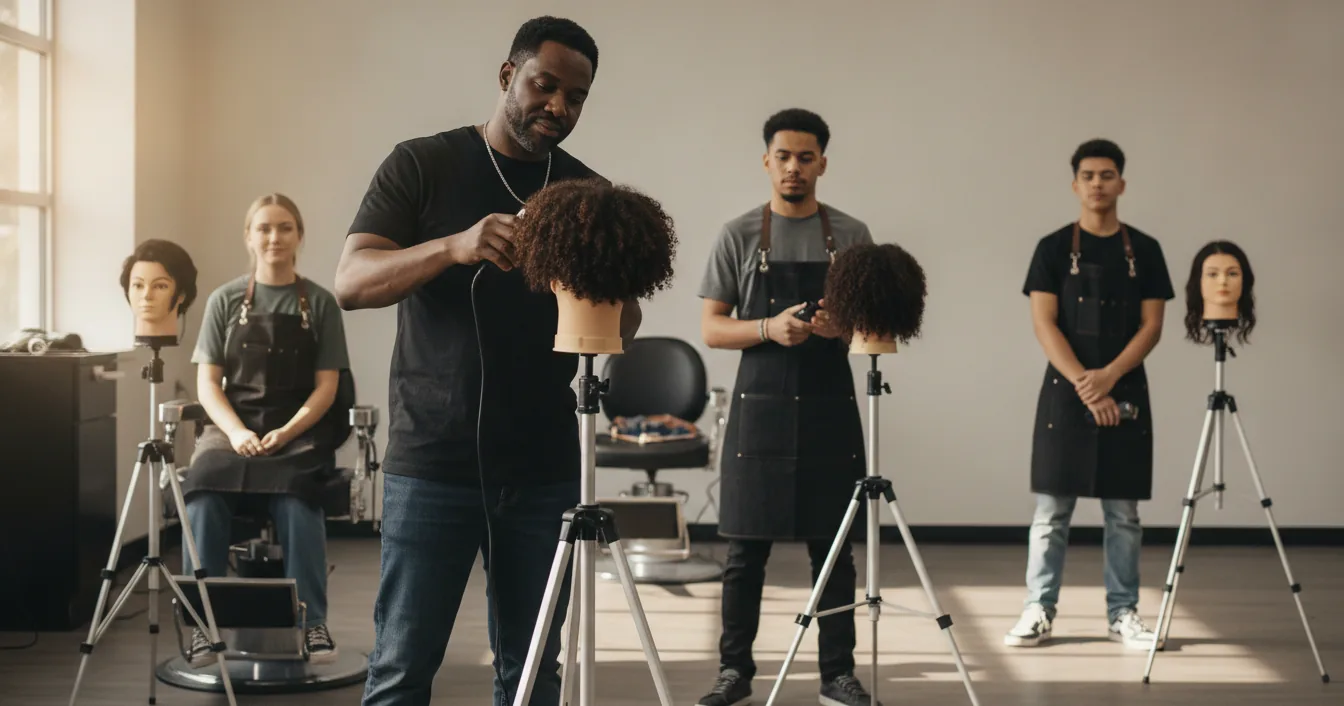
Ask a veteran Black barber who taught him and you will almost never hear the name of a school. You will hear a name. An uncle, a neighbor, the man who owned the shop on the corner and let a teenager sweep hair for two years before handing over a pair of clippers. For most of the last century, that was the entire educational system of Black barbering. It worked, and it produced extraordinary craftsmen, but it was never written down. When the man on the corner retired or passed, everything he knew went with him.
That is starting to change. A new class of Black barber educators is taking the knowledge that used to live only in the chair and putting it into curriculum, into schools, onto state licensing boards, and into structured apprenticeships that a shop owner can actually run. This piece looks at who they are, what problem they are solving, and what an aspiring barber or a shop owner should do about it.
What Barber School Left Out
Start with the gap. Roughly 65 percent of Americans have wavy, curly, or coily hair, and for decades the schools that license the people who cut it treated that texture as an elective. Natural hairstyling was a bolt-on specialty course, taught after the core curriculum rather than inside it, and in many programs it was taught verbally because there were no textured-hair clients or mannequins to practice on.
The professionals themselves say so. Industry surveys collected by the Professional Beauty Association found that around three quarters of stylists want more training in textured hair, and that the number is highest among white stylists who know perfectly well they were sent into the workforce unprepared. The result is a licensed workforce that is certified to cut hair but was never actually taught to cut every kind of hair, and clients who pay the price for it. I traced how that plays out geographically in the guide to Black hair deserts, where the nearest chair that can handle Type 4 coils is sometimes 40 miles away.
Legislators have finally started moving. Louisiana became the first state to mandate textured hair education in November 2021. New York followed in 2023, Minnesota, Connecticut, and California in 2024, and Washington, Vermont, and Maine in 2025. New Jersey proposed rules in 2026 requiring schools to train every student on hair of “all types, textures, and porosities.”
Here is the catch that matters for barbering specifically: most of these laws were written for cosmetology programs. Barbering curricula are not always covered, and barber boards in many states are entirely separate bodies with their own rules. That leaves the actual work of fixing barber education to barber educators. Which is exactly who stepped up.
The Educator Who Failed the Exam Three Times
Rodrick Samuels is the clearest example of the shift. He started cutting at 13 as what he calls a “bathroom barber,” the kid in the house whose hands were steady enough to be trusted. He failed the state barber examination twice before passing on the third attempt. Twenty-five years later he is a Wahl educator, a platform artist, and Director of Education at Hair Lab Detroit Barber School in Southgate, Michigan, which he co-founded with his wife and business partner Lauren Moser Samuels after the two of them spent years teaching men’s grooming and curly hair styling internationally.
The credentials stacked up from there. The North American Hairstyling Awards named him Educator of the Year in 2023. He sits on the advisory board of the National Association of Barber Boards of America and contributed to Pivot Point’s Fundamentals of Barbering, meaning his thinking is now inside a textbook that students who will never meet him will open. In 2025, Michigan Governor Gretchen Whitmer appointed him to the state Board of Barber Examiners, with a term running through September 2029. That is the whole arc in one sentence: from a kid who could not pass the test to one of the people who helps decide what the test should be.
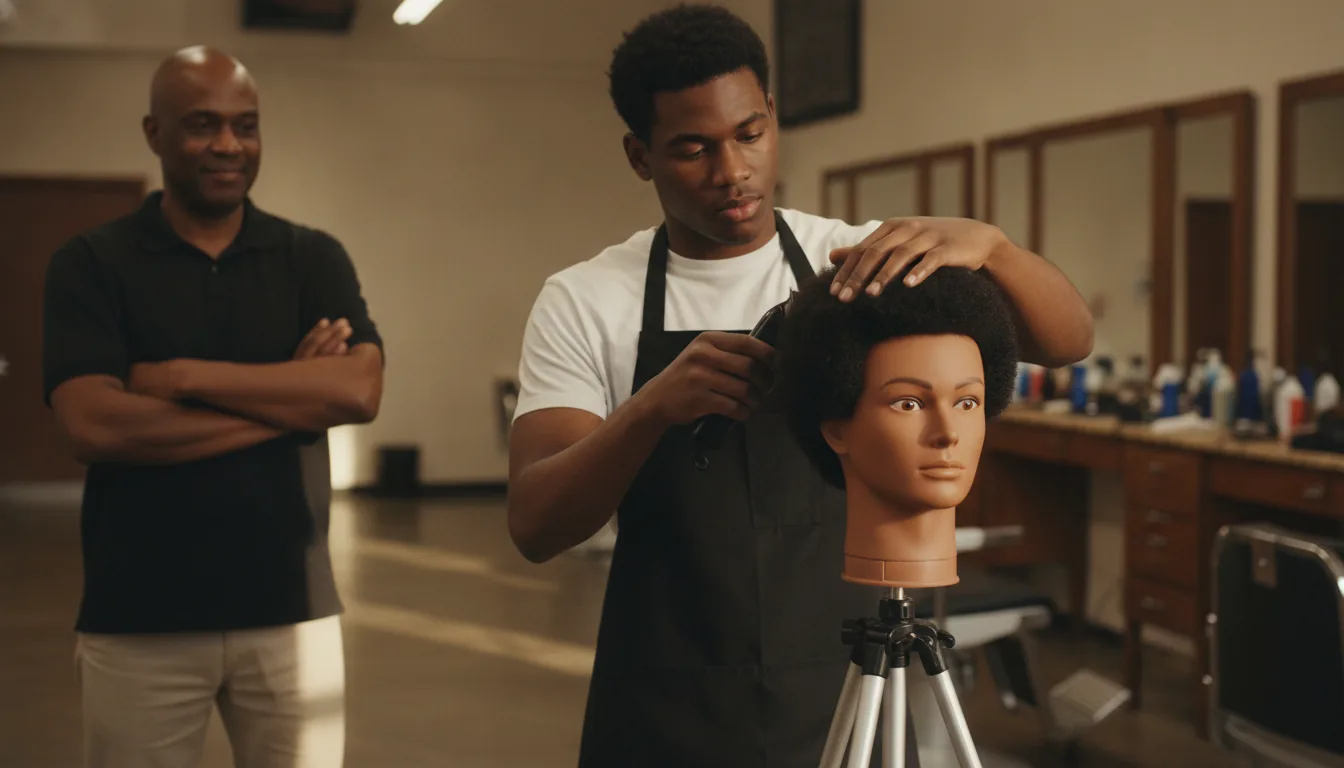
American Salon summed up his posture in a headline he earned, “We Didn’t Wait for Permission.” The phrase is a fair description of the entire movement. Nobody handed Black barbers a seat at the curriculum table. They built their own schools, wrote their own courses, and then took the seat.
Formalizing Mentorship Is Not the Same as Replacing It
The instinct in the shop is to treat “barber school” and “learning from a real barber” as opposites. The educators leading this movement do not see it that way. What they are doing is taking what a good mentor already does and making it repeatable.
Samuels talks about it in terms that have almost nothing to do with clippers. He pushes students hard on soft skills, on eye contact, on communication, on empathy, because a barber who cannot build a relationship will not keep a chair full no matter how clean the line is. He coined the hashtag #Solidhairity to name the case for diversity in beauty education. And he says something about teaching that anyone who has trained a young barber will recognize immediately: “Students who are loved at home come to school to learn and those who aren’t loved at home come to school to feel loved.” A mentor who understands that will get further with a struggling apprentice than one who only knows how to correct a guideline.
His other line is the one to tape above the mirror: “Everyone wants to take the elevator to success and not the stairs.” A man who failed the licensing exam twice has standing to say it.
What formal curriculum adds to that relationship is structure. A defined progression from shampoo bowl to mannequin to clipper-over-comb to a paying client. Written standards for sanitation and blade care so nothing depends on whether the mentor happened to mention it. Real hands-on hours on Type 3 and Type 4 textures, taught from the actual biology of the hair, which is where understanding why textured hair breaks the way it does stops being theory and starts being technique. None of that displaces the mentor. It just means the apprentice is not dependent on one man’s memory.
The Math Every Aspiring Barber Runs
Anyone weighing this path is doing arithmetic, so here it is plainly.
School. Most states require somewhere between 800 and 2,000 training hours, with roughly 1,500 as the common expectation. That is typically 6 to 18 months of full-time attendance, and tuition generally runs $10,000 to $20,000. Many students borrow it, and the Institute for Justice has documented graduates carrying five figures of debt into a trade where the first year behind the chair is the leanest.
Apprenticeship. Where it exists, the hour requirement is usually much higher: Alabama asks 2,000 apprenticeship hours against 1,000 in school, Georgia 3,000 against 1,500, California 3,200 against 1,500. The trade-off is that an apprentice is typically earning rather than paying. It takes longer, roughly 18 to 36 months, and it costs far less. Note that several large states, including Texas, Florida, and Illinois, do not offer a barber apprenticeship route at all.
The instructor pipeline is its own problem. Texas eliminated its separate barber and cosmetology instructor license in 2022. Mississippi merged its barbering and cosmetology boards in 2024, then lost the board’s quorum in the 2025 legislative session, leaving 63 school owners stuck in a regulatory limbo, with at least one instructor closing her doors over it. Teaching is a career track, and in several states the track is currently under construction.
Licensing rules, required hours, apprenticeship eligibility, and health codes vary substantially from state to state and change often. Treat your own state board’s website as the authority, not any national summary including this one.
Building a Teaching Bench in Your Own Shop
If you own a shop, you do not need to open a school to take part. A few things move the needle.
- Find out whether your state registers apprentices at all, and if it does, what paperwork, supervision ratio, and hour logging it requires. This is the single question that determines whether an informal arrangement can become a licensable one.
- Write down your progression. Even one page. What an apprentice must show before touching a live client, in what order, and who signs off. This is the difference between mentorship and hanging around.
- Budget for the teaching time honestly. An apprentice slows a master barber down before speeding the shop up. Fold that into your chair economics the same way you fold in booth rent and retail, as covered in the shop owner’s business guide.
- Teach texture on purpose. Do not let an apprentice learn Type 4 hair by accident, from whoever happens to walk in. Assign it.
- Send them to someone else too. Trade shows, Wahl and Andis education, and barber battles expose a young barber to hands and habits that are not yours. A mentor secure in his craft encourages that.
Legacy Is a Curriculum, Not a Story
The Black barbershop has always been an institution that carried more than haircuts, a role I traced in the cultural history of the shop. What this generation of educators understands is that an institution only survives if it can be taught. A great barber who trains nobody leaves behind a reputation. A great barber who trains twenty leaves behind a standard.
That is the real argument for formalizing all of this. Not that the old way was wrong, but that the old way had no backup copy. Getting textured-hair technique into written curriculum, getting Black educators onto licensing boards, and getting apprenticeships onto legal footing are all versions of the same act: making sure the knowledge outlives the man who has it. For a client, the payoff is simple. It means finding a barber who genuinely knows your hair stops being a matter of luck.
Sources
- American Salon on the barber educator who didn’t wait for permission
- Pro Beauty Association for a profile of the educator behind #Solidhairity
- CanvasRebel with how Hair Lab Detroit was built and what it teaches
- BarberEVO covering an educator’s appointment to a state board of barber examiners
- Pro Beauty Association on the states now mandating textured hair education
Further reading
- Institute for Justice for what barber licensing actually costs the people getting licensed
- Associated Hair Professionals on the industry coalition pushing texture into school curricula
- WLOX covering beauty educators caught in a state licensing transition
- Bureau of Labor Statistics on the training, licensing and outlook for barbers and cosmetologists