The Clean-Shaven Rule: Shaving Waivers, Grooming Standards, and Black Men in Uniform
Published on September 17, 2026
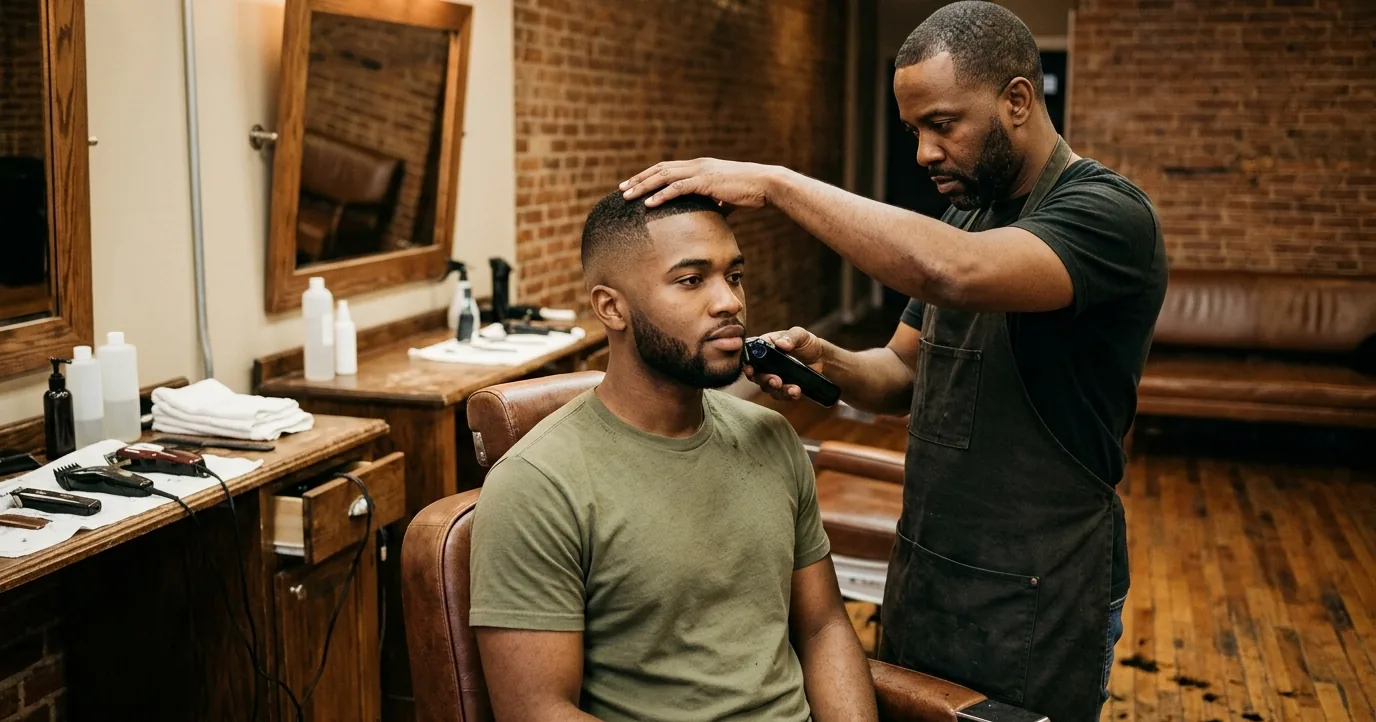
Every barber who cuts near a base, a firehouse or a police academy knows this appointment. The young man in the chair has to report clean-shaven in the morning, and his jaw is still dotted with bumps from the last time he did. He is not asking for a style. He is asking how to pass inspection without paying for it with his skin.
The condition is pseudofolliculitis barbae (PFB), and in 2025 the Army, Navy, Air Force and Marine Corps all tightened the shaving waivers that let men live with it. This is not a treatment guide, and the prevention basics live in our grooming guide. It is about the rule: who it falls on, what a waiver is, what the respirator argument proves, and what the research says employers should do instead.
A Neutral Rule That Lands on One Group
PFB is mechanical. A tightly curved hair cut at or below the skin grows back into it, and the body reacts to the buried hair as a foreign object. Anyone with curly facial hair can get it, but it is concentrated among men of African descent, and the numbers are starkest wherever shaving is mandatory. When dermatologists examined 655 students at Senegal’s National Police Academy in Dakar, all required to shave weekly, 43.7% of the men had PFB. In 90% of those cases it had already left a mark, mostly dark spots and occasionally keloid scars.
The treatment that works most reliably is to stop shaving. Put that beside a rule that every man must shave, and a policy written for everyone becomes a policy about Black men. The U.S. Equal Employment Opportunity Commission says employers generally can require a clean shave, but Title VII requires exceptions for men with PFB “unless being clean-shaven is job-related and consistent with business necessity.”
What a Shaving Waiver Actually Is
In the military, a shaving waiver is permission to put the razor down while a skin condition is treated. The Army calls it a shaving profile, and soldiers and Marines also carry a signed exception to policy. Everywhere, a military medical officer examines the skin and writes a recommendation, and the commander decides. Before 2025, waivers could be temporary, renewable or permanent, and the facial hair they allowed was kept short and even, capped at a quarter inch in the Air Force and Navy.
Today the waiver comes with a treatment plan and a schedule. Under Army Directive 2025-13, a mild case can skip shaving for up to four weeks and a moderate or severe case for up to eight, with a few more weeks possible if it has not responded. An optional fourth phase refers the soldier to specialty care such as laser hair removal, which the directive says may be government funded. The Marine Corps uses the same phases and lets the medical officer endorse clippers in place of a razor.
How the Rules Tightened
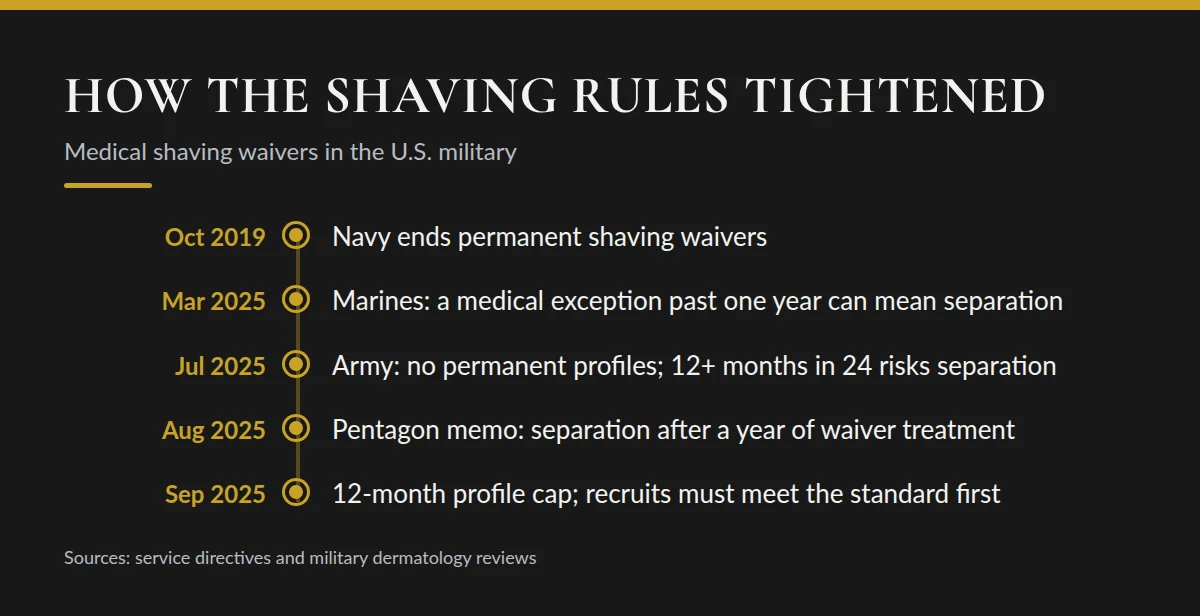
Military grooming has shaped Black barbering for generations, and the fade itself began as a regulation cut. The fight over PFB is nearly as old. Shaving was enforced in the First World War partly so gas masks would seal, and by the 1970s the condition had caused what a 2021 review in Military Medicine calls a “social uproar.” The recent tightening came in steps:
- October 2019. The Navy ended permanent shaving waivers over concern about gas mask fit.
- March 2025. The Marine Corps announced that Marines who need a medical grooming exception for more than a year “may be considered for administrative separation,” reversing a 2022 policy that protected Marines from separation over PFB.
- July 2025. Army Directive 2025-13 banned permanent shaving profiles and warned that exceptions totaling more than 12 months in a 24-month period “may result in an administrative separation.”
- August 2025. A memo from the Secretary of Defense set the standard as “clean shaven and neat in presentation” and directed commanders to “initiate separation of Service members who require a shaving waiver after more than 1 year of medical treatment.”
- September 2025. An implementation memo capped medical profiles at 12 months, sent permanent conditions to evaluation for separation, flagged anyone who refuses, is denied an exemption or fails required testing as non-deployable, and deferred recruits who cannot meet the standard.
From Slower Promotions to Separation
Even before 2025, a waiver carried a price. A study in Military Medicine surveyed male airmen at 12 randomly selected Air Force bases and analyzed 10,383 complete responses. Airmen with shaving waivers took longer to be promoted, and the delay was similar across racial groups. But 64% of waiver holders were Black, in a sample less than 13% Black, so the cost fell mostly on Black airmen. The authors concluded the grooming standard may have a racially discriminatory effect, from a rule that never mentions race.
Dermatologists writing in Cutis suggest why: facial hair can be read as unprofessional, and some high-profile assignments call for “the highest standards of military appearance and professional conduct.” The numbers are not small. A 2026 review in the same journal reports that active-duty Air Force personnel with PFB shaving waivers rose from 10,965 in 2021 to 18,991 in 2023.
What 2025 changed is the stakes. A waiver used to slow a career, and one that runs past a year can now end it. In the Army and Marine Corps, the review notes, even someone who has held a waiver for an entire career now needs a fresh medical appointment, new paperwork and a new commander’s signature for every waiver.
The Respirator Argument, Taken Seriously
The strongest case for the clean-shaven rule is not about looks. It is about air. The September memo grounds the standard in gas masks for chemical, biological, radiological and nuclear threats, and in firefighting and disaster work where respiratory protection may be needed on short notice. That argument deserves a straight answer, because part of it is right.
For civilian employers, OSHA’s respiratory protection standard forbids tight-fitting respirators on anyone with “facial hair that comes between the sealing surface of the facepiece and the face.” For full beards the evidence backs it. When University of Minnesota researchers fit-tested 384 state fair visitors on N95 respirators, not one person with a full beard achieved an acceptable fit.
A waiver beard is not a full beard, though. A University of Oklahoma study trimmed the beards of 19 men in stages and fit-tested a half-face respirator at each length. Every test passed at a smooth shave and at about a sixteenth of an inch, and 98% passed at an eighth of an inch, with fit falling off mainly beyond that. A Melbourne hospital found that 86 of 87 bearded health workers passed three fit tests in a row on one respirator model when an elastic band flattened the beard underneath. The Cutis editorial still calls research on mask seals over neatly trimmed beards, or over PFB, limited.
The law reads the rule as written. An OSHA interpretation letter says beards “present serious problems” for tight-fitting facepieces because their texture and density vary from day to day, while short mustaches, sideburns and small goatees kept clear of the seal usually do not. The same letter notes that loose-fitting and hooded powered air-purifying respirators, which need no face seal, usually can be worn with facial hair.
Firefighters, Police Officers and Everyone Else
Where a tight-fitting facepiece is genuinely part of the job, that literal reading has decided the leading case. In 2015 the New York City Fire Department let firefighters with PFB keep closely cropped beards, one millimeter to a quarter inch and never cut with a razor, if they passed a fit test on their breathing apparatus. Twenty firefighters used the accommodation without an adverse safety incident. In 2018 the department revoked it and told them to shave or take light duty. Four Black firefighters sued and won their disability claim in the district court, but in 2021 the U.S. Court of Appeals for the Second Circuit reversed, holding that the OSHA regulation “unambiguously prohibits” the accommodation. Their Title VII race claim failed for the same reasons.
Most uniformed work is not interior firefighting. Police officers are generally held to a clean-shaven standard for respirator fit, the Cutis editorial notes, and the Dakar study shows how common PFB becomes among recruits under a weekly shaving rule. But the EEOC’s business necessity test asks what a particular job actually requires, and the commission’s own example is a pizza delivery driver fired under an inflexible no-beard rule. The further a role sits from a tight-fitting facepiece, the harder a no-exceptions rule is to justify. State and local law adds its own layer, so anyone disciplined over a beard should talk with a union representative or an employment lawyer before shaving through a flare to keep the job.
What the Research Says Employers Should Do Instead
None of this literature says to ignore the respirator. It says to match the rule to the risk.
- Tie the standard to the equipment, not the look. Require a clear seal zone in roles that really wear tight-fitting respirators, and judge other roles by what the work demands.
- Offer protection that needs no face seal. Where the hazard allows it, OSHA says loose-fitting and hooded powered respirators usually work with facial hair.
- Document every case the same way. Dermatologists urge clinicians to record the diagnosis, clinical findings, severity and treatment used, and call for a standard approach across branches.
- Make treatment reachable. Service members can have little access to dermatologists experienced with PFB and limited insurance coverage for laser hair reduction. The same authors call for more military dermatologists, experienced civilian partners and teledermatology.
- Leave room for the cases treatment cannot fix. The 2021 Military Medicine review concluded that long-term shaving profiles may be needed for treatment-resistant cases.
- Stop penalizing the waiver itself. The Cutis editorial calls for policies that do not penalize service members with tightly coiled hair, for evidence-based accommodation plans, and for protective equipment designed with PFB in mind.
If You Need a Waiver
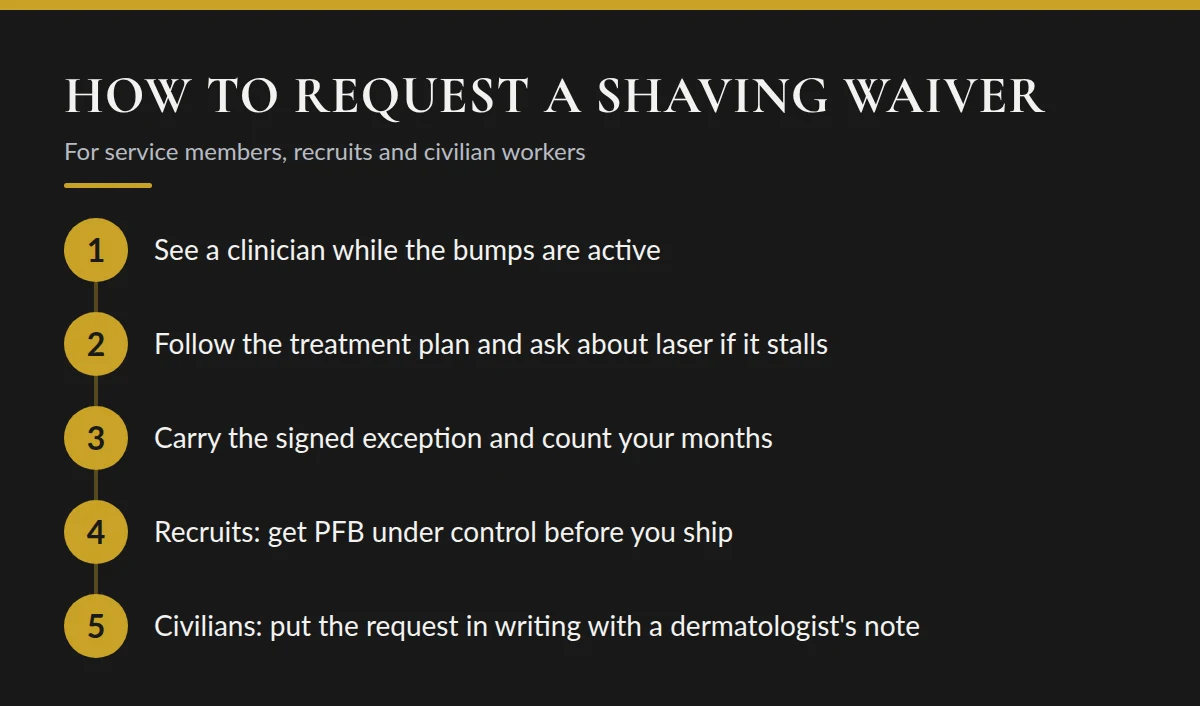
- Get seen while the bumps are active. Ask that the record include what dermatologists say every waiver file needs: the diagnosis, the clinical findings, the severity and the treatment tried.
- Follow the treatment plan, and ask about laser if it stalls. An approved waiver now comes with a required plan. TRICARE covers laser hair removal for active-duty members when it is medically necessary and not available at their military treatment facility.
- Carry the paperwork and watch the calendar. Soldiers and Marines must produce their signed exception on request. In the Army, exceptions totaling more than 12 months in a 24-month period may lead to separation, so keep your own count.
- Recruits, treat it before you ship. Applicants who cannot meet the grooming standard are deferred until they can, and a civilian dermatologist may be the first to diagnose PFB.
- Civilians, put it in writing. Attach a dermatologist’s note, ask whether your role truly requires a tight-fitting respirator, and ask whether a loose-fitting or hooded one could do the job.
Where the Barber Comes In
A waiver is a medical and legal document, and no barber should pretend to write one. But the shop is where a man in uniform stays inside the lines between inspections, and the same trust that makes the chair work for health programs makes it a natural place to say “get that looked at.”
- Lean on clippers. Among the Dakar police students, clipper users had about half the odds of PFB, while shaving against the grain came with more than six times the odds. A finish that cuts at the surface instead of below it is often the difference between a clean face and a flare.
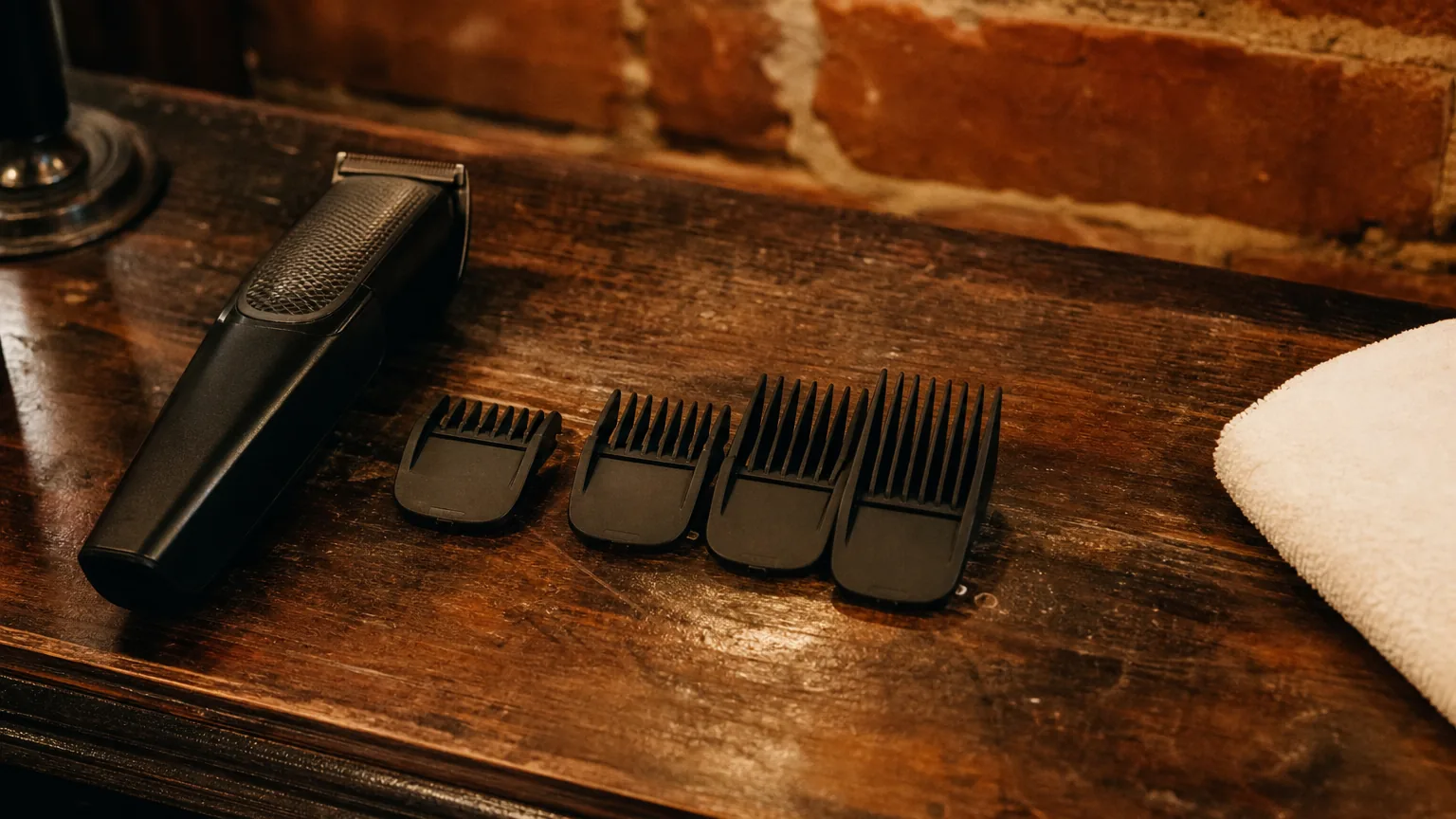
- Hold a waiver beard at one even length. Waiver beards have traditionally topped out around a quarter inch. A #1 guard leaves about an eighth of an inch and a #2 about a quarter, as our cut dictionary lays out, but the client’s own profile and unit rules set his real limit, so ask.
- Keep the mustache inside the lines. The Pentagon’s implementation memo allows a neatly trimmed mustache that stays within the corners of the mouth and out of the respirator seal zone.
- Skip the razor lineup on active bumps. A trimmer edge on the neckline does the job without reopening the skin.
The Bottom Line
The clean-shaven rule is written in neutral language, and for most men it costs a few minutes at the sink. For a large share of Black men it costs skin, and for those in uniform it can now cost a career. The respirator concern is real where a tight-fitting facepiece is part of the work, and the research on full beards supports it. What the research has not settled is how short is short enough, or whether a one-year limit leaves room for the treatment-resistant cases military dermatologists have long described. Until policy answers those questions, the route that works is the old one: a clinician who documents the condition, a file that follows every rule, and a barber who keeps the face inside the standard without cutting below the skin.
Further reading (sources)
- Secretary of Defense on the August 2025 memo setting the clean-shaven standard and the one-year waiver limit
- Secretary of War with the September 2025 implementation memo on profiles, recruits and deployability
- Secretary of the Army for Army Directive 2025-13 and its phased shaving profiles
- U.S. Marine Corps on MARADMIN 124/25 and separation after a year on a medical grooming exception
- Ritchie and colleagues with the Air Force survey linking shaving waivers to slower promotions
- Devine, Cho and Norton for a branch by branch review of the 2025 waiver changes
- Welch and colleagues on PFB in the military, career stigma and practical fixes
- Tshudy and Cho with a history of PFB policy in the armed forces
- Seck and colleagues for PFB among Dakar police students required to shave weekly
- U.S. Equal Employment Opportunity Commission on no-beard rules and PFB under Title VII
- OSHA with the respiratory protection standard and its facial hair rule
- OSHA for an interpretation letter on trimmed facial hair and respirators without a face seal
- U.S. Court of Appeals for the Second Circuit on Bey v. City of New York and the FDNY beard accommodation
- Bagheri Hosseinabadi and colleagues with N95 fit testing by facial hair at the Minnesota State Fair
- Floyd, Henry and Johnson for how beard length changes respirator seal leakage
- Williams and colleagues on an elastic band beard cover tested with health workers