The Black Haircut Dictionary: How to Ask For the Cut You Actually Want
Published on September 9, 2026
Most bad haircuts are not technical failures. They are translation failures. A man sits down, says “just a fade, keep it low,” and means he wants the fade to start low on his head. The barber hears a request for less length and takes the sides down further than the client ever wanted. Nobody was careless. Everybody is unhappy for two weeks.
The vocabulary of Black barbering is precise, and it has never really been written down anywhere a client can find it before he is already in the chair. So here it is: what each term actually means, how the cut behaves as it grows out, the guard numbers underneath it, and a short consultation script that gets you the cut in your head instead of the cut in somebody else’s. Newer barbers are welcome to take the script and use it.
Taper or Fade: The Distinction Everything Else Sits On
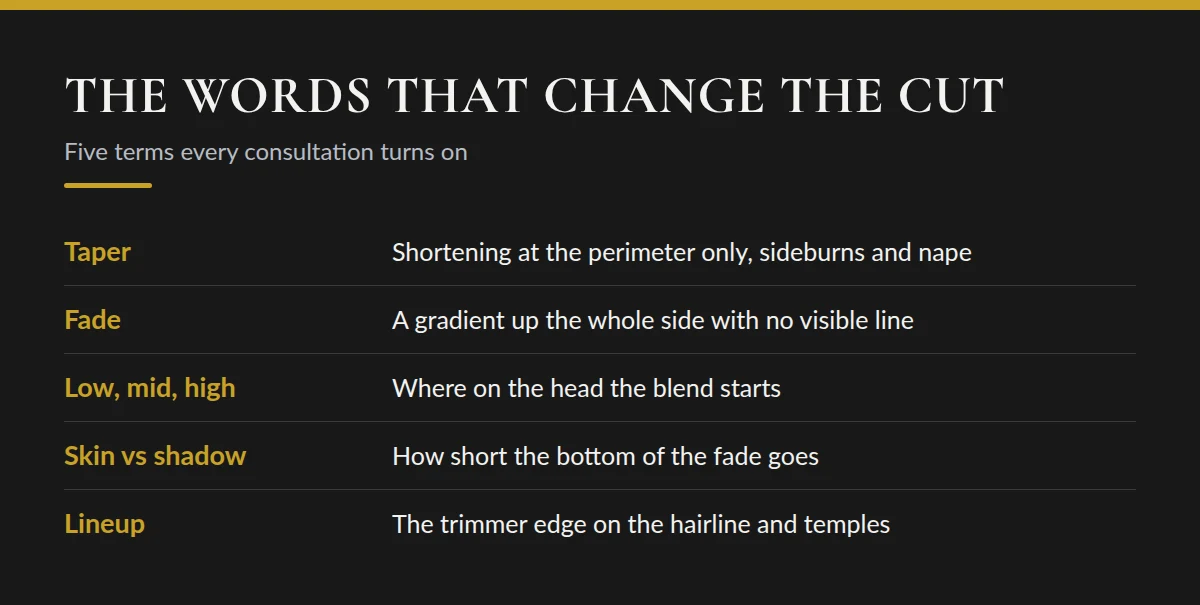
A taper is a gradual shortening of the hair at the perimeter only, at the sideburns and around the nape. The rest of the sides keep their length. It is conservative, it grows out invisibly, and it is what most workplaces picture when they picture a clean cut.
A fade is a gradient across the whole side and back, running from very short at the bottom up into full length near the top, with no visible line where one length becomes another. A taper touches the edges. A fade rebuilds the entire side of your head.
Taper fade is not a hedge or a compromise term. It means a fade that ends in a tapered perimeter, which is the most common way a fade is finished anyway. If you say it and your barber asks a follow-up question, that is a good barber.
The Fade Family
Fade names describe two separate things, and mixing them up is the single most common misfire in a consultation. One set of names says how high on the head the blend starts. The other says how short the bottom of the blend goes. You need one from each column.
How high the fade starts:
A low fade begins roughly an inch above the ear and lives between the ear and the temple. It is subtle, it keeps most of your side profile intact, and it is the safest first fade.
A mid fade starts at the temple, level with the corner of your forehead. It is the middle of the road for a reason and it flatters most heads.
A high fade starts at or above the parietal ridge, the corner where the top of the head turns down into the side. It is dramatic, it makes the top look taller and the head look narrower, and it is the least forgiving of an uneven skull or a scar.
A drop fade arcs downward behind the ear instead of running straight around the head, following the natural curve of the skull. It reads softer and it sits well under a hairline that is already receding at the temples.
A burst fade fades outward in a semicircle around the ear only, leaving the nape and the back long. It is the standard pairing for mohawks, mullets, and tapered afros, and it is the one people most often ask for by pointing rather than by name.
A temp fade, also called a temple fade, a Brooklyn fade, or a blowout depending on the city you are in, confines the taper to the temple corners and the hairline. The rest of the sides stay one length. It is a lineup with a little blending attached.
How short the bottom goes:
A skin fade or bald fade takes the shortest point down to bare skin with a foil shaver or a zero gapped blade. Maximum contrast, maximum sharpness, and it is visible again within about five days.
A shadow fade or low contrast fade stops at a half guard or a #1 instead of skin, leaving a faint dusting of hair at the bottom. Softer, more forgiving of scars and pigment changes on the scalp, and it holds its shape noticeably longer.
These two columns combine freely. A low skin fade and a high shadow fade are both perfectly coherent requests, and knowing that is most of the battle.
Guard Numbers: The Only Vocabulary That Never Lies
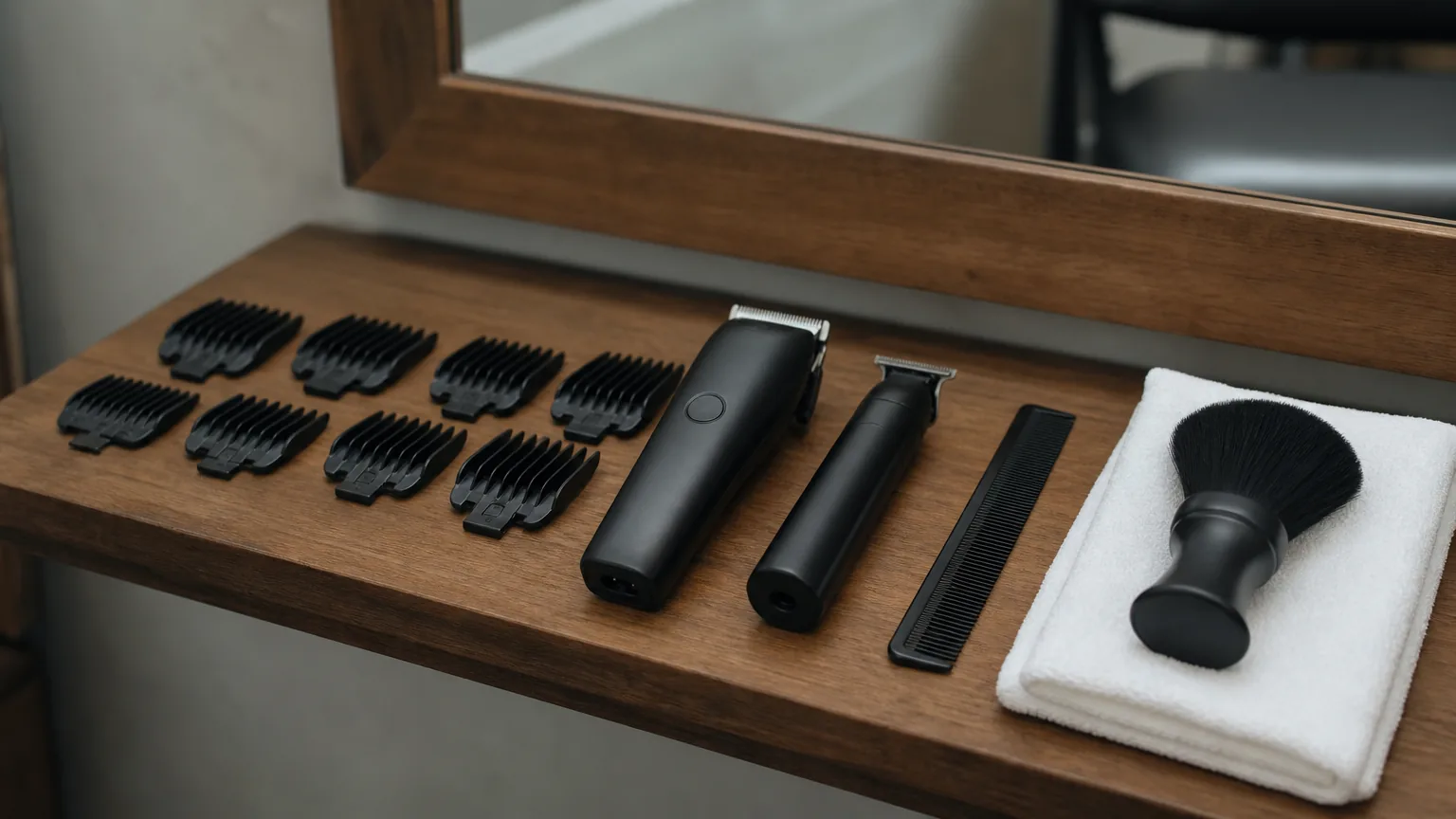
Style names drift by region. Guard numbers do not. Every clipper attachment comb is cut to a fixed length, and if you learn four of them you can describe any cut on earth.
- No guard (naked blade): about 1/16 inch, 1.5mm
- #1: 1/8 inch, 3mm
- #2: 1/4 inch, 6mm
- #3: 3/8 inch, 10mm
- #4: 1/2 inch, 13mm
- #8: 1 inch, 25mm
Half sizes exist (#0.5, #1.5, #2.5) and the taper lever on the side of the clipper closes the gap between any two numbers, which is how a barber builds a smooth gradient rather than three visible stripes.
One caveat that matters enormously on textured hair: a guard number describes the hair, not the look. Because Type 4 coils shrink and because tight curl scatters light instead of reflecting it, a #2 on 4C hair reads shorter and darker than the same #2 on a looser pattern. This is the same structural behavior that governs why textured hair acts differently from every other hair type. Give the number and then say what you want it to look like, and let your barber reconcile the two.
The Cuts on Top
The Caesar is a short, blunt, roughly uniform length on top (usually a #2 to #4) with the fringe brought straight forward and cut level across the forehead. It suits a receding front hairline better than almost anything else because the fringe covers the retreat instead of announcing it.
Waves and the 360 process are not a haircut at all, which is where most requests go wrong. Waves are a trained pattern, produced by brushing the natural curl down flat over weeks, sealing it with moisturizer, and holding it overnight with a du-rag or wave cap. “Wolfing” means deliberately skipping cuts so the pattern has enough length to hold. What you ask your barber for is protection: enough length left on top for the pattern to survive (commonly a #1.5 or #2), a fade that connects to the sides without erasing the pattern where it wraps, and no skin fade run up into the crown.
The afro and the tapered afro keep full length and density on top with the perimeter shaped, either left square or tapered into the sides. Ask for shape, not for length removal, and specify whether you want the outline blown out round or left with its natural silhouette.
Twists, sponge curls, and braids are texture work rather than clipper work, and the barber’s job is the perimeter around them.
Locs get a shape-up, not a cut. The perimeter is lined and the sides or nape can be tapered without the loc bodies being touched. The phrasing that prevents disasters is “line the perimeter, taper the sides, do not cut into the locs.” If you are somewhere in the first two years of the process, where your locs are in their lifecycle changes what a barber can safely do at the edges.
The Lineup, the Edge-Up, the Shape-Up
These are three names for one service, and which one you grew up saying is mostly geography. A trimmer or T-blade squares the front hairline, sets the temple corners, and defines the perimeter into crisp straight edges.
It is also the single most damaging thing that happens in a barber chair, and not for the reason people expect. A hairline is naturally irregular. To make it perfectly straight, a barber has to cut back to the lowest point of the irregularity. Do that every two weeks for a few years and the hairline has genuinely migrated, cut by cut, well before any biology was involved. Dermatology research on Black hairstyling practices puts sustained mechanical stress on the frontal hairline at the center of preventable hair loss, and the aggressive lineup belongs on that list next to tight braids. If the edges are already thinning, the early stages of traction alopecia are reversible and the late ones are not, which makes this worth being fussy about.
The sentence to use is: “line me up where it grows, do not take it back.” Any barber worth returning to will respect it, and a good one will tell you honestly how much straightening your hairline can take.
On the razor question: a razor lineup gives a harder, cleaner edge than a trimmer, and it is also skin contact on the same strip of scalp every visit. If you get razor bumps along the neckline or the temples, ask for the trimmer instead. The prevention side of that problem sits with your grooming routine between visits more than with the barber.
Necklines are their own small vocabulary. Blocked is squared off straight across, sharpest for about a week and then a fuzzy rectangle. Rounded softens the corners and grows in more gracefully. Tapered fades the neckline into the skin and looks intentional for the longest, which is the right answer if you go three or more weeks between cuts.
Matching the Cut to Your Head
Round faces gain length from a high fade and lose it to a low one. Long or narrow faces want a low fade or a taper that keeps some width at the sides. Square faces can carry almost anything, which is a genuinely annoying thing to hear if you do not have one.
A receding hairline does better with low contrast (a shadow fade rather than a skin fade) and a forward fringe like a Caesar, because hard lines and high contrast point straight at the temples. A cowlick or a crown whorl should be mentioned out loud before the cut starts, not discovered halfway through. And a scar, a mole, or a patch of different pigment is a reason to keep the bottom of the fade off the skin. Say it once and it is handled.
The Script That Gets You the Cut
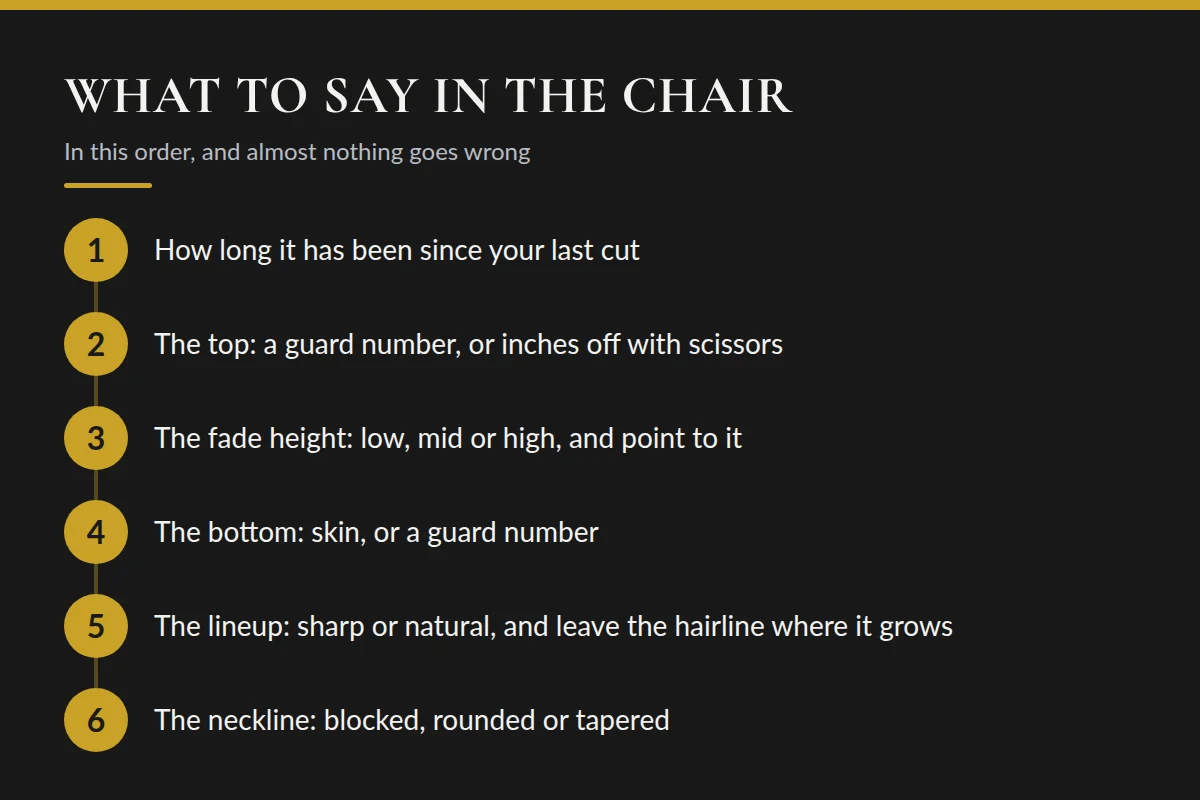
Say these in order and almost nothing can go wrong.
- How long it has been. “Three weeks since my last cut.” It tells your barber how much of what he sees is growth.
- The top. A guard number, or “scissors on top, take about an inch off.”
- The fade height. Low, mid, or high, and point to where you want the blend to start.
- The bottom. Skin, or a number. This is the one people forget.
- The lineup. Sharp or natural, razor or trimmer, and whether the hairline stays where it grows.
- The neckline. Blocked, rounded, or tapered.
- The beard. Connected to the sideburn or separated, and where you want the cheek line and the neckline to sit.
Bring a photo if you have one, but bring a photo of your own head after a cut you liked, not a celebrity with a different hairline and a different texture. Your barber can copy your hair. He cannot copy somebody else’s. Everything else about what separates a barber worth keeping from one you are just passing through shows up in how he responds to that list.
How Long It Lasts
Plan your next appointment by the sharpest element in the cut, not by the calendar.
A skin fade and a razor lineup are at their peak for about five days and start reading fuzzy inside two weeks. A shadow fade or a low taper holds cleanly for three to four weeks. Waves need a cut every two to three weeks or the pattern loses the fight with new growth. A Caesar or a tapered afro can stretch to five or six weeks if the perimeter was cut with grow out in mind.
If you want sharp and you can only get to the shop monthly, the honest answer is to ask for less contrast rather than a sharper cut. A low taper on week four still looks deliberate. A high skin fade on week four looks like a high skin fade you have neglected.
The Bottom Line
The whole language comes down to four decisions: how long on top, how high the fade starts, how short it ends, and how hard the lines are. Everything with a name attached is a combination of those four. Say them in that order, name your guard numbers, protect your hairline, and pick the maintenance level you will actually keep up with rather than the one that photographs best on day one. A generation of barbers built this vocabulary. It only works if both people in the room are speaking it.
Sources
- Journal of the American Academy of Dermatology with Black hairstyling practices stratified by traction alopecia risk
- American Academy of Dermatology on the hairstyles that pull hardest on the hairline
- American Academy of Dermatology for everyday care built around African American hair
Further reading
- Wahl Professional for the attachment guard size chart and cutting lengths
- Andis with blade and attachment comb specifications
- National Museum of African American History and Culture on the community roles of the barber shop and beauty salon
- National Museum of African American History and Culture for the pioneers who built the Black beauty industry