The Barbershop Will See You Now: A Complete Guide to Health Programs in Black Barbershops
Published on September 15, 2026
The Waiting Chair Became a Waiting Room
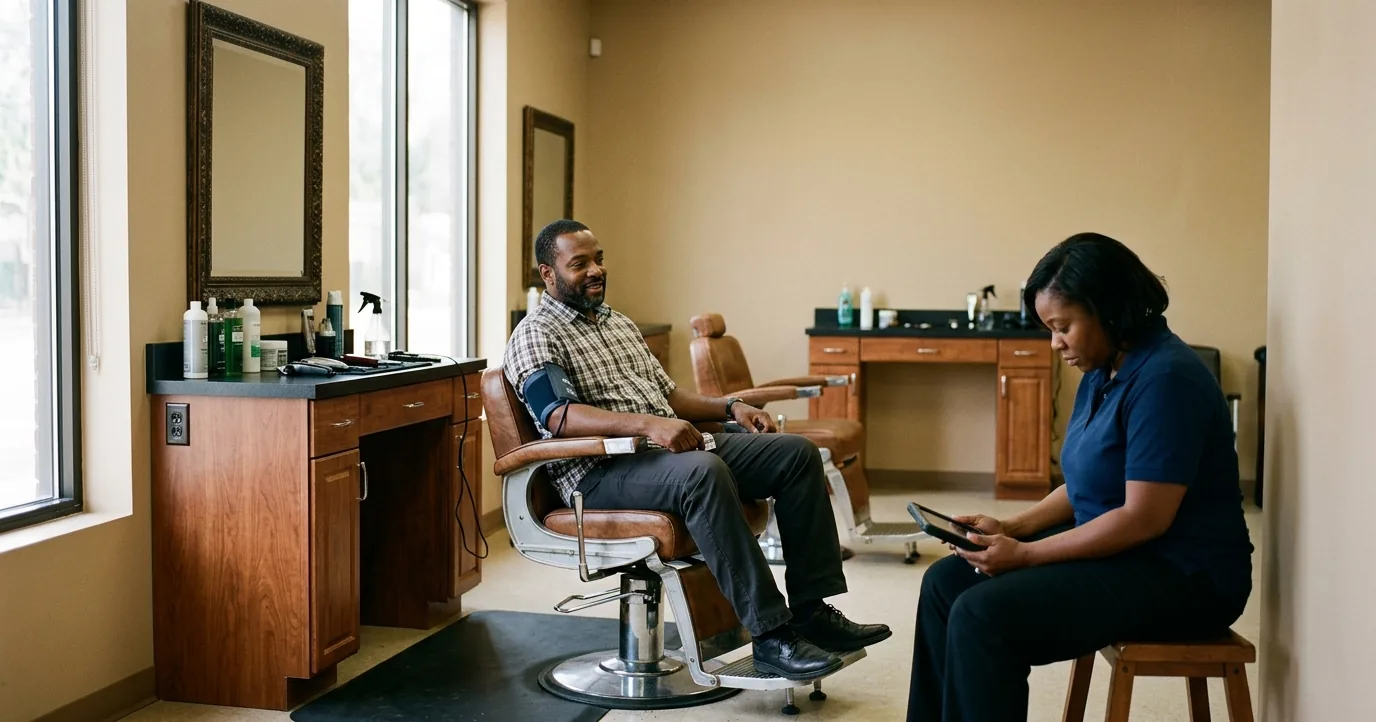
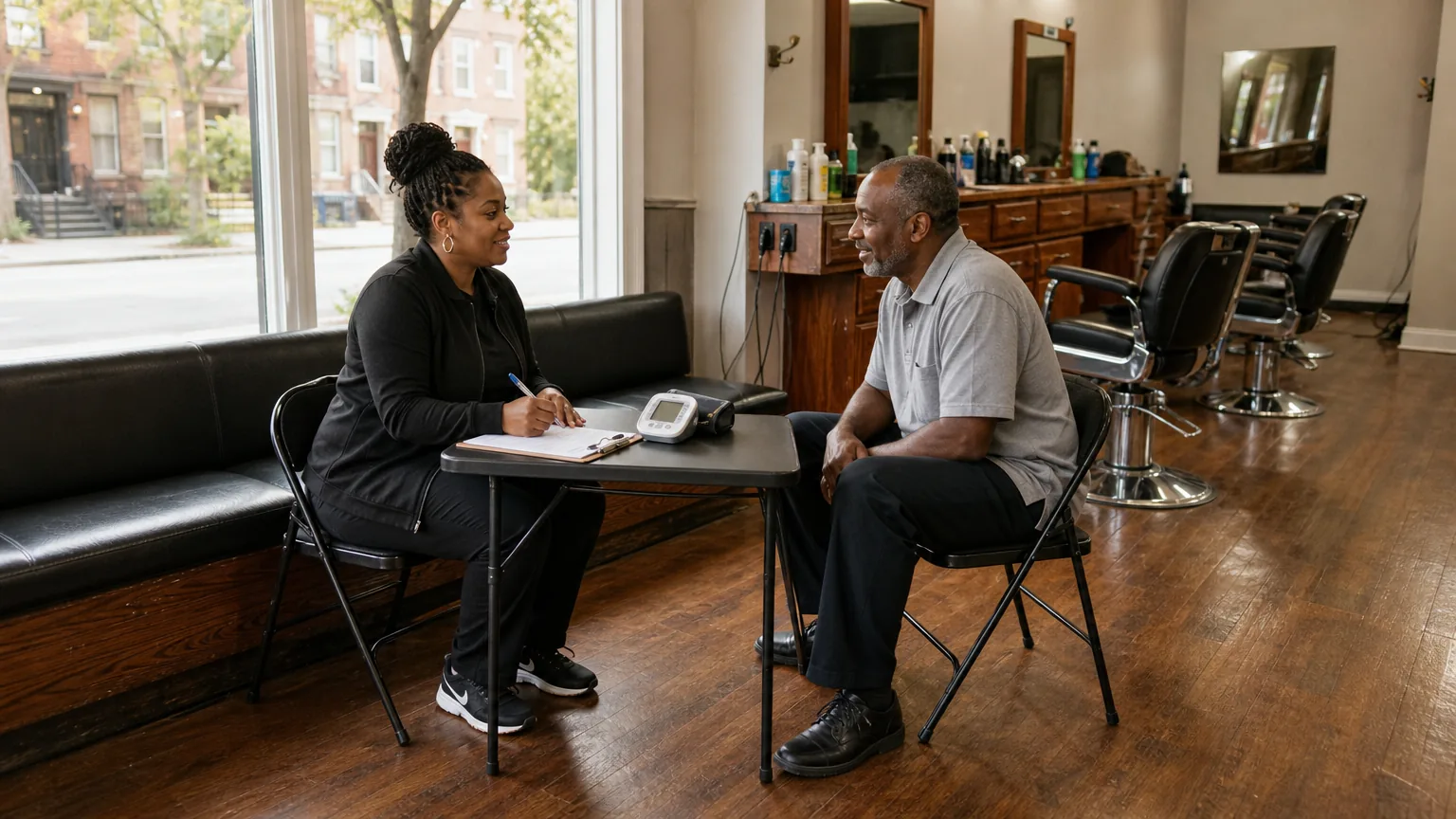
In Indianapolis, a folding table sits near the front door of All in the Wrists Barbershop, and two community health workers set up there on a Tuesday afternoon. In Little Rock, a research coordinator moves between chairs asking men about their drinking. In eastern North Carolina, barbers wear smocks reading “Barbers for Life” and hand over a resource booklet a man can flip through privately while he waits his turn.
None of that is a health fair. It is a standing arrangement, repeated week after week, in the one room where Black men reliably sit still for forty minutes at a stretch. Over the last decade this has become one of the most productive ideas in American public health, and it is spreading fast enough that plenty of shop owners are now fielding the phone call asking whether a hospital can set up in their lobby.
Here is the map: what these programs actually do, what the research shows, how a shop hosts one, and how you protect the man in the chair while it happens.
Why the Shop Works Where the Clinic Struggles
Three things make a barbershop unusual as a place to deliver care, and none of them can be purchased by a health system.
Frequency. A regular sits down every two or three weeks, for years. No primary care practice in the country gets that much contact with a healthy-seeming man in his forties who has no particular reason to make an appointment.
Trust that arrived before the program did. The relationship is measured in seasons, not minutes, and it belongs to the barber rather than to the institution. When a barber walks a client over to the table by the door, the introduction carries weight that a mailer or a robocall never will.
A room that was already his. Men are not being asked to take a half day off, find the building, sit under fluorescent light and explain themselves to a stranger. They are being met somewhere they chose to be. As I wrote in the cultural history of the Black barbershop, the shop has served as a news desk, a hiring hall and an informal counseling office for well over a century. Health screening is a newer item on an old list.
What Is Actually Running in Shops Right Now
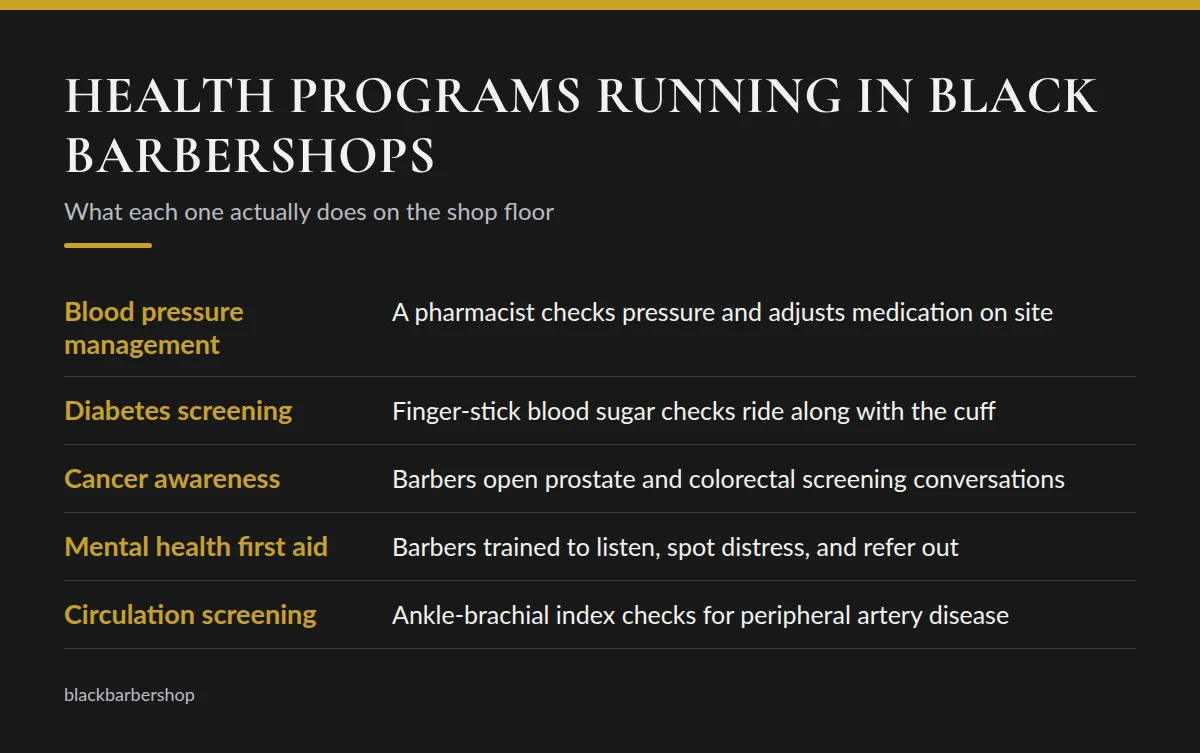
The field is broader than most people realize. A 2024 review in the Yale Journal of Biology and Medicine catalogued the range, and it covers most of the big chronic-disease categories.
Blood pressure. This is the flagship and the reason everything else got funded. The Los Angeles Barbershop Blood Pressure Study put clinical pharmacists inside 52 Black-owned shops and cut participants’ systolic pressure by an average of 28.6 points over twelve months. I go through that trial, its costs and its cost-effectiveness in detail in the barbershop blood pressure guide.
Diabetes and blood sugar. Glucose checks ride along with the cuff, because the men who show up with uncontrolled pressure are frequently carrying prediabetes or diabetes at the same time. The Indianapolis program run by IU Health’s Office of Healthy Communities offers on-site blood sugar checks alongside blood pressure monitoring.
Cancer awareness and screening navigation. ECU Health’s Barbers for Life began in 2016 as a prostate cancer awareness push in Edgecombe County, North Carolina, after a urologist showed that local Black men were being diagnosed late and dying of it. In the program’s first quarter, 11 barbers across seven shops educated 193 men and 44 of them went and got screened. One was diagnosed with prostate cancer. Colorectal cancer education has followed the same route.
Mental health. Barbers trained in mental health first aid learn to listen, notice distress, reduce stigma and refer out. That work has its own guide here: barbers as mental health first responders.
Circulation and limb health. A pilot at two Cleveland shops screened Black men for peripheral artery disease using the ankle-brachial index and found it in 5 of 31 participants, a rate higher than expected, in a group whose awareness of the condition was close to zero before an educational video.
Behavioral health and alcohol. UAMS Barbershop Talk, launched in Arkansas in August 2023, teaches men about heavy drinking. It now runs in 61 shops across 15 counties with more than 600 participants.
Infectious disease. HIV testing and COVID vaccination outreach both moved into shops for the same reason everything else did, and both raised testing and uptake rates.
The Evidence, and Where It Is Still Thin
The blood pressure evidence is genuinely strong: a randomized trial, twelve-month durability, and a published cost-effectiveness analysis. Everything else sits a step behind it.
Most barbershop studies are pilots. They are small, they run at a handful of shops, and they measure awareness or screening uptake rather than whether anybody’s disease got better. The PAD work in Cleveland is a good example. Thirty-one men is a signal, not a settled result.
The real-world programs are starting to publish numbers of their own, and they are worth taking seriously. Indiana University’s HEALeR Collaborative reports that community health workers have screened nearly 2,000 people at Indianapolis barbershops and other sites in two years. Of those screened, 74 percent were hypertensive, and only one in four already knew it. After a four-month program, nearly two of three participants had their pressure under control, a rate 12 percentage points better than similar patients getting usual care.
What the field still lacks is long-term follow-up, cost data outside hypertension, and any settled answer on sustainability. Grants end. The Edgecombe County partnership dissolved during COVID and had to be rebuilt from scratch years later. That is the pattern the whole field is fighting.
How a Shop Owner Hosts or Launches a Program
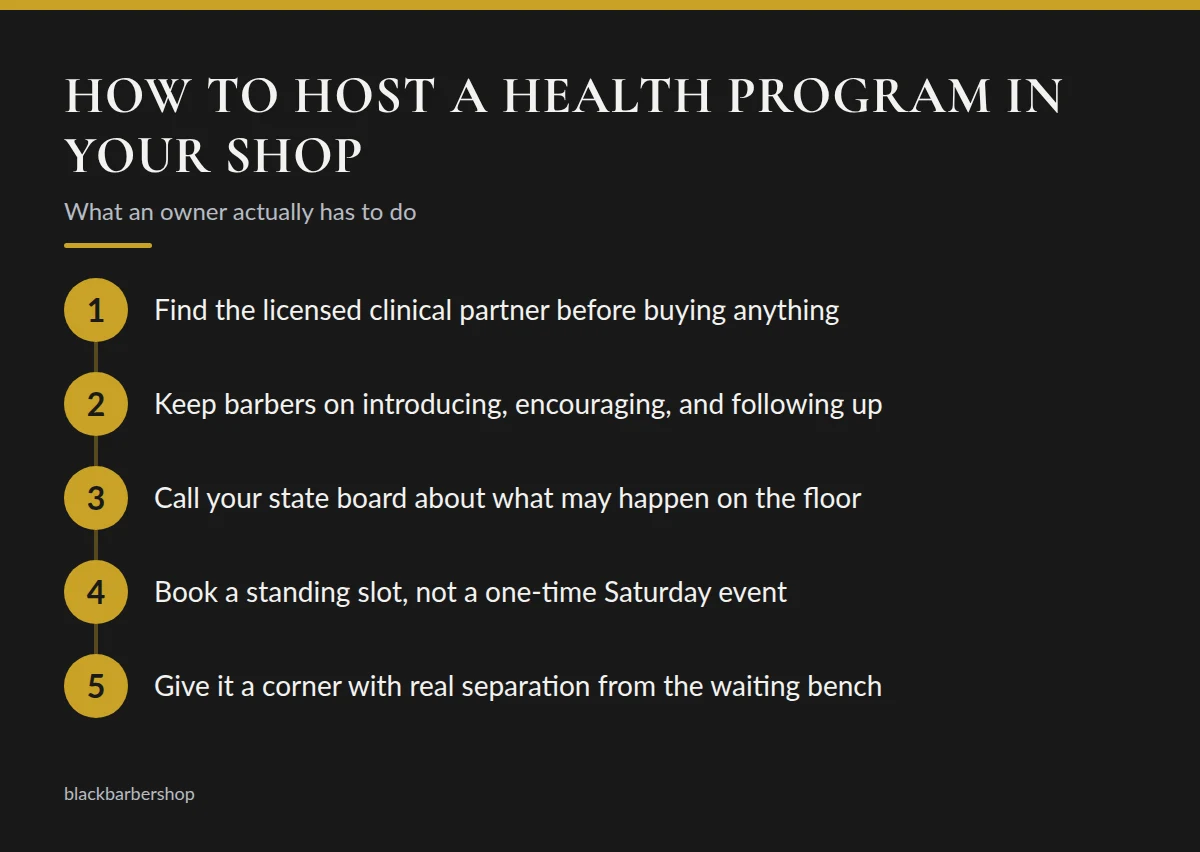
You do not need a grant, and you should not need to buy equipment.
Find the clinical partner before anything else. Federally qualified health centers, hospital community outreach offices, schools of pharmacy and nursing, county health departments and university public health programs are all actively looking for community sites. The CDC’s Million Hearts initiative has gone as far as mapping which barbershops and salons sit within two miles of community health centers in Black neighborhoods, specifically to find places to extend the LA model. Somebody may already have your shop on a map.
Keep the barber’s role on the right side of the line. Your team introduces, encourages and follows up. That is the part no health system can supply and it is genuinely the hard part. Taking readings, interpreting them, diagnosing and prescribing belong to a licensed clinician.
Call your state board before you set anything up. What non-grooming activity may take place on a licensed shop floor varies by state, as do sanitation codes, and so does a pharmacist’s prescribing authority under a collaborative practice agreement. Ask early, in writing. While you are thinking about the health department, the disinfection and bloodborne pathogen rules in the clippers and sanitation guide apply to everything else on your floor regardless.
Pick a standing slot, not a one-off. Repeat contact with the same face is what produced the results in every program above. A single Saturday event produces photographs.
Give it a real corner. A table by the door works, but a corner with a little separation works better, and it costs you one station’s worth of floor space at most.
Privacy and Dignity Are Part of the Program
This is the part that gets skipped, and it is the part that decides whether men come back.
A barbershop is a public room with an audience. A man who finds out in front of six of his neighbors that his pressure is 180 over 110 may never sit at that table again. A few rules protect him:
- Screen out of earshot. Turn the table away from the waiting bench. Keep numbers spoken quietly, or written down and handed over.
- Nobody announces anything. Not the health worker, not the barber, not the client’s cousin in the next chair. Results belong to the man they came from.
- Let people take paper privately. The North Carolina program hands out a guidebook covering mental health, food, housing and substance use, and lets men choose what to read on their own. Nobody has to ask out loud for the section on depression.
- Ask about consent for research separately. Many of these programs are attached to studies. Participating in a screening and enrolling in research are two different decisions, and the second one requires its own clear yes.
- Do not let health talk take over the room. The shop is not a clinic annex. It is a shop that hosts a clinic corner, and the day it stops feeling like a barbershop, the whole mechanism stops working.
Where the Gaps Still Are
Two of them are worth naming, because shops can help close them.
The first is women. Nearly all of this work targets men, for good reasons, but salons reach Black women the same way shops reach men, and the CDC mapping work has already begun including them. Programs on the women’s side are years behind.
The second is cancer care support rather than screening. Research published in Supportive Care in Cancer found that non-White breast cancer patients at one institution were roughly six times less likely than White patients to use scalp cooling during chemotherapy, with barriers including advertising that never showed Black women and real doubts about whether the caps work on textured hair. Stylists and barbers are often the first people a patient talks to about losing their hair, which is why I wrote a full guide to chemotherapy hair loss and scalp cooling.
The Bottom Line
The chair is not a substitute for a doctor and no barber should ever be dressed up as one. What the shop fixes is the last-mile problem: getting a blood pressure cuff, a glucose meter, a referral or a real conversation in front of men who see clinicians least and need them most.
If you own a shop and someone asks to set up a table, the honest answer is that the model has evidence behind it, that it costs you very little, and that your endorsement is the active ingredient. Ask for a licensed partner, a standing time, and a private corner. Then go back to cutting hair, and ask the man in your chair next month how his numbers came out.
Further reading (sources)
- Yale Journal of Biology and Medicine on what barbershop interventions have achieved across chronic disease
- Indiana University for the Indianapolis screening program and what two years of data showed
- ECU Health with the prostate cancer partnership that became Barbers for Life
- Journal of the American Heart Association on screening Black men for peripheral artery disease in the shop
- UAMS News for the Arkansas program teaching men about heavy drinking
- Preventing Chronic Disease, mapping where shops and salons sit near community health centers
- New England Journal of Medicine for the cluster-randomized blood pressure trial in Black barbershops
- Supportive Care in Cancer on why Black patients use scalp cooling far less often