Discoid Lupus on the Scalp: The Scarring Patches Black Barbers and Stylists Spot First
Published on October 14, 2026

It usually turns up in the chair before it turns up in the mirror. A stylist taking down braids finds a patch at the crown about the size of a quarter: the hair is sparse, a dry scale clings to the skin, and the middle has gone paler than the rest of the scalp, ringed in darker brown. Her client had no idea it was there. Across town, a barber has worked the clippers around the same rough spot above a client’s ear for three cuts running. The client calls it ringworm and has been rubbing a drugstore antifungal cream on it since spring.
Either patch could be discoid lupus erythematosus (DLE), the most common form of lupus that affects the skin. It is several times more common in Black people than in white people, and on the scalp it destroys hair follicles and leaves scar where hair used to grow. Caught while a patch is still inflamed rather than scarred, treatment can stop it, which makes the people who see the scalp up close every few weeks unusually important.
This guide covers what DLE looks like on a Black scalp, what it gets mistaken for, why sun on a fresh fade matters, why the next step is a biopsy, how it is treated, and what a barber or stylist can say. It does not replace a board-certified dermatologist: if you have a patch like the ones described below, book that appointment now.
What Discoid Lupus Is
Lupus is a family of autoimmune diseases, in which the immune system attacks the body’s own healthy tissue. The best known, systemic lupus erythematosus (SLE), can reach the joints, kidneys and other organs. Discoid lupus, named for the round, disc-like patches it makes, mostly stays in the skin. DermNet, the dermatology reference, calls it a chronic scarring condition and the most common form of cutaneous (skin) lupus: stubborn, scaly plaques on the scalp, face and ears that can scar, change color and leave permanent hair loss. Like every form of lupus, it is not contagious, the NHS notes.
It can travel with more, though. DermNet estimates that about 5 percent of people whose patches stay above the neck, and 15 percent of those with patches below it too, go on to develop SLE. Across all forms of skin lupus, the American Academy of Dermatology (AAD) puts the figure at about one in five, one reason dermatologists keep following patients after the skin settles.
DLE is far from rare in Black communities. The Georgia Lupus Registry, a surveillance project funded by the Centers for Disease Control and Prevention, tracked new cases in Atlanta’s Fulton and DeKalb counties from 2002 to 2004. Drenkard and colleagues at Emory University found that Black residents developed definite DLE at 5.4 times the rate of white residents, and women at about three times the rate of men. DermNet adds that it most often begins in women in their 20s, 30s and 40s.
Black patients also tend to arrive with more damage done. At the University of Texas Southwestern in Dallas, Joseph and colleagues compared 112 Black and 71 non-Black patients with DLE: activity at the first visit was similar, but the Black patients’ damage scores were higher. A 2024 JAMA Dermatology study of 154 patients at the University of Pennsylvania suggests part of the reason. Patients from more deprived neighborhoods had nearly four times the odds of moderate to severe damage, and current smokers about three times, while race alone no longer predicted severity once neighborhood was accounted for. A review of skin lupus in people of color by Nozile and colleagues draws the practical conclusion: darker skin is prone to thick scarring and dark marks, so treatment should start early and be aggressive.
What It Looks Like on a Black Scalp
DLE changes as it goes, so a patch can look different from month to month. DermNet describes the progression:
- It starts dry and reddish, then thickens into a raised plaque under scale that sticks fast to the skin.
- The follicles plug. Keratin, the protein hair and outer skin are built from, packs into the follicle openings. When a doctor lifts the scale, its underside shows tiny spikes where the plugs sat, which dermatologists call the carpet-tack sign.
- Then it scars. The skin thins, the follicles are destroyed, and hair stops growing in the patch.
On darker skin the color change stands out most. As the patch scars, DermNet notes, light and dark changes in pigment follow, and they are especially noticeable on skin of color; often the scarred center goes pale while the rim darkens. In the Dallas study, color change on the scalp turned up in 82 percent of the Black patients against 48 percent of the others, and scarring hair loss in 79 percent against 56. Desai and Miteva, dermatologists at the University of Miami, add that some patches show up simply as brown spots. Many cause no symptoms at all; others itch, burn or feel tender.
Where to look matters as much as what. About 80 percent of people with DLE have patches only above the neck, DermNet says. In the Dallas study, 87 percent of the Black patients had it on the scalp and 59 percent on the ears, with higher odds of both than the other patients had. One spot is so typical that dermatologists named it the Shuster sign: the hollow bowl of the outer ear, just in front of the ear canal. A 2024 review by Lemos and colleagues adds that scalp DLE tends to start earlier and run a more severe course in Black patients than in white patients.
Those are also places a client can’t see. The crown, the back of the head, the bowl of the ear: a barber or stylist looks at them under bright light every few weeks, and the client almost never does.
Lupus, CCCA, Ringworm or Traction?
Plenty of scalp conditions cause patchy hair loss, and several are common in Black patients. A few clues help sort them, but none settles it.
- CCCA. Central centrifugal cicatricial alopecia, the most common scarring hair loss in Black women, starts at the crown and spreads outward in a widening circle, as our CCCA guide explains. DLE comes as separate patches anywhere on the scalp, often with marks on the ears or face too. Clinging scale, plugged follicles and a pale center inside a dark rim are its signature.
- Ringworm. Tinea capitis is a fungal infection that causes scaly, itchy patches of hair loss, sometimes speckled with black dots, which are hairs broken off at the skin. Unlike lupus, it is contagious. Its most common cause in the US passes from person to person, directly or on brushes, hats and towels, where DermNet notes the spores can survive for months. It mostly affects children aged three to seven, though adults get it too. A scraping under the microscope and a culture confirm it.
- Traction alopecia. Traction follows the pull, thinning the edges, temples and nape where braids, ponytails and sew-ins grip hardest, rather than leaving a scaly island in the middle of the scalp. Our traction alopecia guide covers the early signs. Scarring hair loss is easy to misfile in Black patients, and frontal fibrosing alopecia gets blamed on braids the same way.
- Psoriasis and seborrheic dermatitis. Both bring scale, but the hair loss they cause is usually temporary.
- Alopecia areata. This makes smooth, round bald patches, and early DLE can pass for it. Desai and Miteva show an early DLE case that had been diagnosed and treated as alopecia areata until magnification picked out the keratin plugs.
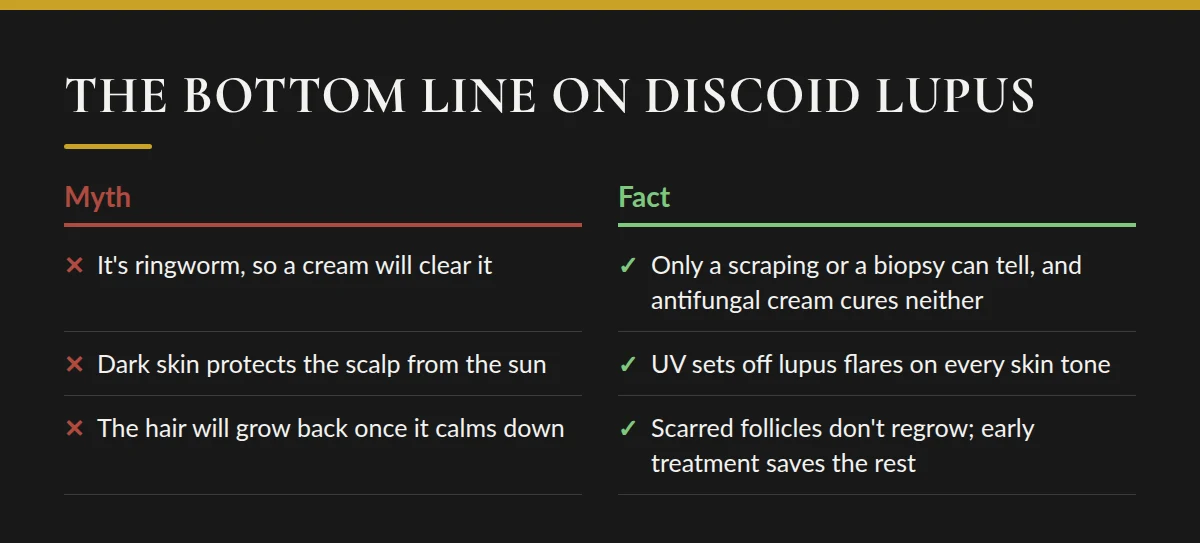
The ringworm mix-up runs both ways. Dermatologists in New Delhi described a 60-year-old woman whose pale, scaly, itchy patches on the scalp and ears were diagnosed as DLE on sight; her biopsy found a fungal infection, and antifungal pills cleared it and let some hair regrow. Either way, the drugstore tube is the wrong tool. Even true scalp ringworm needs at least four weeks of antifungal medicine by mouth, DermNet says, because creams cannot reach the root of the follicle. If the patch is lupus, the cream does nothing, and every month spent on it is a month the patch can spend scarring. By eye alone, from the chair or from across a clinic room, these conditions cannot be reliably told apart.
The Sun and a Fresh Fade
DLE is light-sensitive. Ultraviolet light can provoke it, DermNet explains, though patches also turn up on skin the sun never reaches. Sun exposure both sets off and worsens skin lupus, Desai and Miteva’s review notes, and the AAD says sun protection prevents flares and stops lupus getting worse in people of every skin tone. Melanin is no exemption.
A skin fade or bald fade takes away the shade that hair gives the scalp, and the top of the head catches more direct sun than almost any other part of the body, as our guide to scalp health explains. For someone with DLE, a fresh cut before a weekend outdoors is exactly the exposure a dermatologist wants reduced.

What dermatologists advise:
- Sunscreen on all skin that clothing won’t cover. The AAD’s standard is broad spectrum, SPF 30 or higher and water resistant, applied 15 minutes before going out and again every two hours and after sweating. Desai and Miteva’s review recommends SPF 60 or higher. A tinted formula avoids a white cast, and a spray or light gel spreads on a shaved head without a greasy film.
- A hat. DermNet says sunscreen alone is not enough for DLE and pairs it with clothing, and the AAD recommends a wide-brimmed hat.
- Shade, all year. Seek shade, plan time outside for when the sun is less intense, and keep it up year-round, as DermNet advises.
- Indoor light. Fluorescent, compact fluorescent and halogen bulbs give off some UV. The AAD suggests that very light-sensitive patients swap them for LED or incandescent bulbs, which is worth knowing for a barber or stylist with lupus who works long days under shop lights.
Why the Next Step Is a Biopsy
No single test can diagnose lupus, the AAD says, and a blood test alone cannot tell you whether you have it. DLE is especially quiet in the blood: the antinuclear antibody (ANA) test, the usual lupus screen, is frequently negative in DLE, according to DermNet. A normal blood panel does not rule it out. What usually confirms it is a skin biopsy.
A biopsy removes a small piece of skin for a lab to examine under a microscope, and a dermatologist can do it during an office visit while you are awake, the AAD explains. In DLE the sample shows inflammation attacking the skin and the follicle. A second test on the same sample, direct immunofluorescence, finds a “lupus band” of immune deposits in 60 to 80 percent of cases, Desai and Miteva report. A biopsy is also what caught the fungus in the New Delhi case.

Many dermatologists also use a dermatoscope, a lighted magnifier, which on the scalp is called trichoscopy. A healthy dark scalp has its own look under magnification, so DLE’s signs differ from textbook pictures taken on fair skin. Lemos and colleagues list what to look for on Black scalps: a break in the normal honeycomb pattern of pigment, fewer of the pinpoint white dots a healthy dark scalp shows, keratin plugs and casts around the hairs, blue-gray dots in a speckled pattern, and large branching blood vessels. Recognizing them, they write, allows the early diagnosis that prevents scarring.
That is why a trichologist is the wrong first stop. A trichologist can help with hair care but is not a physician and, as our complete guide to Black hair loss puts it, cannot biopsy, prescribe or rule out lupus. A board-certified dermatologist can, ideally one experienced with textured hair. Bring photos of the patch over time, and be ready for the questions the AAD says dermatologists ask: sores in the mouth or nose, rashes that come and go, new medicines, and relatives with lupus or another autoimmune disease. Mention sun exposure and smoking, then ask directly whether this could be discoid lupus and whether a biopsy makes sense.
Treatment: Saving the Follicles That Are Left
Among a dermatologist’s goals in treating skin lupus, the AAD lists preventing scarring and stopping irreversible hair loss. Desai and Miteva put the limit plainly: once a follicle has scarred, regrowth should not be expected, so prompt treatment is what saves hair. The usual rungs:
- Strong steroid creams, solutions or ointments are the first treatment for localized patches, used in courses of several weeks, DermNet says, and steroid injections can help clear a thick patch.
- Hydroxychloroquine, an antimalarial pill that also calms lupus inflammation, is the usual first medicine by mouth. It works slowly, and the AAD says results can take two to three months. Doses stay within limits set by body weight, because high doses can harm the eyes.
- Tacrolimus ointment, a non-steroid option, may help hair regrow, the AAD says, but only if scarring hasn’t started.
- Next options. About 30 to 40 percent of skin lupus does not respond to the standard first treatments, Desai and Miteva note. Next come methotrexate, retinoids, dapsone or mycophenolate, and the AAD adds biologics.
- Quitting smoking. Smoking is more common in DLE, worsens skin lupus and can stop antimalarials from working. The AAD notes that medication that had failed can start to work once patients quit, and in the Pennsylvania study, current smokers had about three times the odds of moderate to severe damage.
Expect visits once or twice a month while the right combination is found, then every three to six months, according to the AAD. For damage already done, cosmetic camouflage and wigs help many people, DermNet notes. Laser can treat stubborn patches, dark marks and scars, but the AAD advises a board-certified dermatologist experienced with lasers on skin like yours, since in less practiced hands it can burn or leave light or dark spots. Hair transplants come last, after the disease has been inactive for some time, because surgery can set off new patches, Desai and Miteva warn.
Keep the appointments for one more reason. Rarely, a skin cancer called squamous cell carcinoma grows inside a long-standing DLE patch, DermNet notes, and a 2025 review led from the University of Miami found skin cancers reported in several scarring alopecias, DLE among them. The AAD’s advice is to show your dermatologist anything that changes, itches or bleeds.
For Barbers and Stylists: What to Watch and What to Say
You see a client’s scalp under good light every few weeks, including the crown, nape and ears that no bathroom mirror shows. Joseph’s team recommends checking the scalp and ears of Black patients suspected of DLE so treatment can start, and notes that some Black patients feel clinicians lack understanding of their skin and hair, which can keep them from seeking care. The barber or stylist is often the first person a client trusts to say something.
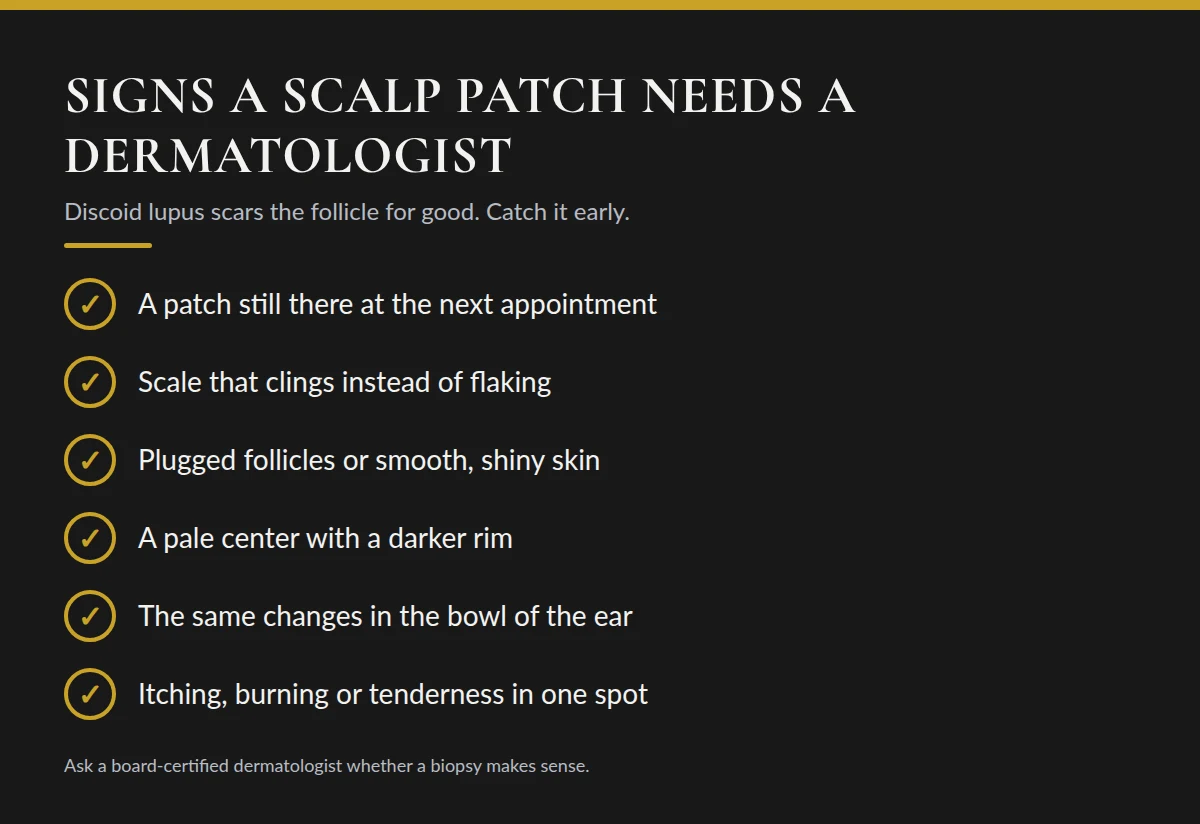
What to watch for:
- A patch still there at the next appointment, or bigger.
- Scale that clings rather than flakes, or follicles that look plugged.
- Smooth, shiny skin where hair used to grow.
- A pale center with a dark rim, or a new dark patch.
- The same changes in the bowl of the ear or on the cheeks and nose.
- Itching, burning or tenderness in one spot.
What to do in the chair:
- Leave a guard on over the patch. No razor, foil shaver or bare blade on it, and no picking or scraping the scale. The AAD warns that touching, rubbing or picking at lupus patches can start new ones, and Joseph’s team notes that DLE can form new lesions where skin is injured. They recommend gentle hair care to limit further scalp damage.
- Disinfect everything afterward, as you would after any scaly patch. Lupus is not contagious, but ringworm is, and nobody can tell them apart by eye.
- Don’t send the client away. A client who keeps coming back is a client someone is keeping an eye on.
- Talk about sun. For a client with a diagnosis who wants to keep a skin fade, a hat and scalp sunscreen matter most in the days after the cut, and a little more length on top is another option.
- Say it privately, without diagnosing. Something like: “That spot at your crown has been there three cuts now, and the color around it has changed. I can’t tell you what it is, but some patches like this scar if they’re left. Get a dermatologist to look at it, and ask whether they’d biopsy it.”
Stylists get an even fuller view on wash days and braid take-downs, section by section. The same watch list applies, and so does the same restraint: keep tension, heat and tools off the patch until a dermatologist has seen it.
The Bottom Line
Discoid lupus is the most common form of skin lupus, several times more common in Black people, and on the scalp it scars the follicle for good. It shows up as a patch with clinging scale and plugged follicles, often pale in the middle with a dark rim, and often with matching changes in the ears. It is easy to mistake for ringworm, CCCA, traction or alopecia areata, and the way to tell them apart is a dermatologist, usually with a biopsy. Sun protection, not smoking and early treatment save the hair that is still there. And the person most likely to spot it first is often the one holding the clippers.
Further reading (sources)
- American Academy of Dermatology on how dermatologists diagnose and treat lupus on the skin
- American Academy of Dermatology with self-care for skin lupus, from sunscreen to quitting smoking
- DermNet for a clinical overview of discoid lupus erythematosus
- DermNet on how scalp ringworm spreads, and why it needs pills
- NHS about lupus as an autoimmune condition that is not contagious
- Drenkard and colleagues on racial disparities in DLE incidence in the Georgia Lupus Registry
- Joseph and colleagues with where DLE appears on Black patients and the damage it leaves
- Nozile, Adgerson and Cohen for a review of cutaneous lupus in skin of color
- Faden and colleagues on neighborhood deprivation, smoking and DLE severity
- Lemos and colleagues for the trichoscopy of discoid lupus on the Black scalp
- Desai and Miteva with recent insight on managing lupus hair loss
- Yadav and colleagues on scalp ringworm that was mistaken for discoid lupus
- Lee, de Gregorio and Tosti with a review of scarring alopecia and skin cancer risk