Acne Keloidalis Nuchae: The Nape Bumps Barbers See First and How to Stop Them Scarring
Published on October 11, 2026
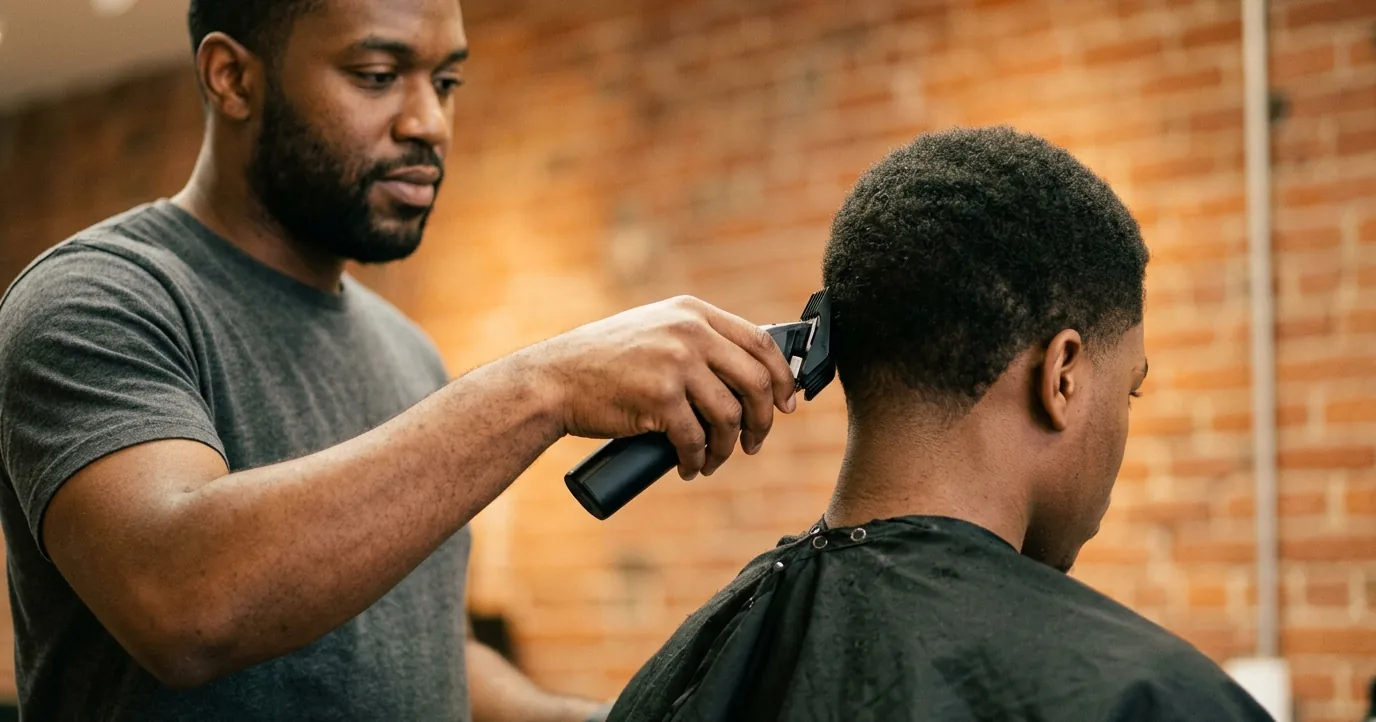
The clipper is halfway up the back of the head when it finds them: a row of small, firm bumps just below the bone at the base of the skull, a couple of them crusted, one that beads a little blood as the guard passes over it. The client calls them razor bumps. He has had them since high school football, they itch for a day after every cut, and he has never had a good look at them, because they sit where no bathroom mirror reaches.
Those bumps often have a name he has never heard: acne keloidalis nuchae, or AKN. The American Academy of Dermatology (AAD) says men of African ancestry carry the greatest risk and that it usually starts between the ages of 14 and 25. It is easy to mistake for razor bumps and easy to ignore, and left alone it can harden into a raised, hairless scar across the back of the hairline. This guide covers how to tell AKN from its look-alikes, why the haircut matters, what a barber should change at the nape, and the treatments dermatologists use to stop it before it scars.
What AKN Is, Despite the Name
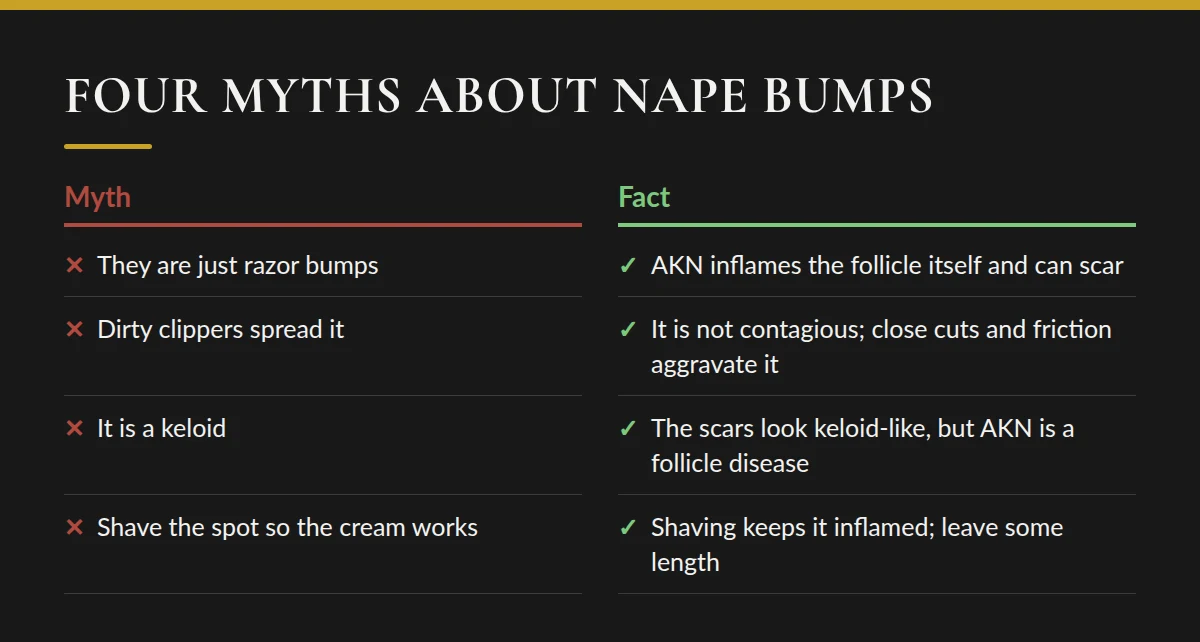
The name gets two of its three words wrong. AKN has nothing to do with ordinary acne, and the raised scars it leaves are not true keloids, according to DermNet, the dermatology reference. Only “nuchae”, the medical word for the back of the neck, is accurate. Dermatologists also call it folliculitis keloidalis nuchae, which is closer to the truth: a long-running, scarring inflammation of the hair follicles at the nape and the back of the scalp. Adebola Ogunbiyi, a dermatologist at the University of Ibadan in Nigeria, notes in a 2016 review that the North American Hair Research Society classes it as a primary scarring alopecia, a form of hair loss that destroys the follicle itself.
It is not a keloid problem in disguise, either. Ogunbiyi stresses that people with AKN are no more prone to keloids elsewhere on the body, and a 1997 Indiana University study of 453 football players found AKN had no link to a personal or family history of keloids. True keloids, the scars that keep growing past the edge of a wound, are a separate condition with its own care.
Men of African descent are most affected, but DermNet notes that men of Hispanic, Middle Eastern, Mediterranean, Asian and Pacific descent can get it too, and that it is about 20 times more common in men than in women. It begins after puberty. Studies of African American men have put its prevalence anywhere from half a percent to 13.6 percent, Ogunbiyi’s review reports, with the high end among football players in helmets. It is not contagious.
The course is predictable if nobody steps in. It often starts as an itch. Small, firm bumps follow along the back of the hairline, sometimes with a pustule among them, and scratching invites infection. Over months and years the bumps can merge into a raised, keloid-like ridge, dark pink to dark brown or black on dark skin. Where that scar forms, the hair stops growing, leaving a smooth band along the hairline. Later on, tufts of several hairs can grow from a single opening, which DermNet calls doll hairs. Advanced cases can form abscesses and tunnels under the skin that drain.
Razor Bumps, Folliculitis or AKN?
In the chair, almost anything raised at the neckline gets called a razor bump. Where it sits and how it behaves tell them apart.
- Razor bumps (pseudofolliculitis barbae) live where the blade goes on the face: the beard line, the cheeks and the front of the neck. A tightly curled hair cut very short grows back into the skin, and letting the beard grow usually settles them. Our razor bump treatment ladder covers them in full.
- AKN sits at the nape and the back of the scalp. Its symptoms flare within hours to days of a haircut, which is exactly why it gets mistaken for razor bumps, but Ogunbiyi notes that early AKN does not show the ingrown hairs that drive razor bumps. The trouble starts in the follicle itself, and growing the hair out helps without curing it.
- Bacterial folliculitis is an infection of the follicle opening: small, tender pustules that tend to clear with treatment. AKN can pick up an infection on top, so a few pustules do not settle the question.
- Helmet breakouts. Friction under a football helmet causes acne mechanica, small breakouts at the nape. In the Indiana study it showed up in 15.5 percent of high school players, while AKN turned up more often in older players, and only in Black players.
- Thick, flaky scale with few bumps points to a different condition, such as scalp psoriasis.
Telling them apart is genuinely hard from behind the chair. In a 2017 University of Oklahoma survey of 50 barbers from 37 shops in Oklahoma City, published in JAMA Dermatology, 78 percent recognized razor bumps from a photograph but only 44 percent recognized AKN, and 30 percent mistook AKN for tinea barbae, a fungal infection of the beard. A dermatologist can usually diagnose AKN by looking. DermNet notes that a biopsy is rarely needed, and a swab or culture can show whether bacteria or fungus are involved.
Why the Haircut Matters
Nobody has proven that a haircut causes AKN, but the research keeps pointing at how close the cut goes and whether it breaks the skin.
Nonhlanhla Khumalo and colleagues at the University of Cape Town found that 86 percent of the men in their studies had their hair cut close to the scalp with clippers. Men who had ever bled during a haircut had about three and a half times the odds of having AKN, and so did men who got crusts or pimples after a cut. The odds peaked between ages 25 and 50, which the authors linked to the popularity of closely shaved styles. They were careful to add that the haircut injuries could be a cause of AKN or a result of it.
A case-control study by dermatologists in Lomé, Togo, comparing 101 people with AKN to 202 without it, found the same pattern more sharply. Very close cropping went with nearly five times the odds of AKN. Bleeding during haircuts went with about 14 times the odds when it happened occasionally and 22 times when it happened at every cut. The authors’ conclusion was plain: limit injury during the haircut.
What does not cause it is a dirty clipper. Many men believe they caught AKN from a barber’s tools, the AAD says, and that is a myth, because AKN is not contagious. The belief runs deep: in a survey of 1,003 men in Ibadan, Ogunbiyi and a colleague found that 42 percent blamed nape bumps on infection from the barber’s instruments.
Clean tools still matter, for a different reason. Active AKN bleeds during haircuts, and Ogunbiyi warns that men who share clippers at the barbershop risk picking up or passing on blood-borne infections such as hepatitis and HIV.

The haircut is not the only source of friction. The AAD lists helmets, hard hats, caps, durags and other head coverings, shirt collars and chains, and notes that extra weight adds folds at the back of the neck that rub together. It says AKN may be most common in Black men who play football in helmets, and is also common among Black men who wear hard hats or durags and those in the military, where short hair is required. A 2016 systematic review from the University of Miami includes the case of a professional football player whose AKN barely responded to treatment during the season, then cleared on its own in the offseason. DermNet’s list of possible contributors also includes some medicines, anabolic steroids and whey protein supplements.
What to Change in the Chair
A barber cannot treat AKN, but the haircut is the one trigger a barber controls. Dermatologists agree on the central change: stop taking the nape down to the skin.
- Leave length at the back. The AAD’s first self-care tip is to let the hair grow and skip haircuts that shave the back of the neck and head. JAMA Dermatology’s patient page on AKN suggests electric clippers on a higher guard setting, or growing the hair out. Neither names a guard number, so let the skin decide: keep a guard on over every bump. A taper that finishes on a guard still looks sharp, while a skin fade takes the nape to bare skin exactly where AKN lives.
- No bare blade at the nape. Keep the razor, the foil shaver and the zero-gapped trimmer off the back of the neck. A natural or tapered neckline needs no blade at skin level. A squared-off, lined-up back does.
- Leave active bumps alone. Ogunbiyi advises men with AKN to skip haircuts while the bumps are active and bleed easily. On a bad week, clean up the top and sides and leave the back.
- Never shave it “so the cream gets in.” Ogunbiyi warns against shaving the area to help a medicated cream absorb, because the shave keeps the irritation going.
- Clean and disinfect between every client. Not because AKN spreads, but because bumps that bleed put blood on the blade. Handle any tool that drew blood the way your state board’s rules require, and keep your clipper sanitation routine tight.
- Hands off. No squeezing, picking or digging. The AAD warns that scratching, picking and rubbing make AKN worse.
- Don’t send him away. Send him on. Nearly half the barbers in the Oklahoma survey said they avoid cutting the hair of clients with AKN. Adjusting the cut keeps him in a chair where someone is watching the back of his head. Then say it plainly: “Those bumps at the back have been there three cuts now. Get a dermatologist to look at them before they scar.”
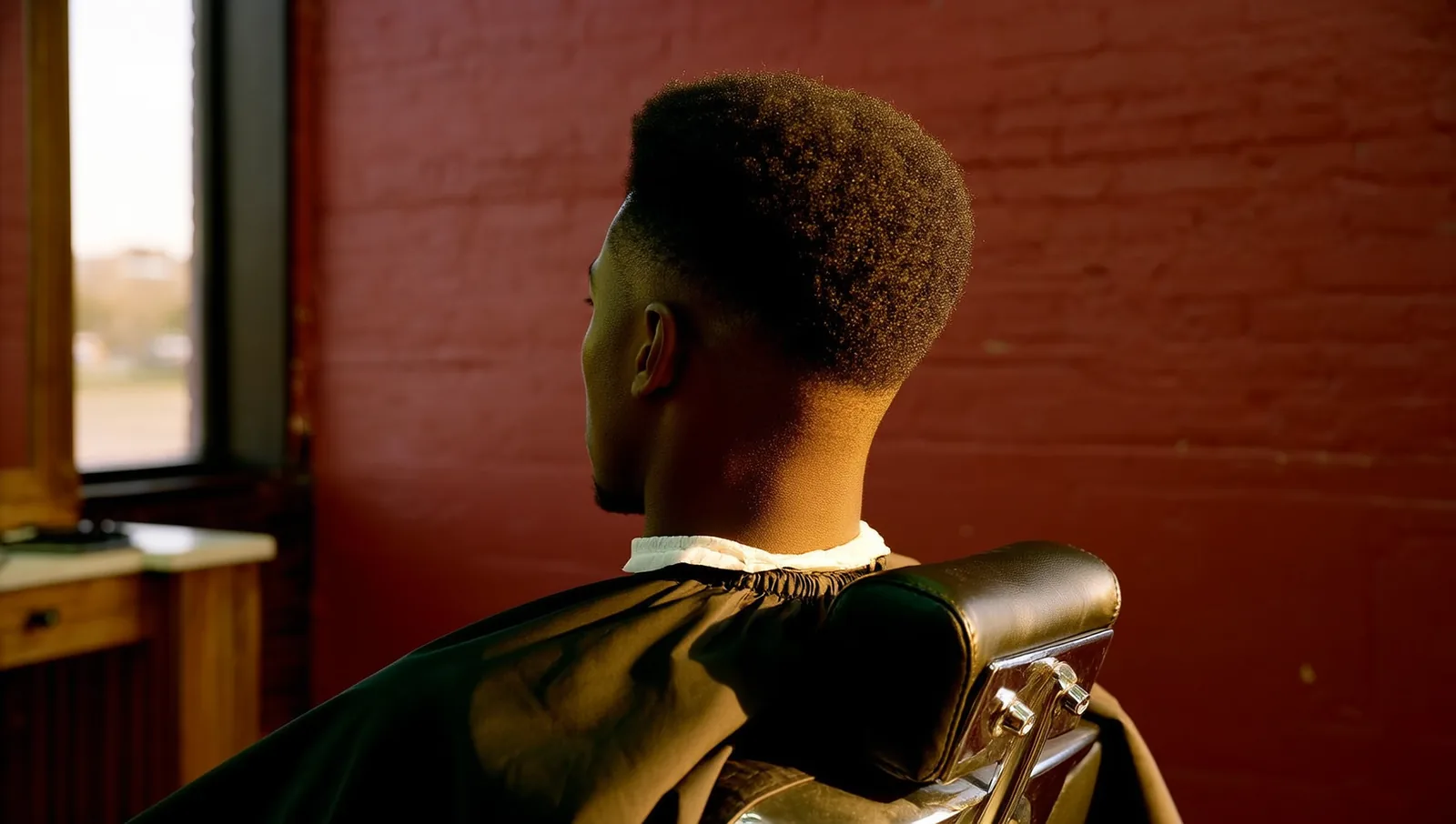
Service members cannot simply grow it out. The AAD says AKN can still be kept under control in the military with medical treatment from a military dermatologist, and a 2020 review by military physicians makes the same point: when grooming standards rule out the main fix, early diagnosis and treatment matter even more.
Why Early Treatment Matters
Once a follicle scars over, it can never grow hair again, the AAD explains, and the hair loss is permanent. The time to act is while the bumps are still small and separate.
In 15 years of clinic records at the University Hospital of the West Indies in Kingston, Jamaica, patients who had had AKN for more than five years had about seven times the odds of keloid-like plaques. Treatment results follow the same curve. In a pilot laser study at Cairo University, early cases improved significantly more than late ones, and in a trial at Henry Ford Hospital in Detroit, laser worked well on small bumps but brought limited improvement to larger plaques and nodules.
The Dermatology Treatment Ladder
AKN can be stubborn. DermNet notes that there are no consensus treatment guidelines, and when University of Southern California researchers reviewed six years of records for 101 patients in the Los Angeles County hospital system, most improved, but very few cleared completely. What works best is a combination, built up in rungs, with self-care running alongside every one of them.
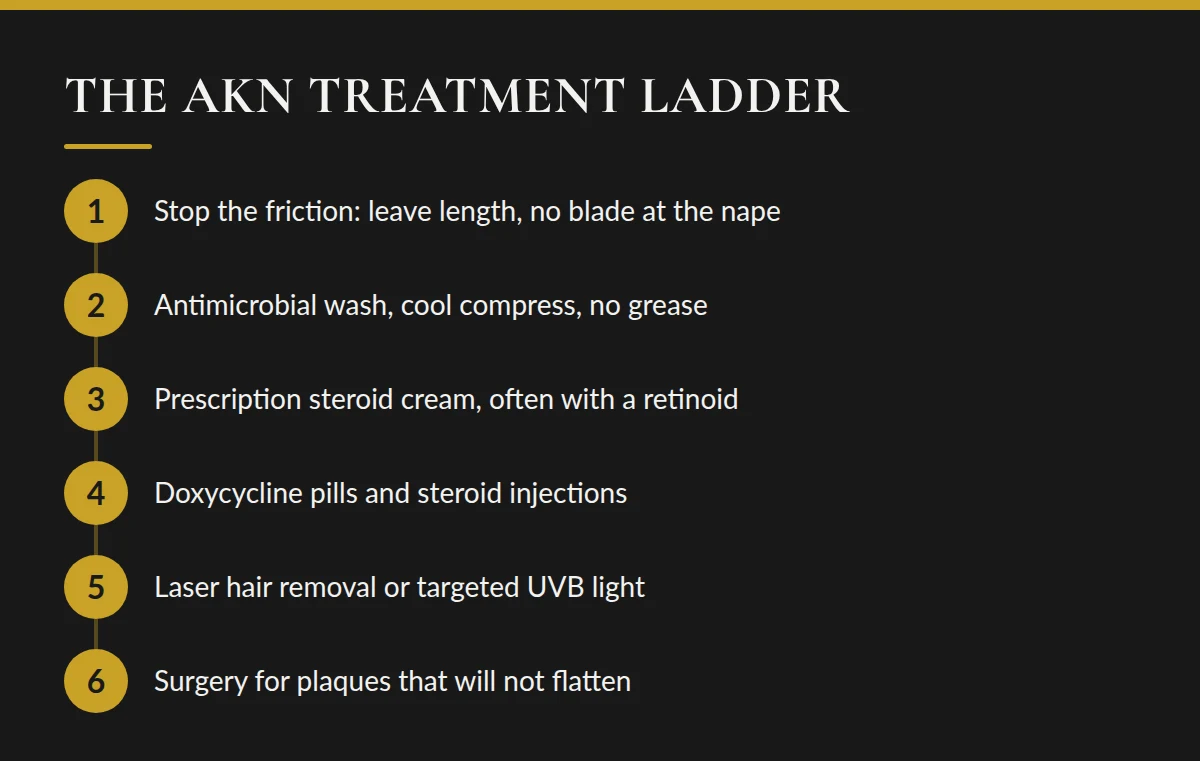
Rung 1: Stop the irritation and clean the skin. Start with the haircut changes above, then the rest of the AAD’s self-care list: collarless shirts and jackets, nothing worn around the neck, and hats that stop short of the bumps. Wash gently with a cleanser containing benzoyl peroxide or chlorhexidine, hold a cool, damp washcloth on the area for 10 minutes when it itches, and stop using pomade or hair grease there. Keep the back of the neck cool and dry, because heat and sweat irritate it.

Rung 2: Prescription creams. For mild to moderate AKN, DermNet describes a high-potency steroid cream, often paired with a retinoid such as tretinoin or adapalene, reviewed every four to six weeks and tapered once it works, usually within six to twelve weeks. When pustules are present, a topical antibiotic such as clindamycin with benzoyl peroxide is sometimes added.
Rung 3: Pills and injections. For moderate to severe disease, DermNet describes a course of doxycycline for at least six to eight weeks, alongside steroid creams or steroid injections into the firm bumps. Ogunbiyi describes triamcinolone injections given every four weeks. Stronger doses work faster but can thin the skin or leave light spots, and the light spots usually fade. Injections generally wait until any infection has cleared. In the Los Angeles records, clindamycin and clobetasol were the most prescribed creams, doxycycline the most prescribed pill, and steroid injections were common. If none of that is enough, DermNet lists isotretinoin as a step up.
Rung 4: Laser and light. Laser hair removal treats AKN by destroying the follicles that keep the inflammation going, so expect less hair wherever it is used. The long-pulsed 1,064 nm Nd:YAG and 810 nm diode lasers, both hair removal lasers, are among the most studied, along with the CO2 laser, which cuts or vaporizes the bumps instead. The University of Miami review found 82 to 95 percent improvement within one to five sessions, with brief redness and mild burning as the usual side effects, though most of the studies were case reports and small case series. In the Detroit trial, 13 patients had laser on one side of the scalp, and both sides got a steroid cream. Among those with small bumps only, the laser side improved by 59 percent, against 30 percent with the cream alone. Targeted UVB light is another option. In a small split-scalp study at Johns Hopkins, it cut lesion counts by about half over 16 weeks. As with any laser on dark skin, choose a clinician experienced in treating it.
Rung 5: Surgery for plaques. When a keloid-like plaque will not flatten, surgeons cut it out. A 2025 systematic review from UT Southwestern pooled 16 studies covering 99 patients. AKN came back in 19 percent, but it could be managed without another operation. About 11 percent developed thickened scars, mostly after the wound was stitched closed, infections were rare at about 3 percent, and patients were consistently satisfied. One established method removes a horizontal strip that includes the lowest part of the back hairline and lets the wound heal on its own. In an early series from Los Angeles it gave the best results, and the University of Miami review notes those wounds took six to eight weeks to close. For the most stubborn cases, DermNet lists radiotherapy as an add-on.
Skip the home remedies. In the Ibadan survey, 71 percent of men who had had the bumps treated them themselves, with antibiotics, steroid preparations, engine oil and traditional leaves. Ogunbiyi’s review says attempts to shrink the bumps with acids, corrosives or car engine oil lead to larger lesions or unsightly scars.
When to See a Dermatologist
Go early. Any of these is reason enough:
- Bumps at the nape that return after every cut, or that are still there a cut or two later.
- Bumps that bleed when the clipper or the comb passes over them.
- Firm bumps joining into a ridge, a smooth bald band forming along the hairline, or tufts of several hairs growing from one spot.
- Bumps spreading upward over the back of the scalp.
- Fever, chills, pain or a rash that is getting worse. The JAMA Dermatology patient page says these need immediate care, because they can signal infection.
The Bottom Line
AKN is not razor bumps, not acne and not a keloid. It is a scarring condition of the follicles at the back of the head, and the barber is often the first person to see it. The changes in the chair are simple: leave length at the nape, keep blades off the bumps, skip the back when it bleeds, and disinfect every tool. The rest belongs to a dermatologist, and sooner is better. Small bumps respond to creams, injections and lasers, old plaques need surgery, and a follicle that has scarred never grows hair again.
Further reading (sources)
- American Academy of Dermatology on what triggers acne keloidalis nuchae, and the dirty-clipper myth
- American Academy of Dermatology with seven self-care tips that keep AKN from worsening
- DermNet for folliculitis keloidalis, from its look-alikes to stepped treatment
- Olagun-Samuel, Manduca and Adotama on the JAMA Dermatology patient page for AKN
- Ogunbiyi with a review of AKN’s prevalence, impact and management challenges
- Adotama and colleagues on what 50 Oklahoma City barbers knew about razor bumps and AKN
- Khumalo, Gumedze and Lehloenya for haircut bleeding and the odds of AKN
- Saka and colleagues with a case-control study of AKN risk factors in Togo
- Ogunbiyi and Adedokun on what 1,003 Nigerian men believed causes nape bumps
- Knable, Hanke and Gonin for AKN and helmet breakouts in football players
- Brahe, Peters and Meunier with AKN under military grooming standards
- East-Innis and colleagues on how keloid-like plaques track with years of disease
- Maranda and colleagues for a systematic review of AKN treatments
- Esmat and colleagues with a pilot study of laser hair removal for AKN
- Woo and colleagues on a split-scalp trial of Nd:YAG laser with steroid cream
- Okoye and colleagues for targeted UVB light in a split-scalp study
- Smart, Rodriguez and Worswick with how 101 Los Angeles patients were treated
- Hinson and colleagues on outcomes of surgery for AKN
- Glenn, Bennett and Kelly for excision with healing by second intention