Chemo Hair Loss and Black Women: Scalp Cooling, Regrowth, and the Gap in the Research
Published on August 31, 2026
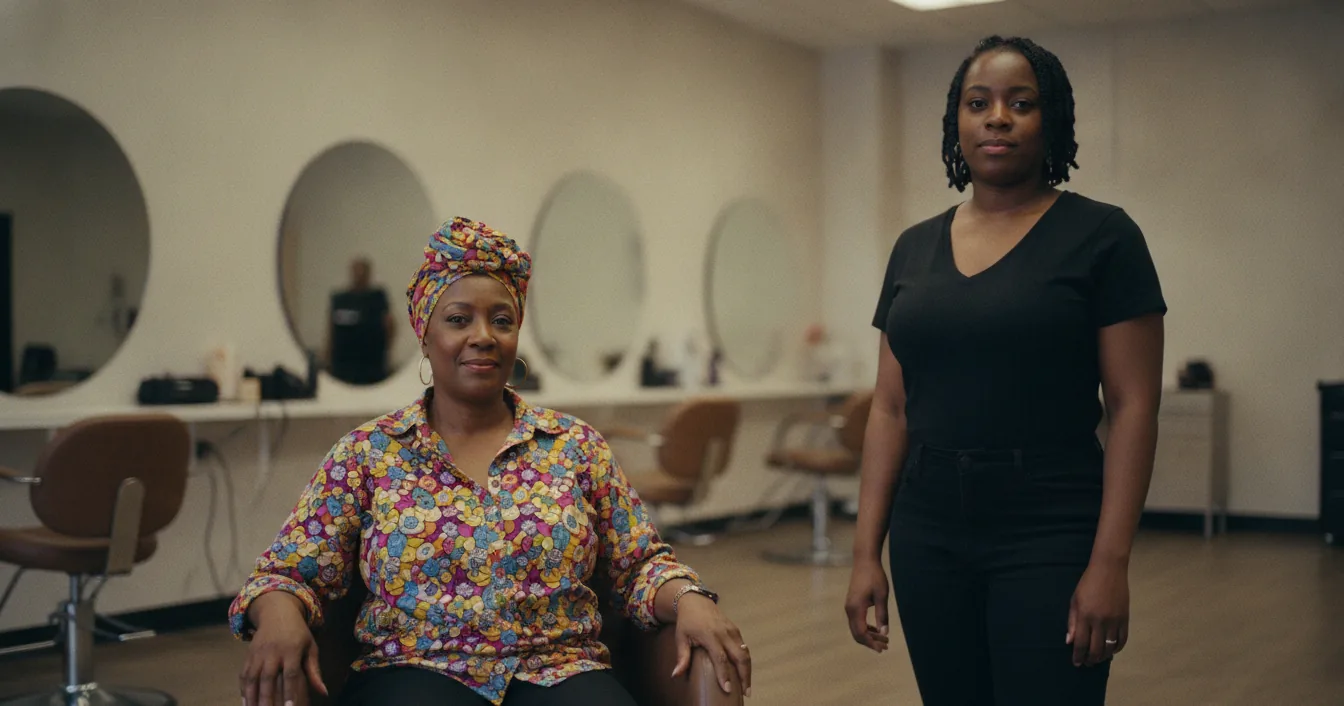
It usually comes out quietly, near the end of the appointment. The chemotherapy finished more than a year ago, and the hair still has not come back the way it was. Almost everyone going into treatment is told to expect hair loss. Far fewer are told that for some patients it never fully reverses, that there is a technology designed to prevent it, and that the technology has been tested almost entirely on hair nothing like theirs. That last part is the real disparity here, and it is not the one the headlines usually describe.
What Persistent Chemo Hair Loss Actually Is
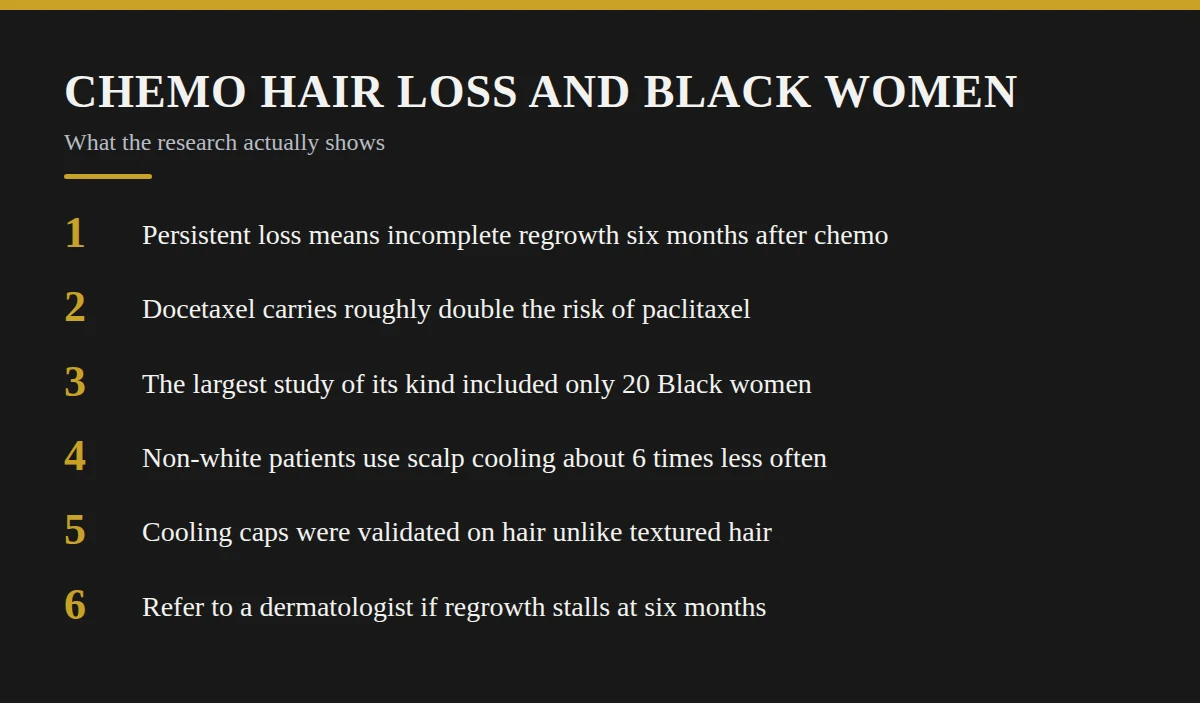
Hair loss during chemotherapy is expected, and for most people it is temporary. The follicle is not destroyed; it is stunned. Persistent chemotherapy-induced alopecia, shortened to PCIA, is what dermatologists call it when regrowth is still incomplete six months after treatment ends. Reported incidence swings widely across studies, from under 1 percent to more than 40 percent, because regimens, doses, and measurement methods all differ. Among breast cancer survivors specifically, one review puts it near 30 percent still affected three years out.
The drug matters more than almost anything else. Taxanes carry the highest risk, and within that class the split is sharp: roughly 23 percent of patients treated with docetaxel develop PCIA, against about 10 percent on paclitaxel. Busulfan, used to condition patients for stem cell transplant, sits around 19 percent cumulative incidence.
It also does not always look the same. Reviews describe two dominant patterns, split nearly down the middle: a diffuse thinning across the whole scalp in about 53 percent of cases, and a pattern that mimics androgenetic alopecia, concentrated at the crown and part, in about 46 percent. Under a dermatoscope a clinician sees thinning, miniaturized hairs, and yellow dots. Importantly, PCIA is a non-scarring loss, which puts it in a different category from the scarring alopecias that permanently destroy the follicle. The follicles are still there. They are underperforming, which is why treatment is worth pursuing rather than accepting.
The Disparity Is Not Where You Would Expect
A prospective cohort published in JAMA Network Open followed 304 women with stage I to III breast cancer at two tertiary cancer centers, one in the United States and one in South Korea, measuring hair density and shaft thickness with trichoscopy before chemotherapy and again twelve months after it ended. PCIA was defined as density or thickness falling more than two standard deviations below each patient’s own baseline, which is a far more rigorous standard than asking someone whether their hair looks thinner.
The results ran against the assumption most people bring to this subject. Incidence was highest in Asian women at 42.1 percent, then white women at 22.2 percent, then Black women at 10.0 percent, and lowest in Hispanic and Latina women at 5.1 percent. Asian participants also reported the steepest rise in alopecia-related distress, particularly in the emotional and activity-related domains.
So Black women were not, in this cohort, at elevated risk of persistent loss. But read the sample before drawing comfort from that. Of the 304 participants, only 20 were Black. Twenty women. A subgroup that size cannot settle anything, and a 10 percent figure drawn from it should be treated as a signal rather than a number to plan around. That thinness is itself the finding worth carrying: the largest multiracial study of its kind still could not say much of substance about Black patients.
The disparity that is well documented sits one step earlier in the process, in prevention.
Scalp Cooling, and Why It Has Underserved Black Patients
Scalp cooling works on a simple premise. A cap circulates coolant across the scalp before, during, and after infusion, dropping skin temperature to somewhere around minus one to minus four degrees Celsius. Blood vessels constrict, less chemotherapy reaches the follicles, and follicular metabolism slows. It is genuinely effective for many patients, and it is the only widely available prevention that exists.
At one United States institution, non-white patients receiving chemotherapy for breast cancer were roughly six times less likely to use scalp cooling than white patients. Researchers followed that gap with hour-long interviews with Black women undergoing chemotherapy, and two barriers came up repeatedly: almost no representation of Black women in scalp cooling marketing, and genuine doubt about whether the caps work on textured hair.
That doubt is not unfounded. A study in The Oncologist enrolled 15 Black patients on a Paxman scalp cooling protocol and closed early for lack of efficacy. Only one participant avoided significant hair loss. Most stopped before finishing chemotherapy because they had already crossed into grade 3 alopecia, meaning more than half their hair was gone.
The representation problem in the underlying evidence explains a great deal. The pivotal SCALP trial enrolled 182 patients, 12 percent of them Black. A Dutch registry of 1,411 patients included roughly 1 percent with African hair texture. Devices, cap designs, and protocols were all validated on a population that barely included the hair type in question.
There is also a plausible mechanical explanation, and it is one every stylist will recognize immediately. Standard protocol calls for wetting the hair before the cap goes on. Textured hair wet with water alone expands. That volume props the cap off the scalp, and cooling that never reaches the skin cannot protect the follicle. The problem may be less about biology than about a cap designed around hair that lies flat when wet.
What Improves the Odds
Case reports have started working out how to prepare textured hair so the cap actually makes contact, and the technique is squarely in a stylist’s wheelhouse. In a documented case involving a woman with type 3 hair going through four cycles of docetaxel and cyclophosphamide, the preparation went like this: part the hair down the middle and distribute it evenly, work a thick conditioner all the way through, then add water with a spray bottle to create an emulsion that carries down to the roots. The conditioner and water combination decompresses the hair instead of swelling it. Then set the hair in small, loose twists to lie as flat as possible under the cap.
That patient held at grade 0, meaning no visible loss, through two cycles, slipped to grade 1 (thinning visible only on close inspection) by cycle three, and stayed stable through cycle four. A separate case report of a Black woman describes the same principle, wetting with the recommended conditioner immediately before the cap to decompress the hair, plus keeping the hair in twists and finger-combing rather than brushing between cycles, and avoiding heat and relaxers entirely for the duration.
None of that is a guarantee, and one case is not evidence of a rate. But it points at something useful: the failures may be partly a preparation problem, and preparation is something a stylist or barber can meaningfully help with.
What Regrowth Looks Like
Hair that comes back after chemotherapy often comes back different. Texture, curl pattern, and color can all shift, sometimes temporarily and sometimes for good. New growth is fine, sparse, and fragile, and on Type 4 hair that fragility compounds an existing structural reality, since textured hair already breaks preferentially at the bends in the coil. Regrowth is the worst possible moment to reach for tension or chemistry.
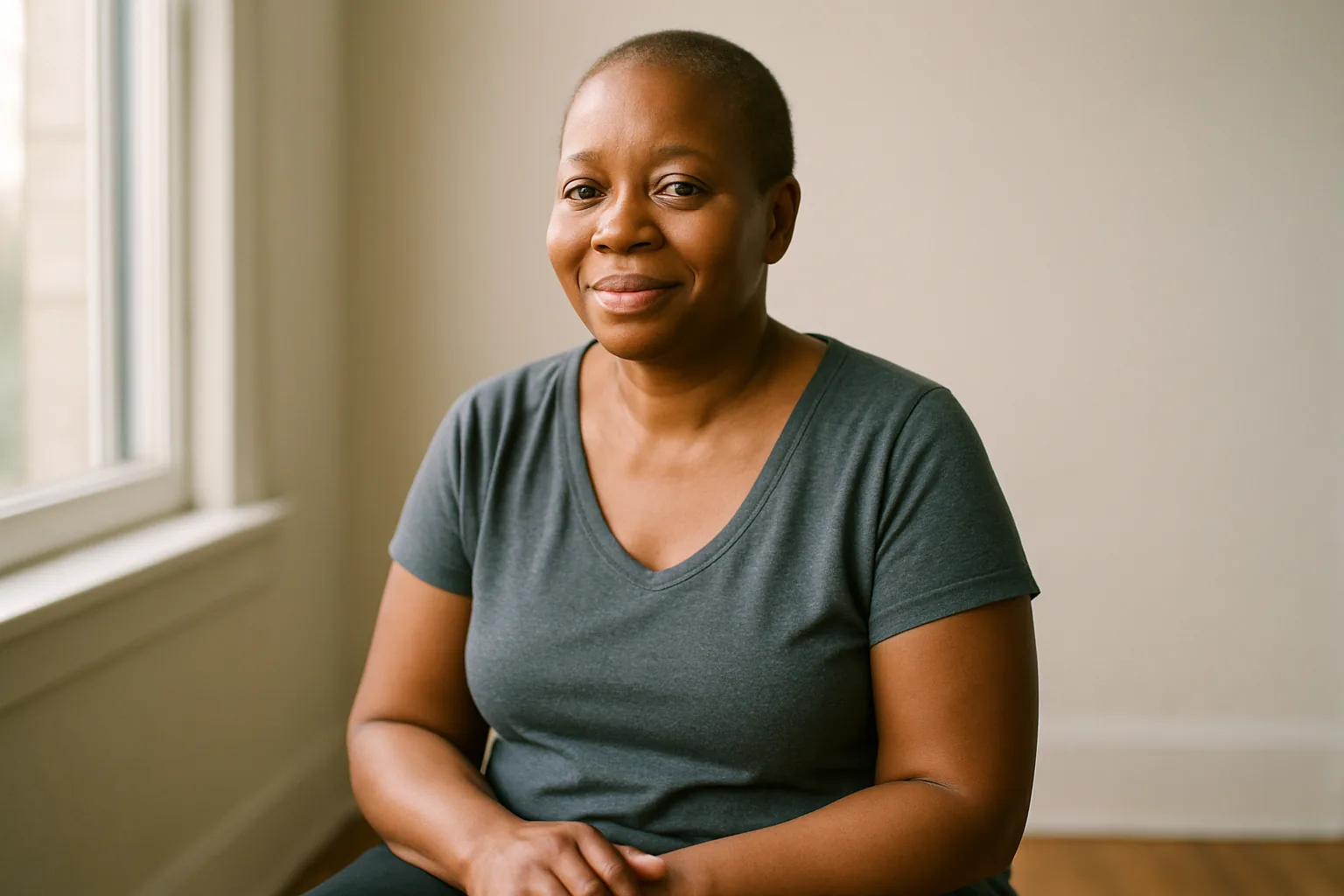
The practical rules for that first year are unglamorous and they work. No relaxers, no permanent color, no high heat. Nothing that pulls: no tight braids, no sew-ins, no edge-gripping styles. Detangle wet and with conditioner, in sections, from the ends up. Cut to shape rather than trying to grow past an awkward stage, because a deliberate short cut reads as intentional in a way that thin length never does. Satin at night. Wigs and headwraps are fine, and a satin-lined one is kinder than a cotton one.
When It Is Not Only the Chemotherapy
This is the part clinicians outside dermatology miss most often. A Black woman who does not regrow well after chemotherapy may have a second process running underneath. Central centrifugal cicatricial alopecia is common in Black women, frequently silent in its early stages, and it destroys follicles permanently. Years of tension may also have already thinned the hairline through traction alopecia. Chemotherapy can strip away the density that was hiding either one.
The distinction matters enormously, because non-scarring loss can be treated and scarring loss cannot be reversed. That is a dermatologist’s call, ideally one experienced with textured hair, and it usually needs a scalp exam and sometimes a biopsy. If regrowth stalls at six months, that referral is the next step rather than another bottle of oil. Anyone still carrying the common myths about what makes hair grow will lose months to products first.
Treatment for PCIA itself is real if modest. Topical minoxidil 5 percent is the usual first line. Low-dose oral minoxidil, typically 1.25 to 5 milligrams, is increasingly used. Spironolactone combined with minoxidil has shown moderate improvement in around 60 percent of patients in one series, but it carries an important caveat for anyone with a hormone-sensitive tumor and must be an oncologist’s decision, not a dermatologist’s alone. Transplantation is reserved for cases that have gone stable.
What the Chair Can Do
Most of this is out of a barber’s hands. Two things are not.
The first is a two-sentence conversation. When a client mentions upcoming chemotherapy, telling them scalp cooling exists and is worth raising with their oncology team may be the only time they hear it. Patients in those interviews specifically asked for better counseling on scalp cooling, camouflage options, and dermatology referrals, which is a polite way of saying nobody had walked them through any of it.
The second is the room itself. Hair loss during cancer treatment is not a cosmetic footnote; it is the part of the diagnosis everyone can see, and the distress it causes is measurable. The shop has always done work that goes past the haircut, which is why training barbers as mental health first responders has taken hold in Black communities. A chair where somebody can sit in a headwrap and not have to explain themselves is worth more than any product on the shelf.
The Bottom Line
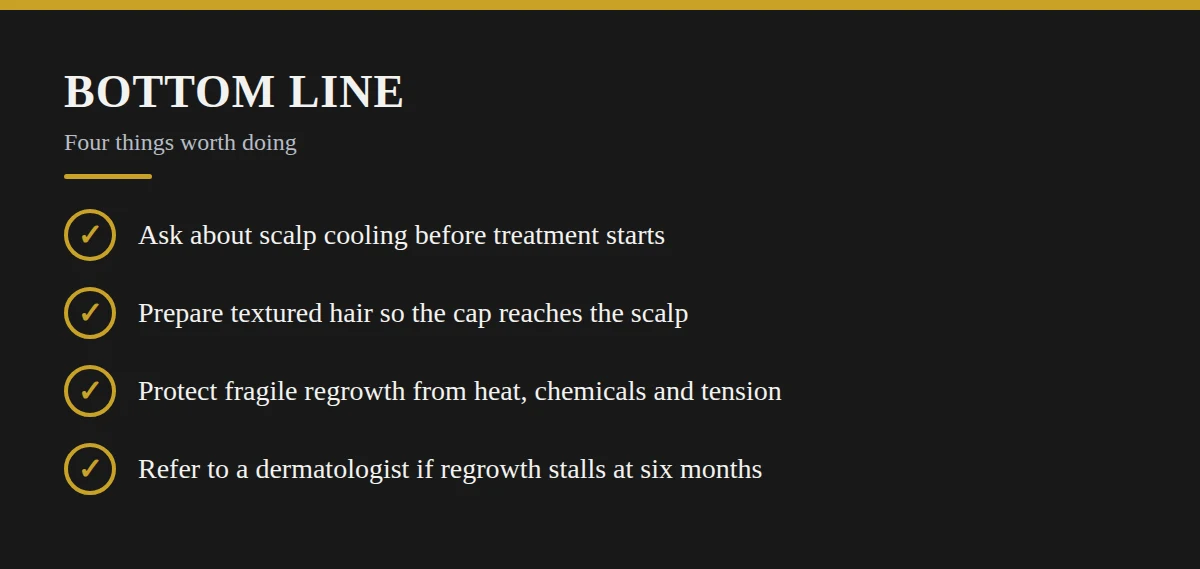
The honest summary is not that Black women lose more hair to chemotherapy. On the best current data, they do not. It is that the science has barely studied them, the one available prevention was designed and validated on hair unlike theirs and then underperformed accordingly, and almost nobody is having the conversation with them beforehand. Twenty participants in the largest study of its kind is the whole problem in a single number. Until that changes, the useful work is smaller and closer to home: ask about scalp cooling before treatment starts, prepare textured hair properly if the cap is used, protect fragile regrowth afterward, and refer at six months if the hair has not returned.
Sources
- JAMA Network Open on racial and ethnic differences in persistent chemotherapy-induced alopecia
- Supportive Care in Cancer for interviews tracing why Black patients use scalp cooling far less
- The Oncologist with a trial that closed early over scalp cooling efficacy in Black patients
- JAAD Case Reports on preparing type 3 hair so a cooling cap reaches the scalp
- Journal of the American Academy of Dermatology for an overview of hair disorders in cancer survivors
Further reading
- American Cancer Society on what to expect from hair loss during cancer treatment
- Skin of Color Society for dermatology resources on hair and scalp conditions in skin of color
- Peer-reviewed research on the SCALP randomised trial of scalp cooling during chemotherapy
- Peer-reviewed research for scalp cooling and alopecia outcomes after breast cancer chemotherapy