Postpartum Shedding and Black Hair: What Is Normal, What Is Not, and How to Style Through It
Published on September 23, 2026

It usually shows up on wash day, somewhere around the three-month mark. The baby has started sleeping in longer stretches, you finally have an afternoon for your hair, and the first pass through a conditioned section comes back wrapped in more hair than you have ever seen leave your head. The edges that stayed full all through pregnancy look thin. Nobody mentioned it would look like this.
Most of the time this is postpartum shedding, and it passes. But Black women face a complication most postpartum advice skips: a thinning hairline after a baby can also be traction alopecia that the shedding has exposed, and the long-wear braids and slicked ponytails that make a newborn schedule workable can turn a temporary shed into permanent loss. Here is why the shedding happens, when it should stop, the signs that point somewhere else, and how to style and wash through it. None of it is a diagnosis; a board-certified dermatologist who knows textured hair is the person who confirms what is happening on your scalp.
Why the Hair Waits Until After the Baby
Every hair on your head runs its own cycle: a growing phase that lasts years, a brief transition, then a resting phase of about three months, after which the old hair falls and a new one starts behind it. The follicles are normally staggered, so you lose up to 100 hairs a day without noticing.
Pregnancy breaks the stagger. Hormonal changes hold more follicles in the growing phase for longer, which is why some women say their hair grows faster and stronger while they are expecting. After delivery those hormones fall (the American Academy of Dermatology points to dropping estrogen), the backlog of held hairs moves into the resting phase at roughly the same time, and a few months later they let go together. Dermatologists call it telogen effluvium. The AAD is plain that it is not true hair loss: the follicles are intact, the hair comes back, and you do not have to do anything to fix it.
How common it is depends on how you count. In a survey of 331 Japanese mothers, 91.8 percent reported at least some postpartum hair loss, though women bothered by shedding may have been likelier to reply. A comprehensive review of telogen effluvium puts the dramatic, molt-like version at about 20 percent of women, mostly after a first delivery. Another review found no published data that clearly showed postpartum women shedding more than pregnant ones. Some extra shedding is close to universal, a frightening amount is not guaranteed, and the science is thinner than the reputation, which is one more reason not to write off every postpartum thinning as hormones.
Breastfeeding is not a settled culprit either. The Japanese survey linked breastfeeding past six months with more shedding, while a Turkish study that measured the hair cycle in 116 women found breastfeeding mothers had fewer resting hairs at four months, not more. Neither finding is a reason to change how you feed your baby.
The Timeline, Month by Month
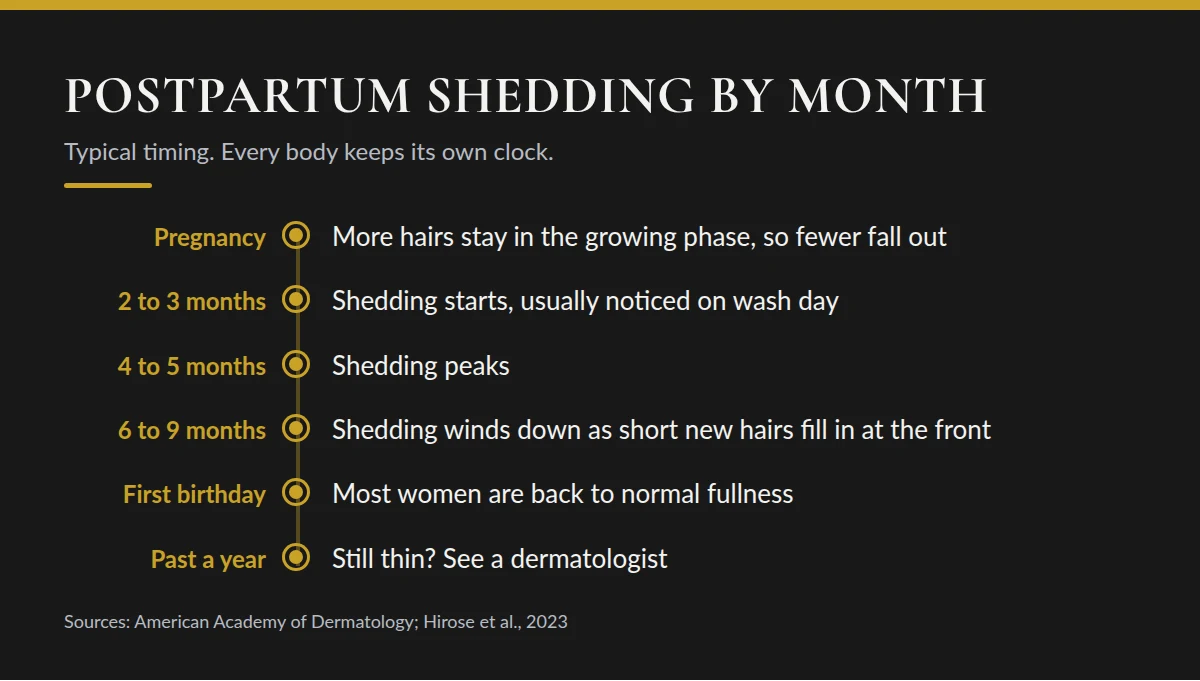
The AAD says shedding usually peaks about four months after the birth, and most women are back to normal fullness by the child’s first birthday, often sooner. The Japanese mothers described a similar arc: shedding started at an average of 2.9 months, peaked at 5.1 and ended around 8.1. The heavy phase itself usually lasts a couple of months and rarely becomes chronic.
Regrowth arrives before fullness does. As the shedding eases, short new hairs come in along the front hairline, and on coily hair the coil shrinks them into a fuzz that takes months to blend in. Those short hairs are the good news, so treat them gently.
The rule for when to stop waiting also comes from the AAD: if your hair has not regained its normal fullness by your child’s first birthday, see a dermatologist, because something else may be causing it.
Why It Looks Worse in Type 4 Hair
Straight hair drops a shed strand wherever you happen to be standing. Coils hold on to it. A hair that lets go on Tuesday stays wound into its neighbors until the next time you detangle, so a week of shedding arrives all at once. At the ordinary rate of up to 100 hairs a day, a weekly wash can surface several hundred hairs before postpartum shedding adds a single one. No wonder 90 percent of the Japanese mothers with shedding said they noticed it while washing.
Protective styles magnify the effect. Braids or twists installed late in pregnancy tend to come down just as the shedding ramps up, releasing every hair that shed while the style was in. That pile is saved-up shedding rather than a new disaster, though take-down is also the best moment to look closely at your edges.

It helps to check what came out. A hair shed from the root is full length and ends in a tiny bulb, what dermatologists call a club hair. Short pieces with no bulb snapped somewhere along the shaft, which is breakage: a moisture and handling problem rather than a hormonal one.
Normal Shedding, or Something Underneath It?
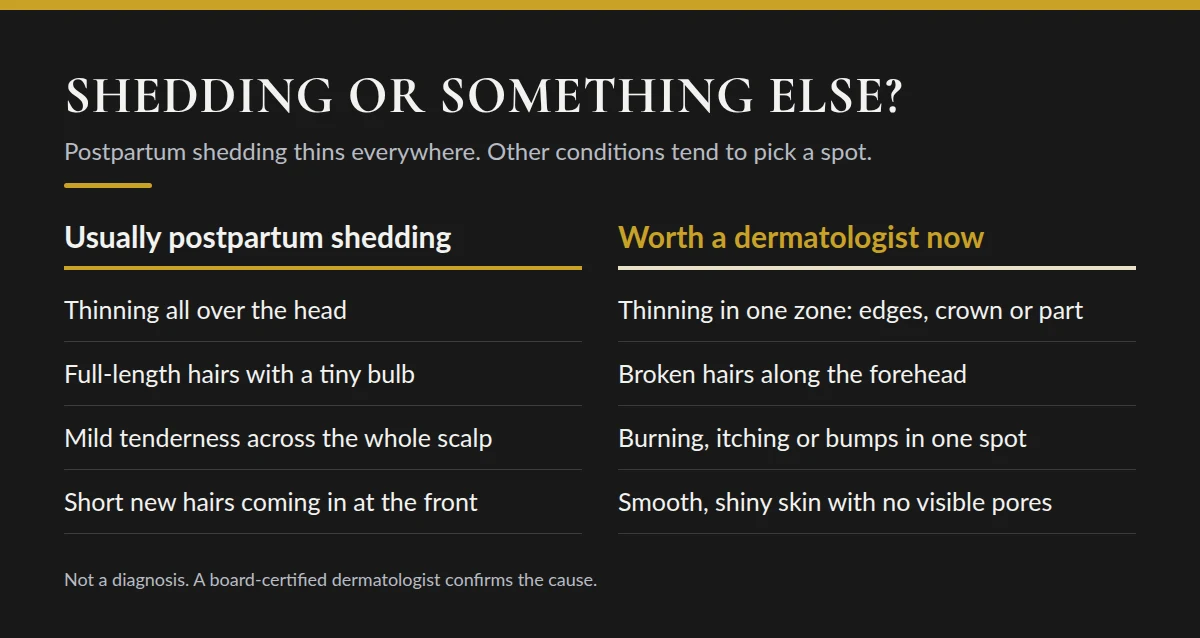
Postpartum shedding is diffuse. It thins the whole head a little, so your puff feels smaller and the part may look slightly wider everywhere. Some women feel mild tenderness or tingling across the scalp while it happens, a symptom dermatologists call trichodynia. What shedding does not do is carve out one zone.
Here is the part that matters most for Black women: shedding can expose a second condition that was already there. When dermatologists in Cairo examined 200 women with postpartum hair loss, clinically and under a dermoscope, only 19 had shedding alone. Most also had pattern hair loss, and about a third had traction alopecia. That is one group of women in Egypt, but a case series from California describes the same thing: three women whose postpartum shedding revealed traction alopecia that had been building quietly under their styles. A hairline thinned by tension can hold together until the shed strips away its last margin.
See a dermatologist without waiting for the first birthday if you notice:
- Thinning where a style pulls. The edges, the temples, around the ears or along part lines, especially a thin line of short hairs at the very edge with a sparse band behind it. That is the classic traction alopecia pattern, and it is reversible only while it is early.
- A crown spot that keeps widening, particularly with itching, burning or small bumps in that one area. That is the profile of CCCA, the most common scarring hair loss in Black women, and it does not belong in the wait-and-see column.
- Smooth, shiny skin with no visible pores. Scarring has started there, and scarred follicles do not regrow.
- A part that was widening before the pregnancy, or that does not recover once the shedding stops, which usually points to pattern hair loss.
- A clean, round bald patch. That is not shedding at all.
- Shedding that runs well past the timeline. Both an overactive and an underactive thyroid can cause telogen shedding, and postpartum thyroiditis affects about 1 in 20 new mothers. Heavy blood loss is a trigger in its own right, so ask about iron too, although researchers still argue over how much low iron alone drives shedding.
Before any blood draw, mention a hair, skin and nails gummy if you take one. The review literature does not support biotin for shedding, and in a small trial published in JAMA, a week of 10 milligrams a day (a common over-the-counter dose) threw off 9 of 23 biotin-based lab assays on a panel that included thyroid and ferritin tests. The complete hair loss guide covers each of these conditions in more depth.
The worry deserves attention too. Almost three in four of the Japanese mothers with shedding said it made them anxious or stressed, and those with the heaviest shedding were more likely to screen positive for anxiety. If your hair is weighing on you, raise it at your postpartum visit. It is a fair question, and one of the few worries of those months that usually ends well.
The Install Trap
The first months with a newborn are exactly when a long-wear install looks most appealing: knotless braids that last eight weeks, a sew-in, a glued unit, a slick ponytail that takes two minutes. They are also when the hairline can least afford tension. Around the peak, a larger share of your hair is resting hair on its way out, and the regrowth at the edge is short and fine. Extensions anchored there hang their weight on fewer strands.
Traction alopecia starts out reversible and ends permanent. The AAD describes the late stage as shiny, bald skin where the hair cannot grow back. So the rule for these months is not “never braid.” It is to take the tension out:
- Go bigger, shorter and lighter. The AAD advises thicker braids and locs, shorter lengths because longer hair is heavier and pulls more, and taking braids out within six to eight weeks.
- Leave the edges out. Ask your braider to start the front sections behind the hairline. Our guide to protective styles that actually protect covers install day and the rest period.
- Sew rather than glue. The AAD prefers sewn-in weaves to bonded ones, worn for short stretches and removed at once if they hurt or irritate the scalp.
- Treat pain as the stop signal. Pain, stinging, crusting or tenting (the scalp pulled up in little peaks) all mean the style is too tight. Ask for it to be redone, not endured.
- Rest between installs, and check your hairline once a month for broken hairs along the forehead or an edge that is creeping back.
Low-Tension Styles for Thinning Edges
The goal for the next several months is a style that asks nothing of the hairline.
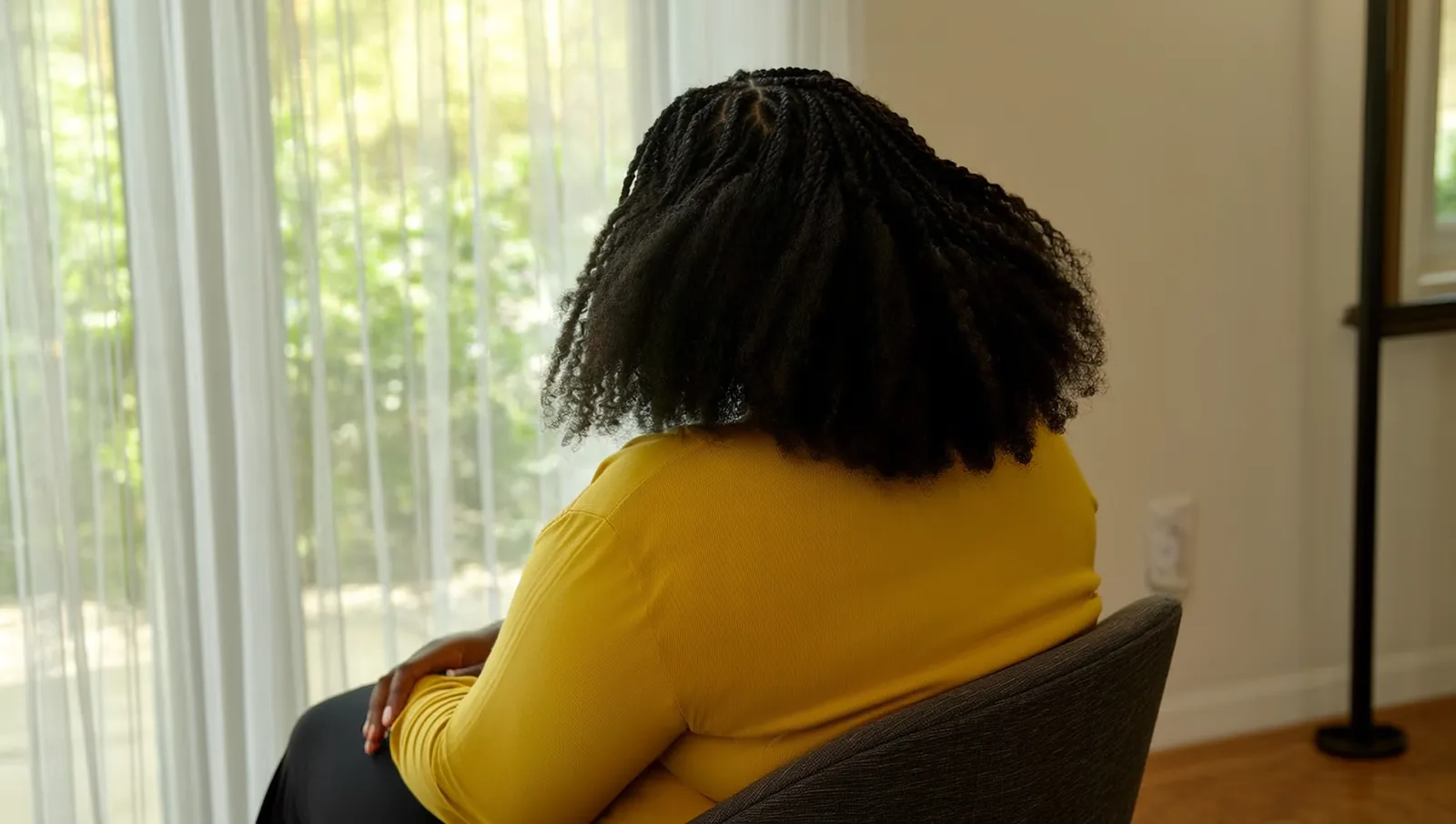
- Big and loose. Twist-outs, braid-outs, wash-and-gos and chunky two-strand twists spread the load across the whole head instead of anchoring it at the edge.
- Soft puffs. A puff held with a fabric scrunchie or a loose satin band is a different style from one wrenched into a tight elastic, even if the two look alike in a photo.
- Let the baby hairs be. Edge control brushed flat every morning works the most fragile hair on your head, which is also the new growth you are trying to keep.
- Wigs without glue. The AAD counts wigs and scarves as a way to give hair a break while it recovers, but glue on the hairline and a tight band undo that. Wear loose cornrows or a flat wrap underneath and a satin-lined cap.
- Consider going shorter. The AAD notes that many new mothers prefer short hair, that a short style can make hair look fuller, and that it saves time. A tapered natural cut from a barber who knows textured hair is about the lowest-tension style there is. Ask for the shape to follow your hairline where it stands; a sharp line-up pushed into a thinning temple trades a crisp week for a weaker edge.
- Sleep on satin. A satin bonnet or pillowcase cuts friction overnight, and a bonnet keeps loose shed hairs contained.
Wash Day Adjustments
Washing does not cause postpartum shedding; it collects it. Resting hairs will come loose at the next detangle whatever you do, so stretching the gap between washes only makes the pile bigger and the knots worse. Keep your usual schedule and change the handling instead.
- Detangle with more slip than you think you need. Fingers first, in sections, from the ends up, with the hair soaked in conditioner. The Type 4 wash day guide lays out the full order.
- Keep heavy product off the scalp. The AAD’s tips for new mothers (a volumizing shampoo and a light conditioner kept mostly to the ends) were written with fine, straight hair in mind. What carries over to coils is keeping thick creams and butters off the roots, where they weigh down thin areas and build up, while you keep conditioning the lengths every wash.
- Go easy on heat and chemicals. Neither causes the shedding, but breakage on top of it doubles what lands in the sink. If you press or relax, this is the season to stretch the interval and turn the temperature down.
A Safety Note for the Nursery
The AAD flags one more postpartum hair issue, and it has nothing to do with your scalp. A shed hair can wrap around a baby’s toe, finger or another body part tightly enough to cut off circulation, which is called a hair tourniquet. It is rare. If you find one, look for a loose end and unwind it gently, or cut it carefully; if it is wound too tight or embedded in the skin, call your baby’s doctor or go to the emergency room. With a week of shed hair stored in a coily head, a bonnet at night and a glance at fingers and toes during diaper changes are easy insurance.

The Bottom Line
Postpartum shedding is one of the few hair problems with a built-in ending. Around the four-month mark it can look like the worst thing that ever happened to your hair, and by the first birthday most women are back where they started. The work in between is mostly restraint: wash on schedule, handle the hair gently and keep tension off an edge with nothing to spare. Watch as well as wait, though. Thinning that settles in one zone, a crown that burns or keeps widening, or skin gone smooth and shiny is not postpartum hair, and it deserves a dermatologist’s eyes now rather than at the one-year mark.
Further reading (sources)
- American Academy of Dermatology on hair shedding in new moms, when it peaks and when to see a dermatologist
- American Academy of Dermatology for how hairstyles that pull cause traction alopecia and how to loosen them
- MedlinePlus with the skin and hair changes of pregnancy and after delivery
- MedlinePlus on normal daily hair loss and the conditions that cause more
- Hirose and colleagues for the timing and risk factors of postpartum hair loss in 331 mothers
- Hirose and colleagues with the link between heavy postpartum shedding and anxiety
- Gizlenti and Ekmekci on measured hair cycle changes through pregnancy and the first postpartum year
- Rebora for a comprehensive review of telogen effluvium, including the postpartum form
- Mirallas and Grimalt on why the evidence for postpartum telogen effluvium is thinner than its reputation
- Asghar and colleagues with a literature review of telogen effluvium triggers, symptoms and course
- Galal, El-Sayed and Henidy for the hidden hair loss found in 200 women with postpartum shedding
- Samrao and Mirmirani on postpartum shedding that unmasked traction alopecia
- Li and colleagues with how biotin supplements distort common lab tests