The Complete Wash Day Guide for Type 4 Hair: Cleanse, Condition, Detangle, Style
Published on September 11, 2026

Wash day has a reputation, and it earned most of it honestly. Somewhere between the shampoo and the last twist, a routine that should take ninety minutes turns into a lost Sunday, and the natural response is to push the next one back a week. Then another. The hair gets harder to detangle every time it is postponed, which makes the next wash day longer, which makes it easier to postpone again.
That loop is the real problem, and it is not a discipline problem. It is a sequencing problem. Almost everything that makes wash day drag comes down to doing steps in an order that fights the hair instead of working with it. Get the order right and the same routine fits an afternoon with room to spare.
How Often Is Often Enough
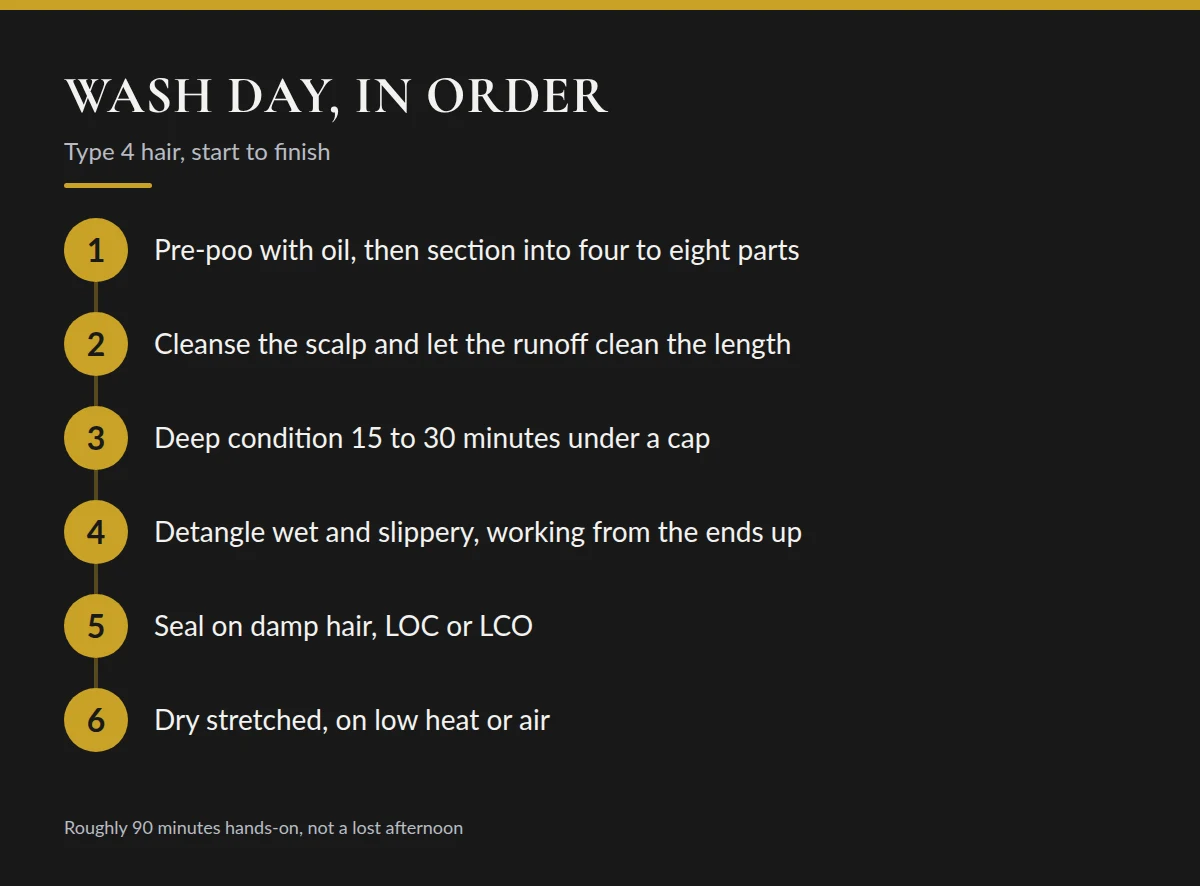
There is no universal number, and anyone who gives you one is selling something. For most Type 4 hair worn loose or in twists, cleansing every seven to fourteen days is a reasonable center of gravity. What moves you within that range is not your curl pattern. It is four things:
- How much your scalp produces. An oily scalp needs a shorter cycle than a dry one, regardless of how tight your coils are.
- How much you sweat. Salt left sitting on the scalp is an irritant. If you train hard, the calendar moves toward the shorter end, and it is worth building the week around wash day rather than the reverse.
- How much product you apply. Heavy butters, gels, and creams accumulate. The more you use between washes, the sooner you need a real cleanse.
- What style you are wearing. Braids and long-term installs stretch the cycle. A short cut shortens it: if you wear a taper, a fade, or a low Caesar, you are essentially washing skin with a little hair on it, and two or three times a week is normal.
Washing frequency is one of the most consistently measured differences between Black and white women’s hair routines in the dermatology literature, and it deserves an honest read. The gap is not really a disagreement about moisture. It is the cost of the styling day attached to the wash, which is the same cost this article is trying to cut. Water is not what dries your hair out. A harsh cleanser with no conditioner behind it is, and so is skipping the wash long enough for buildup to take over the scalp.
Pick the Right Cleanser
Three tools, three jobs. Most routines go wrong by using one of them for all three.
Co-wash (cleansing conditioner). A conditioner with very mild cleansing agents. It removes sweat and light residue while leaving most of the hair’s oil in place. Good for refreshing mid-cycle, for very dry or very fine coils, and for anyone whose hair feels stripped by real shampoo. It does not remove silicones, heavy butters, or mineral oil, so a co-wash-only routine eventually stops working.
Sulfate-free shampoo. This is the default for most wash days. It uses gentler surfactants than sodium lauryl sulfate, cleans the scalp properly, and does not flatten your moisture in one pass. Apply it to the scalp with fingertips, not nails, and let the runoff handle the length. The ends are the oldest and most fragile part of the hair and they do not need direct lather.
Clarifying shampoo. The reset button. Once a month is plenty for most people, less if you use few products. It strips everything, including the buildup that a co-wash cannot touch, and it is what you reach for when your hair suddenly stops absorbing water or your leave-in starts sitting on top of the strand instead of sinking in. Always follow it with a deep conditioner, never with nothing.
If your scalp is flaking, itching, or tender rather than simply dirty, that is a different problem with a different fix. Medicated shampoo needs contact time on the skin, and persistent symptoms belong with a board-certified dermatologist or a trichologist experienced in textured hair. Our scalp health guide covers where that line sits.
Pre-Poo and Sectioning
These two steps cost fifteen minutes at the front of wash day and save an hour at the back of it.
Pre-poo means applying an oil or conditioner to dry or damp hair before shampooing. Coiled hair swells when it takes on water and contracts when it dries, and repeated swelling on already fragile strands is hard on the cuticle. A coat of oil slows that water uptake and gives the shampoo something to strip other than your own lipids. Twenty minutes under a plastic cap is enough. Coconut, olive, and avocado oils are the usual choices, and the cheap ones work.
Sectioning is the step people skip when they are in a hurry, which is exactly backwards. Four to eight sections, each twisted or clipped, means you never lose track of what is detangled and what is not, and you never drag a comb through a full head of shrunken hair. Every step after this one happens section by section: cleanse, condition, detangle, seal, style. The hair stays organized from start to finish.

Deep Conditioning and the Protein Balance
A rinse-out conditioner smooths the cuticle for a few minutes. A deep conditioner sits for fifteen to thirty under a cap and does more. Gentle heat, from a hooded dryer, a thermal cap, or simply your own body heat trapped under plastic, improves how much gets in. Longer is not better past about thirty minutes, and sleeping in one is not a technique, it is just a wet pillow.
The part that confuses people is protein. Hair is keratin, and protein treatments temporarily patch gaps in a damaged cuticle, which makes weak hair feel stronger. But protein also stiffens the strand, and stiff coils snap. Too much moisture and no protein gives you hair that stretches like wet wool and never holds a style. Too much protein and no moisture gives you hair that feels rough and breaks off clean when you comb it. Most people find the balance by reading their own hair rather than following a schedule.
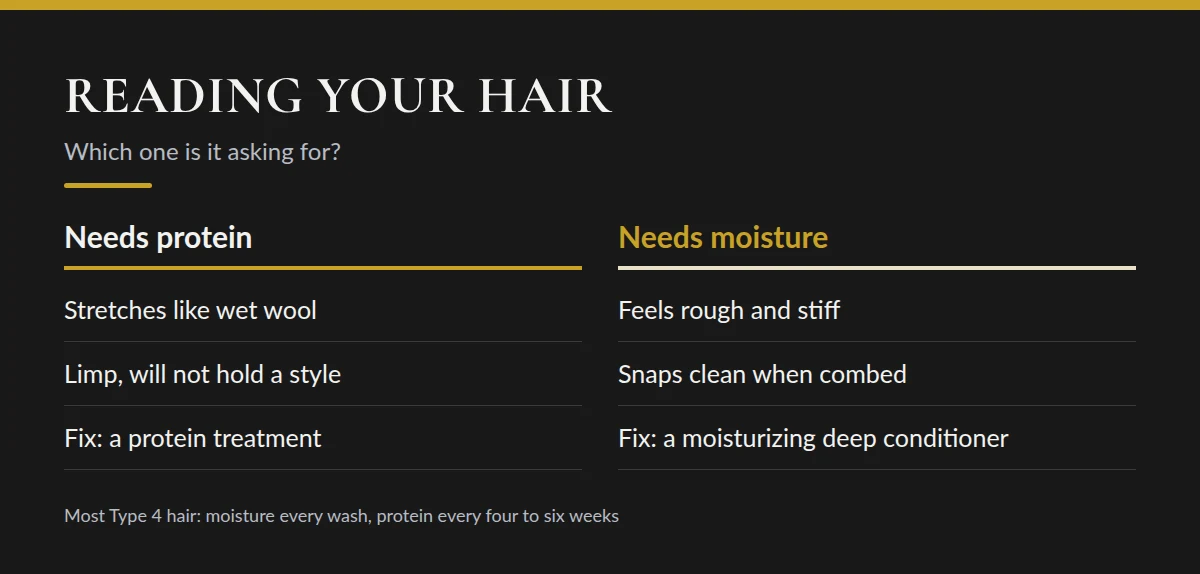
A practical rhythm for Type 4 hair with no chemical service: a moisturizing deep conditioner every wash day, a protein treatment every four to six weeks. Relaxed, color-treated, or heat-damaged hair generally needs protein more often, because the damage it is patching is real and ongoing.
Detangling With the Least Breakage
This is where most of the breakage in a wash day happens, and two changes prevent most of it.
Detangle wet, slippery, and from the ends up. Dry detangling on Type 4 hair is how you fill a sink. Work on soaking wet hair saturated with conditioner, hold the section firmly a few inches above where you are working so the tension lands on your hand instead of your scalp, start an inch from the ends, clear that stretch, then move up an inch. Combing from root to tip does the opposite: it gathers every knot in the section into one ball and forces it through the thinnest part of the shaft.
Use your fingers first. Fingers find a knot before they damage it, which no comb does. Separate by hand, then follow with a wide-tooth comb with long, flexible, well-spaced teeth. A dense brush belongs nowhere near a detangling session. Each bend in a coil is a structural weak point where the shaft is thinnest, which is why textured hair breaks where it does and why force is never the answer to a tangle.

Rinse with cool water at the end to help the cuticle lie flat, then squeeze rather than wring, and blot with an old cotton T-shirt or a microfiber towel. Terry cloth has a raised pile that grabs the curl and roughs up the cuticle every single time.
Sealing: LOC or LCO
Both methods do the same job in a different order, and the job is this: get water into the hair, then trap it there. Water is the moisturizer. Oil is the lid.
- LOC is Liquid, Oil, Cream. Water or leave-in, then oil to seal, then cream on top.
- LCO is Liquid, Cream, Oil. Water or leave-in, then cream, then oil as the final layer.
Coarser, denser, higher-porosity hair usually does better with LCO, because the cream absorbs before the oil closes the door. Finer hair that weighs down easily often prefers LOC with a light hand. Try one for a month, judge it on day three rather than day one, and switch if the hair is either crunchy or limp. Apply every layer to damp hair, section by section, and rake it through rather than patting it on.
Drying and a Realistic Timeline
Air drying is free and gentle, but leaving coils soaking wet for hours keeps the shaft swollen longer than it needs to be. The middle path is best: air dry in a stretched style like twists, braids, or banded sections until damp, then finish with a hooded dryer or a diffuser on low heat. Blow drying on high with a concentrator held close is what turns a wash day into a heat damage story, and heat damage does not grow out of the hair you already have.
Here is the honest timeline for a full wash day on shoulder-length Type 4 hair, with sectioning:
- Pre-poo: 20 minutes, mostly unattended
- Cleanse: 15 minutes
- Deep condition: 25 minutes, mostly unattended
- Detangle in sections: 30 to 45 minutes
- Seal and style: 30 to 45 minutes
- Dry: variable, but stretched and unattended
That is roughly two to two and a half hours of which maybe ninety minutes is hands-on. The afternoon-killer version is what happens when detangling is done dry, on a whole head at once, on hair that was last washed five weeks ago.
The Bottom Line
Wash day is a sequence, not an endurance event. Pick a cleanser that matches the job instead of using one bottle for everything. Pre-poo and section before you turn the water on. Deep condition every time and add protein only when the hair asks for it. Detangle wet, with conditioner, from the ends up. Seal onto damp hair and let the hair tell you whether it wants LOC or LCO. Dry stretched and low.
If you are rebuilding a routine from scratch, change one variable at a time and give it a month. And if the scalp itself is the problem, a licensed stylist or barber who works with textured hair daily is the right first call, with a dermatologist behind them. Scope-of-practice rules for what a barber can advise vary by state, but nobody sees your scalp more often or knows what changed since last month better.
Sources
- Journal of Cosmetic Dermatology on measured differences in washing frequency and hair fragility between Black and white women
- Cutis for a dermatology overview of hair care practices in African American women
- American Academy of Dermatology with its guidance on how often to wash and condition Black hair
- Dermatologic Clinics covering how hair care practice shows up in hair loss in skin of color
Further reading
- American Academy of Dermatology on everyday care tips built around textured hair
- Skin of Color Society for its public education library on hair and scalp conditions
- Campaign for Safe Cosmetics on what is in the products you wash with