Hair Care Myths Black Women Still Believe (And the Research That Disproves Them)
Published on August 28, 2026

Almost every rule a Black woman follows about her hair was handed to her by somebody who loved her. Your grandmother parted your scalp and greased it. Your mother told you not to wash it too often. A cousin swore the braids had to hurt a little or they would not last. That advice came with real care behind it, and a lot of it was the best anyone knew at the time.
The trouble is that dermatology has spent the last twenty years catching up on textured hair, and some of what the research now shows flatly contradicts what gets repeated in kitchens and salons. Researchers publishing in Archives of Dermatological Research have documented measurable knowledge gaps between hairstyling practices and hair loss in the African American community: women were doing things to their hair, and losing hair because of them, without the connection ever being made out loud.
This is not a lecture about doing it wrong. It is a short list of the myths that come up most often in the chair, each one paired with what the published evidence actually says, so you can update the parts of your routine that need updating and keep the parts that were right all along.
Myth 1: Greasing the Scalp Makes Hair Grow
This is the most durable one, and it is the easiest to disprove. Hair growth happens inside the follicle, several millimeters below the surface of the skin, fed by blood vessels rather than by anything sitting on top of the scalp. A layer of grease is on the wrong side of the skin to influence what the follicle does. Nothing you rub on the scalp reaches the growth engine.
So where did the habit come from? A real problem with a wrong solution. On straight hair, sebum from the scalp travels most of the way down the shaft. On a tight coil, it cannot get past the first few bends, so the ends of Type 4 hair are genuinely dry and genuinely under-protected. Grandmothers were not imagining the dryness. They were just treating it at the root instead of at the ends.
The evidence-based version: put moisture where the hair actually needs it, on the mid-lengths and ends, and leave the scalp mostly alone. Heavy petrolatum and mineral oil applied to the scalp week after week traps sweat and product, and dermatology reviews of African American hair care practices consistently connect that kind of occlusive buildup to seborrheic dermatitis flares and scalp irritation rather than to growth. If your scalp itches, flakes, or feels tender, that is a condition to treat, not a dryness to grease over.
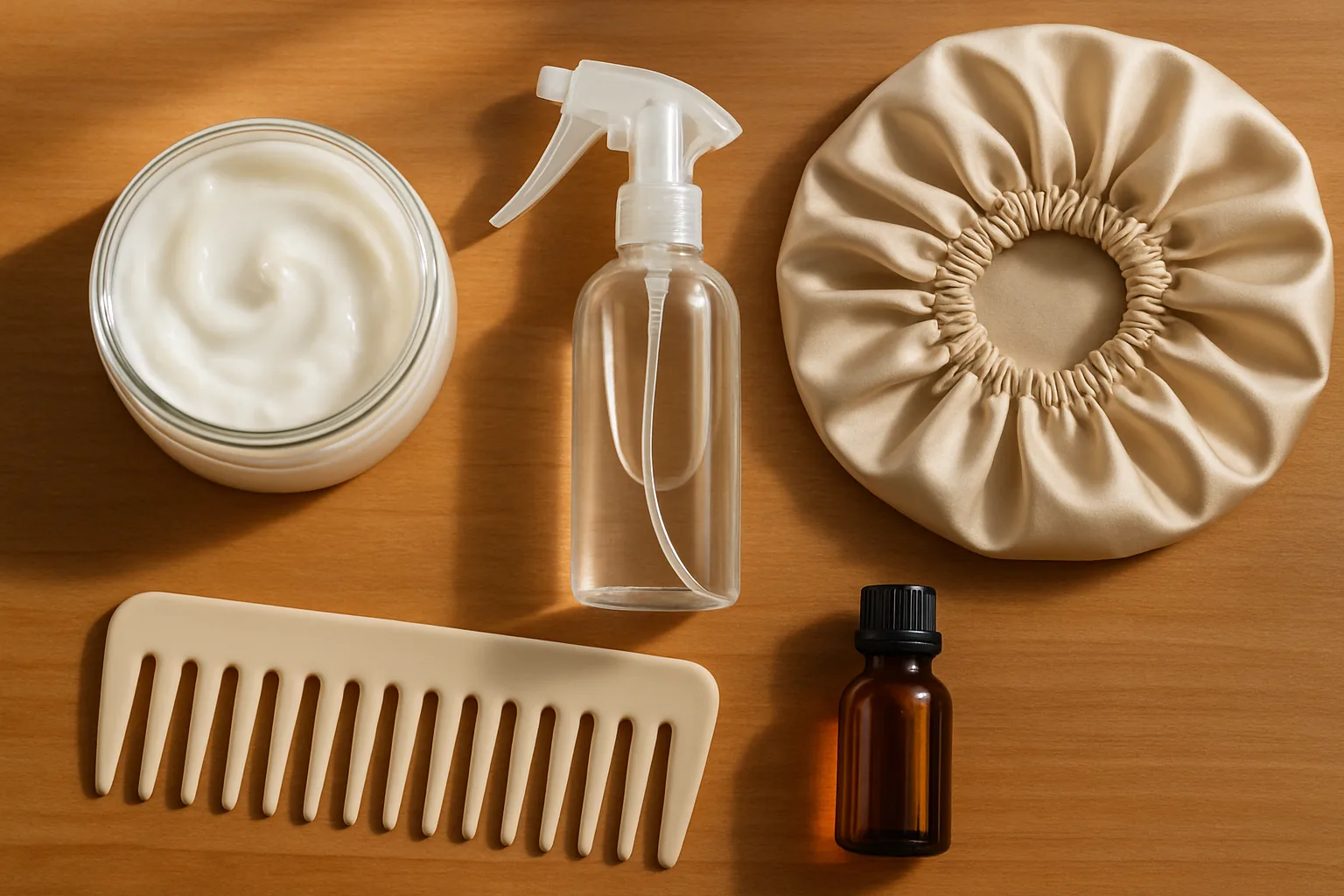
Myth 2: If the Braids Do Not Hurt, They Will Not Last
They will last. The pain is not a quality signal; it is a tension warning, and the research on this is about as settled as textured hair research gets. Sustained pulling on the follicle produces traction alopecia, which starts as thinning at the temples and hairline and, if the tension keeps coming back, ends in permanent loss once the follicle scars over.
The details worth knowing are the early ones. A tender scalp, small bumps around the braid, or a headache after an install all mean the tension is too high right now. The fringe sign, a surviving row of short fine hairs in front of a thinning area, is a classic early clue, and hair casts (small white cylinders sliding along the shaft) are another. Catch it there and hair usually comes back. Catch it after years of tight installs and it may not.
None of this means giving up protective styles. It means smaller sections at the perimeter, no rubber bands at the hairline, taking the install down on schedule, and giving the edges a rest between styles. The full breakdown of which styles put the most load on a hairline is in our guide to how tight braids, weaves and locs cost Black hairlines.

Myth 3: Heat Trains the Curl
There is no training. A curl pattern is set by the shape of the follicle, which is curved before the fiber ever clears the scalp, and no amount of repeated flat ironing renegotiates that. What people call trained hair is hair whose curl pattern has stopped bouncing back, and the technical name for that is heat damage.
Here is what the heat is doing. High temperature on a hair shaft that still holds water can flash that water into steam inside the fiber, blowing small bubbles through the cortex. It also lifts and cracks the cuticle, the shingled outer layer, and the cuticle on coiled hair is already lifted at every bend. Once the internal bonds are cooked, that section will not curl again. It hangs looser, so it reads as trained, but it is a section of the head that has permanently lost its structure and gained a weak point.
The practical rules are boring and they work: fully dry hair before any iron touches it, use a heat protectant, keep the temperature in the moderate range rather than at the top of the dial, and pass once rather than five times. Silk presses are not the enemy. Silk presses every two weeks at 450 degrees are.
Myth 4: Relaxed Hair Breaks Less Because It Is Easier to Manage
Easier to comb is not the same as stronger, and the chemistry says the opposite. A relaxer works by breaking the disulfide bonds that hold the curl in place. Those bonds are structure. Removing them makes the fiber lie flat and detangle easily, and it also makes it measurably weaker, especially at the bends where coiled hair already concentrates stress.
The case-control research comparing African American and Caucasian women is instructive here. It found significantly more broken hairs on the African American participants, along with lower hair density, slower growth rate and different shaft diameter, and it also found that chemical relaxer use was significantly more common in that group. The authors concluded that the differences in both hair care practices and hair fiber morphology contribute to the fragility seen in clinic. In plain terms, structure and styling are both in the mix, and relaxer is on the styling side of the ledger.
Relaxers are a legitimate choice and plenty of women wear them well. The honest framing is that a relaxer is a trade: easier daily handling in exchange for a weaker fiber, a chemical burn risk at the scalp, and an ingredient list worth reading. We break that list down in what is really in your relaxer. Whichever way you go, the underlying fragility is built in, which is the subject of why Black hair breaks differently.
Myth 5: Washing Dries Your Hair Out, So Wash It Less
Water is not the drying agent. Harsh sulfate shampoo strips oil, and skipping conditioner leaves the cuticle rough, but the wash itself is not what leaves hair brittle. Meanwhile the scalp is skin, and skin left unwashed for a month accumulates sebum, sweat, dead cells and product residue, which is exactly the environment seborrheic dermatitis thrives in.
Washing frequency is one of the sharpest measured differences between Black and white women’s routines in the research, and it is worth being honest about why. The real barrier usually is not a belief about moisture. It is that washing means a whole styling day afterward, and that cost is high enough that the schedule stretches. That is a labor problem wearing a hair-science costume, and it is the same math that makes hair a documented barrier to working out for Black women.
A reasonable target for most Type 4 hair is cleansing every one to two weeks, using a gentle or sulfate-free shampoo, always following with conditioner, and focusing the shampoo on the scalp while the ends mostly get the runoff. In a long-term protective style, a diluted cleanser applied along the parts keeps the scalp livable without disturbing the install.

Myth 6: My Hair Just Does Not Grow
Almost always it is growing, and almost always it is snapping off at roughly the rate it grows, so the length never changes. That is breakage, not a growth failure, and the two have completely different fixes.
The measurements back this up. Research comparing the two groups found a slower average growth rate and significantly more broken hairs among African American participants, with no meaningful difference in the hair cycle itself. Slower replacement plus higher breakage is a hard combination, and the visible result is hair that seems stuck at shoulder length forever.
The tell is where the damage sits. If the shortest, most ragged hair is at the ends, that is mechanical and chemical breakage, and it responds to lower tension, less heat, gentle detangling from the ends up, and regular dusting of split ends. If instead the scalp is showing through, the part is widening, or the crown is thinning outward, that is not breakage and no product will fix it. That belongs to a dermatologist, and the range of what it might be is covered in our guide to every type of Black hair loss.
Updating the Routine Without Throwing It Out
Most of what was handed down is sound. Protective styling protects. Satin at night protects. Moisture matters, patience matters, and a stylist who knows textured hair matters most of all. The parts worth revising are narrow and specific: move the oil from the scalp to the ends, treat pain as a stop sign rather than a badge, stop calling heat damage training, read what is in the chemical service before you sit for it, wash on a schedule instead of a fear, and check whether your hair is failing to grow or failing to stay.
For barbers and stylists, this is chair-side work. You are the person most clients ask before they ask anybody with a medical license, and the research on knowledge gaps suggests the question often never gets asked at all. Saying “that tenderness means we go looser next time” or “this is heat damage, not a loosened curl” takes ten seconds and lands with more authority than any pamphlet. Persistent itching, flaking, tenderness or visible scalp still belongs with a board-certified dermatologist or trichologist experienced in textured hair, and licensing and scope-of-practice rules for what a barber can advise vary by state.
Old advice is not the enemy. Old advice that nobody ever updated is.
Sources
- Archives of Dermatological Research on documented knowledge gaps between hairstyling practices and hair loss
- Journal of Cosmetic Dermatology for the case-control comparison of hair care practices and hair shaft parameters
- Journal of the American Academy of Dermatology with an overview of common practices and the scalp disorders that follow them
- Cutis covering the styling methods dermatologists need to understand in African American patients
Further reading
- American Academy of Dermatology on how often to wash and how to care for Black hair
- American Academy of Dermatology for hairstyles that pull and the hair loss they cause
- Skin of Color Society with its public education library on hair and scalp conditions
- National Cancer Institute for what the research actually says about hair dyes and cancer risk