A Parent's Complete Guide to Black Children's Hair: Type 3 and Type 4 Care from Birth to Tween
Published on July 19, 2026
Hair Day Does Not Have to End in Tears
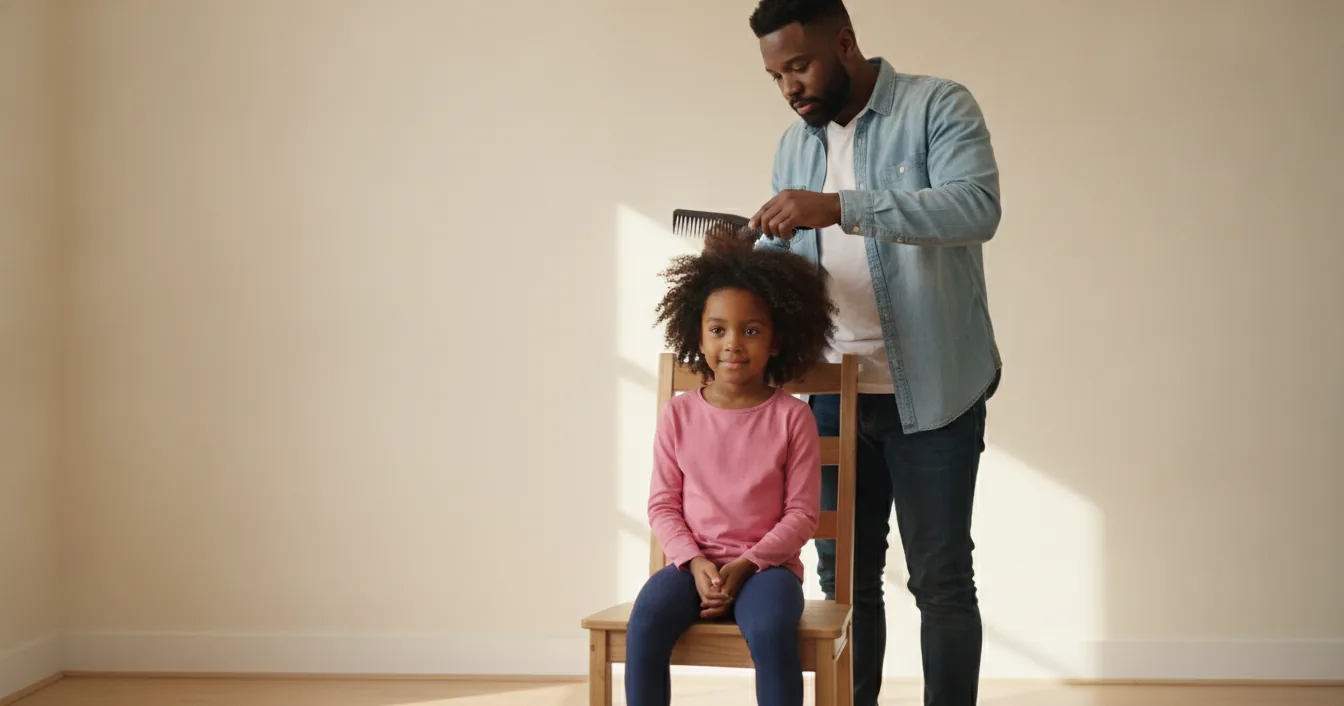
Ask most Black men where they learned about hair and the answer is the barbershop: clippers, fades, a chair, and forty-five minutes of opinions nobody asked for. That education is real, but it stops at the shop door. When a daughter arrives with a head of Type 3 or Type 4 curls, a lot of dads discover they know almost nothing useful, and “hair day” becomes the most dreaded hour of the week.
That is exactly the story the writer Lanre Bakare told in The Guardian earlier this year, describing months of screaming and unsatisfying results with his three and four-year-old daughters before he booked a lesson with a curly hair stylist. Her diagnosis was blunt and encouraging at the same time: the problem was not the hair, it was the technique. “Managing curly hair, once you know how, is easy,” she told him. “It’s easier than trying to hide it anyway.”
This guide is for that parent. Black dads learning their daughters’ hair, transracial adoptive and foster families, grandparents raising grandchildren, and anybody who has ever stood behind a crying child with a comb and no plan. A note up front: for any persistent scalp irritation, bald patch, or unusual shedding, a licensed stylist and a board-certified dermatologist experienced with textured hair are the right people to see. Nothing here replaces that.
Know What You Are Working With
Curl typing is a rough shorthand, not a science, but it is a useful starting point. Type 3 hair forms defined loops and spirals, from loose curls to tight corkscrews. Type 4 hair forms coils and zigzags so tight the pattern can be hard to see until the hair is wet or stretched. Most heads carry more than one pattern, so it is completely normal for a child to have looser curls at the nape and tighter coils at the crown, and for siblings to need entirely different routines.
The important part is not the label but what it implies. Coiled hair is built to be dry. Scalp oil travels easily down a straight strand but stalls at the first few bends of a coil, so the ends of your child’s hair are the oldest, driest, and most worn section, and that is where breakage starts. Every bend in the curl is also a stress point where the shaft is thinnest. This is the structural reason behind almost every rule in this article, and it is worth understanding in more detail if you want the science of why textured hair breaks where it does.
One practical consequence: a child’s hair does not need washing as often as yours might. Once a week is a common rhythm for Type 4, sometimes every other week for older kids in braids or twists. Daily shampooing strips the little oil that does make it down the shaft.
Wash Day, Step by Step
Build a routine and keep it the same every time. Predictability is what turns a fight into a ritual.
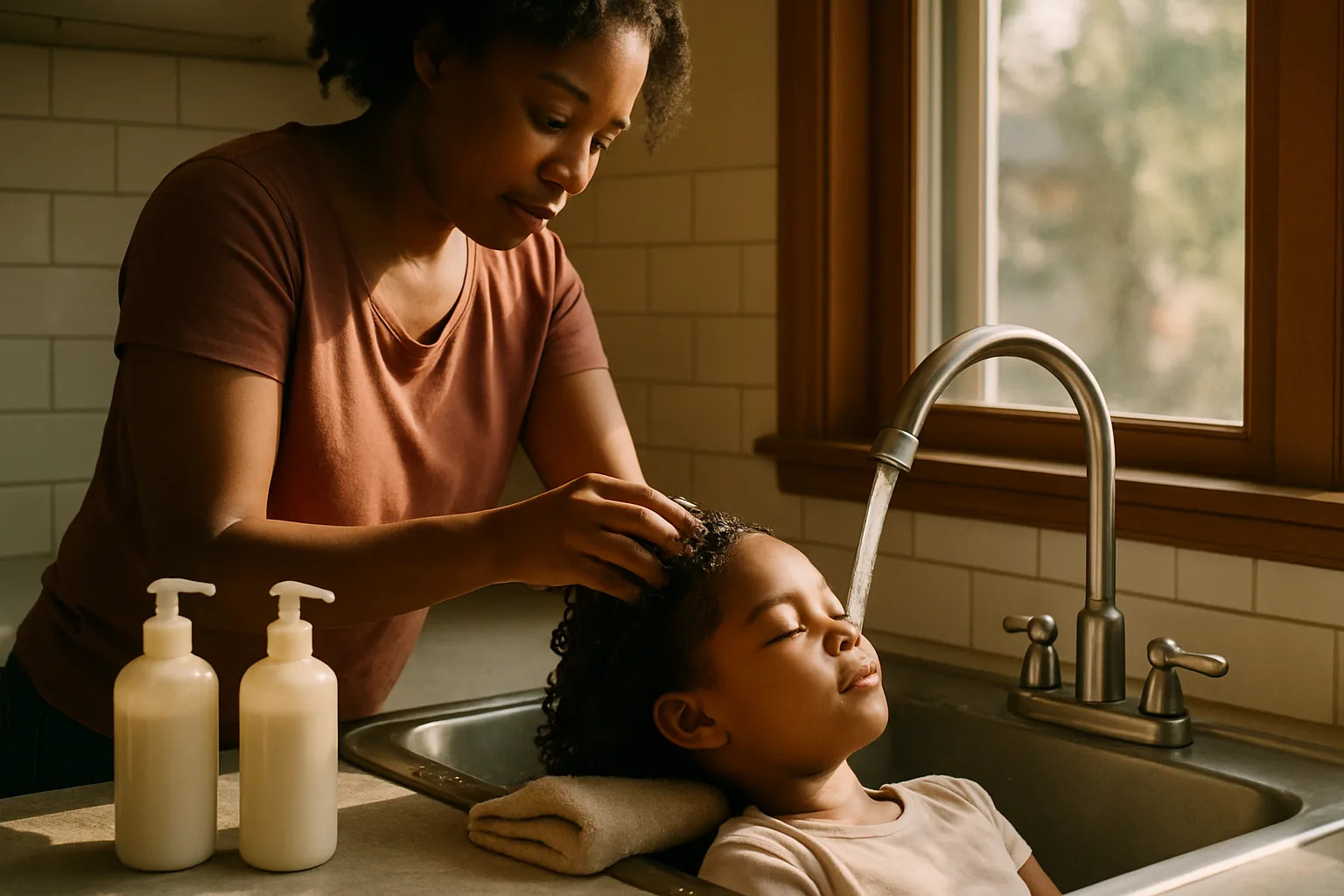
- Detangle before water, or at least before shampoo. Working through knots on dry, product-free hair is harder. Work through them on soaking wet hair with slippery conditioner and they release with far less force.
- Section the hair. Four to six sections, each clipped or loosely twisted out of the way. Trying to manage a whole head at once is how parents end up rushing and pulling.
- Wash the scalp, not the length. Focus the shampoo on the scalp with your fingertips and let the suds rinse down. A sulfate-free or moisturizing children’s shampoo is gentler on a hair type that is already short on moisture.
- Condition generously, section by section. This is where detangling actually happens. Coat each section, finger-detangle, then comb.
- Rinse with cool water to help the cuticle lie flat, then squeeze rather than wring.
- Dry with a cotton T-shirt, not a terry towel. Terry cloth has a raised pile that grabs at the curl and roughs up the cuticle. An old T-shirt blots water without the friction.
- Leave-in conditioner, then a sealant, applied to damp hair in sections. Lighter products (milks and serums) suit looser Type 3 curls; heavier creams and butters suit tighter Type 4 coils. Matching the product weight to the actual curl matters more than the brand on the bottle.
Detangling: The Part That Makes or Breaks It
If hair day goes wrong, it almost always goes wrong here. Two changes fix most of it.
Start at the ends, never the roots. Combing from the scalp down drags every knot in the section into a growing ball and forces it through the weakest part of the shaft. Instead, hold the section in one hand, start an inch or two from the ends, work out that stretch, then move up an inch and repeat. It feels slow. It is faster than the alternative, and it does not hurt.
Use the right tool. A dense brush with short, stiff bristles works on straight hair and is close to useless on coils. What you want is a wide-tooth comb with long, well-spaced, flexible teeth, or your own fingers, which are the most sensitive detangling tool you own. Find the tangle first, ease it apart, and only then comb through.
Two more small things with outsized effects. Swap tight elastic hair ties for smooth, loose satin or silk-covered ones that slide off instead of clinging to and snapping strands. And if a tie is genuinely stuck, cut it out rather than dragging it free.
Protective Styles for School, Without the Tension
Braids, twists, cornrows, bantu knots, and puffs all reduce daily manipulation, which is genuinely protective. They also carry the single biggest risk in children’s hair care: too much tension.
Children’s follicles are not tougher than adults’. If anything they are more vulnerable, because a child often cannot advocate for herself while an adult is installing a style. Sustained pulling causes traction alopecia, a tension-driven hair loss that is fully preventable and, caught early, reversible. Dermatology researchers rank styling practices by risk, and the highest-risk combinations are the familiar ones: micro braids, tight cornrows along the hairline, added synthetic weight, and long wear between takedowns. Our fuller breakdown of how tight braids and locs cost hairlines covers the early warning signs.
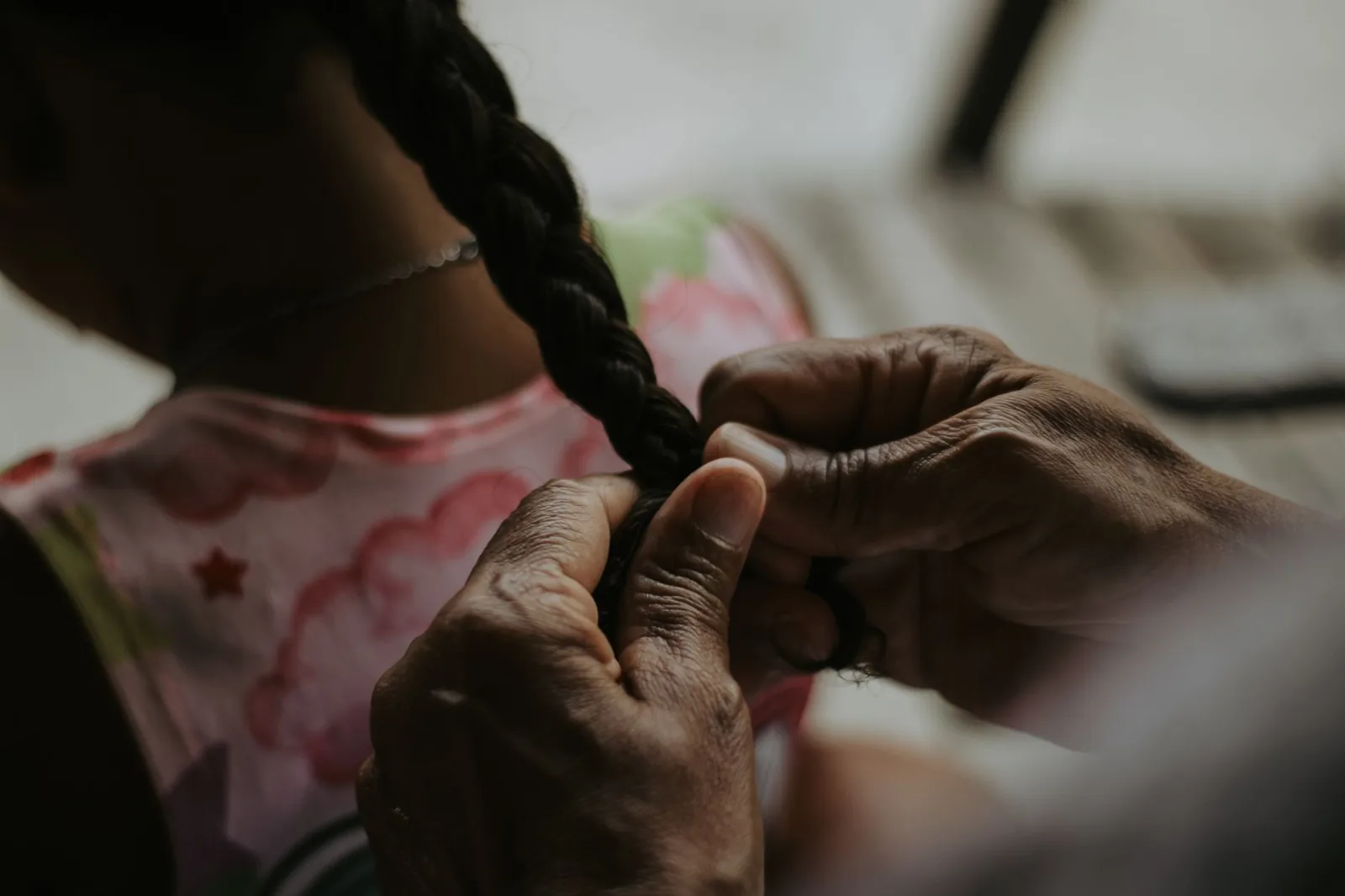
The rule to teach yourself and any stylist you hire is simple. If it hurts to install, hurts to sleep in, or leaves the child with tender spots or bumps, it was too tight. Pain is not proof of a good install. Beyond that:
- Cap wear time. Two to six weeks is plenty for a child, and shorter is better for younger kids.
- Leave rest periods between styles with the hair worn out or loosely twisted.
- Skip the tight edge cornrow at the temple. The hairline is the first thing to go and the hardest to get back.
- Watch for raised bumps, broken skin, or a scalp that is sore days later. A fresh braid that produces an open sore is a medical issue, not a styling complaint. A published case in Pediatric Dermatology described a nine-year-old who developed severe scalp ulceration eleven days after a synthetic braid install, which required months of wound care.
- Do not relax a child’s hair. There is no cosmetic reason worth the chemical risk on a young scalp, and the ingredient questions around relaxers apply doubly to children.
There is also a family-history angle worth knowing. Central centrifugal cicatricial alopecia, a scarring hair loss that radiates out from the crown, has been documented in the children of affected adults, so if crown thinning runs in your family it is worth reading up on the early signs of CCCA and mentioning it at a pediatric visit rather than waiting.
Night Care Is Half the Work
Whatever you do on wash day gets undone every night if the hair spends eight hours grinding against cotton. Cotton pillowcases wick moisture out of hair and create friction that lifts the cuticle and frays the ends.
The fix is cheap and it is the highest-return habit in this entire guide. A satin or silk bonnet, a satin-lined sleep cap for a child who pulls a bonnet off, or a satin pillowcase as a backstop. For toddlers who will not tolerate anything on their heads, the pillowcase alone still does most of the job. Pair it with loose overnight braids or twists (never tight ones) and you wake up with hair that needs a refresh instead of a rescue.
Age by Age, Roughly
Infants. Baby hair is fine and often a different texture than what grows in later. Wash sparingly with a gentle cleanser, keep it moisturized, and leave it loose. No ties, no styles, no tension on a soft scalp. Cradle cap is common and is a pediatrician question, not a styling one.
Toddlers (1 to 3). Texture settles into its real pattern. Keep sessions short and low-stakes. Two loose puffs or a few chunky twists beat anything intricate. Build the habit of sitting for hair, not the expectation of a perfect result.
Preschool and early elementary (4 to 7). Attention span improves enough for real wash days. Introduce the routine as a routine, give the child a mirror and a say in the style, and start simple protective styles for school. Screen time during detangling is a legitimate tool, not a parenting failure.
Later elementary and tween (8 to 12). Hand over the routine gradually. Teach the child to section, apply their own leave-in, and put on their own bonnet. A tween who can care for their own hair carries that independence into adolescence.
When to Bring in a Professional
You do not need a stylist to run a competent wash day, but there are good reasons to book one. A single lesson with a curly hair specialist, which is exactly what Bakare did, buys you technique that no video quite conveys. First trims, locs, and any braiding beyond basic cornrows are worth paying for. And a child who sees a professional treat their hair with care learns something about their own hair being worth care.
Finding the right person matters more than finding the nearest one, and not every licensed stylist has real training in textured hair. The same criteria for choosing a barber who genuinely works with texture apply to your child’s stylist: ask what they do most, ask to see their work on hair like your child’s, and watch how they handle tension.
The Part Nobody Tells You
Here is what the dads in these courses report back, almost without exception. The skill is the smaller half of it. The bigger half is what happens in the hour it takes.
Black women frequently name having their father do their hair among their fondest childhood memories, and it goes uncelebrated. There is the pride of finishing a clean parting that took you forty-five minutes and takes your partner five. There is the quiet of a child sitting between your knees, talking about their day because you both happen to be facing the same direction and nobody is in a hurry.
The Black barbershop has always understood that the chair is about more than the hair. The same is true of the kitchen stool on a Sunday afternoon. Get the technique right and the tears stop. What is left is the ritual, and that part is worth protecting.
Sources
- The Guardian on one Black dad’s crash course in doing his daughters’ hair
- Pediatric Dermatology for how quickly a too-tight braid can injure a child’s scalp
- Journal of the American Academy of Dermatology with a tension ranking of common Black hairstyling practices
Further reading
- American Academy of Dermatology on everyday care tips for Black hair
- American Academy of Dermatology for hairstyles that pull and how to lower the risk
- Skin of Color Society with its public education library on hair and scalp conditions
- U.S. Food and Drug Administration on what to know before using hair dyes or relaxers