Dark Spots After Razor Bumps and Breakouts: Fading Post-Inflammatory Hyperpigmentation on Black Skin
Published on October 1, 2026

The bumps are gone. He changed the shave months ago, the ingrown hairs stopped coming, and the skin along his jaw is smooth again. But the marks stayed: a trail of dark spots down the neck and under the beard line, one for every bump that healed, and now they are what people notice.
On melanin-rich skin the mark often outlasts the problem that made it. Dermatologists call it post-inflammatory hyperpigmentation (PIH), and the American Academy of Dermatology (AAD) counts dark spots and patches among the most common reasons people with darker skin tones see a dermatologist. At one New York skin of color center, dyschromia, the medical word for uneven skin color, was the second most common diagnosis at visits by Black patients, behind only acne, and it did not make the top ten for white patients. This guide is about the aftermath: why the marks form, what fades them, and what to keep off your face. Stopping the bumps themselves is its own job, covered step by step in our razor bump treatment ladder.
Why Brown Skin Holds On to a Mark
Every bump, pimple, nick and scratch is a small injury, and skin answers injury with inflammation. The chemical signals of that inflammation also stir up melanocytes, the cells that make pigment, which respond by making more melanin and passing it to the skin cells around them. Darker skin reacts this way more often and more intensely. When the extra pigment stays in the top layer of skin, the mark looks tan, brown or dark brown.
Deeper damage works differently. When inflammation injures the bottom layer of the epidermis, pigment spills into the dermis below, where immune cells swallow it and hold on to it. That pigment looks blue-gray rather than brown, and a 2010 review of PIH in skin of color describes it as either permanent or slow to resolve over a long stretch.
The numbers show how common this is. The same review cites a 2002 survey in which 65.3 percent of 239 African American acne patients had developed dark marks from their acne, and a study of 71 Black and Hispanic patients with razor bumps in which 90.1 percent reported hyperpigmentation. Pigment specialists writing in 2021 noted that these marks are often more distressing to patients than the breakouts behind them.
Two things keep a mark dark: sunlight and fresh inflammation. Fading starts by taking both away.
Stop the Trigger Before You Buy Anything
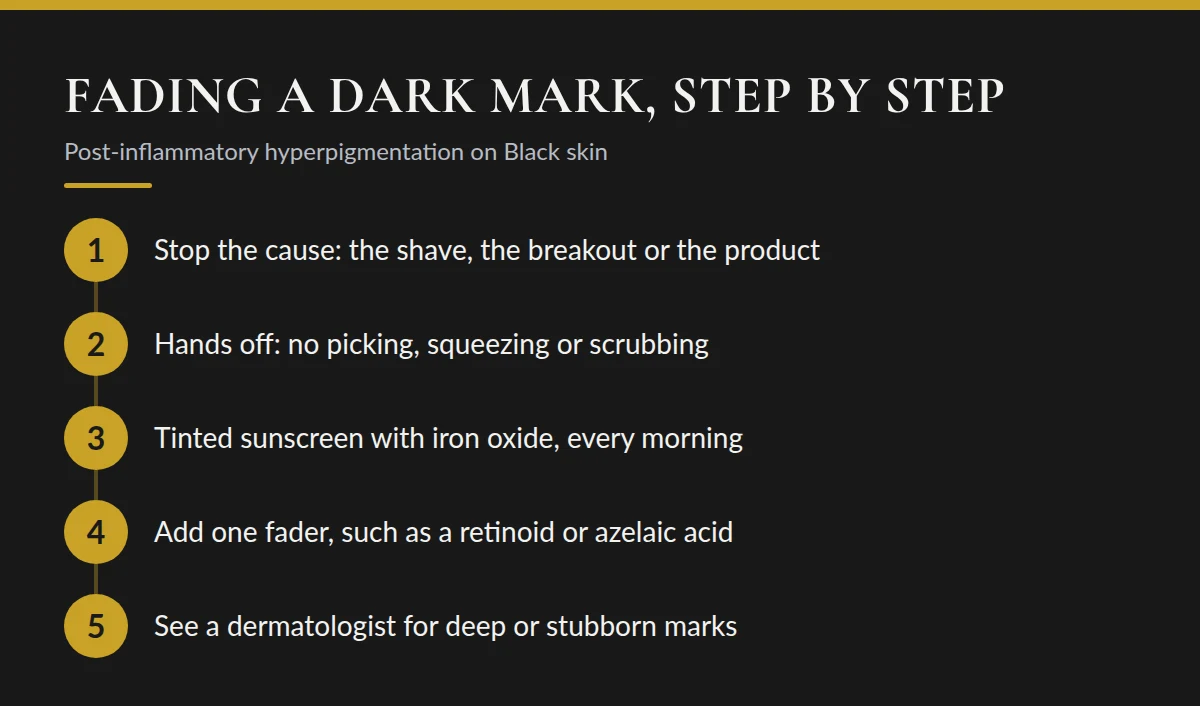
The AAD’s first rule for dark spots is to find the cause and stop it. Do that, it says, and many spots clear on their own and new ones stop appearing. A fading cream on skin that is still being injured is mopping the floor with the tap running. Along the beard line, neck and hairline, the usual causes are these:
- Razor bumps and ingrown hairs. While curved hairs keep re-entering the skin, every shave plants a new mark. The fix is the shave, not a cream: letting the beard grow, leaving some stubble, or changing the technique, all covered in the treatment ladder.
- Breakouts. Treat acne early. The AAD warns that people with skin of color whose acne becomes moderate or severe before treatment run a higher risk of dark spots and keloids. A 2023 consensus of 10 board-certified dermatologists agreed that most people with acne and the marks it leaves should start with early, effective acne treatment: a topical retinoid plus benzoyl peroxide. The AAD calls the idea that benzoyl peroxide leaves light spots on dark skin a myth, though it will bleach towels and pillowcases.
- Hair oil at the hairline. Breakouts only on the forehead and temples often trace back to hair products, common enough that dermatologists named it pomade acne in 1970. The AAD suggests a styling product made with water or glycerin instead of oil, or keeping the oil to the middle of the scalp and the ends of the hair.
- Products that sting. A skin or hair product that irritates can cause dark spots by itself. If an aftershave or cleanser burns, switch to one labeled for sensitive skin or fragrance free. Once the irritation stops, the AAD says, new spots tend to stop with it.
- Flaking rashes. Seborrheic dermatitis in the eyebrows and beard can leave dark patches on brown skin, which fade once the rash is controlled. If the medicated shampoo has stopped working, see our guide to treatment-resistant seborrheic dermatitis.
- Your own fingers. Squeezing a pimple or digging at an ingrown hair is a fresh injury on top of the old one. A mark from a healed injury fades in time, the AAD says, as long as you don’t re-injure the skin.
Sunscreen Comes First, and the Tint Matters
Every fading plan starts with sun protection, and on brown skin the reason goes beyond ultraviolet rays. In a 2010 study at Henry Ford Hospital in Detroit, researchers exposed 20 volunteers with skin types IV to VI to visible light, the ordinary light we see by, and to long-wave UVA. Both darkened the skin, but visible light produced darker pigment that lasted longer. The same light caused no pigmentation at all in fair skin.
Ordinary sunscreen does little against it. A 2021 review in the AAD’s journal explains that broad-spectrum products block ultraviolet rays but not visible light, and that to block visible light a sunscreen has to be visible on the skin. Clear mineral sunscreens use particles too small to do it. Tinted sunscreens add iron oxides, pigments blended into shades for every skin tone. In a 2020 test on skin type IV, iron oxide formulas protected against light-induced darkening significantly better than a clear mineral SPF 50+.

The AAD’s checklist for a sunscreen that helps prevent and clear dark spots:
- Iron oxide in the ingredient list
- SPF 30 or higher, broad spectrum and water resistant
- Non-comedogenic (won’t clog pores) if your skin is oily
- A shade that blends with your skin, with no white cast
Look for iron oxide among the inactive ingredients, the AAD notes, since it blocks visible light rather than UV. Don’t expect the label to say much more. When researchers examined 37 tinted sunscreens in 2026, 97.3 percent did not list iron oxide as an active ingredient, only 9.6 percent of the brands that responded disclosed how much they used, and of six brands claiming visible light protection, only one publicly described its testing.
Put it on every morning, on all skin that clothing won’t cover: face, ears, the neck down to the collar and, under a skin fade or a shaved head, the scalp. Add a wide-brimmed hat outdoors, as the AAD also recommends. Our grooming guide builds the rest of a simple routine around it.
What Actually Fades the Mark
With the cause gone and the sunscreen on, a fading product works far better, the AAD says. The evidence is thinner than the shelf suggests, though. The 2023 consensus panel noted that large randomized trials are lacking, and a 2022 systematic review of 47 studies found the strongest support for retinoids, hydroxy acids such as glycolic acid, and broad-spectrum sunscreen.

- Hydroquinone has long been the first-line fading cream. The 2010 review put hydroquinone 4 percent plus sunscreen at the top of its plan for skin of color, and it is also formulated with a retinoid, glycolic acid or a mild steroid to boost it. In the US it now comes through a doctor. Since September 23, 2020, over-the-counter skin lighteners without FDA approval have had to come off the market, and in April 2022 the FDA sent warning letters to 12 companies still selling hydroquinone products, citing reports of rashes, facial swelling and ochronosis. The review also advises switching to a different agent after prolonged use.
- Retinoids fade marks and treat the acne behind them. In a 40-week trial of 54 Black patients, tretinoin 0.1% cream lightened marks 40 percent of the way back to normal skin color, against 18 percent with an inactive cream, with improvement first visible at four weeks. Half the tretinoin group developed retinoid dermatitis, a red, peeling irritation that can leave new marks on brown skin, so dermatologists start at lower strengths and often choose a cream over a gel. In a trial of 74 patients with acne, tazarotene 0.1% cream lightened and shrank marks more than an inactive cream within 18 weeks. Adapalene 0.1% gel, another retinoid, is sold without a prescription.
- Azelaic acid is the gentler alternative. In a 24-week trial in patients with skin types IV to VI, a 20 percent cream faded marks significantly more than an inactive cream, at the cost of slightly more burning and stinging. In a second trial from the same group, azelaic acid paired with a glycolic acid lotion matched hydroquinone 4 percent over 24 weeks. The AAD lists it among the ingredients worth trying in products sold without a prescription, along with glycolic acid, kojic acid, retinoids and vitamin C.
Whatever you choose, add one product at a time and use it gently. Every one of these can irritate, and the 2010 review warns that a treatment that irritates the skin can cause or worsen the very marks it is meant to fade. If a product leaves your skin red, peeling or stinging, cut back to every other night or stop. Give it 8 to 12 weeks before judging it, the point at which that review’s plan adds a second agent, a peel or a laser.
How Long Fading Takes
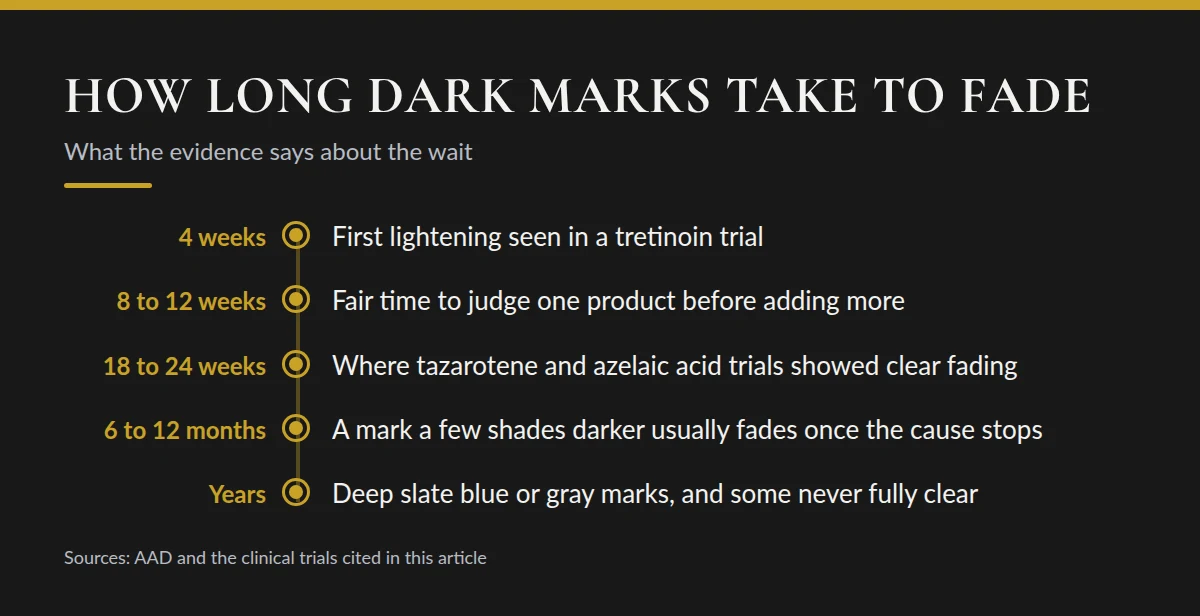
Once the trigger has stopped, time does much of the work. A spot a few shades darker than your natural color usually fades within 6 to 12 months, according to the AAD, while color that sits deep in the skin, slate blue to gray or a brown far darker than your own, can take years.
Treatment speeds that up but rarely erases a mark outright. When a 2024 systematic review pooled 41 studies and 877 patients, complete clearing was uncommon: 5.4 percent of patients on creams and 18.1 percent of those treated with lasers and similar devices. Partial improvement was the rule, reached by 72.4 percent on creams and 84.9 percent on combined treatments. Most of those marks came from acne, the authors note, so results for other causes may differ. The realistic goal is a mark that keeps getting lighter until it stops being the first thing you see.
Products Dermatologists Warn Against
The hunt for a faster fade sends people to the wrong shelf. Leave these alone:
- Imported lightening creams. Researchers have found steroids and mercury, not listed on the label, in skin care products imported from other countries, the AAD warns. Hidden steroids can cause pimples and rashes and, with long use, thin skin and permanent discoloration. The FDA says mercury creams are usually made abroad and sold illegally in the US, and that the label words mercurous chloride, calomel, mercuric, mercurio or mercury give them away. The danger reaches the whole household, through mercury vapor and shared towels and washcloths, and the signs of poisoning include tremors, numbness and tingling, memory problems and depression.
- Hydroquinone from a beauty supply store or a website. It can no longer be sold legally over the counter, and its strength is anyone’s guess. A 2022 systematic review of 126 cases of hydroquinone-linked ochronosis, a blue-black or gray-blue lacy darkening that is hard to treat, found it most often with strengths above 4 percent or unknown strengths, after a median of five years of use.
- A steroid cream from the medicine cabinet. It is not a fading cream, and long use thins skin.
- Liquid bleach. Never, the AAD says.
- Cocoa butter as a fader. There is no scientific evidence that it evens skin tone, according to the AAD, and on the face it can clog pores and cause acne.
- Heavy, oily concealer. Covering marks with thick makeup can cause new breakouts. Mineral makeup, or makeup labeled non-comedogenic, can hide them without that risk.
- Scrubs and harsh soaps. Scrubbing irritates, and irritation is where marks start.
Not Every Dark Patch Is a Healed Bump
PIH is flat and sits exactly where the bump, pimple or rash was, the 2010 review notes. Anything else deserves a doctor’s look before you try to fade it:
- Velvety, thickened darkening on the back and sides of the neck, sometimes in the armpits too, can be acanthosis nigricans. DermNet links it mainly to insulin resistance, including obesity, type 2 diabetes and polycystic ovary syndrome, and puts its prevalence among African Americans at an estimated 13.3 percent. It improves when the underlying cause is treated, not with a fading cream.
- Patches that appeared without any bump or rash, such as those some women notice during pregnancy, may be melasma, a different condition with its own prescription treatment.
- Blue-black or gray lacy patches where a lightening cream was used suggest ochronosis.
- A raised, growing or changing spot, or one that appeared from nowhere, is not PIH. Get it checked promptly.
When to See a Dermatologist
Book a visit if:
- Marks have not improved after 8 to 12 weeks of the routine above.
- The marks are blue-gray. Pigment that deep does not respond well to creams, the 2010 review notes.
- You want prescription hydroquinone, a stronger retinoid or a combination cream.
- You are weighing a chemical peel or a laser. Both can help: the AAD shows a patient whose dermatologist evened out his skin tone in eight weeks with laser treatment and prescription hydroquinone. Both can also backfire on dark skin, and in the 2024 review lasers made PIH worse in 2.6 percent of patients. The 2023 consensus treats peels as an add-on or second-line option. Choose a dermatologist experienced with dark skin.
From the Chair
A barber cannot prescribe anything, but the shop is often where the marks get talked about first, and a few habits help.

- Read the pattern. Marks that follow the razor’s path point to the shave. Marks along the forehead and temples point to hair products.
- Protect healing skin. On a client whose neck is still marked, edge with a trimmer and keep the razor off fresh marks, because re-injured skin starts the clock over.
- Skip the sting. On skin that marks, a fragrance-free finish beats an aftershave that burns.
- Watch what the shop sells. Leave lightening creams of unknown origin off the retail shelf.
- Say what you see. “Those marks will fade once the bumps stop, and sunscreen every day helps.” When a mark looks deep, raised or nothing like PIH, point the client to a dermatologist.
The Bottom Line
Dark marks after razor bumps and breakouts are the skin’s memory of inflammation, and on brown skin that memory runs long. Stop the cause first, because no cream outruns a fresh bump. Wear a tinted sunscreen with iron oxide every day. Add one proven ingredient, such as a retinoid or azelaic acid, and give it two to three months. If the marks are deep, stubborn or not what they seem, a dermatologist has prescription hydroquinone, peels and lasers, and the judgment to use them safely on dark skin. Leave the mercury creams, the bleach and the mystery jars where you found them.
Further reading (sources)
- American Academy of Dermatology on how to fade dark spots in darker skin tones
- American Academy of Dermatology with tips for clearing acne and the dark spots it leaves in skin of color
- Alexis, Sergay and Taylor for the most common diagnoses at a skin of color center
- Davis and Callender on PIH in skin of color, from causes and depth to a treatment plan
- Elbuluk and colleagues with how acne leaves lasting marks on darker skin
- Taylor and colleagues for a Delphi consensus on treating acne-related dark marks
- Plewig, Fulton and Kligman on the 1970 paper that named pomade acne
- Mahmoud and colleagues with visible light and darkening in skin types IV to VI
- Lyons and colleagues for why only tinted sunscreens block visible light
- Dumbuya and colleagues on iron oxide formulas against light-induced darkening
- Doan and colleagues with an analysis of iron oxide labeling in 37 tinted sunscreens
- Tan and colleagues for a systematic review of topical treatments for PIH
- U.S. Food and Drug Administration on over-the-counter hydroquinone and the 2022 warning letters
- U.S. Food and Drug Administration with how to spot mercury in imported skin creams
- Bulengo-Ransby and colleagues for the 40-week tretinoin trial in Black patients
- Grimes and Callender on tazarotene cream for acne marks in darker skin
- Lowe and colleagues with azelaic acid 20% cream in darker-skinned patients
- Kakita and Lowe for azelaic and glycolic acid compared with hydroquinone
- Ishack and Lipner on a systematic review of hydroquinone-linked ochronosis
- Kashetsky, Feschuk and Pratt with how often PIH treatments clear or improve marks
- DermNet for acanthosis nigricans and its link to insulin resistance