More Than a Haircut: A Cultural History of the Black Barbershop as Community Institution
Published on May 26, 2026
A Room That Has Always Carried More Than Conversation
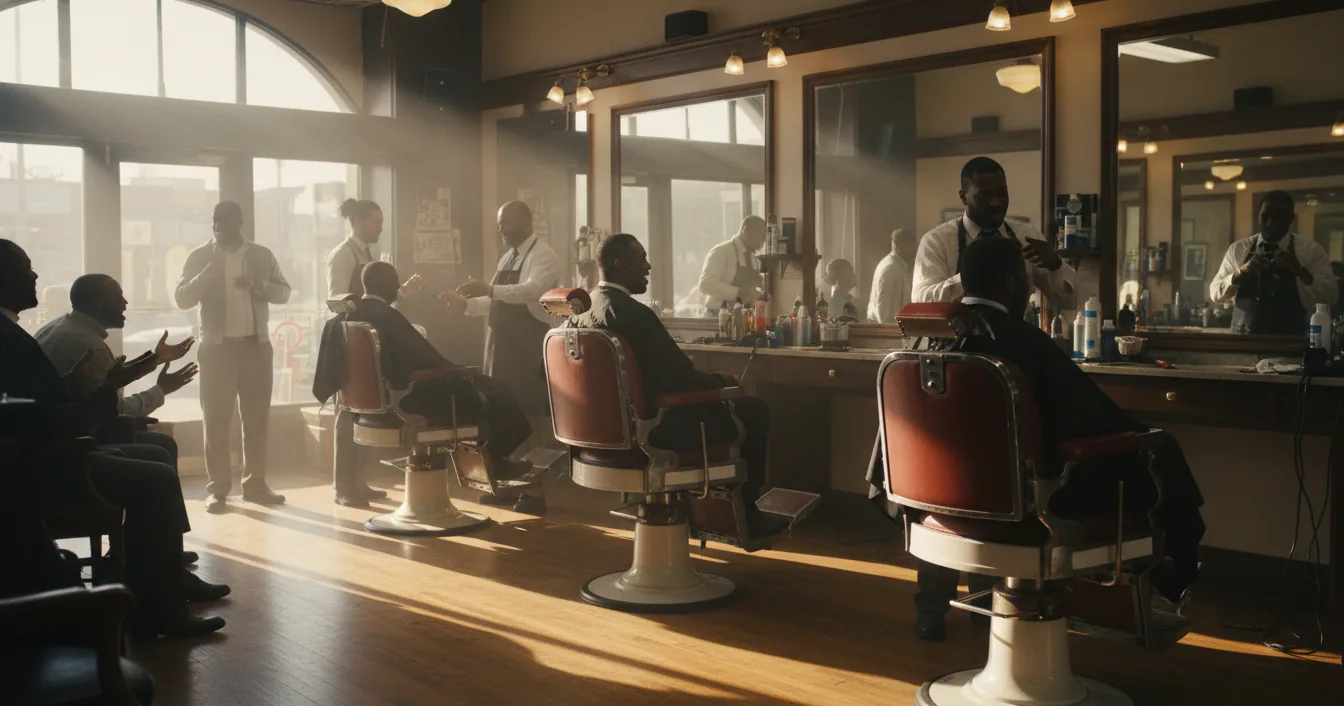
Walk into a Black barbershop on any given Saturday and the chairs are full, the clippers are humming, and the air is thick with conversation that has very little to do with hair. Someone is arguing about a basketball game. Someone is being told to get to a doctor about a knee that has been acting up. A teenager waiting for his first lineup is being teased by men two and three generations older than he is. This room is one of the oldest and most resilient institutions in Black American life, and the haircut is only part of why people are here. As Dr. Asha Winfield put it while curating the Pressin’ and Curlin’ Through the Movement exhibit at LSU’s library in 2025, “Entrepreneurs are birthed there, politicians are birthed there. It’s never just been a space about beauty, it’s always been a space about community.”
That community function did not appear by accident. It was built deliberately, generation by generation, in response to the conditions Black Americans faced outside the shop door.
Post-Reconstruction Roots: A Door Into Black Entrepreneurship
The Black barbershop’s first chapter in the United States was, paradoxically, a story of cutting white hair. In the decades after Emancipation, a small group of skilled Black barbers built thriving “first-class” shops serving wealthy white clients in cities like Atlanta, Richmond, and Chicago. Alonzo Herndon, born into slavery in Georgia in 1858, used the wealth he accumulated from his Atlanta barbershop empire to found Atlanta Life Insurance Company in 1905, one of the most successful Black-owned businesses in American history. He was not alone. Across the late nineteenth century, barbering was one of the very few skilled trades open to Black men, and a sharp razor could be a path into the middle class when almost no other door was open.
By the early twentieth century, as the Great Migration moved millions of Black Americans into northern and midwestern cities, the customer base shifted. Black barbers increasingly served Black clients, in shops located in Black neighborhoods, and the institution became something fundamentally different. It became a Black space, owned by Black people, run for Black people. That ownership matters. As historian Quincy Mills argues in his book on the barbering trade, the shop was never merely a reaction to segregation. It reflected an active cultural life of mentorship, debate, and shared experience that would have flourished regardless of what was happening outside the door.
Jim Crow and the Safe Room
Under segregation, public space in America was hostile space for Black people. Restaurants, hotels, parks, transit, and even hospital waiting rooms were either closed off entirely or made deliberately humiliating. The barbershop became a kind of pressure valve. Inside those walls, Black men could speak freely about white employers, white police, white politicians, and the everyday indignities of life under Jim Crow without worrying who was listening. They could read a Black newspaper that the corner store did not stock. They could laugh loudly. They could cry quietly. The barbershop offered something that white America did not extend to Black citizens in the public square: dignity, on their own terms, in their own room.
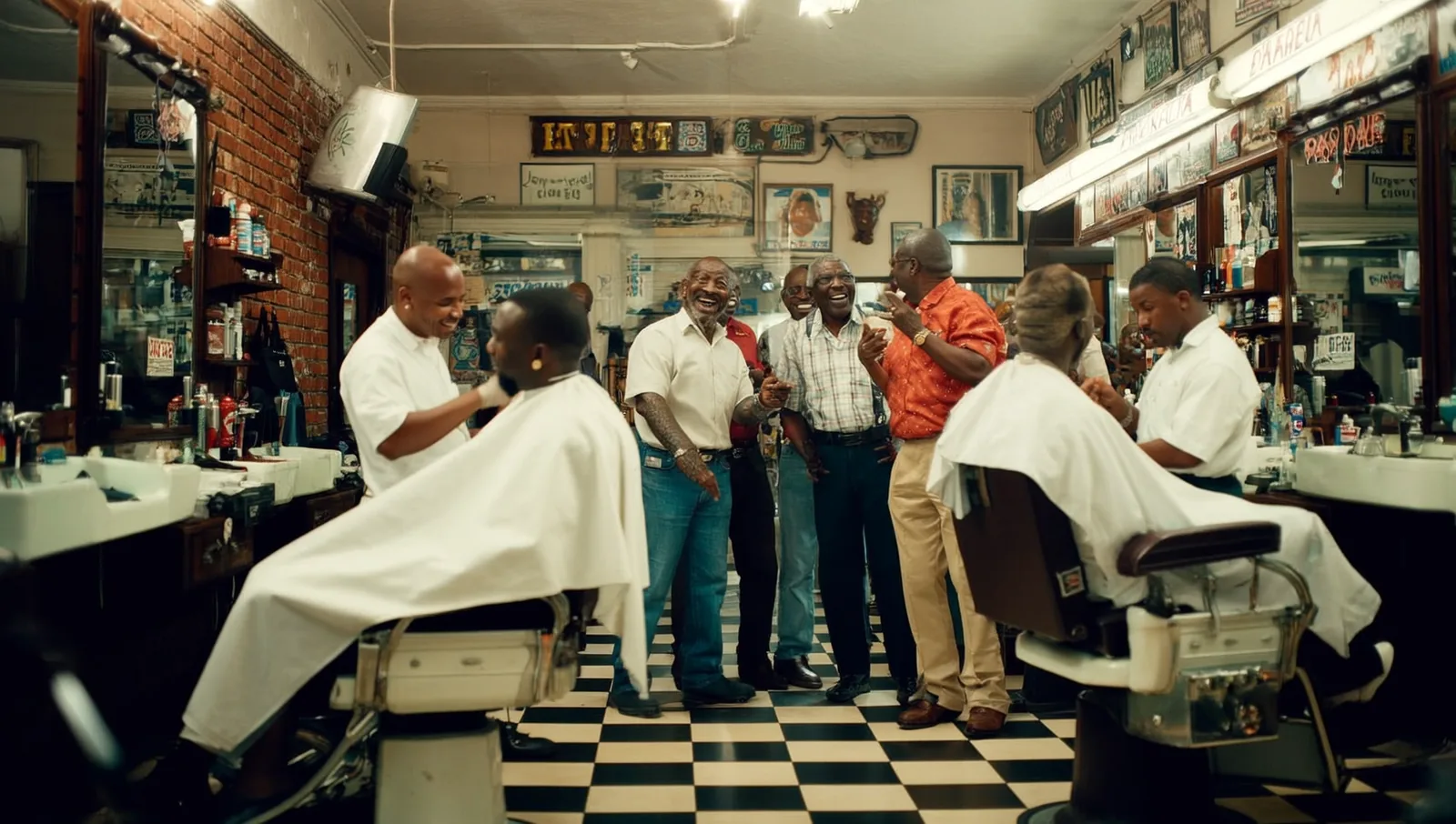
This is why a haircut in a Black shop has never carried the same social weight as a haircut in a chain salon. The relationship between barber and client is built across years, not minutes. The barber who knows how your hair grows also knows your daughter’s name, your father’s funeral, the year you lost your job and the year you started a new one. Working with Type 4 coils and curls demands the kind of technical mastery that only comes from a skilled barber who specializes in textured hair, but the trust that builds across the chair is a separate and equally trained craft.
The Shop During the Civil Rights Movement
When the Montgomery Bus Boycott began in 1955, when SNCC organizers fanned out across the Mississippi Delta in the early sixties, when Black Power chapters were forming in Oakland and Chicago, organizers needed places to meet that were Black-owned, Black-staffed, and reasonably free from white surveillance. Churches were the most famous of those places. Barbershops were the most consistent. They were open six days a week, kept long hours, drew foot traffic from every part of the community, and hosted conversations that no membership list could capture. A flyer for a meeting could sit on the counter next to the talcum powder. A voter registration drive could be discussed between buzzes of the clipper.
As The Guardian noted in its 2024 coverage of Kamala Harris’s outreach to Black men, “A product of segregation, the Black barbershop is as much a symbol of Black entrepreneurship as it is a safe space for Black men to socialize and strategize, at no point more so than during the civil rights movement.” That dual identity, business and movement, has shaped how the shop functions to this day.
Care Beyond Hair: The Informal Therapy Room
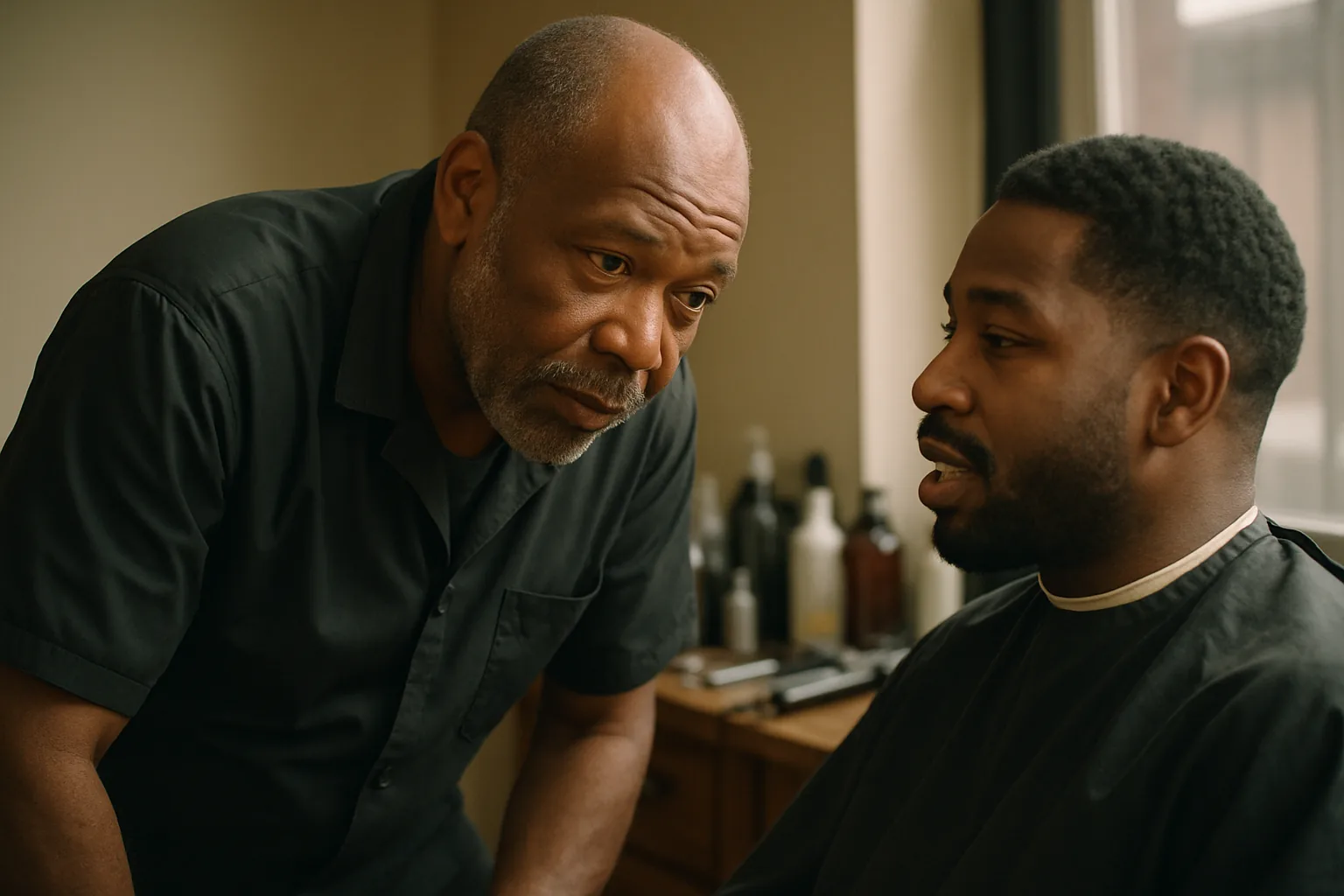
Pierre Johnson, an OB-GYN in Chicago, spent years working as a barber before he went to medical school. “The barbershop was therapy for a lot of people,” he told WHYY’s The Pulse. “A lot of people didn’t even really need haircuts at the time. They’d come in just to have conversations and to tell their problems and get advice.” Mike Jordan, a barber at South Street Barbers in Philadelphia, has said much the same thing: “Barbering is not just cutting hair. You got counseling, advising, you get friendships. It’s a lot of different things that go on in a barbershop.”
Public health researchers have noticed. Hypertension screening programs run out of Black barbershops have produced some of the strongest results in cardiovascular outreach to Black men. Prostate cancer awareness campaigns partner with shops because the captive audience and the existing trust shorten the distance between a flyer and a phone call. Hair loss conversations happen there too, because a sharp barber will catch the early signs of traction alopecia or other tension-driven scalp damage before the client even thinks to ask a dermatologist. The shop is, in its informal way, a clinic, a counseling office, and a financial-advice corner all running on the same hour-long appointment.
The Shop on Screen and in Pop Culture
Hollywood eventually caught on. Coming to America (1988) gave the world Eddie Murphy’s affectionate parody of an old-school New York shop and its cast of regulars. The Barbershop franchise that launched in 2002 with Ice Cube and MGM turned the daily rhythm of a Chicago South Side shop into a mainstream hit, spawning two sequels and the spin-off Beauty Shop with Queen Latifah. LeBron James launched The Shop on HBO in 2018, transplanting the freewheeling conversational format into a televised setting where athletes, musicians, and politicians sit for a “haircut” that is really a long-form interview. Each of these productions trades on the same understanding: the Black barbershop is a place where Americans expect honesty, expertise, and a particular kind of frankness that does not survive in many other rooms.
Politics Comes Through the Door
Every recent Democratic presidential campaign has made a stop at a Black barbershop. Barack Obama made it a recurring ritual in 2008 and 2012, including a 2012 South Carolina stop where he reportedly traded the dozens with waiting customers before grabbing a quick shape-up. In 2024, Kamala Harris took a different angle, telling The Guardian, “I’m all about straight talk, and there’s no better place to do that than in the barbershop,” before pivoting much of her outreach to barbershop-adjacent Black media spaces like Charlamagne tha God’s Breakfast Club and Roland Martin’s daily digital show. Actor Wendell Pierce ran a six-week tour of barbershop conversations in key districts to drum up voter enthusiasm. Even Donald Trump made a barbershop appearance in the Bronx that fall. The trope is so embedded in American politics that candidates of both parties now reach for it.
Museums, Universities, and the Long Memory
The institution is now being recognized in the rooms that historically kept it out. The Smithsonian’s National Museum of African American History and Culture features the barbershop and beauty salon as central community spaces in its permanent collection. University exhibits like Pressin’ and Curlin’ Through the Movement bring shop chairs, tonics, and clipper kits into academic libraries, treating the daily practice as the cultural history it has always been. Students at the University of Toronto in 2025 reflected on a campus Black barbershop event as a space “built by Black people, for Black people,” a phrase that captures the throughline from Alonzo Herndon’s Atlanta to a student common room in Toronto.
Why It Still Matters
The Black barbershop is one of the very few American institutions that has continuously served the same community, in the same way, for more than a century. It survived Jim Crow. It survived urban renewal. It survived the chain-salon boom of the 1980s and the digital disruption of the 2010s. It is still the place where a fresh fade or a careful taper and an hour of conversation cost less than a therapy session and often do more work. For shop owners trying to articulate why their craft matters, the answer is simple. They are not running a salon. They are stewarding one of the longest-running community institutions Black America has ever built, and every cut is part of that record.
Further reading (sources)
- The Guardian on Kamala Harris and the evolving role of the Black barbershop in American politics
- WHYY The Pulse with the barbershop as care beyond hair
- LSU Reveille for Pressin’ and Curlin’ Through the Movement, an immersive Black barbershop exhibit
- EBONY Magazine on the Black films that celebrate shop culture
- San Francisco Chronicle with why barbershops are a haven for Black men
- Central Illinois Proud for Shop Talk, Black barbershops and hair salons as community hubs
- The Varsity on students reflecting on a Black barbershop built by Black people, for Black people
- National Museum of African American History and Culture on the community roles of the barber shop and beauty salon