Living With Hair Loss on Black Hair: Styling, Camouflage, and Daily Care While Treatment Works
Published on November 2, 2026
The dermatologist has named it and written the plan. Now comes the part nobody hands you a leaflet for: the months, sometimes years, before the mirror catches up. Most hair loss treatment works slowly. “Patience is key,” dermatologist Crystal Aguh tells patients in an American Academy of Dermatology (AAD) feature on hair loss in Black women, and the academy is honest that not everyone regrows everything, although treatment still puts you back in control of the condition. With a scarring condition, the aim is to stop the spread, not to bring back what is gone.
Meanwhile life goes on: wash days, work, weddings, a barber appointment every two weeks. This guide covers that stretch. How to wash and handle thinning hair without losing more of it, the cuts and styles that take the pressure off, every way to cover it, from a powder that rinses out tonight to scalp micropigmentation that lasts for years, and what a barber or stylist can do at the chair. If you do not know yet what kind of loss you have, start with our complete guide to Black hair loss, because the right cover depends on the diagnosis.
Diagnosis First, Then Disguise
When hair starts to go, the AAD says, people often try to hide it by changing their part or hairstyle, buy products that claim to restore hair, or take supplements sold for hair growth. Some women also cut back on how often they shampoo. The results, it says, are modest at best and rarely get to the root of the problem. MedlinePlus, the National Library of Medicine’s consumer health site, puts the alternative in one line: treatment for hair loss depends on the cause.
That is the case for a diagnosis before a disguise. A patch colored in with spray, or a widening part hidden under a unit, is a patch nobody is watching, and nobody can tell whether it is spreading. Once a dermatologist has named it, cover it however you like, or not at all. The AAD tells Black women plainly that they do not need to cover hair loss, but that if it is affecting their self-esteem, a stylist can help them choose an option that gives them back their style and sense of self. Dermatologist Oma Agbai adds the message she most wants Black women with hair loss to hear: don’t blame yourself. Many people assume Black women cause their own loss through their styling, she says, when what decides the outcome is an accurate diagnosis and early treatment.
A Wash Day That Doesn’t Cost You Hair
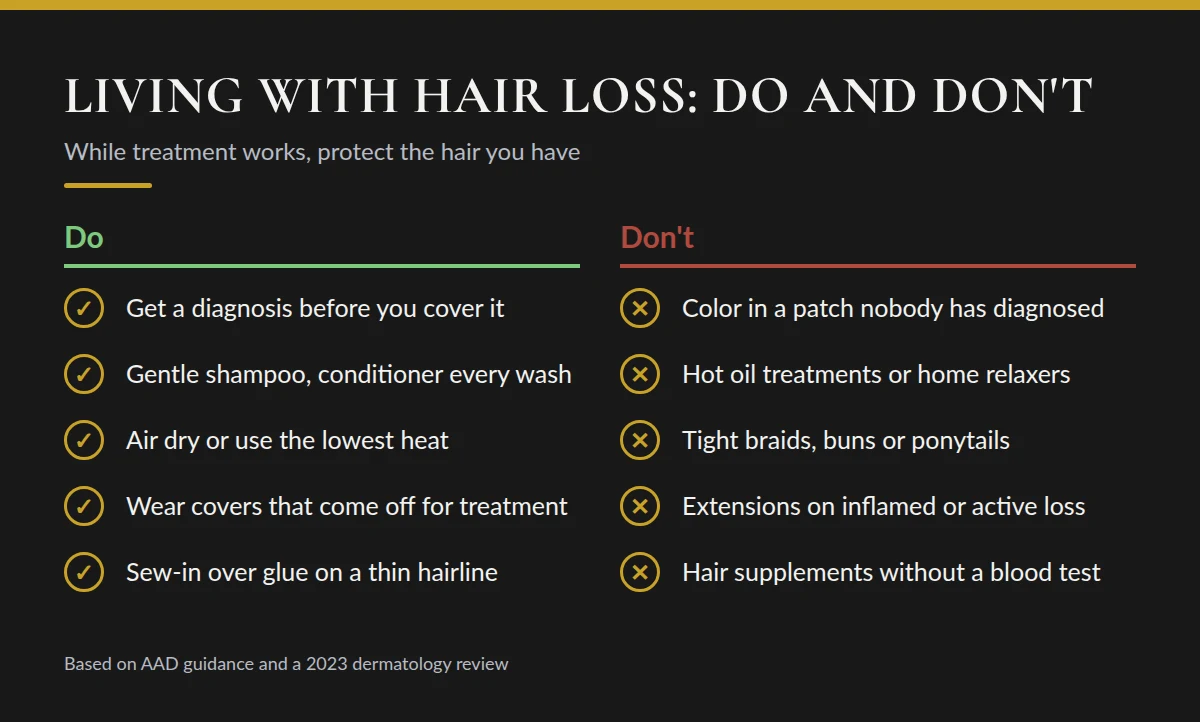
Hair that is thinning or falling out is fragile and easily damaged, the AAD warns. Its advice for patients with hair loss reads like a gentler version of a good Type 4 wash day:
- Gentle shampoo, then a moisturizing conditioner every time. Some shampoos strip moisture from the hair. Conditioner coats the strands, which cuts breakage and split ends.
- Leave-in or detangler after every wash. It reduces breakage, split ends and frizz. Detangle with it in, and comb or brush only as much as the style needs, because tugging while you comb can pull hair out.
- Microfiber towel, then air or the lowest heat. Wrapping wet hair in a microfiber towel helps it dry faster, so the blow dryer runs for less time. Let it air dry when you can.
- Skip the hot oil treatment for now. Many Black hair routines swear by one, but the AAD tells patients with hair loss to forgo them, because they heat hair that is already fragile.
- Save the flat iron and hot comb for occasions. The AAD’s examples are a wedding or a job interview.
- No relaxers, color or perms at home. If you want a chemical service, have it done at a salon whose professionals examine your scalp and hair first and finish with a moisturizing conditioner.
- Hands off. Twisting hair around a finger or pulling at it weakens hair that is already fragile.
Don’t panic at the sink, either. Losing up to 100 hairs a day is normal, according to MedlinePlus, and coils tend to hold on to shed hairs until the comb goes through, so a week of ordinary shedding can come out in one wash. Washing less to save hair is not the answer: it is on the AAD’s list of things people try that rarely help.

What you eat matters too. Too little iron or protein can lead to hair loss, the AAD says, and so can eating too few calories. Before you buy a hair supplement, it suggests a blood test to see whether you are actually short of anything. Supplements are not reviewed by the FDA for safety or effectiveness before they go on sale, and too much selenium, vitamin A or vitamin E has been linked to hair loss. If you smoke, stopping helps, since smoking causes inflammation throughout the body that can make hair loss worse.
Styles That Take the Pressure Off
Whatever caused the loss, pulling on the hair that is left only adds to it. The AAD tells patients to stop wearing their hair tightly pulled back in a bun, ponytail, pigtails, cornrows or braids, because a style that pulls can cause traction alopecia, and in time anything that pulls can cause permanent loss.
- Go shorter. A tapered natural cut, close at the sides with a little length on top, puts no tension on the scalp and narrows the difference between thin and full areas, which is what the eye picks up.
- Move the part, or lose it. Female pattern hair loss starts around the part, the AAD notes. A side part, or a twist-out or wash-and-go worn with no part at all, shows less scalp.
- Men: take away contrast. Short, even lengths, a low taper rather than a high skin fade, a matte product instead of shine, and a beard to carry the weight. Our guide to cutting for a thinning crown has the guard-by-guard version, and a bare patch from alopecia areata can often be blended into a lower fade or covered with texture on top.
- Be careful with extensions. Taye and colleagues, dermatologists at Emory and Johns Hopkins who reviewed hair camouflage for Black women in 2023, discourage extensions for anyone with traction alopecia, even a mild case, and call them unsuitable for inflammatory hair loss or active alopecia areata. The strain is easy to miss: in one study they cite, all 12 women examined who wore extensions and had no hair loss complaints showed broken hairs and signs of traction. If you wear them anyway, choose loosely sewn-in or microring extensions over glue, keep them no longer than shoulder length, and wear them for three to four weeks at a time, then wear your own hair for the same stretch.
Covering It: From a Wash-Out Powder to Scalp Micropigmentation
Covering hair loss is nothing new and nothing to apologize for. Wigs and added hair go back to ancient Egypt, Taye’s team notes, and about half of Black women are adding to their natural hair in some way at any given time, according to a 2015 study they cite. Their warning is the reason for this section: many camouflage methods rely on adhesives, chemicals or tight braiding, and all three can make alopecia worse.
One rule matters most while treatment is still running: choose a cover that comes off easily. For traction alopecia, CCCA and frontal fibrosing alopecia, early treatment often means medicine applied to the scalp and steroid injections into it, the review explains, and both need a scalp you can reach.
Powders, sprays and fibers
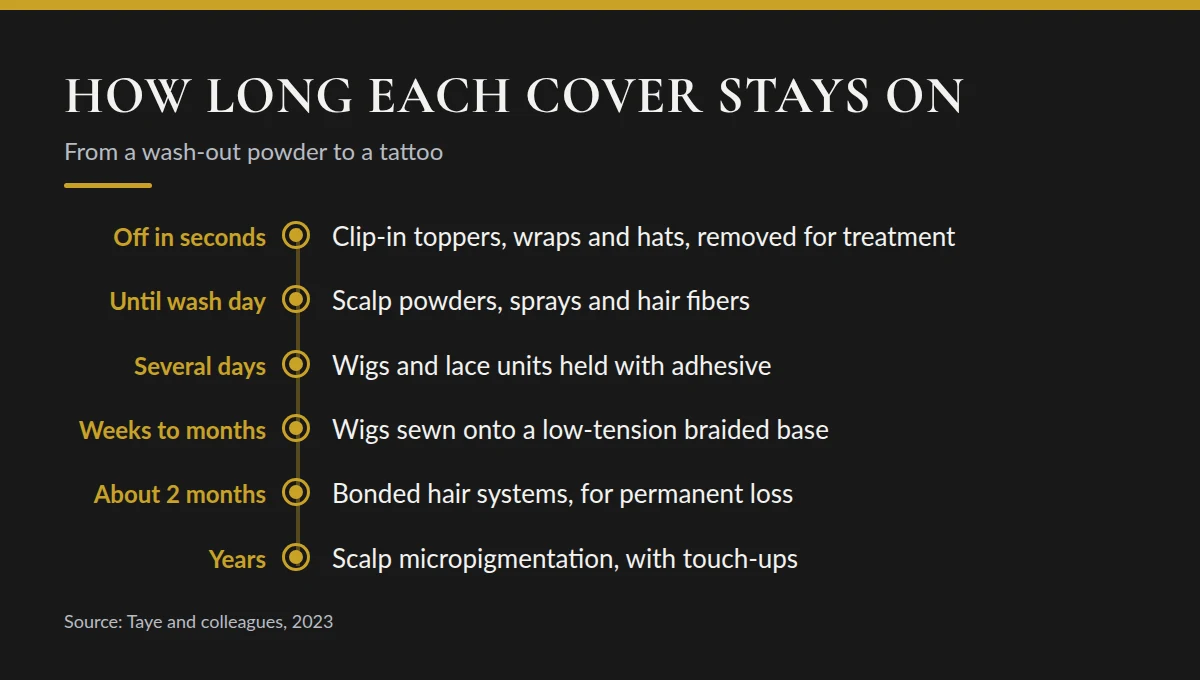
Scalp powders, sprays and lotions coat the skin with color so it shows less through thin hair. Hair fibers go a step further: tiny strands, often made of keratin, that cling to the hairs you have through static charge. They are sprinkled on after styling, set with hairspray and combed through, and they make thin hair look fuller until the next wash. Because fibers need hair to hold on to, they suit mild to moderate thinning, not a bare patch. Creams and gels make them clump, and they rub off on pillows.
For textured hair, Taye’s team adds two rules. Put any scalp medicine on a clean scalp first and let it dry completely before the fibers go on. And use a light hand with an applicator, because a weekly or biweekly wash routine layered with other products makes clumping more likely. They are also frank that fibers have barely been studied on textured hair.
Toppers and clip-ins
A topper is a partial hairpiece that adds coverage and volume where the top is thinning, the American Cancer Society (ACS) explains. Clips give instant coverage and come off quickly, which suits patchy loss and a treatment schedule. The catch is the hair they grip: clips can break fragile hair with repeated use, Taye’s team warns, particularly where traction loss or breakage is already present. Take them off slowly and keep an eye on the hair under each clip.
Wigs and units
A wig can be one of the gentlest styles you can wear or a daily strain hidden from view, depending on how it is attached, as our protective styles guide explains. Wigs held with adhesive usually stay put for several days, while sewn-in wigs can stay in for weeks or months, Taye’s team writes, and a full-cap unit makes the scalp hard to wash for as long as it is on.
- Glue is the riskiest choice for a thinning hairline. Pulling adhesive off can take hair from the front hairline with it, and the acrylate glues used to fix lace units have been linked to allergic contact dermatitis, the same acrylates our eczema guide flags in bonding adhesives. A unit sewn onto low-tension cornrows may be easier on the hairline, the review suggests, and the ACS recommends a cushioned wig grip band to hold a wig securely and comfortably.
- Braid down loose, and change direction. Braid with minimal tension, and alternate the direction of the braids between installs, front to back one time and side to side the next. Any discomfort, pulling, redness or pus bumps means loosen them now.
- Line it and feed what is underneath. A silk cap cuts friction between the wig and your hair. Leave-in conditioner several times a week and a wash every one to two weeks keep coils from drying out and breaking under the unit.
- Buy for fit. The ACS suggests an adjustable wig, checking the return policy before you buy, and having a stylist trim and thin the wig so it looks natural. A lace front gives a natural-looking hairline, and a monofilament top, a fine mesh that mimics the scalp, lets you part the hair in different directions.
Good wigs are not cheap. In a 2023 case report, a team including Mayo Clinic dermatologists put synthetic wigs at $30 to $500 and human hair wigs at $800 to $3,000. Their patient, a 70-year-old woman with CCCA, paid for hers after her insurer refused to cover it. With the wig, her depression score fell from 6, the mild range, to 1, and she began going to social events and volunteering. The authors published a sample appeal letter that doctors can send to insurers. The ACS suggests asking your insurer whether it covers a cranial prosthesis for medical hair loss: many insurers want a letter or prescription from your doctor, and some pay part or all of the cost or reimburse you after you buy.
Bonded hair systems
For loss that is permanent and finished, a custom hair system can be bonded to the scalp with strong adhesive and worn around the clock, washed and styled like your own hair, for about two months at a time, according to Taye’s review. Men often know them as units, and some barbers now fit and cut them. Because they stay on for weeks, they suit loss that has run its course rather than a scalp that still needs medicine every day, and contact dermatitis from the glues, though uncommon, has been reported.
Scalp micropigmentation
Scalp micropigmentation (SMP) is a cosmetic tattoo. Pigment is placed between the hair follicles in a stipple of tiny dots that resembles closely cut hair, as University of Miami dermatologists describe it, so it suits someone who wears a close cut, and it can also give the impression of follicles where density has dropped or disguise a scar. Taye’s review lists it for scarring alopecias, alopecia areata that has not responded to treatment, pattern hair loss and scalp scars, and notes that the plan should account for the lower follicle density and finer hair shafts typical of Black scalps.
It is also a tattoo, with a tattoo’s risks. The FDA treats tattoo inks as cosmetics and has approved no color additive for injection into the skin, and tattooing itself is regulated locally, so the rules on who may perform SMP depend on where you live. The FDA’s list of complications includes infection, allergic reactions, granulomas (nodules that form around pigment) and keloids: if you are prone to them, a tattoo can start one, and as our keloids guide explains, Black skin forms them more readily. Pigment placed too deep can migrate and blur. Taye’s team adds repeat sessions and touch-ups, and two things to weigh before the first dot: the hair around it may go grey, and the loss may keep moving while the dots stay where they are.
Removal is harder than application. The FDA calls tattoo removal a painstaking process that usually takes several treatments and considerable expense, and says complete removal without scarring may be impossible. In a Korean series of 120 people treated for SMP results they were unhappy with, Park and colleagues report fixes that ranged from laser removal and a fresh session to, most often, a hair transplant to cover the tattoo.
Before booking, ask to see healed work on scalps with your skin tone and hair color, ask how many sessions and touch-ups to expect, and talk to your dermatologist first if you have a scarring condition or form keloids. A transplant is a separate decision, and for an inflammatory scarring alopecia Taye’s team advises waiting until the disease has been quiet for at least one to two years, because the surgery itself can set off a new flare. For eyebrows lost to frontal fibrosing alopecia or alopecia areata, the same review covers microblading, a semipermanent cousin of SMP that lasts 12 to 18 months.
Wraps, scarves and hats

The simplest covers still work. A head wrap, a scarf or a hat hides everything, comes off for treatment and costs little. Tie it over hair that sits loose underneath rather than pulled tight, and choose a silk or satin lining, much like the silk cap dermatologists suggest under a wig. On a bare or thinning scalp, a hat outdoors also keeps the sun off skin that hair used to shade.
What a Barber or Stylist Can Do at the Chair
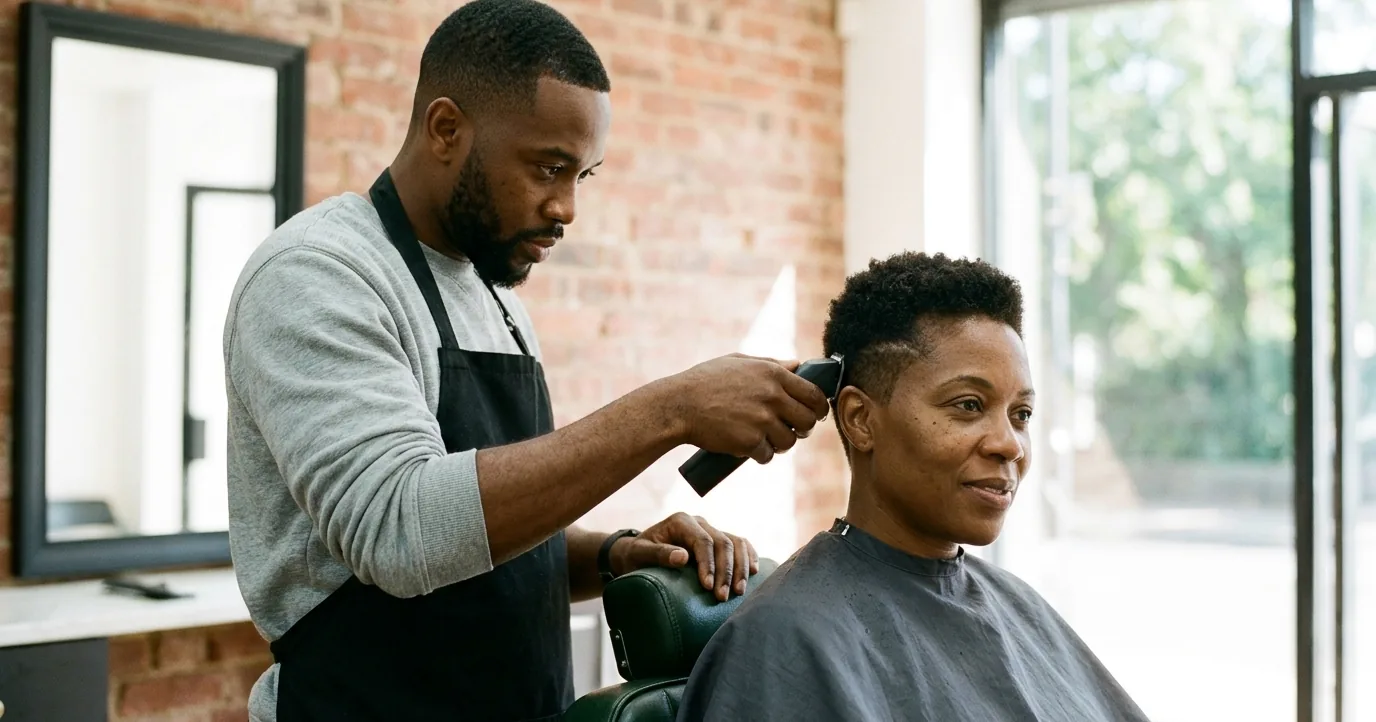
Only a board-certified dermatologist is trained to recognize and treat scalp disease, Dr. Aguh says in the AAD feature, “however, there is a role for stylists.” Treatment plans take time and effort, and a stylist can support them with hair care that puts less stress on the follicles, or take over the hair care for clients who are not comfortable doing it themselves. In practice, that looks like this:

- Keep the record. Photograph the area on the client’s phone at each visit, under the same light and at the same length. A dermatologist judging whether treatment is working will want to see them.
- Work around the treatment. Ask what the client puts on the scalp and when, and when injections are due. A glued unit or a tight braid-down over a scalp that needs medicine every day works against the plan.
- Cut for the cover. Blend the client’s own hair into a topper or unit so the edge disappears, trim and thin a new wig so it looks natural, and shape the cut so the part falls where the hair is fullest.
- Install low, look underneath. Loose braid-downs, a new braid direction each time, and a careful look at take-down for tender spots, redness, pus bumps, broken hairs where clips sat, or a sore hairline where glue was.
- Match the shade, and don’t hide the unknown. Fibers and powders go on after the cut, in a color that matches the hair, and never over a patch nobody has diagnosed.
- Give it privacy. A quieter hour, the chair at the end of the row, and no audience at the bench.
The Part No Treatment Plan Covers
Hair loss is rarely only about hair. The AAD notes that women report lower self-esteem and more anxiety and depression after their hair starts to go, and that counseling can help when it reaches that point. Support groups connect you with people who already understand what you are going through. Dr. Aguh points her patients to the National Alopecia Areata Foundation and the Scarring Alopecia Foundation, and any dermatologist can suggest others.
It is also worth finding a doctor who understands your hair. In one study Taye’s team cites, more than half of 200 Black women reported excessive hair loss, and only 32 percent of those felt their physician understood Black hair. Ask any new dermatologist about their experience with textured hair before you commit to a treatment plan.
The Bottom Line
Living with hair loss is a long game played one wash day at a time. Get the diagnosis before the disguise. Wash gently, condition every time, and keep the heat low and the tension lower. While treatment is running, choose covers that come off: powders, fibers, a topper on clips, a wig that sits rather than grips. Save glue, bonded units and the permanence of scalp micropigmentation for loss that has settled, and go in knowing the risks, especially if you form keloids. And lean on the people around you: a barber or stylist who works with your treatment plan, a dermatologist who knows textured hair, and a support group for the harder days.
Further reading (sources)
- American Academy of Dermatology on what dermatologists tell patients to do while managing hair loss
- American Academy of Dermatology with how dermatologists and stylists support Black women with hair loss
- MedlinePlus for an overview of hair loss causes and treatment
- Taye, Kamili, Aguh and Krueger on camouflage options for Black women with alopecia
- Chan, Coias and Wyles with a wig’s effect on quality of life in CCCA, plus an insurance appeal letter
- American Cancer Society for choosing, fitting and paying for a wig
- Nguyen, Mervis, Romanelli and Tosti on what scalp micropigmentation looks like up close and under the microscope
- Park and colleagues for correcting unsatisfactory scalp micropigmentation in 120 patients
- U.S. Food and Drug Administration on tattoo and permanent makeup risks, including keloids