Cutting for a Thinning Crown: How Barbers Work With Male Pattern Hair Loss in Black Men
Published on October 31, 2026
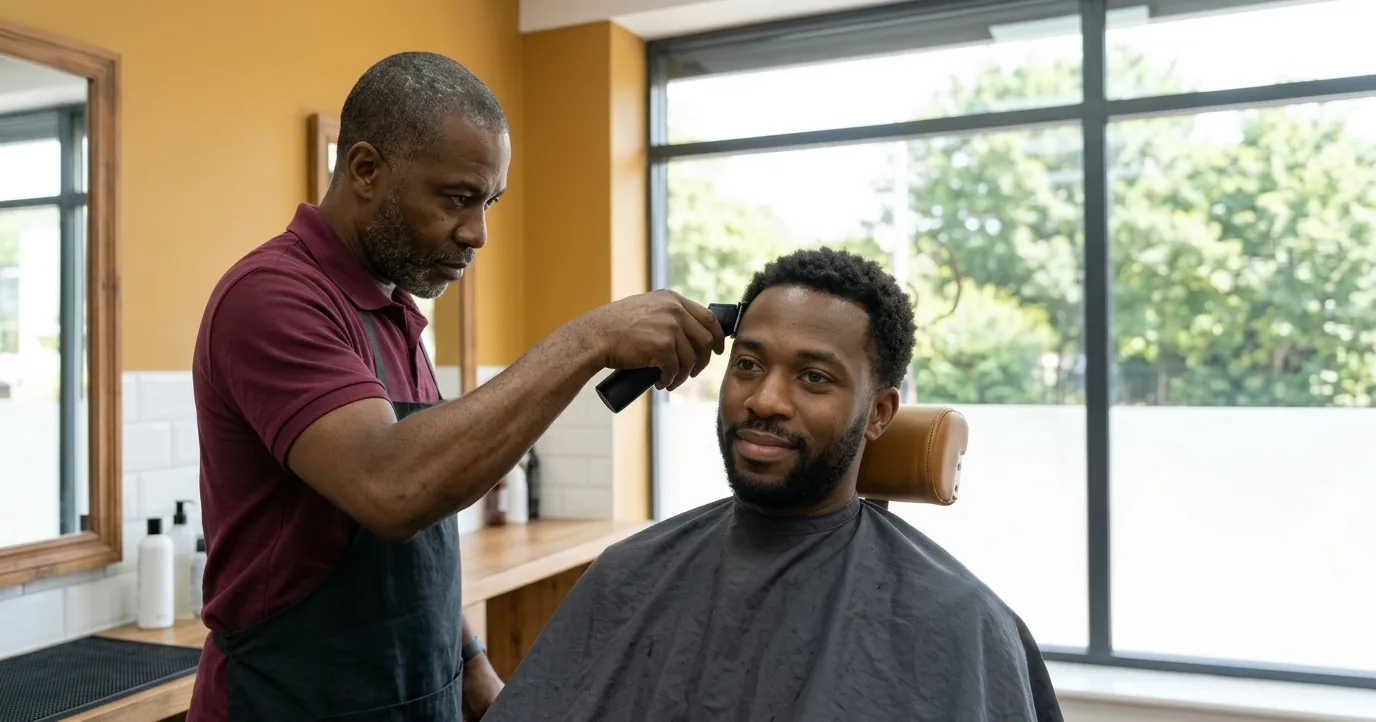
“Be honest with me. Is it going?” Sooner or later every barber hears it, usually from a regular in his late twenties or thirties who has started angling his phone over the top of his head. Just as often the barber noticed first: the corners of the lineup sitting a little higher than they did last year, or a crown that used to disappear under a #1 guard now showing scalp under the shop lights.
Most of the time the answer is male pattern hair loss, the hereditary kind, which the American Academy of Dermatology (AAD) calls the most common cause of hair loss in men. It does no harm on its own, and the AAD says nobody has to treat it. But it changes the haircut, it changes the lineup, and it raises a question barbers hear before doctors do: is this worth seeing someone about? This guide takes all three, for barbers and for the men in their chairs. Our complete guide to Black hair loss gives pattern loss a single paragraph. This one is about what to do with the clippers.
How Pattern Loss Shows Up on a Black Man’s Head
Dermatologists call it androgenetic alopecia, and it works by miniaturization, as Janivara and colleagues explain: the follicles above the temples and on the crown shrink over time, so the hair they grow comes in finer and shorter until the area thins out. The AAD says it can start in the late teens or early twenties, though it usually shows later, and that it begins as a receding hairline or a bald spot on top and moves slowly, over years. Doctors stage it on the Hamilton-Norwood scale, which runs from a barely moved hairline to a bare top ringed by hair at the sides and back.
Much of what is known about it comes from men of European descent, Janivara’s team notes. The AAD’s often quoted figure, that more than half of men show visible signs by age 50, is a figure for white men specifically. Studying 2,136 men from Ghana, Nigeria, Senegal and South Africa, Janivara and colleagues found that genetic scores built from European studies predicted baldness in African men barely better than chance, and they point out that men of non-European descent are more likely to keep their frontal hairlines. For a barber, that makes the crown worth watching as closely as the corners.
On coily hair, early thinning shows as texture before it shows as skin. The crown hairs come in finer and shorter than the hair around them, the cut there looks a shade lighter, and a guard that used to leave solid cover starts to show the scalp. On a 360 wave client, the crown is where the swirl starts, so thinning there shows up as waves that will not connect.
Not every higher hairline is loss, either. Hairlines change shape between childhood and adulthood, and Rassman and colleagues describe that maturing as normal, so the edge a man had at sixteen often looks different at twenty-five. Telling the two apart takes time and a trained eye. Dated photos taken a few months apart, at the same guard length, show what is happening better than any single look in the mirror.
Cuts That Hide It and Cuts That Expose It
Every rule in this section comes from one idea: the eye catches contrast, not hair count. A thin crown is obvious when it sits inside longer, denser hair, and a receding corner is obvious when a hard line frames it. Take the difference away and the same density reads as a haircut.
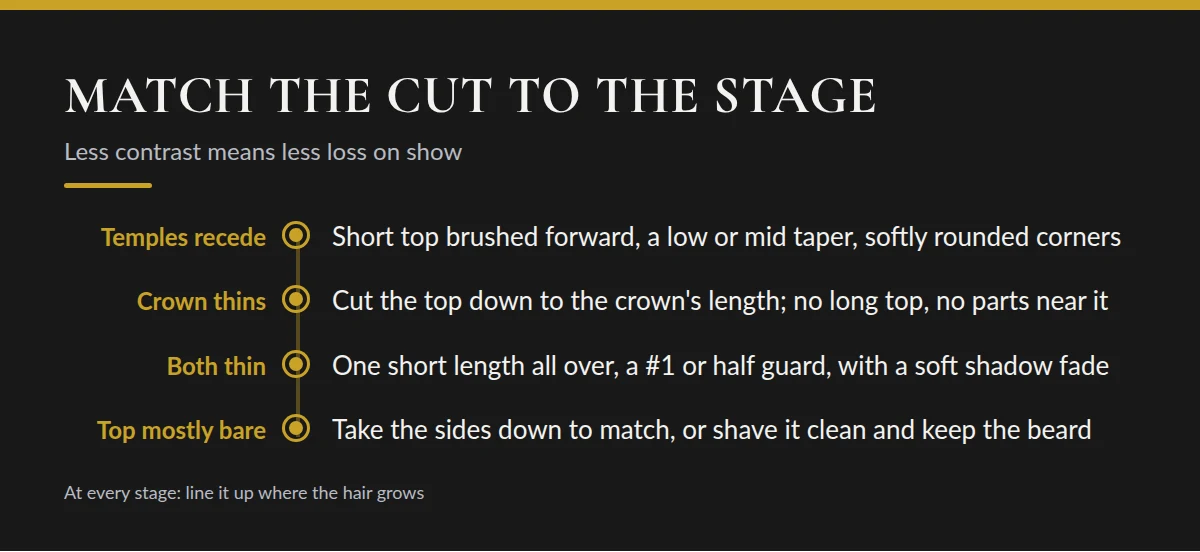
- The temples start to go. Keep the top short and brush it forward. A Caesar’s forward fringe softens the corners, the advice our haircut dictionary gives for a receding hairline, alongside its guard numbers. Choose a low or mid taper over a high skin fade, because a high fade takes away the side hair that frames the temples and leaves the corners standing alone.
- The crown starts to show. Bring the top down to the length of the crown rather than leaving extra length that parts and separates over it. Long sponge twists, a high top and any top long enough to split will open up exactly where the hair is thinnest. Keep parts and designs well away from the crown, since a shaved line points straight at it.
- Front and crown thin together. One short length all over, a #1 or a half guard, blended into a soft shadow fade at the sides. The whole head reads as a deliberate low cut, and nothing stands out as the weak spot.
- The top is mostly bare. Do not leave a dense ring around it. A thick horseshoe at the sides and back is about as much contrast as a head can carry. Take the sides down to match the top, or move to the clean shave below.
A high skin fade with a short top is not off limits, and on a full head it is one of the sharpest cuts in the shop. On a thinning top it puts bright bare skin right beside the weakest zone, and the top looks thinner for it.
Two details finish the job. Shine shows scalp: a high gloss grease, gel or wave pomade bounces light off the skin through thinning hair, while a matte product, or none, keeps it reading as hair. And a beard is the best counterweight a thinning top has. It moves the eye down and puts density where the hair still grows well, so keep it shaped, even and dense.

Lining Up a Hairline That Is Moving
The lineup is where a barber can help most, and hurt most.
- Cut it where it grows. Edge the natural hairline, never a millimetre behind it. A line taken a little farther back every visit moves the visible hairline back on its own, without a single follicle lost. Clients have a phrase for it, “my barber pushed my hairline back”, and on a man who is already receding it adds years.
- Round the corners. A hard square corner at the temple draws a frame around exactly the spot that is receding. A soft, slightly rounded corner reads as natural. Hair restoration surgeons aim for the same thing: a gradual, irregular front edge looks real and a ruler-straight one looks artificial, as our guide to hair transplants for Black men explains.
- Keep the fine hairs at the edge. The thinner hairs along a receding front are still part of the hairline. Shaving them off for a crisper line makes the recession look deeper. A trimmer with a light touch keeps them, while a razor pass takes them off.
- Fill, do not draw. Many shops now offer enhancements, a spray, pencil or fiber that darkens and sharpens the lineup. Used lightly, in a matching color, to fill small gaps inside the existing edge, it can pass. Drawn as a new straight line out onto bare forehead, it reads as paint from across the room, and it comes off with sweat, rain and the pillow. Never color over thinning that nobody has looked at, because a hidden patch is one nobody is watching.
When the Clean Shave Makes Sense
For many men there comes a point when the top is mostly bare and the ring is all that is left, and a clean head looks far more deliberate than the ring. It is the client’s call. Offer it the way you would suggest any cut, not as a verdict, and let him come to it in his own time.
How it is done matters on coily hair. A foil shaver or a close trimmer leaves a trace of stubble and the least irritation. A blade gives the smoothest finish, but if a man gets razor bumps in his beard, a blade on the scalp is the likeliest way to give him the same bumps up top. Whatever the method, a bare scalp has lost its shade, so sunscreen or a hat joins the routine; our scalp health guide covers sun on a bald head and a fresh fade. And keep the beard: a shaved head with a well kept beard is a look, while a shaved head with a patchy one is a compromise.
Bringing It Up From Behind the Chair
A barber’s words land harder than most people’s, so pick them.
- Follow his lead. Some men want to talk about it and some do not. If he asks, answer straight. If he has not, one quiet sentence is enough, and never in front of the bench.
- Show, do not announce. Offer to take a photo of his crown on his own phone, then do it again in a few months at the same guard and under the same light. Dated photos are the best record of whether it is moving, and a dermatologist will want to see them.
- Keep it plain. “Your crown’s a little thinner than it was in the spring. Probably the regular kind, but if you want to hold on to what you’ve got, a dermatologist can tell you for sure, and the treatments work best early.”
- Do not sell a cure off the shelf. Even the store-bought minoxidil label says not to use it if your hair loss is sudden or patchy, or if you do not know the reason for it. The first step is a diagnosis, not a product.

Not Every Thinning Crown Is Pattern Loss
The look-alike that matters most is central centrifugal cicatricial alopecia (CCCA), the scarring condition best known in Black women, covered in our CCCA guide. Men get it too. Davis, Reid, Callender and Sperling reported three biopsy-proven cases in African American men in 2012 and urged doctors to consider it whenever a man’s crown is thinning and his scalp has symptoms. In 2023 Lubov and colleagues described three more Black men, aged 36 to 41, each with a thinning crown and a front hairline that held. They point out that classic pattern loss takes the temples before the crown, so a crown that goes while the temples stay is a clue. It is not proof, since Black men are more likely than white men to keep their frontal hairline with ordinary pattern loss too, and the two conditions can exist at once.
Other clues are what the client feels and what the barber can see: itching, burning, tenderness or pain; bumps, pus spots or scale; redness that on dark skin looks deep red or violet; and skin at the crown that has gone smooth, with the tiny follicle openings gone. Not every man has them, and one of Lubov’s three felt nothing at all. The team adds unexplained breakage at the crown as an early sign, notes that two of their three men wore locs, and says most people with CCCA wait months or years before seeking care. Ordinary pattern loss lacks those signs of inflammation, and scarring loss is the kind where waiting costs hair that will not come back.
Other causes have their own signs: the smooth round patches of alopecia areata, the scale of ringworm, thinning at the edges under heavy locs or tight braids. Shedding after a big event is another story again. The AAD notes that hair can regrow on its own after a major illness or surgery, or after losing 20 pounds or more.
At the appointment, a dermatologist will ask how long the loss has gone on and how fast it came, examine the scalp, the nails and any other area losing hair, and gently pull on the hair to see how it is growing and whether it breaks, the AAD explains. If a disease, a vitamin shortfall, a hormone problem or an infection is suspected, a blood test or a small scalp biopsy may follow. Sometimes there is more than one cause at once.
What a Dermatologist Can Offer
Pattern loss does not need treatment, the AAD says, but treatment can slow it, some men regrow a little, and the men who see the best results start soon after they notice. That last point is the real reason a barber’s early word matters.
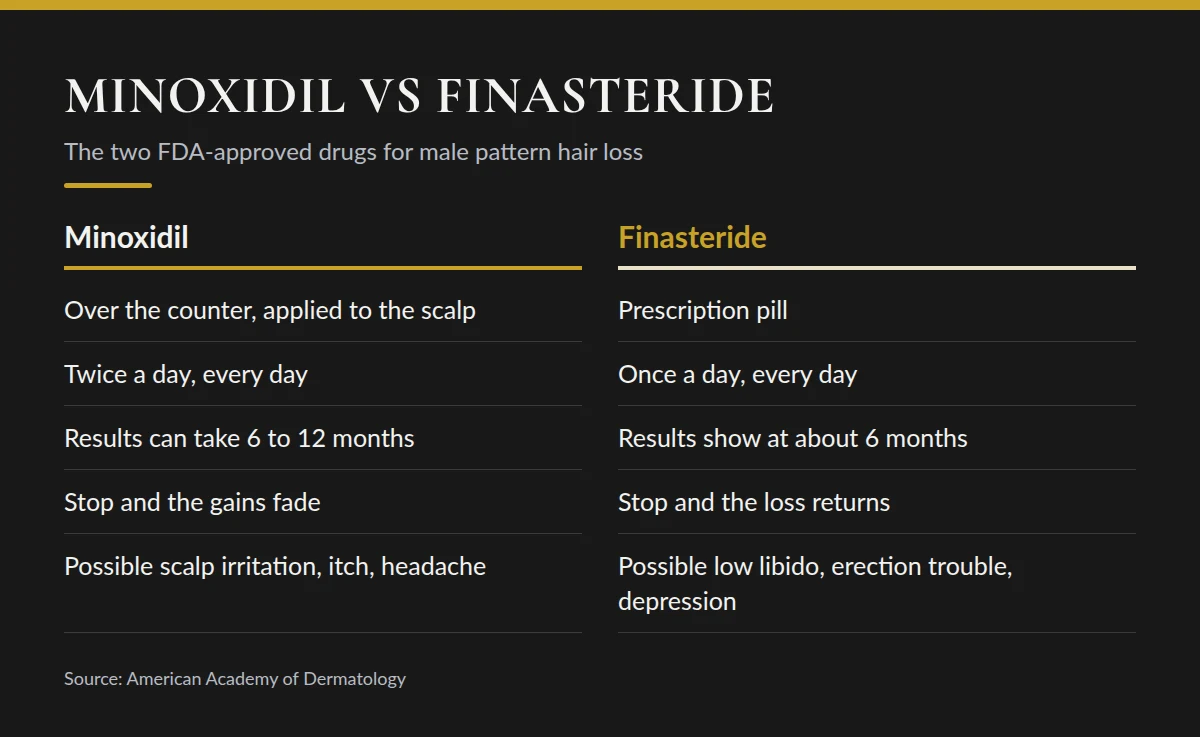
Minoxidil is the most widely used treatment, sold without a prescription and applied to the scalp twice a day, every day. Some men see results and some see no difference, results can take six to 12 months, and stopping gives the benefit back, so hairs thin again and shedding picks up, according to the AAD. Possible side effects include an irritated or itchy scalp and headaches, and the foam seems less irritating than the liquid. Read the Drug Facts label on men’s 5% foam before buying. It is labelled to regrow hair on the top of the scalp only, it says outright that it is not intended for frontal baldness or a receding hairline, it tells men with heart disease to ask a doctor first, and it warns that some people have seen changes in hair color or texture, which matters when a man’s coil pattern is part of his cut.
The formula matters. In a 2025 Johns Hopkins chart review of 66 Black women, Wyche and Aguh found that 44.7 percent had kept using store-bought minoxidil, against 84.7 percent on a compounded version with a steroid and a retinoid added, which also caused fewer side effects. The study was in women, but its conclusion, that the choice of formula affects whether people keep using it, is a fair question for any man to raise. Low-dose minoxidil pills are now prescribed off label too, and they are not automatically stronger: in a 2024 trial in Brazil that enrolled 90 men, Penha and colleagues found that 5 mg a day was not shown to work better than the 5% solution twice a day over 24 weeks, and nearly half the men on the pill grew unwanted hair elsewhere.
Finasteride is a prescription pill taken once a day. The AAD says it slows further loss in about 80 to 90 percent of men who take it, and results start to show at about six months. Side effects can include lower sex drive, trouble getting or keeping an erection, breast swelling or tenderness, and depression, and sexual side effects have been reported to continue after stopping. Stop the pill and the loss returns. The prescribing label also lists suicidal thoughts among the problems reported since approval.
The label shows how thin the evidence is for Black men. In a combined analysis of the two crown trials behind its approval, only 84 of the 1,351 men were Black. Those on finasteride gained an average of 49 hairs in the counted area while those on placebo lost 27. Among the 1,185 white men, the figures were a gain of 91 and a loss of 19. It worked, in other words, but in a group too small to say much more.
Finasteride also lowers PSA, the blood test used to screen for prostate cancer. In the label’s studies of the 1 mg hair loss dose in men aged 18 to 41, average PSA fell from 0.7 to 0.5 ng/mL over a year, and the label tells men to inform whoever orders a PSA test that they take it. That matters more for Black men than for most: the American Cancer Society says prostate cancer develops more often in African American men, and at younger ages. If your shop hosts a screening day, say so at the table.
The topical finasteride sold online is a different product. No topical version is FDA approved, so what is sold is compounded. In April 2025 the FDA warned that it had received 32 reports of harm from these products between 2019 and 2024, describing the same problems as the pill, including erectile dysfunction, depression, anxiety, brain fog and suicidal thoughts, mostly continuing after people stopped. Some users said they had been told a topical product carried no risk. The FDA also flags a bigger risk than with the coated pill: the product can rub off onto a woman, which matters in pregnancy.
Beyond the two drugs, the AAD lists platelet-rich plasma injections, given monthly for three months and then every three to six months, which help but are not permanent, and at-home laser caps and combs, noting that “FDA cleared” is a much lower bar than “FDA approved”. The permanent answer is a transplant, where the curl of the follicle changes how the surgery is done, as the transplant guide linked above explains.
The Bottom Line
Male pattern hair loss is common, slow and harmless in itself, and in Black men it does not always follow the textbook built on white men: the front is more likely to hold, so the crown deserves as much attention as the corners. The cut that hides it takes contrast away, with short, even lengths, low tapers over high skin fades, no long top splitting over the crown and a beard to carry the weight, then a clean shave once the ring is all that is left. The lineup should follow the hairline, never chase it back or draw it forward. And because the treatments work best early, and a thinning crown with an itchy, sore or shiny scalp may be a scarring condition, the most useful thing a barber can say is the plain thing: this is changing, and a dermatologist can tell you why.
Further reading (sources)
- American Academy of Dermatology on how male pattern hair loss is treated, from minoxidil to PRP
- American Academy of Dermatology with how dermatologists find the cause of hair loss
- Janivara and colleagues for the genetics of male pattern baldness in 2,136 African men
- Davis, Reid, Callender and Sperling on telling CCCA from pattern loss in African American men
- Lubov and colleagues with a case series of CCCA in Black men
- Rassman, Pak and Kim on how a normal hairline matures
- DailyMed for the Drug Facts label on men’s 5% minoxidil foam
- DailyMed with the finasteride 1 mg prescribing label, including PSA effects and results by ethnicity
- U.S. Food and Drug Administration on reported harms from compounded topical finasteride
- American Cancer Society for prostate cancer risk factors, including race
- Wyche and Aguh on compounded versus store-bought minoxidil in Black women
- Penha and colleagues with a trial of minoxidil pills against minoxidil solution in men