Why Black Hair Breaks Differently: The Science of Density, Curl, and Fragility
Published on June 1, 2026
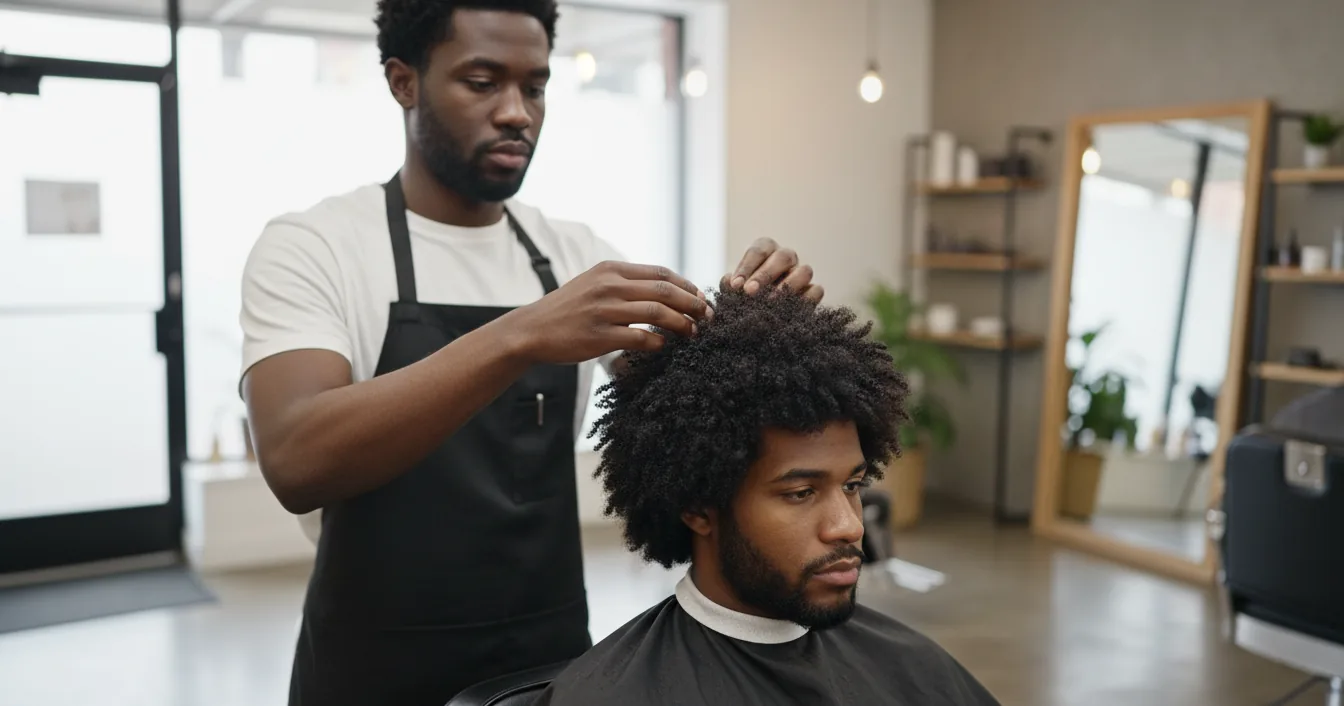
The Break Is Not Your Fault
Ask ten clients with Type 4 hair why it breaks and most will blame themselves: not enough oil, the wrong comb, a heavy hand at the last appointment. Some of that is fair. But underneath every product choice and every styling habit sits a set of structural facts that were settled before the hair ever cleared the scalp. Black hair is built differently at the follicle, along the shaft, and at every bend in the curl, and those differences are measurable in a dermatology lab, not just visible in the mirror.
This guide translates what the research actually shows about density, shaft shape, and fragility into the why behind the best practices barbers and stylists already follow. Understanding the structure is what turns a rule of thumb (be gentle, cut it dry, keep it moisturized) into a decision you can defend and adapt to the head in front of you.
A note up front: scalp and hair-shaft health is medical territory. Nothing here replaces a licensed barber or stylist, and a board-certified dermatologist or trichologist, ideally one experienced with textured hair, is the right call for any persistent breakage, shedding, or scalp concern.
The Numbers Start Lower
Start with a counterintuitive fact: a full, voluminous Afro usually grows from fewer follicles than a flat, fine head of straight hair. When researchers counted follicles in 4-millimeter scalp biopsy samples, they found total hair density significantly lower in African American scalps than in white scalps. The coil does the work of looking full. Pack a strand into a tight spiral and it occupies far more space than the same strand hanging straight, so the eye reads volume where the follicle count is actually lower.
That single fact reframes a lot of what happens in the chair. Lower density means less margin for error: thinning, an aggressive fade, or a patch of breakage shows scalp sooner than it would on a denser head. It also means apparent thickness and true density are not the same measurement, which matters when a client worries about shedding or a barber assesses coverage before a cut.
Growth adds to the picture. The same line of research that measured density also found a slower average growth rate, along with differences in shaft diameter and the number of broken hairs between African American and Caucasian hair, with no real difference in the hair cycle itself. Slower growth paired with higher breakage is a hard combination. Hair lost to a snapped shaft is replaced more slowly, so damage that would be invisible on faster-growing hair can read instead as a stall in length, the classic “my hair just won’t grow” that is often breakage in disguise.
A Ribbon, Not a Rod
Cut a straight-hair fiber across and the cross-section is close to a circle. Do the same to a tightly coiled fiber and you get a flattened ellipse, closer to a ribbon than a rod. That flattening is not cosmetic. A round rod bends the same way in every direction, while a flat ribbon has a strong axis and a weak one, and it tends to kink rather than curve smoothly when it is forced against the grain.
The curl itself is set long before anyone touches the hair. The follicle that produces coily hair is curved, sometimes described as retro-curving, so the fiber is pushed out of the scalp already programmed to spiral. This is not straight hair that someone twisted. It is grown curved from the root, with the cross-section, the curl pattern, and the points of strain all established below the surface. That is why coil pattern stays so consistent across a single head, and why mechanical or chemical straightening is always fighting the structure rather than gently adjusting it.
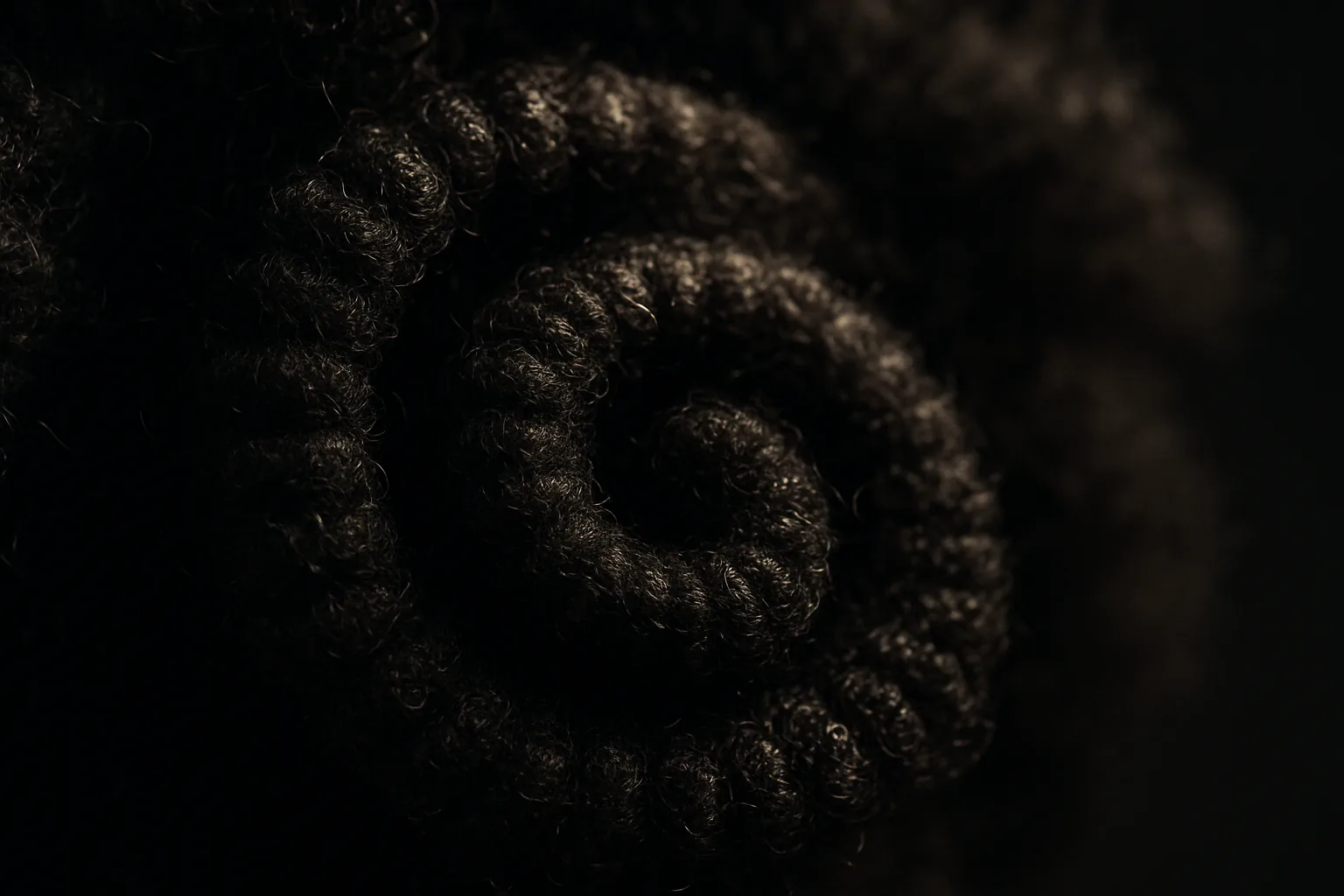
Where the Coil Bends, the Hair Breaks
Every coil is a series of bends, and a bend is a stress concentrator. At the apex of each twist the shaft sits at its thinnest, and the cuticle, the shingled outer layer that shields the inner cortex, is most lifted and most exposed. Pull a coiled fiber and the force does not spread evenly down its length. It piles up at those turns. In tensile testing, tightly coiled hair tends to break at lower force and with less stretch than straighter hair, and it fractures right at the bends. The everyday version of this is the single-strand knot, the tiny tangle that forms when a shed strand wraps a curl and cinches tight. Comb through it carelessly and the shaft gives way at the knot.
Moisture makes it worse in a way that is purely geometric. On straight hair, sebum from the scalp travels down a fairly direct track and coats the fiber most of the way to the ends. On a coil, that oil cannot get past the first few bends, so the ends are the oldest, driest, and least protected part of the strand, which is exactly where they are also the most worn. Dry keratin is brittle keratin. The familiar advice to seal the ends and keep moisture in is really a workaround for a shaft the scalp’s own oil was never going to reach.
When dermatology researchers compared African American and Caucasian hair head to head, they counted significantly more broken hairs on the African American scalps and measured lower scalp blood flow, and they concluded that the differences in hair fiber shape, not only in how people style their hair, contribute to the fragility seen in the clinic. In plain terms, some of the breakage is built in. Styling can protect the fiber or punish it, but the starting point is a strand engineered with its own weak points.
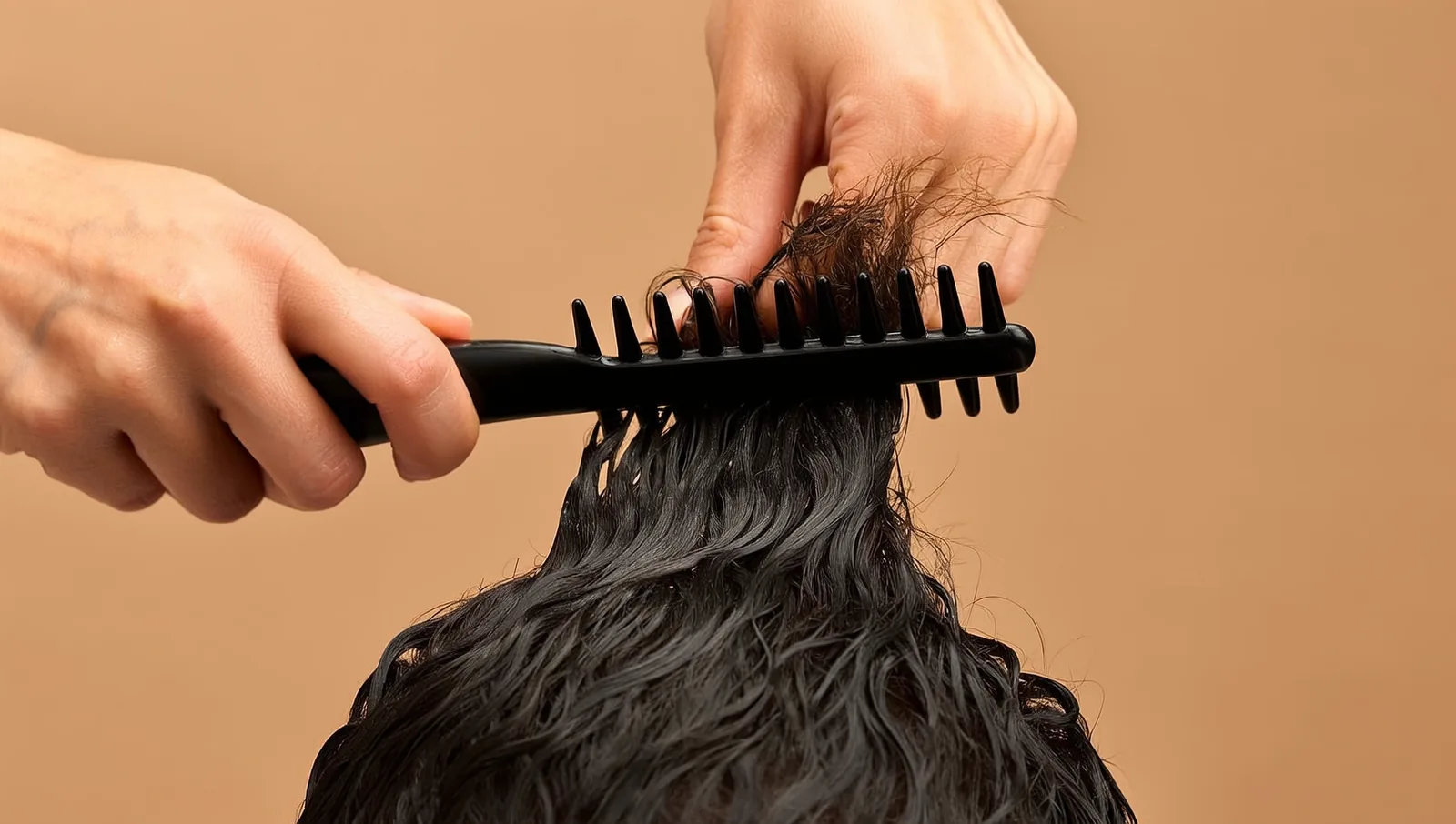
What This Means in the Chair
None of this says textured hair is fragile in the sense of weak or lesser. It says the smart move is to work with the structure instead of against it.
- Cutting. Because a coil retracts when it gets wet (shrinkage can hide most of the actual length) many barbers shape Type 4 hair dry or stretched, where the true line is visible and the blade is not chasing a moving target. Lower density rewards a careful hand too, since there is less hair to cover an uneven guard or an overly bald fade. It is one more reason to sit in the chair of a barber who works with textured hair every day.
- Combing and detangling. Work from the ends upward, on damp, conditioned hair, with a wide-tooth comb or your fingers. Starting at the root drives every tangle down into the bends where the shaft is weakest and turns a quick detangle into a breakage session.
- Chemical services. A relaxer works by breaking the disulfide bonds that hold the curl, which means it is cutting into the very structure at the points already carrying the most strain. Stacking a chemical service on top of an already fragile bend is how breakage compounds, so it is worth knowing the formula and the risks before committing, as covered in what is actually in a relaxer.
- Tension and products. The dryness at the ends calls for sealing and moisture, and the weakness at the bends calls for low tension. Tight, heavy styles do not just stress the follicle, they load the fiber’s weak points around the clock, which is the through-line connecting everyday breakage to traction alopecia and the slow loss of an edge.
The Bottom Line
Black hair breaks differently because it is built differently: fewer follicles carrying more visual volume, a flattened shaft grown from a curved root, and a coil whose every bend is a place where force and dryness gather. Those are not flaws to apologize for. They are design facts to plan around. The best barbers and stylists have always known the moves, cut it dry, detangle from the ends, respect the curl, keep it moisturized, and the science simply explains why the moves work. That knowledge has been handed down chair to chair for generations, which is part of why the Black barbershop has mattered as more than a place for a haircut. Understand the structure, and every other decision about the hair gets easier to make and easier to stand behind.
Sources
- Archives of Dermatology on hair density measured from scalp biopsies in African Americans
- Journal of Cosmetic Dermatology for a structural comparison of hair shaft and scalp parameters in African American and Caucasian women
- Journal of the American Academy of Dermatology with an overview of ethnic hair structure and scalp disorders
- Cutis covering the hair care practices behind common textured-hair concerns
Further reading
- American Academy of Dermatology on everyday care tips for Black hair
- American Academy of Dermatology for how dermatologists evaluate and treat hair loss in Black women
- Skin of Color Society with its public education library on hair and scalp conditions
- U.S. Food and Drug Administration on what relaxers and dyes do to the hair shaft