Alopecia Areata on Black Hair: The Smooth Round Patch a Barber Finds Under the Guard
Published on October 22, 2026

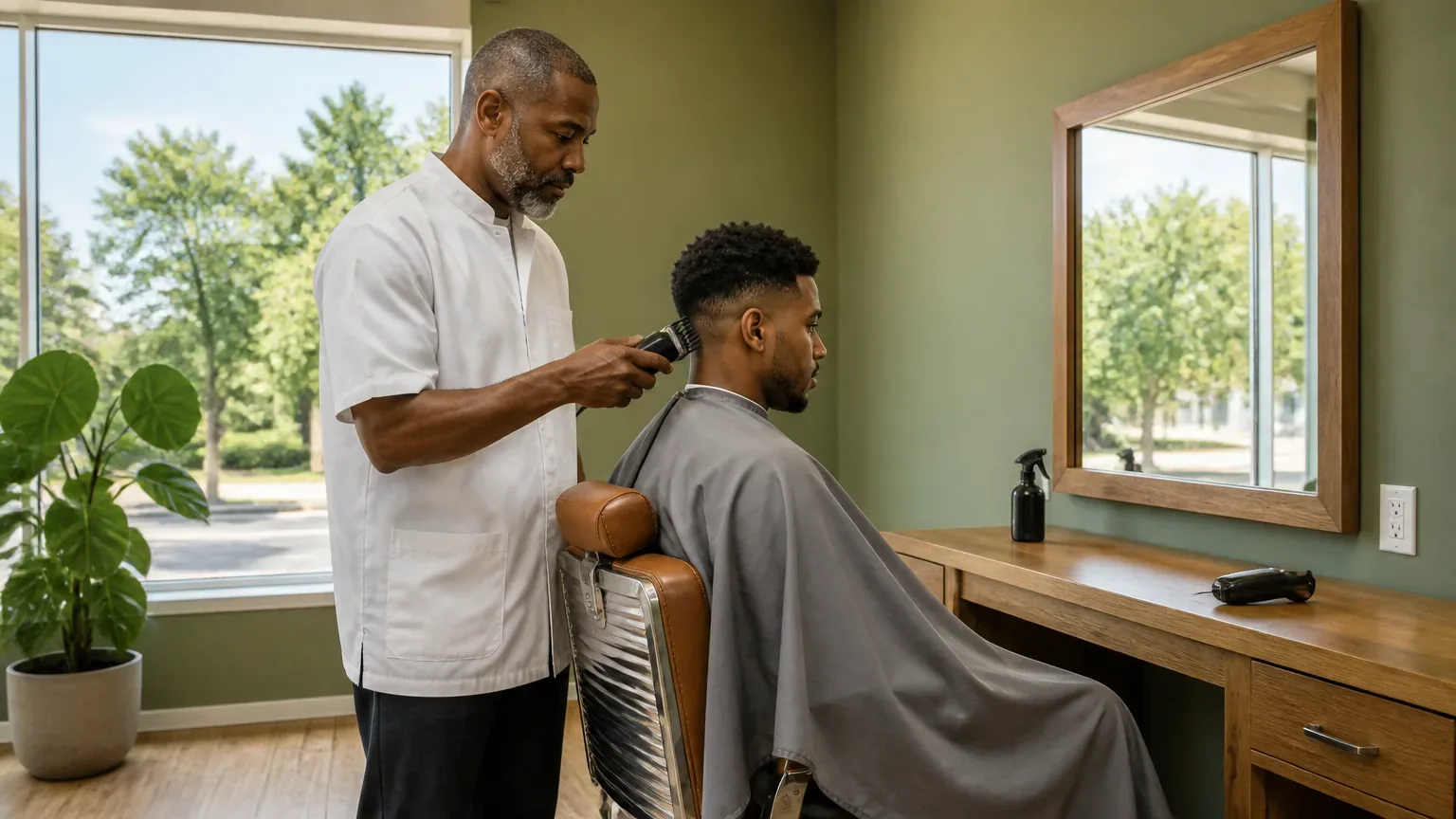
The guard is halfway up the back of his head when the barber sees it: a circle of bare skin behind the left ear, about the size of a quarter. It is smooth, with no bumps, flakes or redness, and it was not there at the last cut three weeks ago. The client had no idea, because nobody sees the back of their own head. The beard side of the chair turns up the same thing, a clean round gap under the jaw that a client has spent a month blaming on a bad trim.
Both fit alopecia areata, a condition in which the immune system attacks the hair follicles. It is more common in Black Americans than in white Americans, it can start on the scalp or in the beard at almost any age, and unlike the scarring conditions elsewhere in this series, it usually leaves the follicle able to grow again. Our complete guide to Black hair loss gives it one paragraph. This guide covers how a patch looks from the chair, how to tell it from its look-alikes, why Black patients often wait longer for answers, what injections and the newer JAK inhibitor pills can do, and how to cut around a patch while treatment works.
None of it replaces a board-certified dermatologist. If you have found a patch like these, or your barber has found one on you, book that appointment.
What Alopecia Areata Is
Normally the immune system goes after invaders such as bacteria and viruses. In alopecia areata it turns on the hair follicles and shuts down growth, MedlinePlus explains, but it does not permanently damage them, which is why hair can come back. Genes play a part, many of them genes that help run the immune system, and people with alopecia areata have a higher risk of other autoimmune and allergic conditions, including vitiligo, lupus, thyroid disease, eczema and allergic asthma.
Most people first get it in their teens, twenties or thirties, and when it starts before age 10 it tends to be more extensive, according to the National Institute of Arthritis and Musculoskeletal and Skin Diseases (NIAMS). Stress or an illness may set it off in someone already at risk, though usually there is no obvious trigger. It is not a product reaction or a styling injury: the attack comes from the client’s own immune system.
The old textbook patient was white, and the numbers no longer support that picture. In two large Nurses’ Health Study cohorts, Thompson and colleagues found that Black women had 2.7 and 5.5 times the odds of alopecia areata that white women had. In the All of Us research program, which deliberately recruits groups that research has left out, Moseley and colleagues found 1.72 times the odds in Black adults. Among nearly 600,000 children in routine care in Northern California, Dani and colleagues found it 2.3 times as common in Black children as in non-Hispanic white children. Nobody yet knows why, Obeime, Larrondo and McMichael note in a 2023 Cutis editorial.
What It Looks Like From the Chair
The usual first sign is a sudden round or oval bald patch, often about the size of a quarter, NIAMS says, and MedlinePlus puts most between roughly 0.4 and 1.6 inches across. The skin inside looks ordinary, with no rash, redness or scar, though some people feel tingling, burning or itching just before the hair goes.
Look closely at the edge. While the disease is active, a patch is often ringed by exclamation point hairs: short broken hairs, thinner where they enter the scalp than at the tip, as NIAMS and DermNet describe. Two more clues read clearly in Black hair. The attack tends to spare grey hairs, so in a salt-and-pepper head or beard a patch can look like a cluster of white that appeared overnight (DermNet). And regrowth often comes in white or grey before it darkens (NIAMS), so a tuft of pale fuzz in a dark fade is often a patch healing, not a new problem. Tiny pits and ridges in the nails turn up in an estimated 10 to 40 percent of people with the condition, DermNet adds.
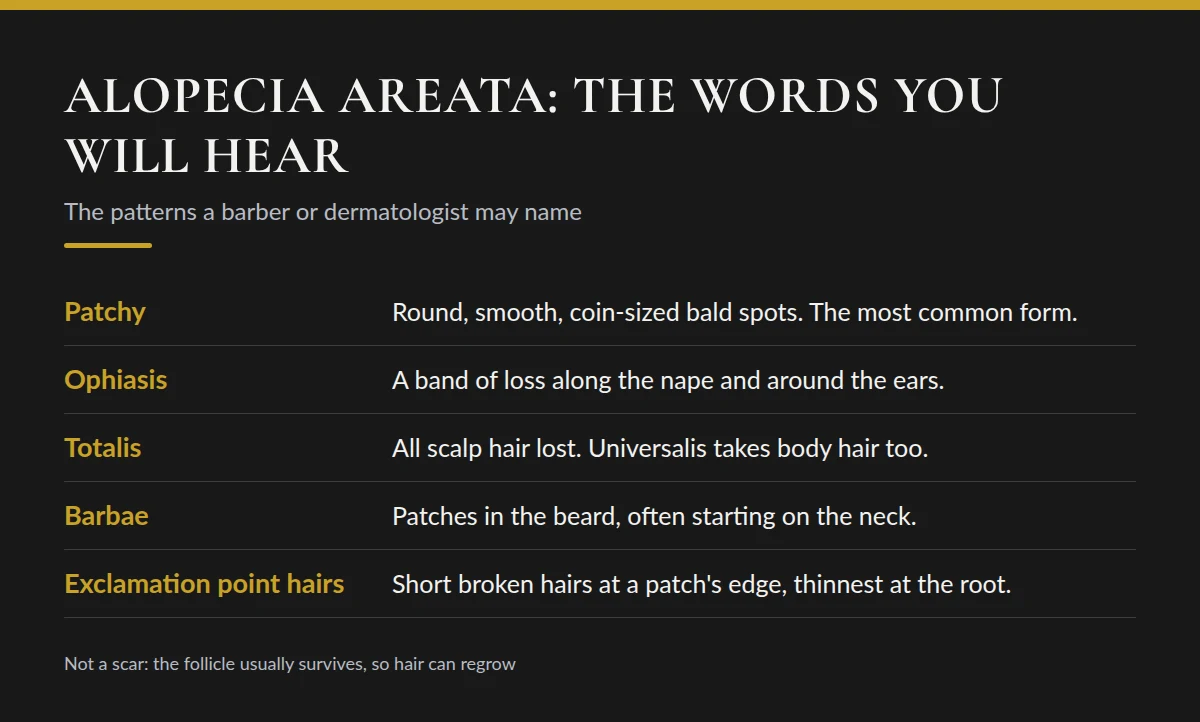
The patterns have names, and the names hint at what comes next.
- Patchy: one or more coin-sized spots, the most common form. In one hair clinic’s review of 265 Black patients, summarized by Obeime’s team, 68 percent had it.
- Ophiasis: a band of loss along the back and sides of the scalp margin, over the nape and around the ears (DermNet). It made up 15 percent of that clinic’s cases, it runs right through the zone a barber fades, and DermNet counts it among the signs of a harder course.
- Totalis and universalis: loss of all the scalp hair, or of hair from the whole body. DermNet puts the chance of progressing to either at about 5 to 10 percent, and MedlinePlus notes that when total loss happens, it usually comes within six months of the first symptoms.
- Barbae: alopecia areata in the beard. Across 25 published reports, Nwosu and Miteva found it mostly in men around 31, typically starting on the neck portion of the beard and reaching the scalp within a year.
The course is hard to call. Hair can regrow within months, new patches can open as old ones fill in, and repeat episodes are common. Regrowth on its own is likelier with less extensive loss, a later start, no nail changes and no family history, NIAMS says.
Alopecia Areata, a Slipped Guard, or Something Else?
Several causes of patchy hair loss are common in Black clients. Here is how they differ.
- A slipped guard. Every barber has put a divot in a fade. A gouge still holds stubble, its edge follows the line of the blade, and it grows back in with the rest of the cut. An alopecia areata patch is bare to the skin, round, often edged with exclamation point hairs, and usually sits where no blade went. Check the back and sides before the first pass and you will know which one you are looking at.
- Traction alopecia. Traction follows the pull, thinning the edges, temples and nape where braids, ponytails and sew-ins grip, as our traction alopecia guide explains. A smooth island in the middle of the scalp is not traction’s shape, but an ophiasis band works the same margins, so the styling history matters.
- CCCA. Central centrifugal cicatricial alopecia starts at the crown, widens outward and destroys follicles for good, as our CCCA guide explains. Alopecia areata leaves normal skin with the follicles alive.
- Ringworm. Tinea capitis is a fungal infection that spreads by contact and on brushes, hats and towels, where its spores can survive for months, and it mostly hits young children, peaking between ages three and seven (DermNet). The tell is scale: ringworm patches are dry, flaky and often itchy, sometimes dotted with black specks that are hairs snapped off at the skin, while alopecia areata causes no scale. Ringworm needs at least four weeks of medicine by mouth, because creams cannot reach the root of the follicle.
- Discoid lupus. Clinging scale, plugged follicles or a pale center inside a dark rim point to discoid lupus, which scars, and an early patch can pass for alopecia areata, as our guide to discoid lupus on the scalp describes.
- Hair pulling. Trichotillomania, the urge to pull out one’s own hair, also leaves patches without scale, DermNet notes.
These can overlap. People of African heritage often have more than one kind of hair loss at once, scarring and nonscarring together, Jackson and colleagues write in a 2025 case report, and missed or wrong diagnoses can delay treatment. Their patient, a 48-year-old African American woman, was diagnosed with CCCA, alopecia areata and telogen effluvium, a shedding condition, all at once after a biopsy.
Why the Diagnosis Often Comes Late
No study has timed the delay directly, but researchers point to several reasons Black patients can reach diagnosis and treatment later than they should.
- The research was built on other people. Ezemma and colleagues reviewed six trials of JAK inhibitors for alopecia areata with 1,690 participants: 60 percent white, 28 percent Asian and 8 percent Black, and none reported results by race. The two trials behind baricitinib’s approval enrolled 1,200 people, only 98 of them Black, Obeime’s team notes, too few to compare results.
- Dark scalps look different under the lens. To the eye, alopecia areata looks the same on any skin tone, DermNet says. Under a dermatoscope, Pyles and colleagues found features rarely described before in 10 Black patients, such as darker pigment around the hairs and paler follicle openings, and called the condition’s appearance in Black patients underexplored.
- Other hair loss hides it. With traction or CCCA already in the chart, a new patch is easy to file under the old diagnosis.
- Access. In All of Us, adults without health insurance had about a third the odds of a recorded diagnosis, which Moseley’s team reads as a sign of limited access to dermatology and undiagnosed cases. Black Americans are more likely to be uninsured or underinsured, Obeime’s team adds, and prior authorization can hold up the newest drugs even after a diagnosis.
- Nobody sees it. A patch at the back of the head never shows in the bathroom mirror, and one under a wig, a sew-in or a full beard can hide for months. Often the first person to see it is holding the clippers.
Time matters. DermNet counts hair loss lasting more than a year among the signs of a poorer outlook, and in an injection study described below, patches older than six months responded less well. Obeime’s team names hairstylists, alongside community health centers, as places to put resources and raise awareness.
Getting a Diagnosis
A board-certified dermatologist can often diagnose alopecia areata by examining the patches and the nails, sometimes through a dermatoscope, a lighted magnifier, the American Academy of Dermatology (AAD) says. Expect questions about relatives with the condition. Sometimes the doctor pulls a few hairs or takes a small biopsy, and blood tests may check the thyroid and iron and vitamin levels. Bring dated photos of the patch, ideally a series your barber took over several cuts, and mention itching, nail changes, new patches in the beard or brows, and any thyroid disease, eczema or vitiligo in the family. Then ask directly whether this is alopecia areata, and whether traction or CCCA is going on too.

Treatment: From Waiting It Out to JAK Inhibitors
There is no cure, but treatment can help hair regrow, and the plan depends on how much hair is gone, for how long, where, and the patient’s age, the AAD explains.
- Waiting. For one or two spots present less than a year, a dermatologist may suggest watching, since many people, children especially, regrow hair untreated.
- Steroid injections. For adults with a few patches, the AAD calls corticosteroid shots into the bald spots the most effective treatment. They are repeated every four to six weeks, regrowth usually shows within three months, and in one study the AAD cites, more than 80 percent of 127 patients regrew at least half their hair within 12 weeks. DermNet adds that injections work in the beard and eyebrows too. The trade-offs show in a study of 85 patients by Muhaidat and colleagues: about one in five had minor local side effects, mostly small dents in the skin at injection sites, and nearly half saw the loss return within one to three years.
- Creams and solutions. Steroids applied to the skin tend to work better in children than adults, anthralin is another option at the cost of some irritation, and minoxidil helps keep regrowth, the AAD says.
- Contact immunotherapy. For widespread loss, a chemical painted on the bald skin each week sets off a mild allergic rash meant to stop the immune attack, with success rates of 17 to 75 percent, according to the AAD. DermNet lists depigmentation, a loss of skin color that would show plainly on dark skin, among its side effects.
JAK inhibitors are the biggest change. These pills calm the overactive immune system behind the attack, and the FDA has approved three for alopecia areata, the AAD says: baricitinib and ritlecitinib for patients 12 and older, and deuruxolitinib for adults. In the two trials behind baricitinib’s approval, which enrolled adults missing at least half their scalp hair, roughly 36 to 39 percent on the higher dose had 80 percent or more of the scalp covered after 36 weeks, against 3 to 6 percent on placebo, King and colleagues reported in the New England Journal of Medicine. That is a real shift, and it also means most patients had not reached that mark after nine months. Three caveats:
- They work while you take them. When people who had regrown hair after a year on baricitinib were switched to placebo, 80 percent had lost the benefit by week 152, against 7 percent of those who stayed on it, though most who restarted got their response back.
- They carry the FDA’s strongest warning. Baricitinib’s label has a boxed warning about serious heart-related events, cancer, blood clots and death, added after a large safety trial of a related JAK drug in people with rheumatoid arthritis. Tell the dermatologist if you smoke or used to, or have had a heart attack, stroke or blood clot. In the alopecia trials, acne and higher cholesterol were also more common than on placebo.
- The data on Black patients are thin. Mukenge and colleagues described 16 African American patients on JAK inhibitors at one hair clinic. Ten of them, 63 percent, improved, and the authors tied non-response to hair loss lasting over 15 years and extensive involvement before treatment. DermNet likewise notes the drugs may work better before the disease has run for several years, and calls them expensive.
Hair loss this visible can weigh on anyone. The AAD points patients to the National Alopecia Areata Foundation for support, and to regular primary care visits, since people with alopecia areata have a higher risk of conditions such as thyroid disease.
Cutting and Styling Around a Patch
The barber who finds a patch can also make it easier to live with.

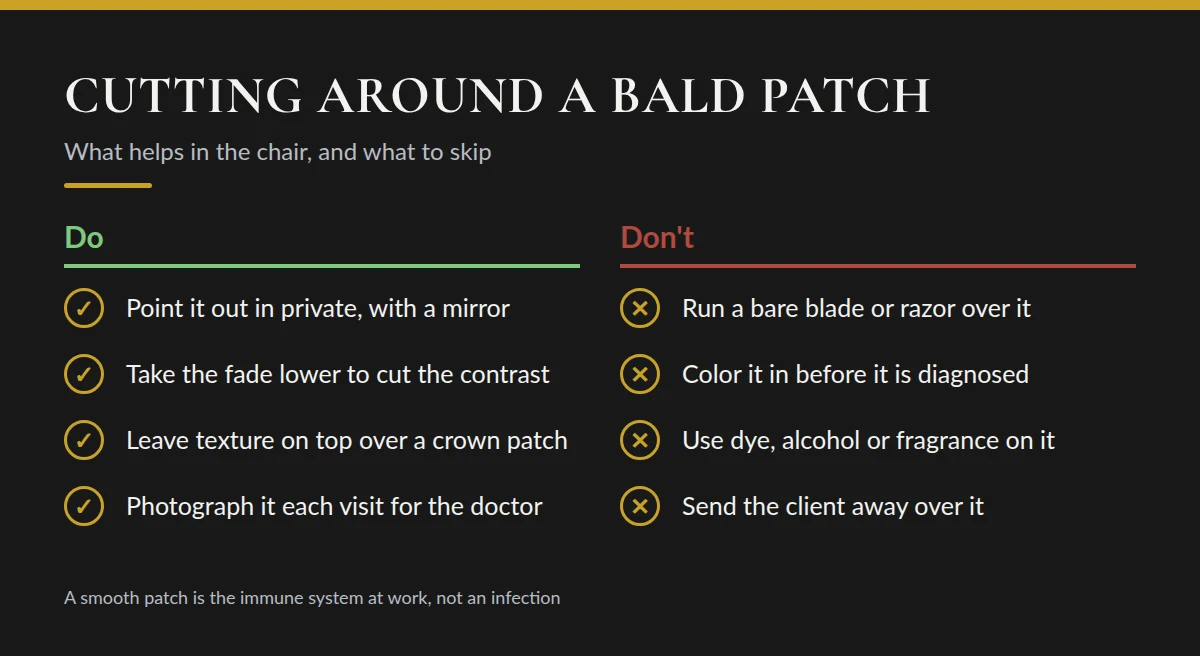
- Say it, in private. Angle a hand mirror at the spot or show a photo, and keep it plain: “There’s a smooth round patch back here that wasn’t there last time. I can’t tell you what it is, but get a dermatologist to look at it soon.” Offer to photograph it each visit so the doctor can see whether it is spreading or filling in.
- Keep the client in the chair. Alopecia areata comes from the client’s own immune system, not a germ, so a smooth patch is no reason to turn anyone away. Disinfect tools after every client as always, and take more care with any patch that is scaly or itchy, the ringworm picture.
- Lower the contrast. A bare circle stands out most against thick, dark hair. When a patch sits in the fade zone, taking the fade lower, from a #2 to a #1 or a half guard, or down to a skin fade, puts bare skin beside short hair instead of a wall of it. Our haircut dictionary covers the guard numbers. An ophiasis band at the back of the hairline can often disappear into a high skin fade.
- Cover the crown with texture. For a patch on top, go the other way: keep length and texture so the surrounding coils fall over it, with a twisted or curly top or scissor work instead of a close guard, and keep parts and designs away from it.
- Or take it all off. Some people would rather shave than cover, the AAD notes, and a clean head ends the patchy look in one cut. Then add sun protection: a wide-brimmed hat, or a broad-spectrum, water-resistant SPF 30 or higher sunscreen on the bare scalp, reapplied every two hours and after sweating, as the AAD advises.
- Be gentle with the patch. There is nothing on it to cut, so keep the bare blade, foil and razor off it. The AAD’s self-care advice is a soft brush and a wide-tooth comb, air drying instead of a blow dryer, and no hair dye or products with fragrance or alcohol on the scalp or the patches, which rules out alcohol aftershave on a beard patch.
- Don’t paint over it. Grease, oils and growth serums are not among the treatments the AAD lists. Gel, mousse, powder or spray can hold the hair around a patch in place, and the AAD counts them among ways to disguise hair loss; choose fragrance-free ones. But a patch nobody has diagnosed should not be colored in with sprays or fibers, because a hidden patch is one nobody is watching.
- Work the beard line. Take the beard down to a shorter, even length so a gap reads less, move the line so the patch falls outside it, or shave clean, which the AAD lists for the beard too. Skip beard dye. With treatment, beards can come back: Nwosu and Miteva report up to 75 percent beard regrowth on JAK inhibitors over about a year.
- For stylists, loosen up. The AAD advises loose styles, because tight ponytails and cornrows pull on the scalp and can cause further loss. Keep braids, sew-ins and edges low-tension around a patch.
The Bottom Line
Alopecia areata is the immune system turning on the hair follicle, and it is more common in Black Americans than older textbooks suggested. It shows up as a smooth, round patch of ordinary-looking skin, sometimes ringed by exclamation point hairs, on the scalp or in the beard, and it usually leaves the follicle able to grow again. Scale points toward ringworm, a widening crown toward CCCA, and loss that follows the pull toward traction, and more than one can be present at once. Injections help a few patches, JAK inhibitors have changed the outlook for extensive loss, and both work best early. The person most likely to find the patch is the one holding the clippers: say something, keep the client in the chair, and cut to make it easier to live with.
Further reading (sources)
- American Academy of Dermatology on how dermatologists diagnose and treat alopecia areata
- American Academy of Dermatology with self-care for alopecia areata, from gentle styling to scalp sunscreen
- NIAMS for an overview of alopecia areata, its patterns and its course
- MedlinePlus Genetics on the immune system and genes behind alopecia areata
- MedlinePlus about the size of patches and how fast total loss can follow
- DermNet for a clinical overview of alopecia areata and its outlook
- DermNet on scalp ringworm, how it spreads and why it needs pills
- U.S. Food and Drug Administration with the boxed warning on baricitinib and related JAK inhibitors
- Obeime, Larrondo and McMichael on alopecia areata in skin of color after the first JAK approval
- Thompson and colleagues for race and alopecia areata in the Nurses’ Health Studies
- Moseley and colleagues on alopecia areata in underrepresented groups in All of Us
- Dani and colleagues with racial and ethnic differences in alopecia areata among children
- Ezemma and colleagues for the racial makeup of JAK inhibitor trials for alopecia areata
- Pyles and colleagues on trichoscopy of alopecia areata in Black patients
- Jackson and colleagues with a case of CCCA, alopecia areata and telogen effluvium in one patient
- Nwosu and Miteva for a review of alopecia areata in the beard
- Muhaidat and colleagues on two strengths of steroid injection for patchy alopecia areata
- King and the BRAVE-AA investigators with the two phase 3 trials of baricitinib
- King, Ko and colleagues on what happened when patients stopped baricitinib
- Mukenge and colleagues for JAK inhibitors in 16 African American patients