Frontal Fibrosing Alopecia: The Receding Hairline in Black Women That Isn't Traction
Published on October 6, 2026

It often goes like this. The edges at her temples sit a little higher in this year’s photos than last year’s, and the front of the hairline has thinned enough to show skin. Everyone offers the same explanation: the braids. So she takes them out, switches to a loose wig, and keeps tension off her edges for a year. The hairline keeps moving anyway, and somewhere along the way her eyebrows have thinned too, which no braid can explain.
That pattern has a name. Frontal fibrosing alopecia (FFA) is a scarring hair loss that moves the front and sides of the hairline back in a band and very often takes the eyebrows with it. In Black women it is easy to file under traction alopecia, because the two look alike at the edges and, as the research below shows, often turn up together. This guide covers what FFA is, why it gets mistaken for traction, the clues at the hairline, brows and face that set it apart, what a dermatologist does to confirm it, and what stylists and barbers can do when they spot it in the chair.
A note before anything else: FFA is a medical diagnosis, and nothing here replaces a board-certified dermatologist, ideally one experienced with Black hair and scalp. If your hairline is moving and your eyebrows are thinning at the same time, book that visit now rather than waiting to see what the next few months bring.
What Frontal Fibrosing Alopecia Is
FFA destroys hair follicles, the openings hair grows from, and the hair it takes does not come back, the American Academy of Dermatology (AAD) explains. It usually starts slowly, as a thin band of balding skin along the front and sides of the hairline. Many people lose some or all of their eyebrows, and as it advances it can thin the hair on the arms, legs and underarms, and the beard area in men. It is not contagious.
Dermatologists class it as a form of lichen planopilaris, an inflammatory condition in which immune cells attack the upper part of the follicle until scar tissue takes its place. Under the microscope the two look the same. What sets FFA apart is the pattern: a symmetrical retreat of the front and sides of the scalp. Its cause is still unknown. A 2020 treatment guide by Imhof and Tolkachjov lists immune, hormonal, genetic and environmental factors among the suspects, and notes that a genome-wide study tied FFA to four regions of the genome.
What is clear is that it is far more common than it used to be. When the first patients were diagnosed in the 1990s, FFA was considered rare; today the number of people diagnosed is growing rapidly, the AAD says. Mirmirani and colleagues counted one paper on FFA in the medical literature in 1994 and 44 in 2016, and the hair referral centers in their collaboration saw a significant rise in new diagnoses between 2006 and 2016. Nobody yet knows why.
Why It Gets Called Traction in Black Women
The textbook FFA patient is a white woman past menopause, and most notice the loss two to 12 years after menopause begins, according to the AAD. Black women tend to get it younger. In a series of 18 African American women with biopsy-confirmed FFA, Callender and colleagues recorded ages from 28 to 85, and half of the women whose status was known had not reached menopause. A 2023 systematic review by Hai, Meyer and Agbai pooled 51 Black patients from eight studies and found 53 percent of the women premenopausal, with onset on average in their mid-forties. A review of 60 white women with FFA, which they cite for contrast, found 5 percent premenopausal and an average onset age of 64. Plenty about hair does change after 40, as our guide to how Black hair changes after 40 explains, but a hairline retreating in a band while the brows thin is not normal ageing.
Add years of braids, sew-ins or relaxers, and the diagnosis seems to make itself. In the pooled review, 37 percent of patients had worn styles that pull on the scalp and 55 percent had used chemicals such as relaxers or dye before FFA began. A third (17 of 51) had traction alopecia as well. None of the studies had a comparison group, so that history cannot show that styling caused the FFA.
Adotama and colleagues, who compared white and Black women with FFA, put the problem plainly: in people with skin of color, FFA “is often misdiagnosed as traction alopecia.” Hai’s team adds that FFA in Black women is less likely to be biopsied, which tilts the diagnosis toward traction or pattern hair loss, the conditions doctors assume are more common in this group. One case report describes FFA in an African American woman that looked like ordinary pattern hair loss and lacked many of the usual signs.
Darker skin also hides one of the classic signs. Redness around the follicles turned up in 44 percent of patients in a large, mostly white review, against 12 percent of the Black patients in Hai’s, and the authors suggest the pigment may simply mask it.
A Fringe at the Edge Does Not Rule It Out
Our traction alopecia guide describes the fringe sign, a border of short hairs left standing at the very front of the hairline while the area behind it thins, as one of the most reliable markers of traction. FFA can fake it. Pirmez and colleagues described 16 people with FFA whose original hairline held on in front of a bald band, producing what they called a misleading pseudo fringe sign. Biopsies from all 16 showed the scarring inflammation of FFA, and other signs of the disease, such as eyebrow loss and bumps on the face, turned up alongside it.
Two later cases reported by Contin and Rocha show how it plays out over time. Unlike a traction fringe, the FFA fringe slowly thins until it too becomes shiny, scarred skin. So a fringe is not the all-clear it can look like, and the rest of the face is where to look next.
The Clues: Brows, Band and Skin
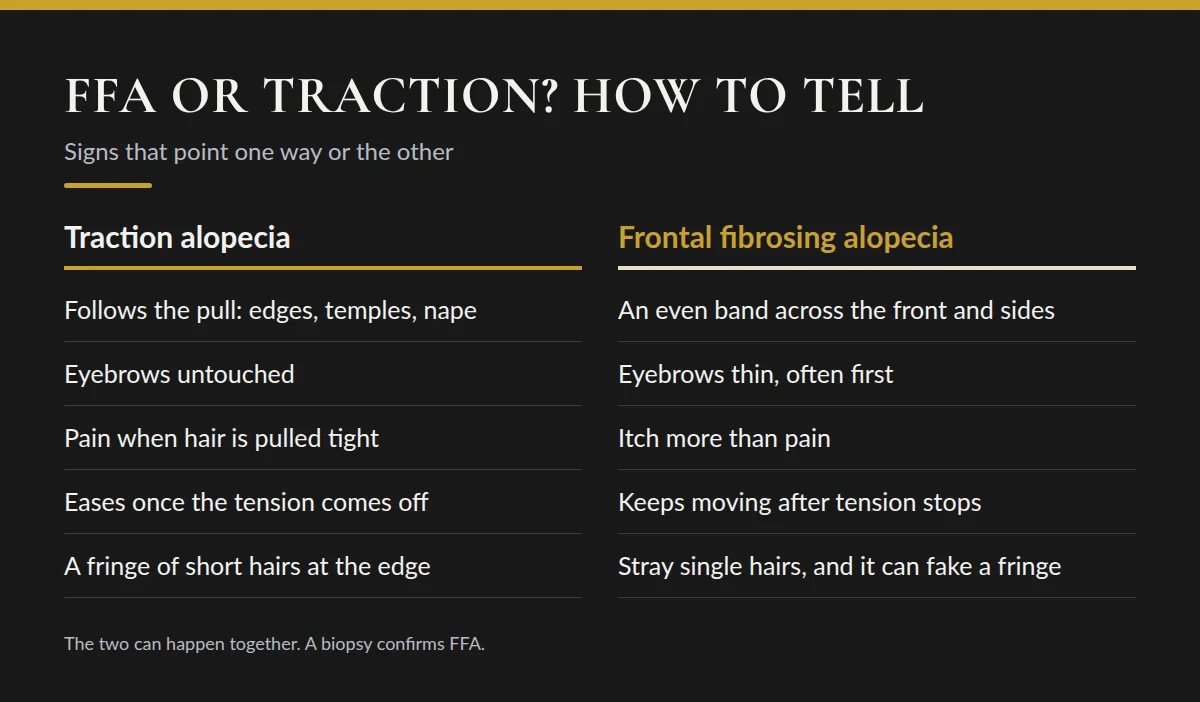
No single sign settles the question, but several point away from traction.
- Thinning eyebrows. Nothing in a braid or a sew-in pulls on the eyebrows, which makes brow loss the strongest clue. Between 80 and 95 percent of women diagnosed with FFA have lost some or all of their eyebrow hair, and it is often the first sign anyone notices, according to the AAD. It was visible in 76 percent of the women in Callender’s series, and Souza and colleagues note that in Black patients the brows may thin before the scalp does. Tell your dermatologist about any plucking, waxing or threading, since those thin brows too.
- A band rather than a patch. FFA tends to move the whole front and sides back together, leaving a strip of smooth skin where the follicle openings have disappeared, sometimes paler than the forehead below it. Traction follows the pull, with broken hairs around the forehead and bald patches wherever the style is tightest, the AAD says.
- Lonely hairs. Single hairs left standing alone in the bare strip. This lonely hair sign was found in 29 percent of the Black patients in Hai’s review and in 14 of 20 patients in a South African series.
- Dark speckles at the hairline. Callender’s team saw a speckled darkening around the follicles along the hairline, a sign they had not seen described before and one that appears more common on darker skin. Along with dark patches on the face, they write, it can help tell FFA from traction.
- Itch more than pain. Half of the patients in Hai’s review (51 percent) had an itchy scalp, while scalp pain was far less common. Traction tends to announce itself differently, with pain from hair pulled tight or tenting, where sections of scalp are lifted into little peaks, the AAD says.
- Dark patches on the face. Lichen planus pigmentosus, a related condition that leaves dark patches on sun-exposed skin such as the forehead and cheeks, travels with FFA in darker skin. Uwakwe and colleagues, reporting seven African American women with both, concluded the two probably sit on the same spectrum of disease, and Souza’s review calls the patches a possible herald sign that can come first. Hai’s review found them in 14 percent.
- Bumps and losses elsewhere. Tiny skin-colored bumps on the face, called facial papules, are a recognized feature, and in a Spanish review of 355 patients they went with more severe disease, as did loss of eyelashes and body hair. The sideburns and the hairline at the back of the head can be involved too.
FFA, Traction or CCCA?
Traction alopecia, central centrifugal cicatricial alopecia (CCCA) and FFA can all end in permanent loss, and they start in different places.
- Traction follows the pull, usually at the edges, temples and nape. If the pulling goes on, the AAD warns, the hair stops growing, the skin turns shiny and bald, and the hair cannot grow back.
- CCCA starts at the crown and spreads outward, as our CCCA guide explains.
- FFA works from the front and sides backward and takes the eyebrows with it.
The most useful test at home is time. Edges that keep retreating many months after the tight styles stopped, or brows thinning while the hairline moves, deserve a dermatologist’s look. Other things thin edges too, from shedding after a baby to pattern hair loss, and our complete guide to Black hair loss sorts through them.
The conditions also overlap. A third of the Black patients in Hai’s review had traction alopecia as well as FFA, so “it’s traction” can be half right. Easing the tension then fixes the half you can see while the other half keeps going.
Getting a Diagnosis
A dermatologist will look at the scalp closely, often through a dermatoscope, a lighted magnifier. Darker skin can hide some of what that exam shows on fair skin, Hai’s team notes, which is why Souza and colleagues reviewed how FFA looks under magnification on Black scalps specifically. For Black patients with hair loss at the front and temples, Hai’s team calls a biopsy paramount. Callender’s group recommends taking it at the edge of the bald area, where hair is still present.

Because FFA moves slowly, many people do not notice it until much of the damage is done, Callender’s team observes. Help the appointment along:
- Bring photos of your hairline and brows from the past few years. They show the speed better than memory does.
- Give your full styling history, including braids, relaxers, and when you stopped them. Traction and FFA can coexist, and the doctor needs both stories.
- Mention brow plucking or threading, any itch or burning, and any dark patches or bumps on your face.
- Ask directly whether this could be frontal fibrosing alopecia, and whether a biopsy makes sense.
Treatment: The Goal Is to Stop It
Caught early, treatment can stop further hair loss and may regrow some hair, the AAD says, but follicles that have already scarred over will not grow again. Without treatment, FFA often claims a wider strip every year, and a recession that was once barely visible can become a bald band reaching the middle of the head. For some people it stops on its own after years, but there is no way to know who, which is why dermatologists treat it.
There is no standard regimen, and most people get a combination, according to Imhof and Tolkachjov’s review:
- Finasteride or dutasteride. These pills block the enzyme that converts testosterone into dihydrotestosterone (DHT). In a systematic review the authors cite, they stabilized hair loss in 88 percent of 180 patients, the best showing of any oral treatment, and in the Spanish review of 355 patients, 47 percent of those taking them improved and the rest held steady. They can harm a male fetus, though, so contraception is mandatory, and for premenopausal women the guide suggests dermatologists may consider hydroxychloroquine or doxycycline first. That caveat matters, given how many Black women with FFA are premenopausal.
- Steroid injections into the hairline and brows calm the inflammation. In the Spanish review, injections every three to six months brought a positive response in 83 percent of patients, and used alongside other treatment they can regrow eyebrow hair.
- Hydroxychloroquine, an antimalarial pill that also calms inflammation, is a common first systemic choice. It can take up to a year to reach full effect and needs regular eye exams.
- Creams and solutions play a supporting role. Steroid creams rarely work on their own, and tacrolimus, pimecrolimus and minoxidil are used as add-ons.
- Doxycycline, an antibiotic used for its anti-inflammatory effect, has given unpredictable results, though a 2025 study of 50 women with skin of color in Morocco reported improvement in 57 percent.
The results in Black patients so far are sobering. Across the 51 patients in Hai’s review, treatment slowed or stopped FFA in 45 percent, hair regrew in 6 percent, and the loss kept progressing in 51 percent. A cohort of 58 Asian patients, by comparison, saw improvement or stabilization in up to 90 percent. The authors point to the larger share of Black women who were premenopausal at onset, since premenopausal onset often means more severe disease, and Souza’s review adds coexisting hair loss and delayed diagnosis. Both arguments land in the same place: the sooner FFA is named, the more hairline there is to save.
Hair transplants come last, and the guide suggests waiting until the disease has stabilized. In a study of 51 FFA patients, 87 percent of grafts survived at one year but only 41 percent at five, and in a small study of eyebrow transplants, most patients had lost the new hairs three to four years later. While treatment works, brow pencil or powder can fill in thin brows. Hair loss this visible can be hard to live with, and Imhof and Tolkachjov note that patients may experience depressive symptoms, so tell your dermatologist if it is getting you down.
The Sunscreen Question
Search for FFA and you will soon find sunscreen. In a British questionnaire study, 105 women with FFA reported using sunscreen significantly more than 100 matched women without it, and the authors raised the possibility that sunscreen chemicals play a role. It remains unproven. Imhof and Tolkachjov note that the methods behind some of these studies have been challenged, that a Mayo Clinic survey of 56 patients found no significant link between daily facial sunscreen and continued progression, and that FFA can reach parts of the scalp sunscreen never touches. With no conclusive evidence either way, talk it over with your dermatologist before changing your routine.
For Barbers and Stylists: What to Watch and What to Say
You see a client’s hairline every few weeks, closer and under better light than almost anyone else does. That makes you the person most likely to notice a hairline that keeps moving after the style stopped explaining it.
- Check the brows as well as the edges. A client whose brows have thinned since last season, with a hairline moving at the same time, fits the FFA pattern better than the traction one.
- Look for the strip. Smooth skin along the front with a few lonely hairs, or dark speckling around the follicles, is worth mentioning even when there is a fringe at the very edge.
- Ask two questions. Does it itch, and how long ago did the tight styles stop?
- Take the tension off anyway. With a third of the Black FFA patients in Hai’s review also showing traction, lowering the pull still removes one problem. The AAD’s advice holds: loosen braids around the hairline, keep braids in for no longer than six to eight weeks, choose sewn-in weaves over bonding glue, take out any style that hurts, and give the hair breaks in a natural style.
- Name it without diagnosing. Something like: “Your edges are moving and your brows look thinner than last year. That combination doesn’t fit braids. Ask a dermatologist about frontal fibrosing alopecia, and whether they would biopsy it.”
Men get FFA too, though rarely. Callender’s review counted five men among 66 published cases in people of African descent, and the AAD notes that men with facial hair may see their beard thin. Most receding hairlines in men are ordinary pattern loss, but a barber lining up a man whose temples, sideburns and eyebrows are all retreating at once has reason to say something.
The Bottom Line
FFA is a scarring hair loss that moves the hairline back in a band and thins the eyebrows. In Black women it tends to arrive younger, often before menopause, hides its redness under darker skin, and turns up alongside traction often enough to be mistaken for it. Thinning brows, a smooth strip with lonely hairs, an itchy hairline, dark speckles at the follicles or dark patches on the face are all reasons to see a dermatologist and ask about a biopsy. Treatment aims to stop the loss rather than reverse it, and it works best on the hairline you still have.

Further reading (sources)
- American Academy of Dermatology on what frontal fibrosing alopecia is, who gets it and why early treatment matters
- American Academy of Dermatology with the warning signs of hairstyles that pull, and how to loosen them
- Callender and colleagues for diagnostic clues to FFA in 18 African American women
- Hai, Meyer and Agbai on a systematic review of FFA treatment in Black patients
- Adotama and colleagues with a comparison of FFA in white and Black women
- Pirmez and colleagues on the pseudo fringe sign that makes FFA look like traction
- Contin and Rocha for two pseudo fringe cases followed over time
- Souza, Cortez de Almeida and Melo with a review of how FFA looks under magnification on Black scalps
- Uwakwe and colleagues on FFA with lichen planus pigmentosus in seven African American women
- Huerth and Kindred for an FFA case that looked like pattern hair loss
- Vañó-Galván and colleagues with a multicenter review of 355 patients with FFA
- Mirmirani and colleagues on the rise in FFA diagnoses since its first description
- Imhof and Tolkachjov for a practical guide to FFA treatment options
- Aldoori and colleagues on the questionnaire study linking FFA to sunscreens and facial products
- Loubaris and colleagues with doxycycline in 50 women with skin of color and FFA