Grey, Coarser, Drier: How Black Hair Changes After 40
Published on September 18, 2026
He has been in the same chair for fifteen years and the request has never changed: same taper, same line, every two weeks. What changed is the hair. The temples came in salt first, then the top. The grey strands stand up where the black ones lie down, the clipper catches differently over them, and the wash routine that worked at thirty leaves his scalp tight and itching by Thursday.
None of that is imagination, and none of it is a fault to correct. Hair ages the way skin ages, and textured hair ages with its own particulars. Here is what actually changes in the fibre, the follicle and the scalp after forty, and what to do differently about the cut, the wash day and the beard. One thing up front: sudden shedding, scalp pain or a patch that will not grow back is a different conversation, and it belongs with a board-certified dermatologist who works with textured hair.
Pigment Cells Clock Out, One Follicle at a Time
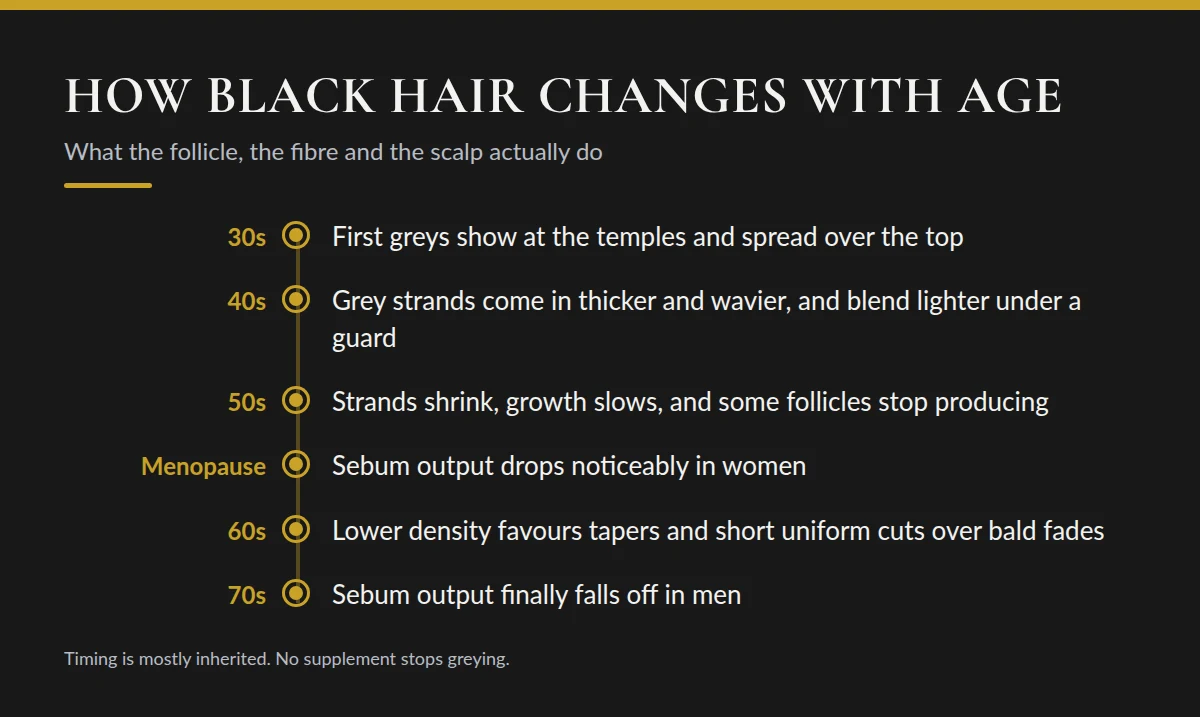
Hair colour comes from melanin made by melanocytes inside the follicle and packed into the shaft as it grows. Two kinds do the work: eumelanin, the brown to black pigment that dominates Black hair, and pheomelanin, the yellow to red one. Grey is not a colour the follicle produces. It is what a shaft looks like when those pigment cells degenerate or stop handing melanin off to the growing fibre, and dermatology reviews are honest that the exact mechanism is still unsettled.
The pattern is predictable even when the timing is not. Greying usually begins in the thirties, starts at the temples and works back over the top of the scalp. Colour lightens before it goes white. Body and facial hair turn later than scalp hair, and underarm, chest and pubic hair may grey very little. That is why a man can be half silver on top with a beard that is still mostly black.
The timing itself is mostly inherited, with smoking and oxidative stress nudging the clock. No supplement, vitamin or topical has evidence behind it for stopping or reversing the process, and anything marketed that way is selling the promise rather than the result. Once a follicle stops making pigment it almost never starts again, which is why colouring remains the only reliable way to put the black back.
Why Grey Coils Feel Coarser Under the Clipper
Ask a barber and you get one answer. Ask a lab and you get a more careful version of the same answer. One study compared pigmented and unpigmented fibres from people with salt-and-pepper hair in an Old Order Mennonite community, chosen because cultural practice ruled out dye, relaxers and heavy sun exposure, leaving pigment as close to the only variable. Averaged across the whole group the differences were small, but within individual people they were real, and they showed up more in the body of the fibre than on its surface. The measured differences in mechanics and in how the fibre takes up and loses water, the researchers wrote, support the common complaint that grey hair is wilder, drier and less manageable.
A second line of work explains the feel through the guard. Non-pigmented fibres measure larger in diameter than the pigmented hairs on the same head and carry more waviness, which makes them stiffer in bending and more likely to catch on their neighbours. A strand that is thicker, wavier and higher in friction stands off the head instead of lying with the pattern. On Type 4 hair, where the shaft is already a flattened ribbon that kinks rather than curves, that extra stiffness is easy to feel: a grey section drags, pushes back against the guard, and blends a shade lighter than the black around it.
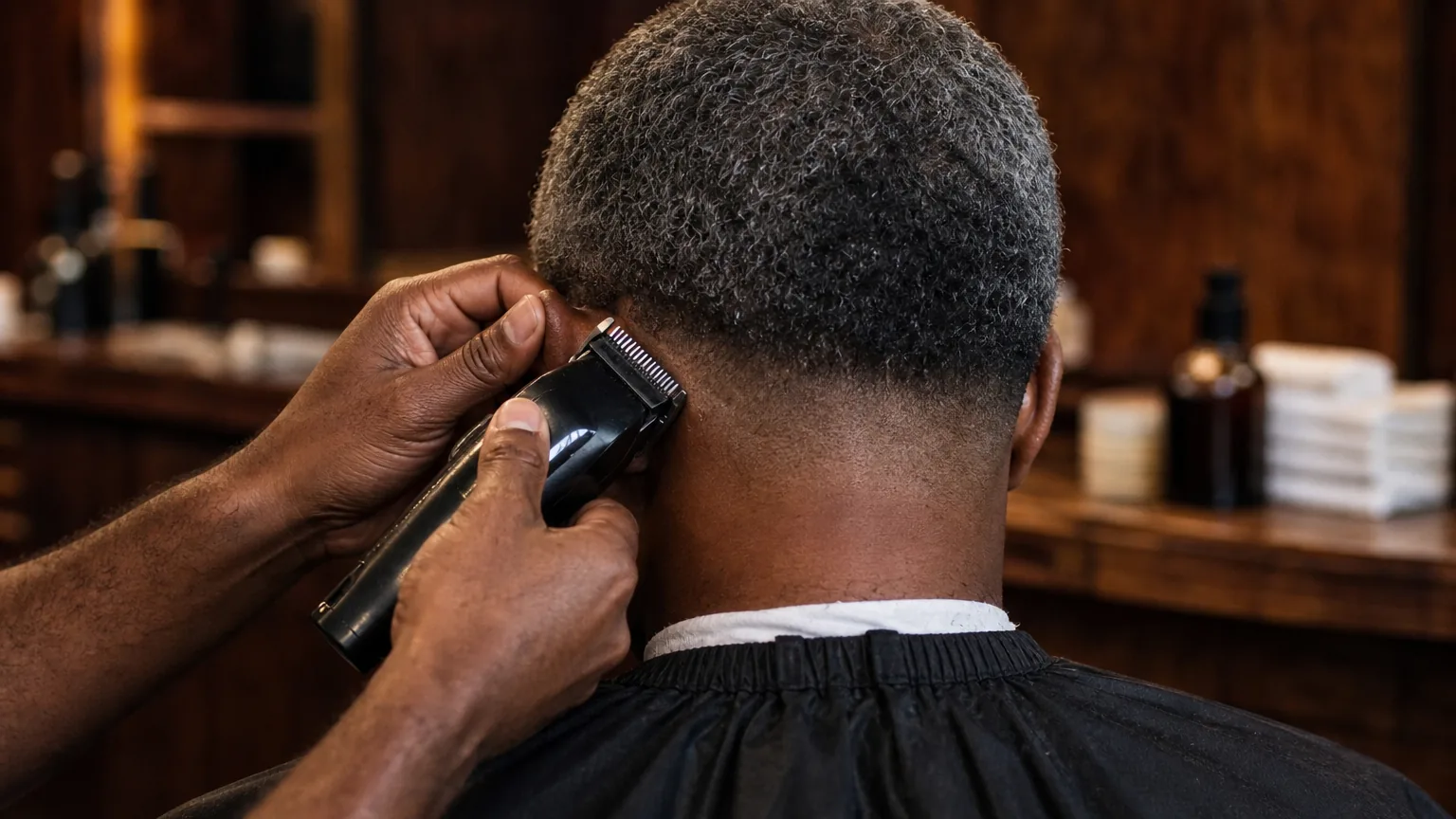
Three adjustments follow from that, and experienced barbers make them without naming them:
- Grey reads lighter than black at the same guard. A salt-and-pepper head often needs a half-guard change through the silver zones to keep a fade looking even from across the room.
- A stiff grey patch pushes hair away from the blade. Slow the pass and use a sharp, properly aligned blade. Forcing the speed pulls the hair instead of cutting it, which is one more argument for a disciplined blade routine.
- Dry cutting matters more than it used to. Grey coils spring back differently from black ones on the same head, so wet length lies twice over.
Thinner Strands and a Coarser Feel, at the Same Time
Clients who were told their hair would get finer are thrown by the coarseness. Both things are true, and they are happening to different hairs. Hair ageing runs on three tracks at once: the shaft weathers, melanocyte function falls, and the follicle produces less. Strands come in smaller and lighter, growth slows, and a share of follicles stop making hair at all, while the grey strands that do arrive are thicker than the black ones they replaced. The head reads thinner overall and feels coarser in patches, and both descriptions are correct.
Density is the part that shows in the chair. Textured hair starts from a lower follicle count than straight hair, with the coil doing the work of looking full, so there was never much margin to spend. Take a share of those follicles out of service and the margin goes fast. A bald skin fade that covered scalp cleanly at twenty-five can expose it at forty-five on the same head.
The Scalp Gets Drier, But Not for the Reason Everyone Repeats
“Your scalp stops making oil” is the usual explanation, and it is about half right. Sebaceous gland activity peaks in the twenties and declines after that, but not on the same schedule for everyone. Sebum output falls noticeably in women around menopause, while in men no major change appears until roughly the eighth decade. A man of fifty-five with a tight, itchy scalp is usually not out of oil. He is dealing with a skin barrier that holds water less well, more sun landing on a thinning crown, and the structural problem he always had, which is that sebum cannot travel past the first few bends of a coil to reach the ends.
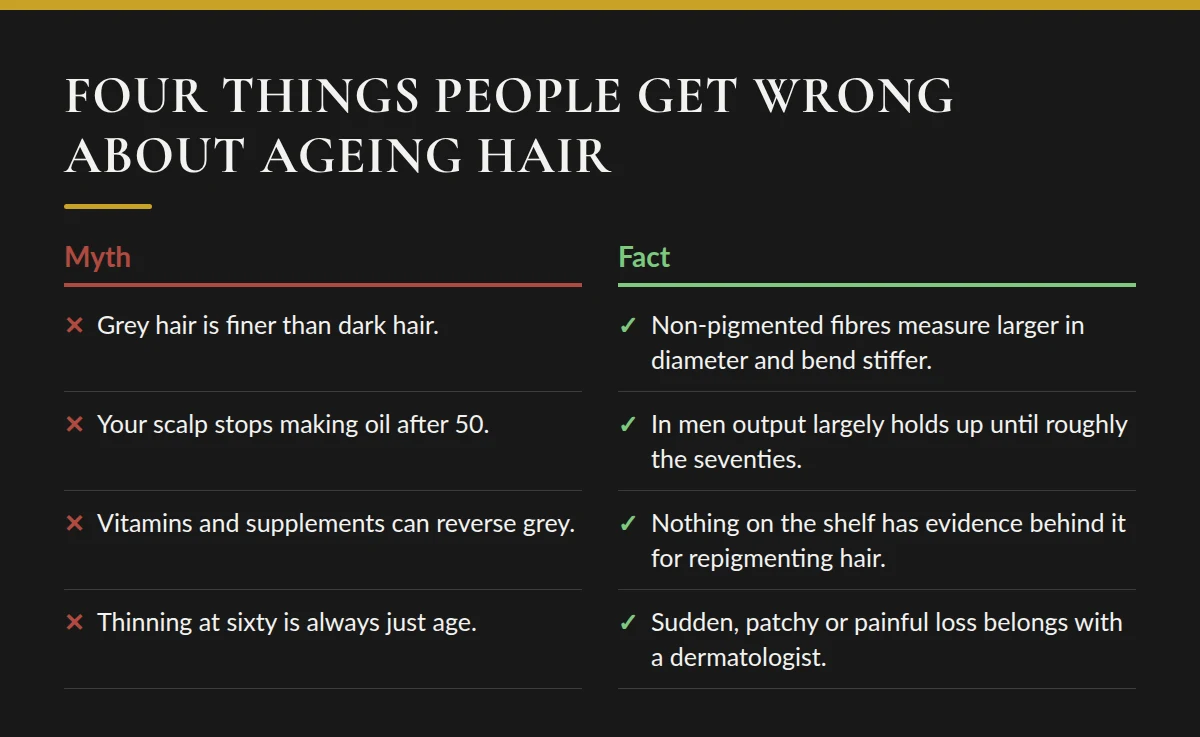
So the answer is not more grease. It is less stripping and better sealing.
- Stretch the wash interval, do not abandon it. Buildup on an ageing scalp flakes and itches just as fast as it ever did. Our scalp guide covers what healthy looks and feels like.
- Trade heavy petrolatum grease for a lighter leave-in cream, with an oil sealed over the ends. Thick product sitting on a lower-density scalp shows through and attracts lint.
- Condition every single wash. A weathered, unpigmented shaft handles water differently, and conditioner is doing structural work at this age rather than cosmetic work.
- Cover or protect a thinning crown outdoors. Grey hair has no pigment left in it to shade the scalp underneath.
The Beard Turns Last and Turns Wiriest
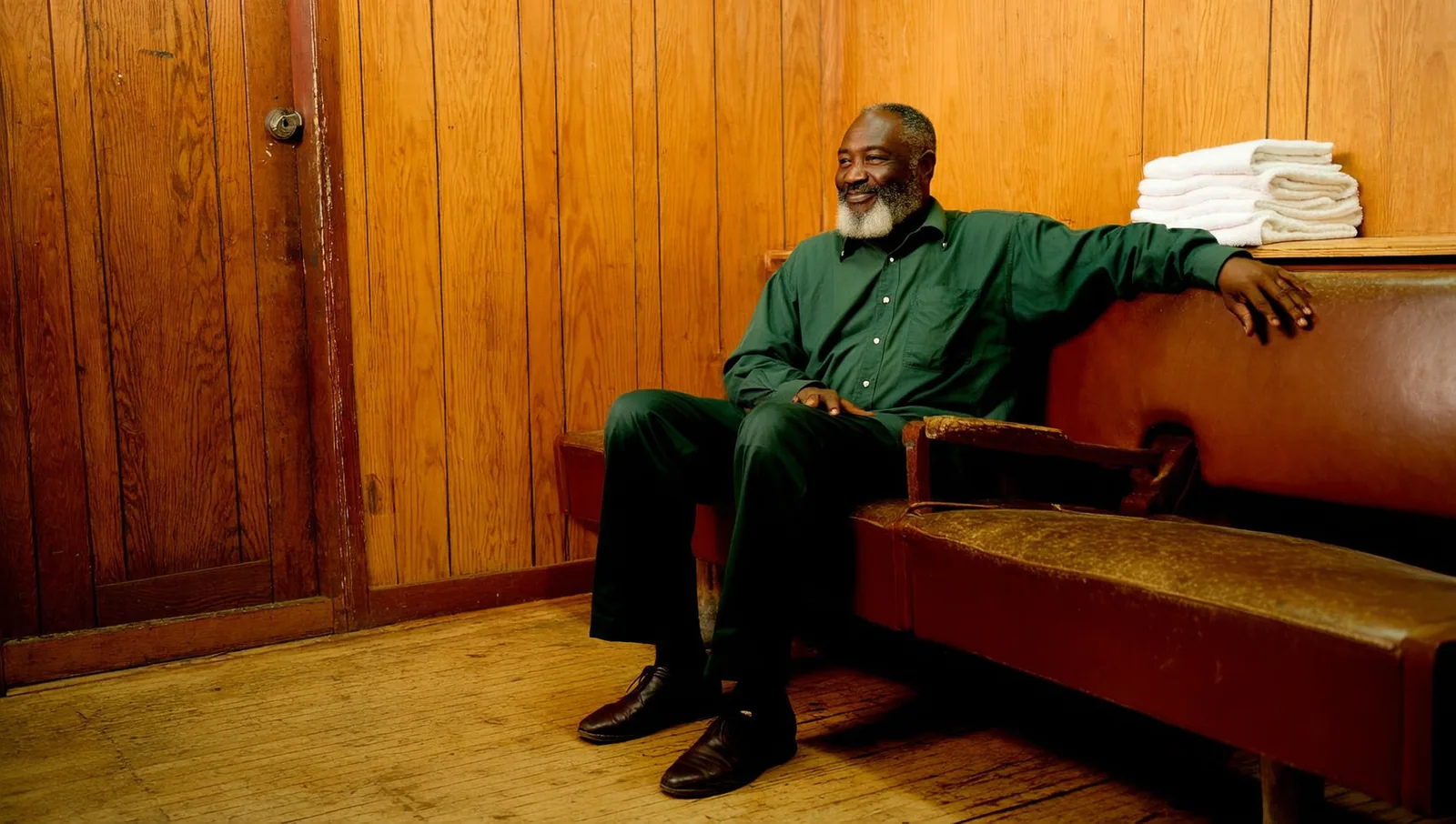
The beard usually greys years behind the scalp, then makes up for lost time. Facial hair also coarsens with age in a way the research notes plainly: men grow longer, coarser eyebrow, ear and nose hair after midlife, and the same thickening shows up in the beard. A wiry grey beard hair holds a bend from the pillow, sits at an odd angle and catches the light, which is why a beard that used to look tidy after a rinse now wants a comb and a balm.
Nothing about ageing cancels pseudofolliculitis barbae either. A curved hair cut below the skin still grows back into it at sixty, so the trimmer-and-guard approach stays the safer one. Beard oil is worth more now than it was at twenty-five, both for the coarser fibre and for the drier skin under it. The grooming guide covers oil against balm and the skin care underneath.
Cuts That Still Hold a Shape at Sixty
Ageing hair does not need a different barber. It needs a shape chosen for the density that is actually there.
Shorter uniform lengths flatter a thinning crown far better than a dramatic contrast. A Caesar, a low taper or a soft shadow fade keeps the silhouette without drawing a bright line around the spot with the least coverage, while a high skin fade does the opposite. The lineup deserves the same restraint: line the hairline where it stands, because carving a corner forward buys one fresh week and costs the next two years, and a sharp edge only makes the recession behind it more obvious. A well-kept beard is the best counterweight a thinning top has, since it adds visual mass where the hair still grows well. If the vocabulary gets in the way of asking for any of this, the haircut dictionary lays out the terms.
For women, the same density arithmetic changes the tension calculation. A hairline with fewer working follicles has less to lose before the loss shows, so install weight, install frequency and the rest period between styles all matter more after forty than they did at twenty-five. Choosing a protective style that actually protects is the difference between a style that rests the hair and one that quietly finishes an edge.
Ageing, or Something a Dermatologist Should See
Normal ageing is slow, even and symmetrical. It thins the whole head a little, over years, without pain. Take it to a dermatologist when the picture does not fit that description:
- Shedding that arrives suddenly, in handfuls, over weeks rather than years.
- A defined bald patch, especially a round one, or loss on one side only.
- Scalp that itches, burns, stings or feels tender before or while hair goes.
- Skin at the crown that looks smooth and shiny, with the little follicular openings gone. That is scarring loss, and the window to save what is left is short.
- Any loss that comes with a new medication, an illness, surgery or major weight change.
Pattern loss, alopecia areata, traction and scarring conditions all have their own signs, and the ones that scar are the ones where waiting costs the most. Our complete hair loss guide walks through every type rather than repeating it here.
The Bottom Line
Hair after forty is not worse hair. It is different hair, and most of the frustration comes from running a routine built for a head that no longer exists. Pigment cells retire on a genetic schedule nobody can bargain with. The grey strands are thicker, wavier and stiffer than the ones they replaced, which is why they fight the guard, while the black ones are gradually getting smaller and some follicles quit entirely, which is why density needs respecting when the cut gets picked. The scalp is drier, though less from a collapse in oil than from a barrier that holds less water. Adjust the guard, the shape, the wash interval and the weight of the product, and a head of salt-and-pepper coils can look as sharp at sixty as it did at thirty. It just gets there by a different route.
Further reading (sources)
- MedlinePlus on when hair starts greying and how the pattern spreads
- Kaplan and colleagues for pigmented and unpigmented fibres compared in a photoprotected population
- Bechthold, Zur Wiesche and Wortmann with the diameter, waviness and stiffness of non-pigmented hair
- Trüeb on the three tracks of hair ageing and what drugs can and cannot do
- Trüeb, Rezende and Dias for a working definition of the science of hair ageing
- Triwongwaranat, Thuangtong and Arunkajohnsak covering follicular melanogenesis and why pigment stops
- Poonia and Bhalla on the evidence behind treatments for premature greying
- Zouboulis and Boschnakow with how sebaceous gland activity shifts with age in men and women
- American Academy of Dermatology for how often textured hair actually needs washing
- American Academy of Dermatology on hair loss in people with darker skin tones