Eczema at the Hairline and Scalp: Atopic Dermatitis on Black Skin From the Barber's Chair
Published on October 24, 2026

The guard is already on the clipper when the barber finds it at the nape: a rough, dry patch a shade greyer than the skin around it, crossed with faint scratch lines. The client calls it ashy. He has switched to a heavier grease, the patch is still there, and it itches worst at night. A second rough spot sits at one corner of his hairline, and the skin around his eyes has gone darker than it used to be.
That picture fits atopic dermatitis, the most common kind of eczema. Most descriptions of eczema center on a red rash, which is how it often looks on lighter skin. On darker skin, the American Academy of Dermatology (AAD) says, it more often shows up as dark brown, purple or greyish patches and small, rough bumps, and that is easy to write off as dry skin or dandruff. It is also more common among Black children: in a 2003 national survey of 102,353 US children, Shaw and colleagues found that Black children had 1.7 times the odds of an eczema diagnosis once other factors were accounted for.
This guide covers how eczema looks on Black skin and where it sits around the hairline, nape, beard and eyes, how to tell it from seborrheic dermatitis and psoriasis, what flares it, how to cut around it, and when it needs a dermatologist rather than another jar.
What Eczema Looks Like on Black Skin
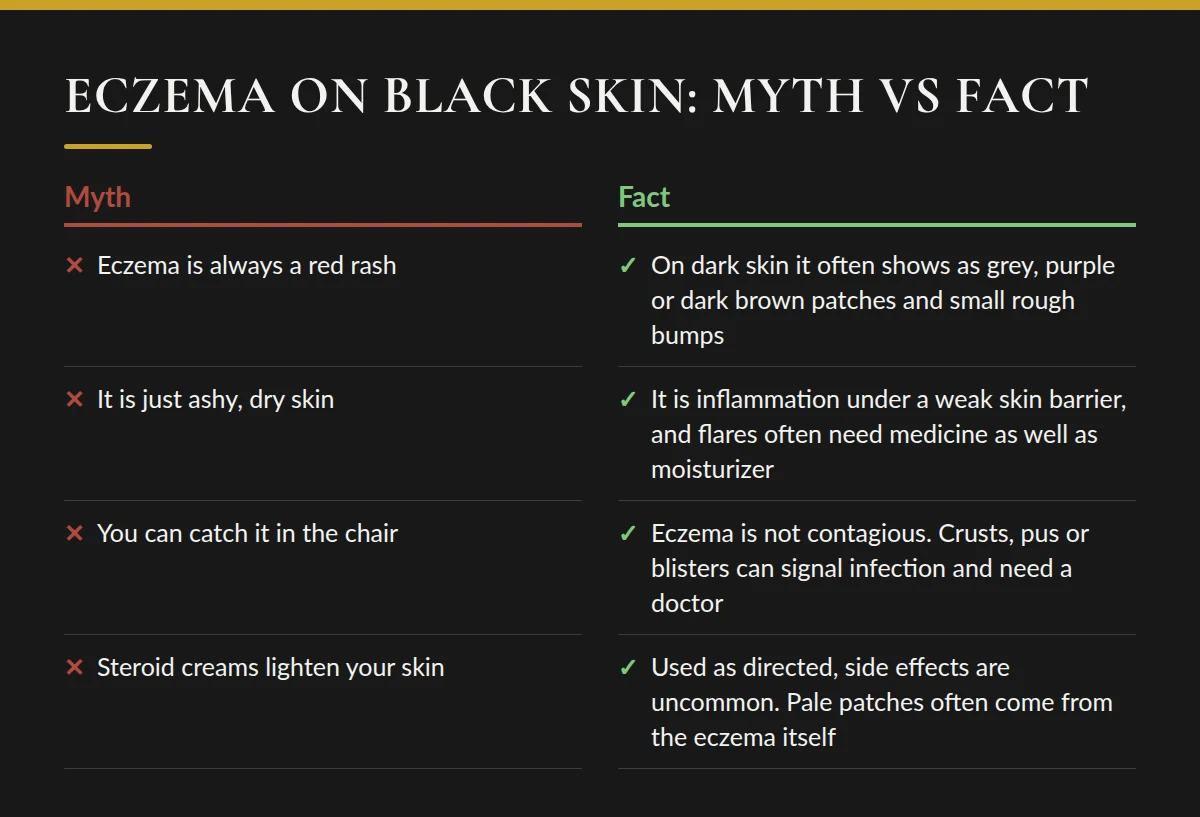
Dermatologists call atopic dermatitis “the itch that rashes,” the AAD explains: the itch comes first, and scratching brings on the rash. Underneath is a weak skin barrier that lets moisture out and leaves the skin’s immune system exposed to whatever touches it, according to the National Institute of Arthritis and Musculoskeletal and Skin Diseases (NIAMS). Genes and the environment both play a part, and a family history of eczema, hay fever or asthma raises the odds. It is not contagious, NIAMS and the NHS both say.
The AAD’s list of signs on darker skin:
- Dark brown, purple or greyish patches, where lighter skin would show a red rash.
- Small, rough bumps, which are more common in darker skin tones. In older children and teens, these bumps tend to be grey to violet-brown.
- Dry, scaly skin, scratch marks and raw patches, sometimes with bumps that leak fluid and crust over.
- With time, thickened, leathery skin that looks darker, or lighter, than the skin around it.
The NHS describes eczema on dark brown skin as areas that look grey, white and dry. DermNet, the dermatology reference, adds that a papular pattern (many small bumps) and a perifollicular one (bumps gathered around the hair follicles) may be more common in people of African descent. On a freshly clipped nape or beard line, follicle bumps like these are easy to mistake for razor bumps.
Then come the marks. Healed eczema often leaves skin darker or lighter than before, NIAMS notes, and DermNet says these changes are more common and more noticeable on skin of color, which also appears especially prone to the hard, thickened, intensely itchy bumps that scratching and rubbing can build. Our guide to dark spots on Black skin explains why brown skin holds on to a mark after inflammation, and why sun keeps it dark.
That difference in looks has a cost, because severity scores lean heavily on redness. In a London study that followed 137 children, Ben-Gashir and Hay found that Black children looked no more likely than white children to have severe eczema on a simple comparison, but had about six times the odds once redness scores were adjusted for. Redness “can be a misleading indicator of severity in black children,” they warned, and DermNet notes that scoring systems can underestimate severity in skin of color because the redness looks violet.
Where It Shows Up: Hairline, Nape, Beard and Eyes
Eczema moves around the body with age, and the head and neck stay on the map at every stage.
- Babies. The cheeks, forehead and scalp are common early sites, the AAD says. Soon after birth it can look like cradle cap, DermNet notes, and babies rub the itchy back of the head against their bedding, which can thin the hair there for a while.
- Children. Between age 2 and puberty, the AAD lists the neck, wrists and ankles among the common places. In children with darker skin, patches tend to form on the fronts of the knees and elbows and the backs of the hands rather than in the creases, and children with brown or Black skin are more likely than white children to get it on the trunk.
- Teens and adults. NIAMS describes a red to dark brown scaly rash on the hands, the neck, the bends of the elbows and knees, around the eyes, and on the ankles and feet. Adults are more likely than children to get it around the eyes, where it often leaves thickened, darker skin, the AAD says. In a study of 602 US adults with eczema, Silverberg and colleagues found trunk lesions more often in Black and Hispanic adults, and one of five patterns they identified centered on the front and back of the neck.
- The oily zone. Head and neck dermatitis is a form of atopic dermatitis that settles in the same oily, seborrheic areas as seborrheic dermatitis. A 2024 review by Chong and colleagues ties it to Malassezia, the skin yeast also linked to seborrheic dermatitis, and notes that antifungals helped in several placebo-controlled trials. Same zones, same yeast: no wonder the two get confused.
Rubbing leaves its own marks. DermNet lists “atopic dirty neck,” a rippled darkening of the skin on the neck, among the forms eczema takes in children and teens. At a skin center in Singapore, Seghers and colleagues found it in one in seven eczema patients and traced it to friction plus darkening after inflammation: pigment, not dirt.
Eczema, Seborrheic Dermatitis, Psoriasis or an Allergy?
All of these can flake, itch and leave marks on dark skin, and a person can have more than one at a time. These are the usual clues.
- Atopic eczema itches first and hardest. It looks dry and rough, often with small bumps and scratch marks, and it favors the neck, the eyelids and the body’s folds or, on darker skin, the fronts of the knees and elbows. A personal or family history of eczema, asthma or hay fever makes it more likely.
- Seborrheic dermatitis shows white-to-yellow greasy scale, usually on the scalp and face, a 2025 review by Turchin and colleagues says, and on richly pigmented skin it can leave lighter or darker patches too. When the medicated shampoo stops working, our guide to treatment-resistant seborrheic dermatitis picks up the story.
- Psoriasis builds raised, sharply bordered plaques with silvery scale and can pit the nails, as Von Lotten and Mayo summarize in a 2026 case discussion. On dark skin the plaques are often violet or dark brown with grey scale and tend to cross the hairline, as our guide to scalp psoriasis on Black hair explains.
- Allergic contact dermatitis follows the product: a rash exactly where something touches, such as a dye line at the hairline or the sides of the neck under extensions. Eczema-prone skin can develop one on top. Among patients referred for patch testing in North American Contact Dermatitis Group (NACDG) data, Warshaw and colleagues found allergy was the main diagnosis in 38.6 percent of scalp-only rashes, ahead of seborrheic dermatitis at 17.2 percent, and in more than half of rashes that also reached neighboring skin. PPD (para-phenylenediamine, the classic hair dye ingredient) led the allergens, followed by a fragrance mix, nickel, balsam of Peru and cinnamic aldehyde.
- Ringworm, a fungal infection of the scalp, scales too. DermNet warns that a steroid cream can mask or aggravate fungal infections such as tinea, so a child’s scaly scalp needs a diagnosis before anyone reaches for hydrocortisone.
An exam and a few questions may be all a dermatologist needs to tell these apart, the AAD says, though sometimes a small skin biopsy is required. When a product is the suspect, patch testing identifies it, and DermNet suggests considering it whenever eczema resists treatment.
What Flares It: Wash Day, Oils, Fragrance and Heat
Triggers differ from person to person, and some people never pin theirs down, the AAD says. Its common ones read like a tour of a grooming shelf: skin care products, fragrance and perfumes, harsh detergents, wool, hot or cold weather, and stress. The NHS adds heat, soap and some fabrics.
- Hot water and harsh cleansers. NIAMS recommends lukewarm baths no more than once a day, a mild unscented or soap-free cleanser, patting dry instead of rubbing, and moisturizing before the skin dries out. Shampoo runoff goes down the nape and behind the ears, and shampoos and conditioners were among the three leading sources of scalp allergens in the NACDG data, so rinse those areas well and moisturize them too. Our Type 4 wash day guide covers how often to wash.
- Fragrance, including the natural kind. Fragrance is on the AAD’s trigger list, and NIAMS lists fragrances in skin products and soaps among the things that can change the skin barrier. Scented pomades, wave grease, sheen sprays, edge control, beard oils and aftershave put it right on the hairline, beard and neck. Natural is no guarantee: balsam of Peru, a tree resin, and cinnamic aldehyde, which gives cinnamon its scent, both ranked among the five leading scalp allergens in the NACDG data. Choose fragrance-free.
- The wrong oil. In a small forearm study of 19 adults, Danby and colleagues found that four weeks of olive oil weakened the skin barrier while sunflower seed oil kept it intact, a challenge, they wrote, to the belief that all natural oils are good for skin. In 117 children with mild to moderate eczema in the Philippines, Evangelista and colleagues found that virgin coconut oil cut severity scores by 68 percent over eight weeks, against 38 percent for mineral oil. Neither study tested the scalp, and scented blends carry fragrance, so a plain, fragrance-free moisturizer stays the safer default.
- Heat and what sits on the hairline. Being hot makes eczema itchier, the NHS says, and NIAMS advises avoiding overheating and keeping rough fabrics such as wool off the skin. A wool beanie pulled down over the forehead and nape all winter, or any snug band that holds heat against the hairline, is worth testing as a trigger.
- Extensions, dyes and adhesives. Von Lotten and Mayo describe a 37-year-old Black woman with eczema whose itchy, darkened plaques on the sides of her neck, behind her ears and around her eyes got worse with every new style using synthetic extensions. Synthetic fibers can carry allergens such as PPD, acrylates and formaldehyde-releasing resins, they write (acrylates also turn up in some bonding adhesives), and skin with eczema lets allergens in more easily. Advised to switch to untreated human hair or low-residue fibers and to get patch tested, she improved once she avoided the trigger.
- Stress and scratching. Stress is on the AAD’s list, and scratching keeps the cycle going: NIAMS says it increases inflammation and can make the itch worse. The NHS suggests gently rubbing an itchy spot with a finger instead, and keeping nails short.

For Barbers: Cutting a Client With Eczema
Eczema is not contagious, so there is no reason to turn a client away, and a careful cut is part of feeling normal with a skin condition. What changes is where the blades, the heat and the products go.
Rules vary by state, so check your own board, but California’s regulation shows the principle: no one working in a shop may perform services on skin or scalp that is inflamed or broken, or where a skin infection or eruption is present. An active eczema patch is inflamed skin, and a scratched one is broken skin.
- Look before you cut. Lift the hair at the nape, behind the ears and along the hairline before the first pass, and ask whether anything is sore, cracked or freshly treated.
- Leave length over active patches. Keep a guard between the blade and the patch. A skin fade, a foil shaver, a zero-gapped trimmer or a razor has no business on inflamed or scratched skin.
- Edge on clear skin. Shape the line-up and the beard line where the skin is calm, and soften the line over a patch rather than carving through it.
- Skip the sting and the scent. NIAMS warns that lotions high in alcohol can burn skin with eczema, and fragrance is a known trigger, so keep alcohol aftershave, scented sprays and fragranced oils off the neckline of a client with eczema.
- Go easy on heat. Heat makes eczema itchier, so a steaming towel on a flaring neck is the wrong comfort. Offer it lukewarm, or skip it.
- Patch-test dye every time. The FDA names PPD as the hair dye ingredient most prominently linked to allergic reactions, warns that people can react even after years of trouble-free dyeing, and advises a skin test before every use. In NACDG testing from 1998 to 2006, Black patients reacted to PPD more often than white patients (7.0 versus 4.4 percent). Never dye over active eczema, or color brows or lashes with hair dye, which the FDA warns can cause blindness.
- Know the red flags. Yellow or golden crusts often mean a staph infection, the AAD says, and the NHS advises an urgent appointment for blisters, crusting, pus, warmth, swelling, pain, a sudden flare or fever. Clusters of dome-shaped blisters with fever, tiredness and swollen glands can be eczema herpeticum, a herpes infection the AAD calls potentially life-threatening in babies, children and people with weakened immune systems. Postpone the cut, then disinfect your tools as you would after any client.
- Mind your own hands. Adults are more likely than children to get eczema on their hands, the AAD notes, sometimes only there. California’s rule also requires anyone working with inflamed or broken skin on their hands to wear gloves.
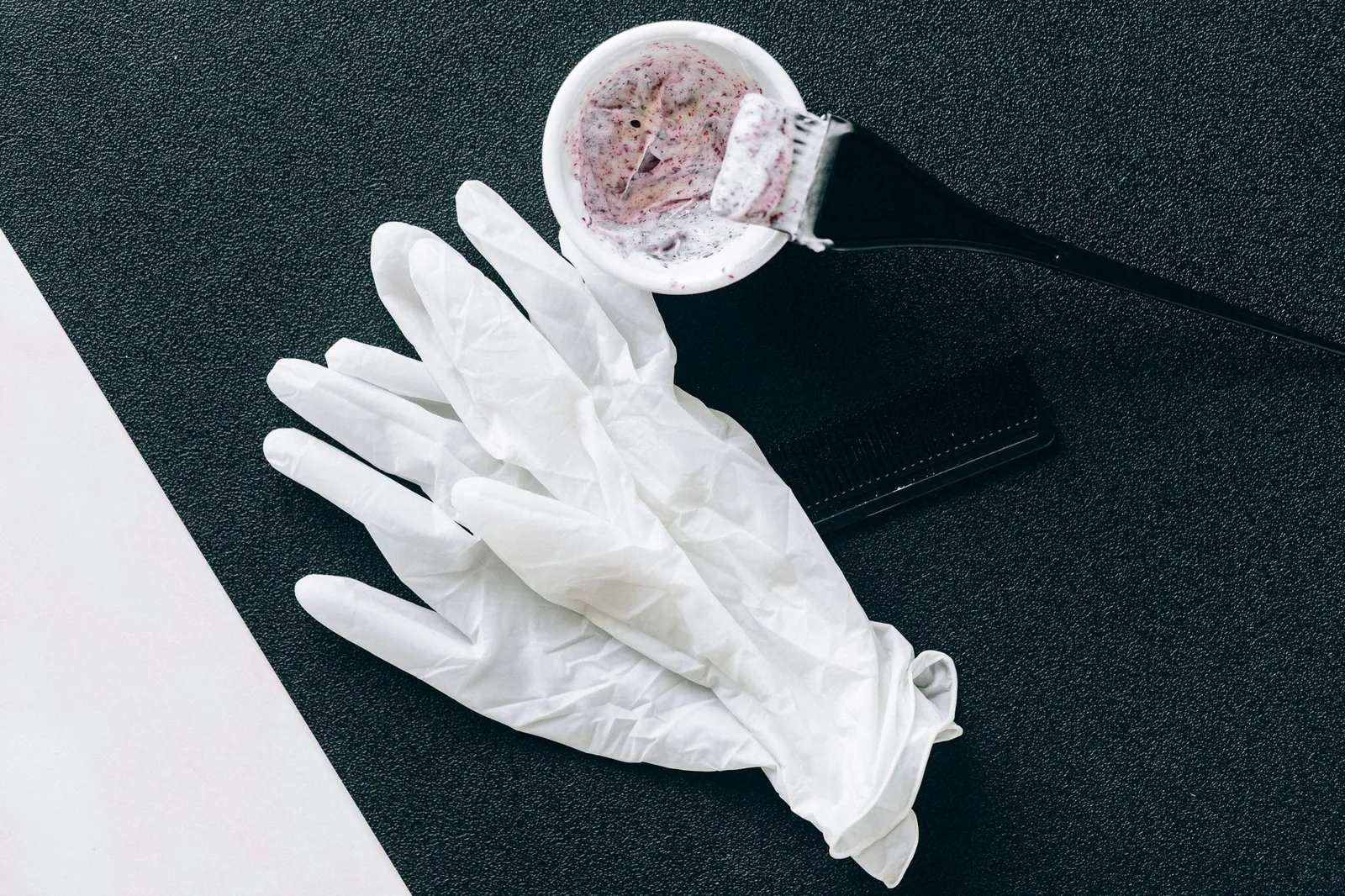
Then say what you see, without diagnosing: “That patch looks like more than dry skin. Eczema can look grey or dark on our skin, and a dermatologist can treat it.” A barber cannot prescribe anything, but the right word in the chair can save someone years of treating eczema as ashy skin.
Treatment: What a Dermatologist Can Offer
Eczema cannot be cured, but it can be controlled. A dermatologist’s plan aims to reduce flares, ease the itch, prevent the thickened skin that itches all the time, keep skin hydrated and lower the risk of infection, the AAD says.
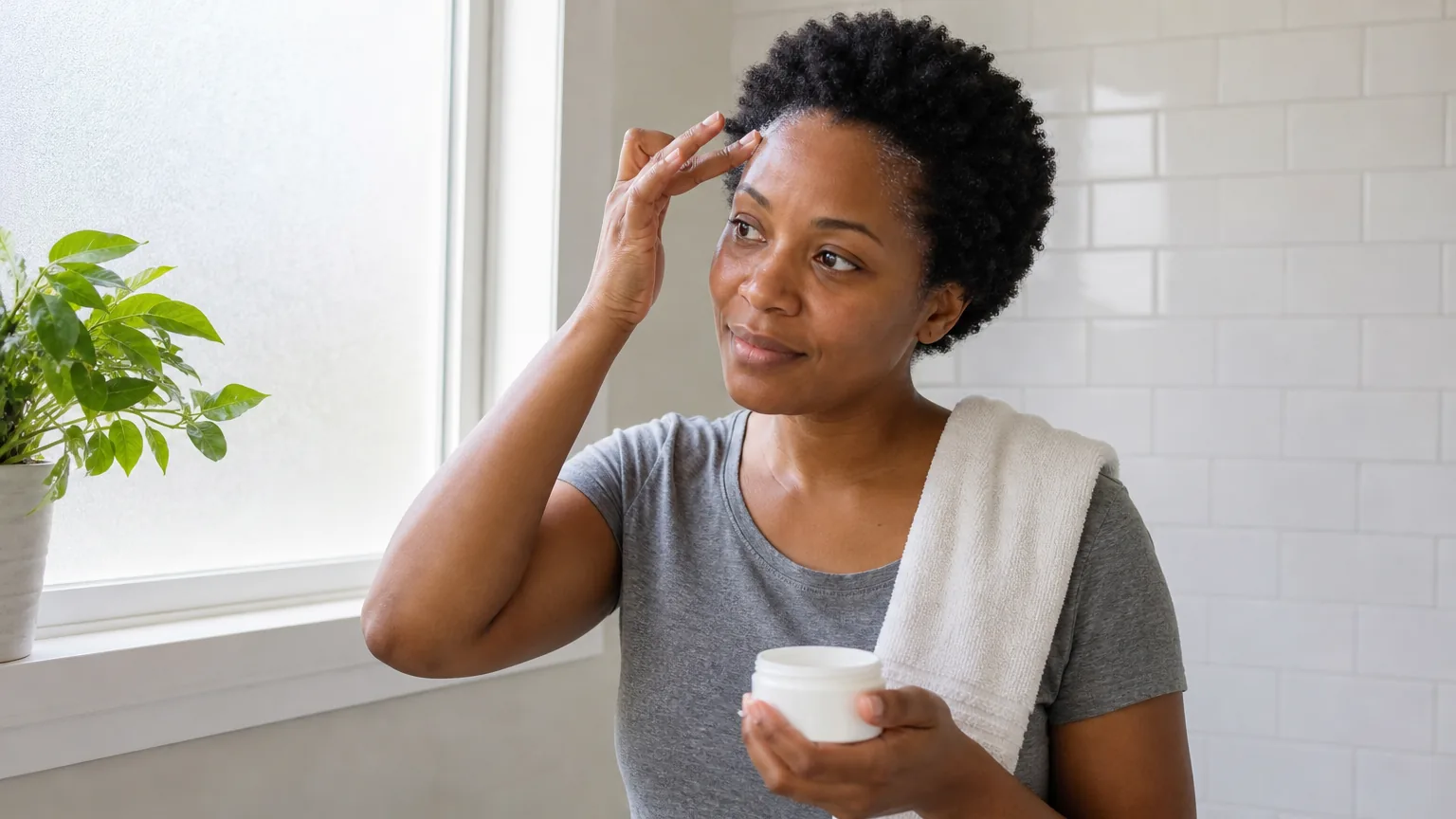
- Moisturizer, for everyone. The AAD recommends it for everyone with atopic dermatitis, because well-moisturized skin is less likely to crack. NIAMS favors creams and ointments over thin lotions, applied after bathing to seal in the water.
- Steroid creams, ointments and solutions. Topical corticosteroids are the usual first medicine, and on the scalp a gel or solution suits hair-bearing skin but can sting inflamed skin, DermNet notes. Worried they lighten dark skin? DermNet says side effects are uncommon when steroids are used as directed, that thinning and similar problems come from months of daily use of an unnecessarily strong one, and that steroids often take the blame for pale patches the eczema itself left. Steroid pills are rarely used, NIAMS says, because eczema can flare back worse when they stop.
- Steroid-free creams. Tacrolimus ointment and pimecrolimus cream are options when steroids stop working, fail to work or are not a good fit, the AAD says. Newer choices include crisaborole ointment, approved from 3 months of age, and roflumilast, ruxolitinib and tapinarof creams, approved from age 2.
- Light therapy. Usually two to three sessions a week, often for at least a few months, at a dermatologist’s office or treatment center. The AAD warns against substituting tanning beds, sunlamps or time in the sun.
- Injections and pills. For moderate to severe eczema that creams do not control, the AAD lists injected biologics (dupilumab from 6 months of age; lebrikizumab, tralokinumab and nemolizumab from 12) and the JAK inhibitor pills abrocitinib and upadacitinib (from 12).
How well do they work on Black skin? Better than anyone could say a decade ago, though the data are still thin. Pooling three of dupilumab’s phase 3 trials, Alexis and colleagues found that the 128 Black patients among 2,058 improved on eczema severity and itch compared with placebo. ADmirable, the first lebrikizumab study limited to skin of color, treated 90 adults and teens with darker skin types: at 16 weeks, 69.2 percent had at least a 75 percent improvement in their eczema score, and by week 24, 64.4 percent of those who started with darkened patches had less darkening. It had no placebo group, and the drug’s maker funded and helped run it. Across 68 eczema trials completed from 2019 to 2024, Kabakova and colleagues found that 13.4 percent of participants were Black, a rising share.
When to See a Dermatologist
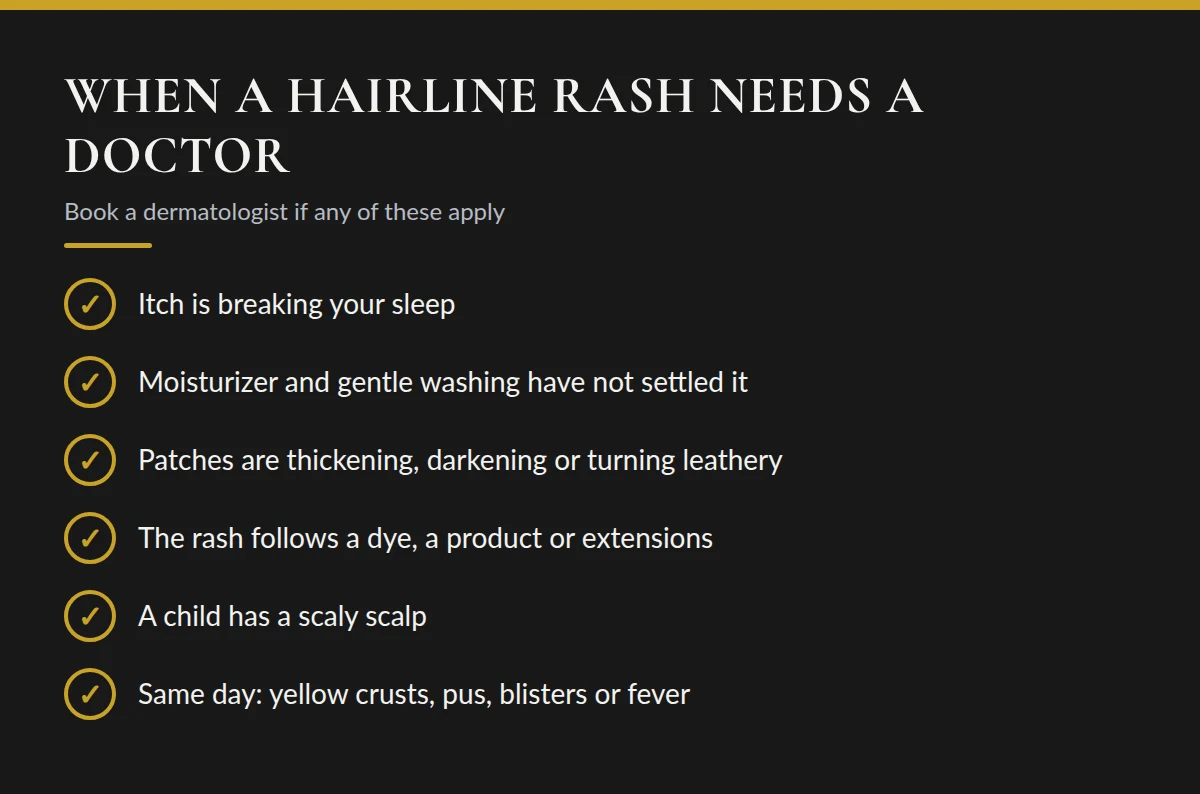
A pharmacist can help with small patches that are dry and only slightly itchy, the NHS says. Book a dermatologist when:
- Itch is keeping you or your child up at night.
- Gentle washing and a fragrance-free moisturizer have not settled it, or the patches keep coming back.
- Patches are thickening, darkening or turning leathery. Treating eczema before the skin thickens helps prevent skin that itches all the time, the AAD says.
- The rash sits where a product, dye, extension or adhesive touches. Ask about patch testing.
- A child has a scaly scalp. Get a diagnosis before any steroid cream goes on.
- Hair is coming out in patches. People with alopecia areata have about two and a half times the odds of eczema, a meta-analysis by Mohan and Silverberg found, so the two can turn up together. Our guide to alopecia areata on Black hair covers the smooth, round patches.
Get help the same day for yellow crusts, pus, blisters, spreading warmth or swelling, a sudden flare, or fever.
Before the visit, the AAD suggests noting when symptoms began, where they appear, what makes them better or worse, and whether blood relatives have eczema, asthma or hay fever. Bring a list of everything that touches your hairline, beard and neck, photos of a flare (eczema waxes and wanes, so it may be calm on the day), and your real wash schedule and styles, so the plan fits wash day.
The Bottom Line
Eczema on Black skin rarely looks like the textbook red rash. At the hairline, nape, beard and around the eyes it tends to show up grey, violet or dark brown, often as small rough bumps, and it can leave skin darker or lighter as it heals. It is not contagious, and it is more than ashy skin: lukewarm water, fragrance-free products and a plain moisturizer help, flares often need medicine, and a rash that follows a dye or extensions deserves patch testing. In the chair, keep blades, heat and alcohol off inflamed skin, patch-test dye every time, and when a patch looks like more than dry skin, say so.
Further reading (sources)
- American Academy of Dermatology on how atopic dermatitis looks at different ages and on darker skin
- American Academy of Dermatology for diagnosis, common triggers and every current treatment option
- NIAMS with an overview of who gets atopic dermatitis and where it appears
- NIAMS on diagnosis, treatment and daily skin care for eczema
- NHS for atopic eczema on brown and black skin and when to get urgent help
- DermNet on atopic dermatitis patterns, including in skin of color
- DermNet with how topical steroids are chosen and what their side effects really are
- Shaw and colleagues on eczema prevalence among US children
- Ben-Gashir and Hay for how redness scores can hide severe eczema in Black children
- Silverberg and colleagues on where eczema lesions appear in US adults
- Seghers and colleagues with a clinic study of darkened neck skin in eczema
- Chong and colleagues on head and neck dermatitis and the Malassezia yeast
- Turchin and colleagues for how seborrheic dermatitis presents across skin tones
- Warshaw and colleagues on patch test results in patients with scalp rashes
- DeLeo and colleagues with race and patch test results in North American clinics
- Von Lotten and Mayo on a neck rash linked to synthetic hair extensions
- Danby and colleagues for olive oil versus sunflower seed oil on the skin barrier
- Evangelista and colleagues on virgin coconut oil for children with eczema
- U.S. Food and Drug Administration on hair dye allergies and the skin test before every use
- California Code of Regulations for the rule against services on inflamed or broken skin
- Alexis, Rendon and colleagues on dupilumab results by racial subgroup
- Alexis and the ADmirable investigators with lebrikizumab in patients with skin of color
- Kabakova and colleagues for racial and ethnic representation in eczema trials
- Mohan and Silverberg on the link between alopecia areata and atopic dermatitis