Scalp Psoriasis on Black Hair: Cutting, Styling, and Keeping the Hair You Have
Published on October 3, 2026
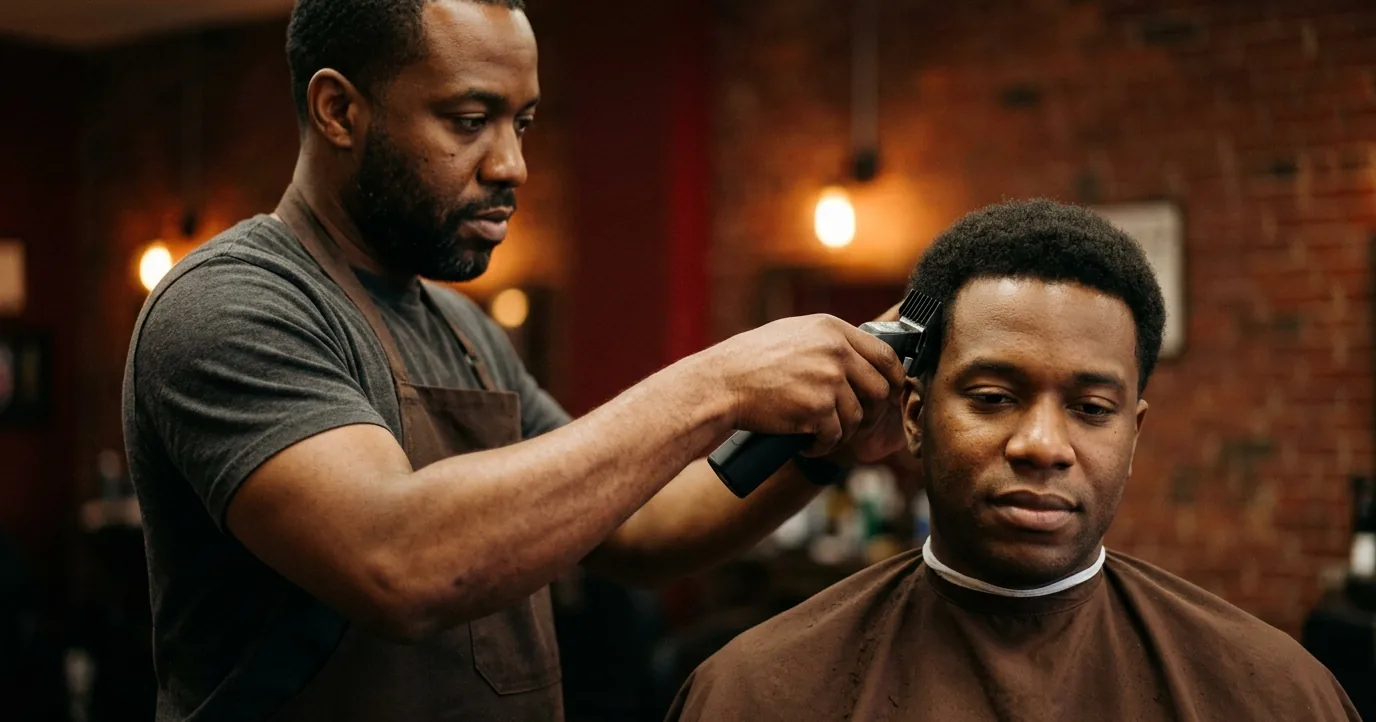
It usually starts where the client cannot see it: thick gray scale at the nape, another patch creeping past the hairline behind one ear, and a man who has called it dandruff for two years and bought a new bottle every few months. Underneath, the skin is not red like the textbook pictures. It is violet, or a brown a few shades deeper than the skin around it, which is a big part of why it gets missed.
That can be scalp psoriasis. A national survey put psoriasis at 3.0 percent of US adults and 1.5 percent of Black adults, though the National Psoriasis Foundation (NPF) says the gap may partly reflect psoriasis being misidentified on dark skin, so more people of color may have it than the counts show. Of everyone with psoriasis, 52 to 80 percent have had it on the scalp. This guide covers how it looks on dark skin, how to tell it from the flaking conditions in our complete guide to scalp health for Black hair, how to remove scale without taking hair with it, and how a barber should cut a client whose plaques are active.
What Scalp Psoriasis Looks Like on Dark Skin
Psoriasis is an immune condition, not an infection. An overactive immune system makes skin cells that normally take about a month to grow and shed do it in three or four days, so they pile up on the surface, the NPF explains. On the scalp that pile-up forms plaques: raised, sharply edged patches topped with scale. It is not contagious, the NHS says, so you cannot catch it or spread it.
Most descriptions are written for light skin, where plaques look red with silvery-white scale. On darker skin, the NPF notes, psoriasis may look salmon, dark brown, purple or violet with grayish scale, and plaques may be thicker with more scaling. In a review from a New York skin of color center, Andrew Alexis and Paul Blackcloud warn that this violaceous or dark brown hue can be mistaken for an old mark when it is actually active inflammation that still needs treatment. DermNet notes that diagnosis may be delayed or missed in darker skin, where the patches range from purple to dark brown.
Scalp psoriasis rarely stays inside the hairline. It often reaches the forehead, the back of the neck and the skin around the ears, according to the NPF and DermNet, which is exactly where a barber edges. It can itch fiercely: adults with skin of color in a 2025 scalp psoriasis trial rated their itch at 7.6 out of 10 before treatment. The skin can also crack and bleed.
When plaques clear, they often leave patches lighter or darker than the surrounding skin. Alexis and Blackcloud write that these can take 3 to 12 months to fade, and that some patients find them as upsetting as the psoriasis itself. They are a change in pigment, not a scar. Our guide to dark spots on Black skin explains why brown skin holds on to a mark after inflammation, and why sunlight keeps it dark.
Psoriasis, Seborrheic Dermatitis or Dandruff?
All three flake, and all three end up on a dark collar.
- Scalp psoriasis has dry, powdery scale with a silvery sheen, the NPF says, on raised plaques with sharp borders, often violet or dark brown on dark skin. It tends to cross the hairline and bleeds when picked.
- Seborrheic dermatitis looks yellowish and greasy, also turns up in the eyebrows and beard, and on brown skin can show as lighter patches. If that sounds more like yours, our guide to treatment-resistant seborrheic dermatitis picks up where the dandruff shampoo leaves off.
- Dandruff is fine flaking without raised plaques, and it usually settles with a dandruff shampoo used properly.
Check beyond the scalp, too. Plaques on the outer elbows and knees, the palms or the soles, and changes in the nails help confirm psoriasis, Alexis and Blackcloud note, and the National Institute of Arthritis and Musculoskeletal and Skin Diseases (NIAMS) lists thick, ridged, pitted nails among its signs. One recent scalp psoriasis trial required every participant to have a plaque away from the scalp, precisely to rule out seborrheic dermatitis.
The lines are not always clean. Some people have both, which DermNet calls sebopsoriasis, and on dark skin discoid lupus, lichen planus and sarcoidosis can imitate psoriasis closely enough to need a biopsy, the NPF warns. DermNet adds tinea capitis, a fungal infection of the scalp, to the look-alikes. A scaly scalp that shrugs off the usual shampoos needs a dermatologist, not another bottle.
Removing Scale Without Taking Hair With It
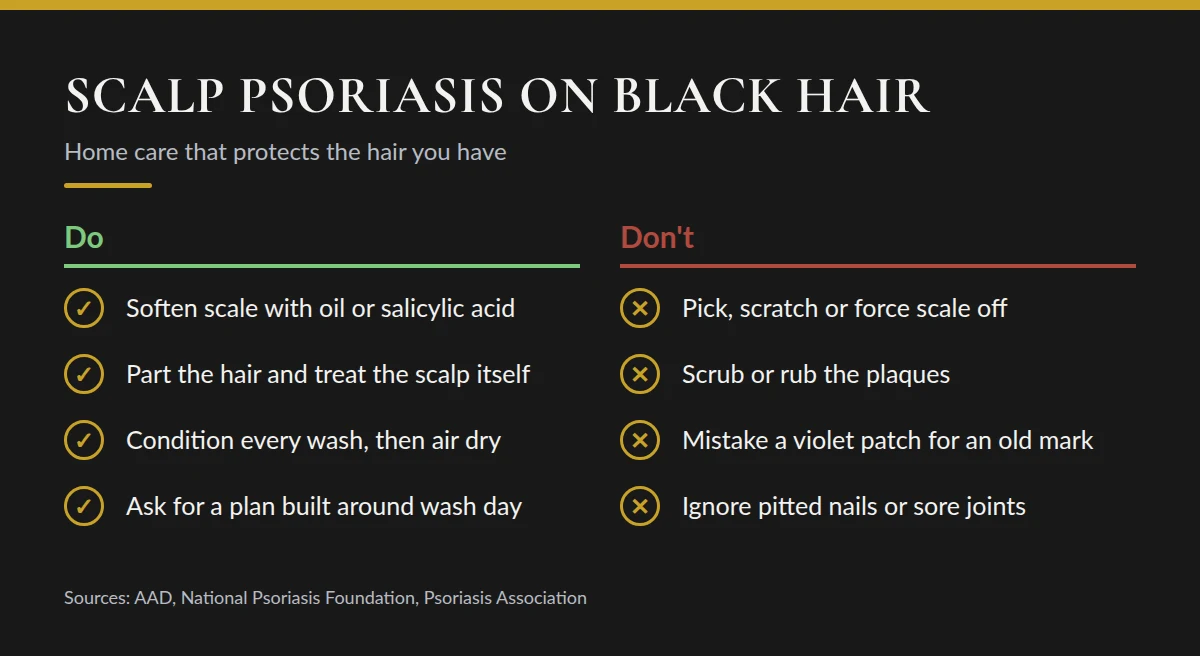
Scale has to come off for treatment to reach the skin, but how it comes off decides whether hair comes with it. The American Academy of Dermatology (AAD) is blunt: forcefully removing scale often loosens hair along with it, and picking aggravates the skin and can make psoriasis flare. Soften first, then lift gently.
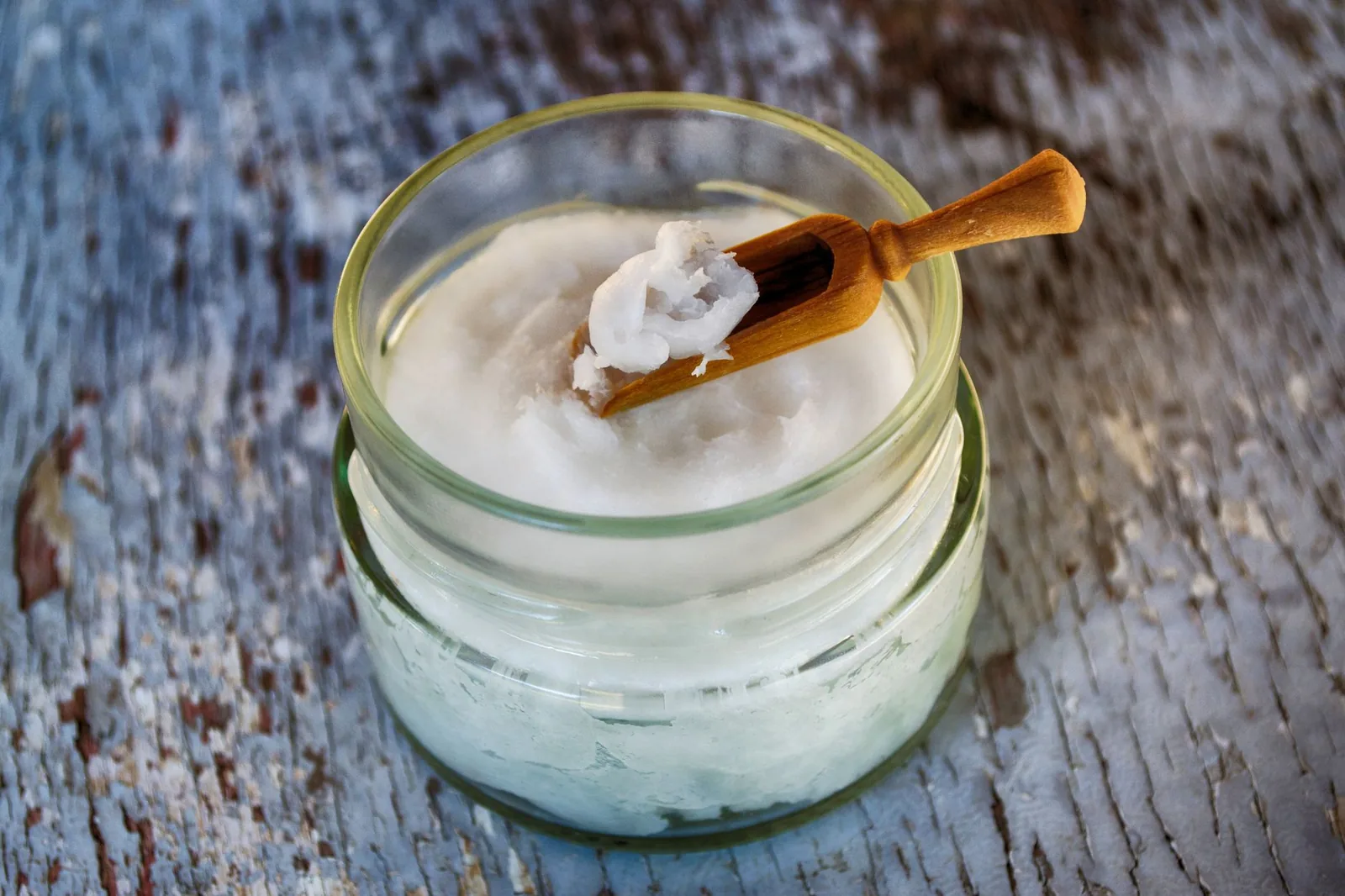
- Soften. Salicylic acid softens plaques and loosens scale, the NPF says, and the UK’s Psoriasis Association suggests olive or coconut oil to help scale lift. A 2021 review found very few studies of scale softeners on the scalp itself, so the evidence is thinner than the shelf suggests.
- Treat the scalp, not the hair. Part the hair and apply along the parts. The AAD stresses that medicine only works once it reaches the scalp.
- Lift only what has let go. Work in small sections. On tightly coiled hair a fine comb snags and breaks strands, so fingertips or a soft brush do less damage. Scale that is still stuck needs more softening, not more force.
- Wash without scrubbing. The NPF advises against rubbing or scratching plaques, and Alexis and Blackcloud describe skin growing thicker and darker in patients who scrub their lesions.
Keep fingernails short and filed smooth, as the AAD suggests, so the itch you cannot resist does less damage. Scratching is not harmless here. Injury to the skin can seed new plaques, a reaction called the Koebner phenomenon, and the NPF singles out scalp scratching, a habit in some African American communities, as one way it happens. If scale builds into thick layers, which DermNet compares to overlapping roof tiles, let a dermatologist take it from there.
Fitting Treatment Around a Weekly Wash Day
Most psoriasis advice assumes frequent washing, which backfires on coily hair. Alexis and Blackcloud point out that daily washing with a prescription shampoo is often unworkable for African American women: it dries the hair, causes breakage and undoes the style, so people quit. The NPF says the same of medicated shampoos that need daily use on coarser hair. A plan that fits looks more like this:
- A medicated wash about once a week, worked into the scalp and followed by conditioner. The AAD advises conditioning after every shampoo and, for people who wash more often, alternating the medicated shampoo with a gentle one.
- A leave-on treatment between washes, usually a topical steroid, in a base that does not fight the hair. Alexis and Blackcloud find oils, oil-based suspensions, lotions and emollient foams suit most textures and styles. A 2021 review notes that some Black patients prefer ointments and lotions, and the NPF warns that alcohol-based formulas can leave hair brittle. Tell your dermatologist how often you wash and how you wear your hair.
- Patience. Most treatments need several weeks of regular use before they help, DermNet notes.
Over the counter, the NPF points to salicylic acid and tar. Tar slows skin cell growth and eases itch and scaling, but it can stain the scalp and light or gray hair, the 2021 review notes.
Prescription treatment is where most scalp psoriasis gets controlled:
- Topical steroids come first. In one trial, people who responded to a once-daily clobetasol shampoo over up to four weeks were then split between twice-weekly clobetasol and a plain shampoo. After six months, 31.1 percent on clobetasol were still relapse free, against 8.1 percent on the plain shampoo, with no more skin thinning.
- Calcipotriene plus betamethasone, a vitamin D analog paired with a steroid, is one of the few scalp treatments tested specifically in Black and Hispanic patients. In a trial of 78 Black and 99 Hispanic patients, 71.9 percent were clear or nearly clear after eight weeks of once-daily use, against 40.5 percent on the inactive base, with side effects no more common.
- Roflumilast foam 0.3%, a once-daily non-steroid, is approved in the US for plaque psoriasis of the scalp and body from age 12. In its 432-patient trial, 66.4 percent reached a clear or almost clear scalp at eight weeks, against 27.8 percent on the plain foam, and itch improved more than on the plain foam within a day.
- Light and systemic treatment. Targeted light such as the excimer laser can reach scalp plaques, though the NPF notes light treatment can temporarily darken skin. Pills and injectable biologics handle stubborn or widespread disease. In VISIBLE, which its authors describe as the only scalp psoriasis trial limited to people with skin of color, 57.9 percent of adults on the biologic guselkumab had a completely clear scalp at 16 weeks, against 3.8 percent on placebo. Only 11 of its 102 participants were Black, and the drug’s maker funded it.
The same trial exposed a gap. Its participants had lived with psoriasis for more than 10 years on average, yet only 17.6 percent had ever had a non-biologic systemic drug, against 63.2 percent in the drug’s earlier trials. If years of creams have not cleared your scalp, ask about the next rung.
Keeping the Hair You Have
Hair loss is one of the most frightening parts of scalp psoriasis and usually one of the most temporary. Hair tends to regrow once the psoriasis clears, the AAD says, and a review of psoriatic alopecia found regrowth in most cases, with scarring loss rare. DermNet ties that rare scarring to chronic, relapsing disease, one more reason to get control rather than live with it.
Much of the loss is pulled out rather than shed. Scratching and forcing scale off loosen hair along with it, the AAD notes, and the Psoriasis Association adds heavy scale build-up as a cause. The same review found that rubbing in topical products can cause loss through friction, that some systemic drugs bring hair problems of their own, and that people with psoriasis run a higher risk of alopecia areata.

The AAD’s habits for protecting hair:
- Remove scale gently, and never pick at it.
- Condition after every shampoo, since dry hair breaks more easily.
- Let hair air dry. Blow drying dries an already dry scalp further.
- Test every product on a small patch of scalp first. Hair color, straightening products and hair sprays can dry hair and irritate the scalp.
- Tell your dermatologist if treatment feels too harsh, or if hair keeps falling out, because the loss may have another cause.
That last point matters in Black hair, where traction alopecia and central centrifugal cicatricial alopecia are common and can sit alongside psoriasis. Our complete guide to Black hair loss sorts out which is which.
For Barbers: Cutting and Lining Up a Client With Active Plaques
A client with psoriasis is not a hygiene risk, and the cut can go ahead. Many people with scalp psoriasis dread the chair anyway, and the Psoriasis Association’s leaflet suggests phoning ahead so the conversation happens before the cape goes on. A barber who already knows what psoriasis looks like on dark skin makes that call unnecessary. DermNet even notes that some people find a shorter cut helps control scalp psoriasis, probably because treatment is easier to apply.
What changes is where the blades go. Rules vary by state, so check your own board, but California’s shows the principle: no one working in a shop may perform services on skin or scalp that is inflamed or broken, or where a skin eruption is present. An active plaque is inflamed skin. And in roughly 25 to 30 percent of people with psoriasis, an injury to clear skin grows a new plaque in the same spot, a review of the Koebner phenomenon found; the NHS lists cuts, scratches and grazes among psoriasis triggers. The AAD notes that a shaving cut can turn into new psoriasis about 10 to 14 days later, right where the skin was nicked. The client will not connect the two. The barber should.
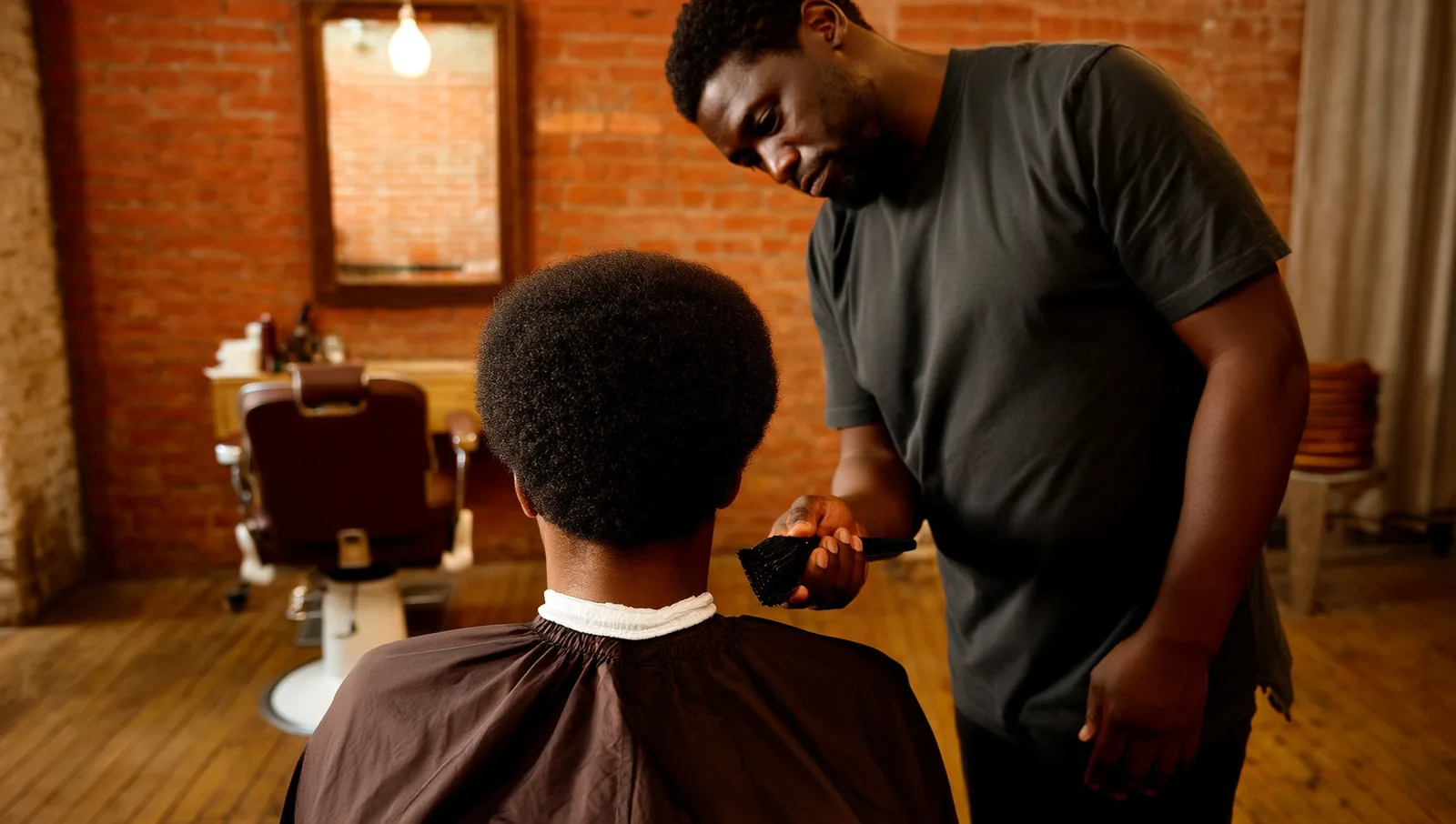
How to work it:
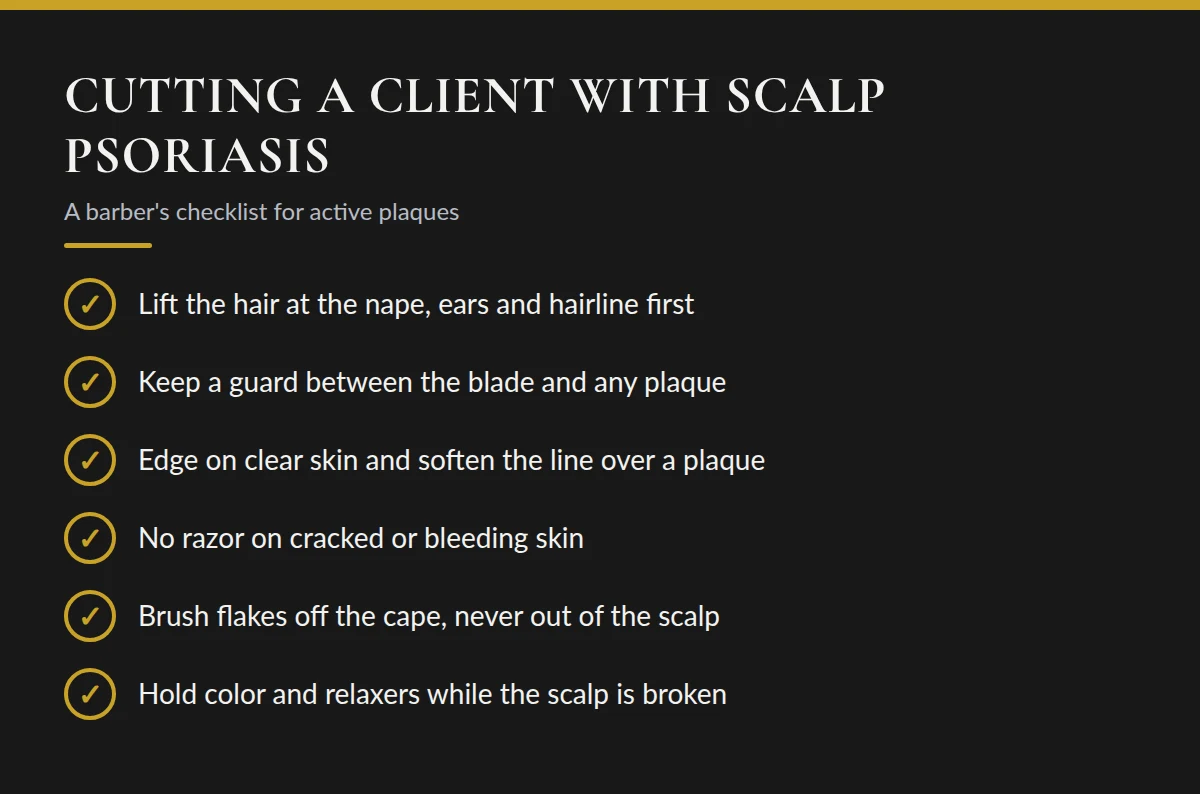
- Look before you cut. Lift the hair at the nape, around the ears and along the hairline before the first pass, and ask whether anything is sore, cracked or freshly treated.
- Keep a guard between blade and plaque. Over active patches, leave enough length to cut without the blade touching skin. A skin fade, a foil shaver or a zero-gapped trimmer has no business on a plaque, and the extra length covers it.
- Edge on clear skin only. Plaques cross the hairline right where the line-up goes. Shape the line where the skin is clear and soften it over a plaque rather than carving through. No razor on cracked or bleeding skin.
- Leave the scale alone. Brush flakes off the cape and neck, not out of the scalp. For clients who brush for waves, suggest a soft brush and a lighter hand during a flare, as the NPF recommends a soft hairbrush.
- Go easy on heat and finishes. Towel dry or use a cool setting rather than a hot blow-dryer, since the Psoriasis Association advises limiting hot styling, and keep fragranced or alcohol-based finishes off inflamed skin.
- Pause chemical services during a flare. The Psoriasis Association says highlights that stay off the scalp should be fine, but dyes and perms that touch it need a patch test first and should not go onto broken skin. Relaxers and texturizers, applied right to the roots, call for the same caution.
- Clean as always. Psoriasis does not travel on a comb, so the standard clean and disinfect routine covers it. If a crack bleeds, follow the blood and nick procedure in our clipper and sanitation guide.
Then say what you see, without diagnosing: “That looks like more than dandruff. Thick patches past the hairline can be psoriasis, and a dermatologist can treat it.” A barber cannot prescribe anything, but the right nudge can save someone years of buying the wrong bottle.
When to See a Dermatologist
Drugstore salicylic acid and tar can manage mild scalp psoriasis, but plenty of people need more. Book a visit when:
- Scale keeps coming back despite a few weeks of a medicated shampoo used properly.
- Plaques are thick, cross the hairline, crack or bleed.
- Hair is thinning or coming out in patches, or itch is keeping you up at night.
- You have plaques elsewhere, pitted nails, or stiff, swollen or painful joints. One in three people with psoriasis may develop psoriatic arthritis, the NPF says, and NIAMS warns that untreated psoriatic arthritis can cause irreversible damage.
- A child has a scaly scalp.
Bring a list of everything you have tried, your real wash schedule and styles, and photos of a flare, since the scalp may be calm on the day. Ask for a formulation that suits your hair, and if light treatment comes up, ask about skin darkening. If you are not getting answers, the NPF suggests finding a dermatologist experienced in diagnosing psoriasis in people with your skin color.
The Bottom Line
Scalp psoriasis on Black hair is easy to miss and very treatable. On dark skin it shows up violet or dark brown with gray scale, often across the hairline. Soften scale before lifting it, never pick or scratch, and treat the scalp rather than the hair, on a plan built around a weekly wash day. Hair lost to a flare usually grows back once the psoriasis is controlled, and the patches left behind fade over months. In the chair, keep a guard between blade and plaque, keep razors and heat off inflamed skin, and when it looks like more than dandruff, say so.
Further reading (sources)
- Armstrong and colleagues on psoriasis prevalence among US adults by race and ethnicity
- National Psoriasis Foundation with how psoriasis looks, and is treated, on skin of color
- National Psoriasis Foundation for scalp psoriasis symptoms, look-alikes and hair-friendly treatment
- Alexis and Blackcloud on psoriasis in skin of color, from presentation to treatment nuances
- DermNet with an overview of scalp psoriasis across skin types
- NHS for psoriasis triggers and why it cannot be caught
- National Institute of Arthritis and Musculoskeletal and Skin Diseases on psoriasis symptoms, nail changes and psoriatic arthritis
- American Academy of Dermatology with ten ways to reduce hair loss from scalp psoriasis
- American Academy of Dermatology for common psoriasis triggers, including shaving cuts
- Psoriasis Association on scalp psoriasis, hair loss and visiting the hairdresser
- Mosca and colleagues with a review of scalp psoriasis therapies and practical management
- Poulin and colleagues for clobetasol shampoo as long-term scalp psoriasis control
- Tyring and colleagues on calcipotriene and betamethasone in Black and Hispanic patients
- Gooderham and colleagues with the phase 3 trial of roflumilast foam for scalp and body psoriasis
- DailyMed for the current US prescribing label for roflumilast foam 0.3%
- McMichael and colleagues on the VISIBLE trial of guselkumab for scalp psoriasis in skin of color
- George, Taylor and Farrant with a review of hair loss caused by psoriasis
- Ji and Liu for how skin injury seeds new psoriasis plaques
- California Code of Regulations on the barbering rule against working on inflamed or broken skin