When the Medicated Shampoo Stops Working: Treatment-Resistant Seborrheic Dermatitis
Published on September 29, 2026
The first bottle worked. The flakes cleared in a couple of weeks and the itch let go. Then, a month or two later, it all came back, and the second bottle, a different brand off the same shelf, did less. By the third, the scalp is itching under a fresh install, the flakes are back on a dark collar, and the obvious conclusion is that nothing works on your scalp.
That conclusion is usually wrong. Our complete guide to scalp health for Black hair covers the first move: a medicated shampoo worked into the scalp and given real contact time. This is the next chapter, for the people it did not fix and for the barbers who see those scalps every two weeks. A scalp that keeps flaking rarely means you have run out of options. More often it is a relapse mistaken for failure, one active ingredient bought three times under three labels, a missing maintenance step, or a different condition behind the same flakes. Dandruff and seborrheic dermatitis carry a real cost in distress and quality of life, a 2025 review notes, so it is worth getting right.
Relapse Is Not the Same as Failure
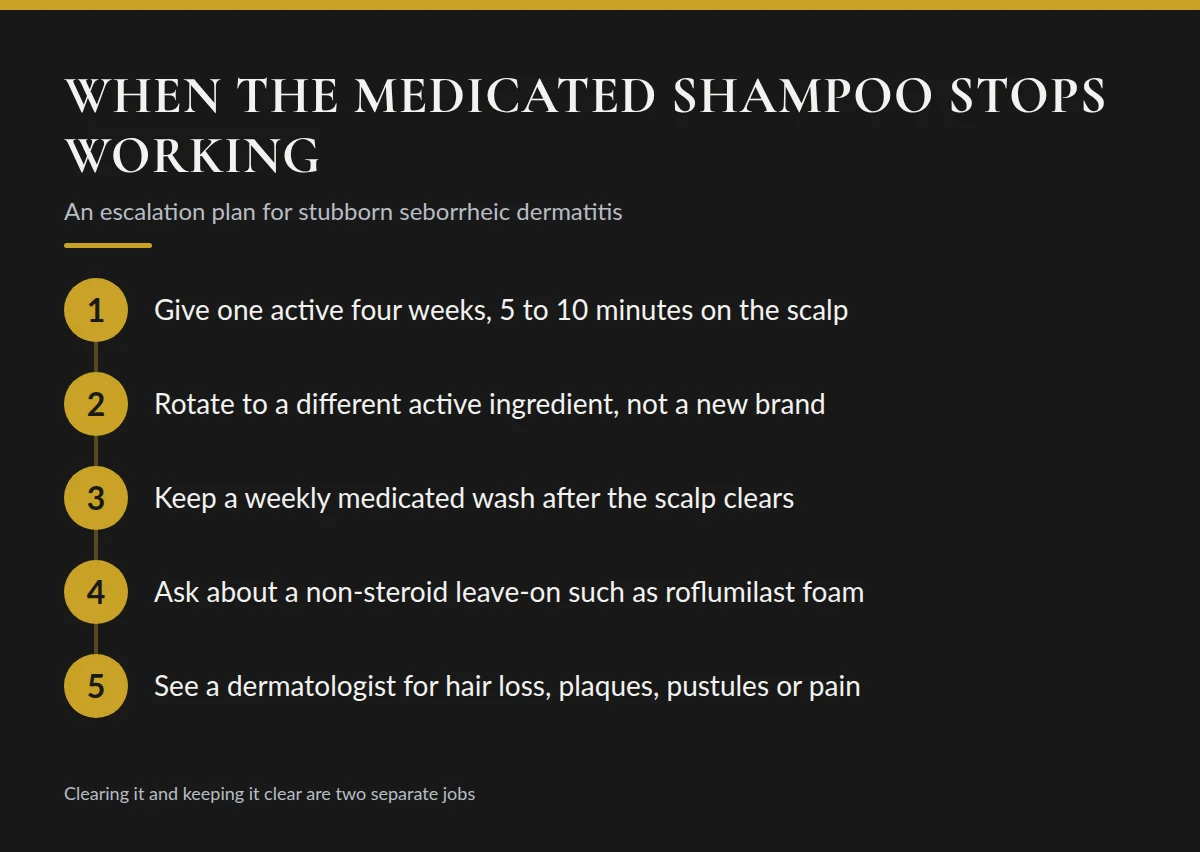
Seborrheic dermatitis is chronic. An international panel of hair and scalp specialists, reviewing 131 papers for a 2024 consensus, called the scalp form chronic and relapsing, and a 2024 systematic review put it more bluntly: current treatments provide only temporary control. Clearing the scalp and keeping it clear are two separate jobs, and most people only do the first.
So if a bottle cleared your scalp, you stopped, and the flakes came back, the bottle did not fail. The plan was missing its maintenance step. Before writing off any product, check four things:
- Contact time. Some dandruff shampoos need 5 to 10 minutes on the scalp before rinsing. A quick lather and rinse gives the drug almost no time to work.
- Reach. On coily hair the shampoo has to reach skin, not sit on the lengths. Section the hair and work it along the parts with your fingertips.
- Strength. Drugstore ketoconazole is 1 percent. Most of the trials behind its reputation used 2 percent, which needs a prescription in the US.
- Time. About four weeks of correct use is the usual yardstick. The American Academy of Dermatology (AAD) asks patients on prescription ciclopirox to report back if nothing has improved by then.
Why It Keeps Coming Back
Malassezia, the yeast at the center of the condition, is not a germ you catch and clear. It lives on everyone’s scalp. What differs in seborrheic dermatitis is the reaction: reviews describe the yeast and the wider microbiome, the oil that feeds them, an overreacting immune response and a weakened skin barrier, all working together. A 2024 review found more Malassezia, Staphylococcus and Brevibacterium on affected scalps than on healthy ones.
An antifungal knocks the yeast down. It does nothing about the oil or the overreaction, so the yeast rebuilds and the reaction returns. That is why the question shifts from “which shampoo” to “which combination, on what schedule.”
Resistance plays a smaller part. Researchers have isolated ketoconazole-resistant strains of Malassezia restricta, the species that dominates the scalp, from people with dandruff. A 2025 study found most skin strains still respond to common azole antifungals, with a few less sensitive exceptions, and named prior antifungal exposure as one factor. How often resistance explains a shampoo that stopped working is unknown, but it is one more reason to change the mechanism rather than the brand.
Rotate the Active Ingredient, Not the Brand
Three bottles are not three treatments if they all contain the same drug. Turn the bottle over and read the active ingredient. The AAD’s advice is direct: if one dandruff shampoo does not work, alternate between shampoos with different active ingredients, and if one has stopped working as well as it did, it may help to rotate.
- Ketoconazole has the deepest evidence. A Cochrane review of 51 trials and 9,052 participants found the 2 percent strength cut the risk of failing to clear by 31 percent against placebo at four weeks, clearing about as well as steroids with 44 percent fewer side effects. A 2024 review found side effects rare, mostly irritation that settles once the shampoo stops.
- Ciclopirox comes from a different drug family and matched ketoconazole head to head. In a trial of about 1,000 patients, twice-weekly ciclopirox shampoo worked for 57.9 percent, against 31.6 percent on an inactive shampoo. In the US it is prescription only, approved for people 16 and older.
- Selenium sulfide kept pace with ketoconazole in a 246-patient dandruff trial, trailing only at day 8, but all nine side effects reported during treatment happened on selenium sulfide. That matters on a scalp that is already irritated.
- Zinc pyrithione is the familiar drugstore option and a fair partner in a rotation.
- Salicylic acid lifts thick, stuck-on scale so an antifungal can reach the skin, and a 2025 treatment table uses it twice a week or alternating with an antifungal. Coal tar, another older option, can make the scalp more sensitive to sun.
A sensible rotation pairs two mechanisms, say ketoconazole one wash and selenium sulfide or zinc pyrithione the next. On a weekly wash day that gives each active every other week, so a flare may need the mid-week, scalp-only wash described below.
When the Scalp Needs an Anti-Inflammatory
If a correctly used antifungal has not settled things after about four weeks, the leftover problem is often inflammation rather than yeast. When the consensus panel met in late 2023, it found no approved therapies aimed at moderate and severe scalp disease. That has started to change.
- Topical steroids calm inflammation fast, and the AAD says a dermatologist may add one when an antifungal fails. A 2025 treatment table limits strong ones like clobetasol to cycles of two weeks at most. They come as scalp solutions, foams and oils, and they are for getting a flare under control, not for daily use.
- Calcineurin inhibitors, pimecrolimus cream and tacrolimus ointment, calm inflammation without the skin thinning that long steroid use brings. Patients in studies improved within two weeks, and flares that returned were milder.
- Roflumilast 0.3% foam is the first topical PDE4 inhibitor approved for seborrheic dermatitis. It is not a steroid, goes on once a day, and has been FDA approved since December 2023 for anyone 9 and older, including on the scalp, eyebrows, ears and nose. In its phase 3 trial, 79.5 percent of patients were clear or almost clear at eight weeks, against 58.0 percent on the same foam without the drug, with the gap visible by week two and few side effects. The AAD adds a detail that matters on darker skin: among trial patients with dark spots, 64.7 percent saw them clear within eight weeks, as did 46.2 percent of those with light spots, though a few developed new ones.
Two honest caveats. The drug-free foam reached 58 percent on its own, so the drug’s contribution is the gap, not the headline. And the trial lasted eight weeks for a condition that lasts years; its authors call for longer studies.
Severe or widespread disease that resists all of this may need treatment by mouth or with light. The AAD lists oral antifungals such as itraconazole or terbinafine to regain control before switching back to a topical, and UVB light therapy, and a 2025 review adds low-dose isotretinoin to turn down oil production. These are specialist decisions with their own monitoring.
What Diet and Drinking Have to Do With It
People who have tried everything on the shelf often turn to the kitchen next. A 2024 systematic review of 13 studies and 13,906 patients found lower blood levels of zinc and vitamins D and E in people with seborrheic dermatitis, and higher copper, manganese, iron, calcium and magnesium. Most studies linked regular drinking to the condition. In one study, women who ate the most Western-style food (meat, potatoes, alcohol) had a somewhat higher risk, a result that just missed statistical significance, while people who ate the most fruit had a lower risk. Findings on weight were mixed.

These are associations, not a treatment plan. The authors say supplement trials are still needed, and one zinc study found no link between zinc levels and how long or how badly people had the condition. The sensible takeaways are ordinary ones: drink less, eat more fruit, and do not megadose zinc on the strength of any of this.
When the Burning Is the Treatment
Cycling through products has a trap: the products can become the problem. A 2023 review of sensitive scalp describes burning, itching and even pain, often on skin that looks normal or only slightly red. It can stand alone or ride on top of seborrheic dermatitis or psoriasis, stress and topical products are among its triggers, and no lab test confirms it. Contact dermatitis is the other look-alike; a 2025 review says to suspect it when a scalp flares with shampoos or creams and to confirm it with patch testing. Relaxers, dyes and fragranced styling products all touch the scalp, which is one reason to know what is in the products you use.
The tell is timing. If the sting starts as a product goes on, or the burn worsens while the flakes improve, stop adding bottles. Pare back to one medicated product, keep everything else plain and fragrance free, and tell your dermatologist exactly what you have been using.
Making Treatment Fit a Once-a-Week Wash Day
This is the tension that sends many Black clients around the loop. Type 4 hair usually does best washed every week or two, because frequent shampooing dries the lengths and undoes the style. The standard advice, written for straight hair, is a dandruff shampoo two or three times a week, which does not survive a twist-out or a fresh set of braids.
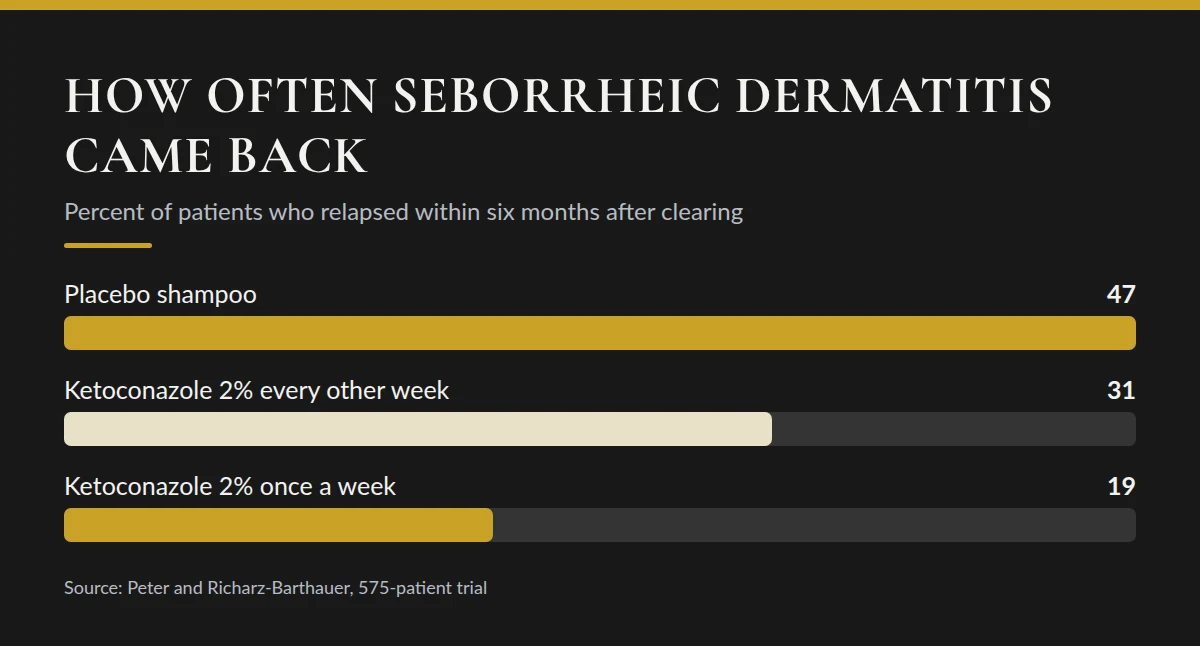
The evidence fits a weekly rhythm better than most people expect. The AAD says a dermatologist may recommend medicated shampoo once a week for curly or tightly coiled hair, and that patients often continue weekly to prevent flares. A 2019 review of seborrheic dermatitis in skin of color makes the same point about adjusting for hair texture and washing frequency. The maintenance trials back it up. In a study of 575 patients, twice-weekly ketoconazole 2 percent produced an excellent response in 88 percent, and the responders spent the next six months on a set schedule: 47 percent relapsed on a placebo shampoo, 31 percent with ketoconazole every other week, and only 19 percent with it once a week. A ciclopirox trial found the same pattern over three months, with relapse at 35.5 percent on an inactive shampoo, 22.1 percent every two weeks and 14.7 percent weekly.
How to make it work:
- Medicate the scalp, not the lengths. The AAD advises people with curly or coily hair to apply dandruff shampoo to the scalp only, since the actives can dry the hair, then wash and condition the lengths as usual. An applicator bottle along the parts does it neatly.
- Clear a flare, then drop back. The trials cleared the scalp with two medicated washes a week for two to four weeks. A mid-week, scalp-only wash along the parts, with the style left in, adds the second session without a second wash day.
- Let a leave-on cover the days between. This is the real reconciliation. Prescription foams and solutions stay on rather than rinsing off, and roflumilast foam needs no wash at all. A review of unmet needs in seborrheic dermatitis names vehicle preference as something that varies between patients, so tell your dermatologist how often you actually wash and ask for a formulation that fits.
- Keep the parts reachable. Styles with open parts let you treat the scalp without taking anything down. Our Type 4 wash day guide builds a routine that fits in one afternoon.
For Barbers: When It Might Not Be Seborrheic Dermatitis
A barber is often the first to see a scalp that is not responding. On dark skin the condition is easy to miss to begin with: a 2025 review notes that redness can look violet or darker rather than red and that coiled hair can hide the greasy scale, leading to missed and wrong diagnoses. Scaly light patches are another way it shows up on darker skin.
The look-alikes matter most, because several do not respond to dandruff shampoo at all.
- Tinea capitis, a fungal infection of the hair itself, shows as scaly patches with broken hairs or bald spots and needs medication by mouth; topical treatment alone is not recommended. It is most common in children, but among adults it most often affects women past menopause, Black women in particular, and a late diagnosis can scar. It also spreads, so tools that touched it need the full disinfection routine.
- Psoriasis has thicker, drier, silvery scale in sharp-edged plaques that often creep past the hairline. The two can overlap, which dermatologists call sebopsoriasis.
- Discoid lupus leaves scaly patches with thinned centers that can scar permanently.
- Infection shows as pustules, crusts, pain or fever, and seborrheic dermatitis can open the door to it.
The beard counts too. Seborrheic dermatitis often turns up in the beard and eyebrows, and a dermatologist may suggest washing the beard with the same medicated shampoo. Bumps along the neck after a shave are a different condition with its own treatment ladder.
Refer when four weeks of correct treatment has changed nothing; for hair loss, broken hairs, thick plaques past the hairline, pustules, crusting, pain or shiny patches; and for any child with a scaly scalp. The words can be simple: “This has looked the same three visits running. Worth having a dermatologist look at it.”
What to Bring to the Dermatologist

Arrive with the history that saves a visit: every product you have tried, by active ingredient, with how often, for how long and how long you left it on; your real wash schedule and style; photos of a flare, since the scalp may be calm that day; and what seems to set it off. Mention your general health too, because seborrheic dermatitis is far more common in people living with HIV or Parkinson’s disease, and in Parkinson’s it responds less well to treatment. Then ask directly about a non-steroid option, a formulation that suits a weekly wash, and whether anything else could be going on.
The Bottom Line
A scalp that keeps flaking usually means the plan was missing a step, not that you ran out of treatments. Give each active four real weeks with real contact time, rotate mechanisms instead of brands, and keep a weekly medicated wash going after the scalp clears, since in the trials that one habit cut relapse by more than half. If that is not enough, the next rung is anti-inflammatory, and roflumilast foam adds a non-steroid, leave-on option that does not depend on wash day. And if the scale comes with broken hairs, bald patches, thick plaques or pain, it may not be seborrheic dermatitis at all, which is the barber’s cue to speak up.
Further reading (sources)
- Vano-Galvan and colleagues on an international expert consensus for scalp seborrheic dermatitis in adults
- Gupta and colleagues for a review of dandruff and seborrheic dermatitis and their burden
- Shah and colleagues with how the scalp microbiome shifts in scalp disease
- Navarro Triviño, Velasco Amador and Rivera Ruiz on pathophysiology, look-alikes and emerging therapies
- Park and colleagues for ketoconazole-resistant yeast isolated from dandruff patients
- Leong and colleagues with azole susceptibility in common scalp yeast strains
- Okokon and colleagues on a Cochrane review of 51 topical antifungal trials
- Tynes and colleagues for a narrative review of ketoconazole shampoo on the scalp
- Shuster and colleagues with ciclopirox shampoo for treatment and relapse prevention
- Danby and colleagues on ketoconazole compared with selenium sulfide for dandruff
- Peter and Richarz-Barthauer for the ketoconazole trial that tested weekly maintenance
- LeFevre, Braudis and Feigenbaum with a 2025 overview of diagnosis and treatment
- Turchin and colleagues on current and emerging treatment options
- Blauvelt and colleagues for the phase 3 trial of roflumilast foam 0.3%
- Miller, Watson and Inglese with a review of roflumilast foam’s safety and efficacy
- Woolhiser and colleagues on a systematic review of diet, supplements, alcohol and weight
- Guerra-Tapia and González-Guerra for diagnosing and managing sensitive scalp
- Elgash and colleagues with clinical considerations for seborrheic dermatitis in skin of color
- Jackson and colleagues on unmet needs for patients across skin tones
- Hill, Gold and Lipner for tinea capitis in adults and who is most at risk
- American Academy of Dermatology with how dermatologists treat seborrheic dermatitis, from shampoo rotation to roflumilast
- American Academy of Dermatology on dandruff shampoo by hair type, including coily hair