How to Become a Barber: School, Licensing, Apprenticeship, and Your First Chair
Published on September 3, 2026
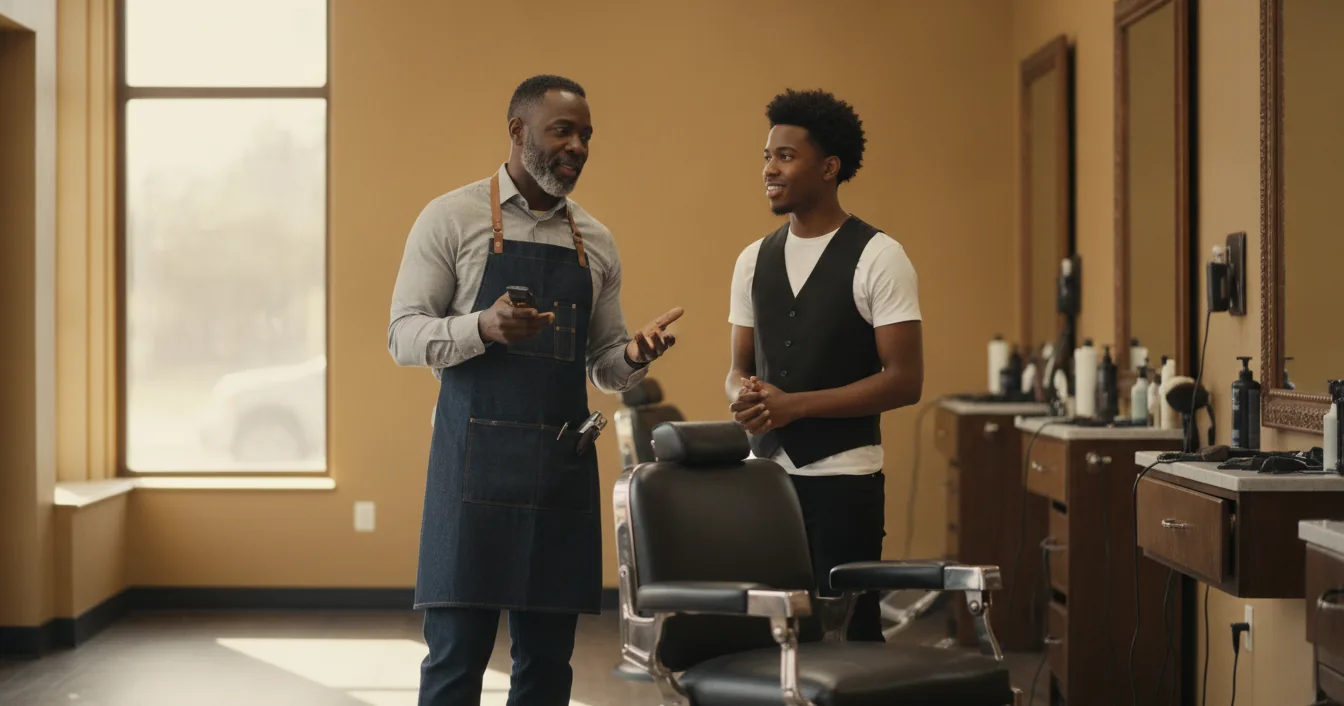
Every barber I know has fielded this question from the chair. A young man watches the fade come together in the mirror, waits for the clippers to go quiet, and asks some version of the same thing: how do I do what you do? The honest answer is that the craft is the easy part to explain and the paperwork is the part that trips people up. Nobody tells you that the hours you need depend entirely on which side of a state line you live on, that the exam that decides your career is mostly about sanitation, or that your first chair will probably pay worse than the job you are leaving.
So here is the whole path, front to back. What school actually costs, how the licensing works, when an apprenticeship beats a classroom, what happens to your license when you move, and how to land and keep that first chair.
The First Fork: Barber School or Cosmetology School
Before you look at a single program, understand that these are two different licenses with two different scopes, and in most states two different governing boards.
A barber license covers cutting, clipper work, tapers and fades, shaving with a straight razor, and beard and mustache work. The razor is the dividing line. In many states a barber license is the only one that permits a straight-razor shave on the face and neck, which is why the hot towel shave has stayed a barbershop service.
A cosmetology license covers cutting, chemical services (color, relaxers, perms), and usually skin and nail work depending on the state. What it often does not cover is the straight razor.
For someone aiming at a Black barbershop, the barber license is almost always the right call. The work you are building toward is clipper work, precision lineups, and skin fades, and that is the barber curriculum. Some states offer a combination or dual license if you want both, and some barbers add cosmetology later to open up braiding, locs, and color for a broader client base.
One thing to check before you enroll anywhere: how much hands on time the program gives you with Type 3 and Type 4 hair. This is not a small detail. Textured hair education has historically been treated as an elective bolt on rather than core curriculum, and a wave of state laws since 2021 has only started to fix that, mostly on the cosmetology side. Ask the admissions office directly how many mannequins with textured hair are in the building and who on staff teaches coily texture. If they get vague, that tells you something. The work being done by a new generation of Black barber educators exists precisely because so many programs left this out.
Hours: The Number That Varies Most
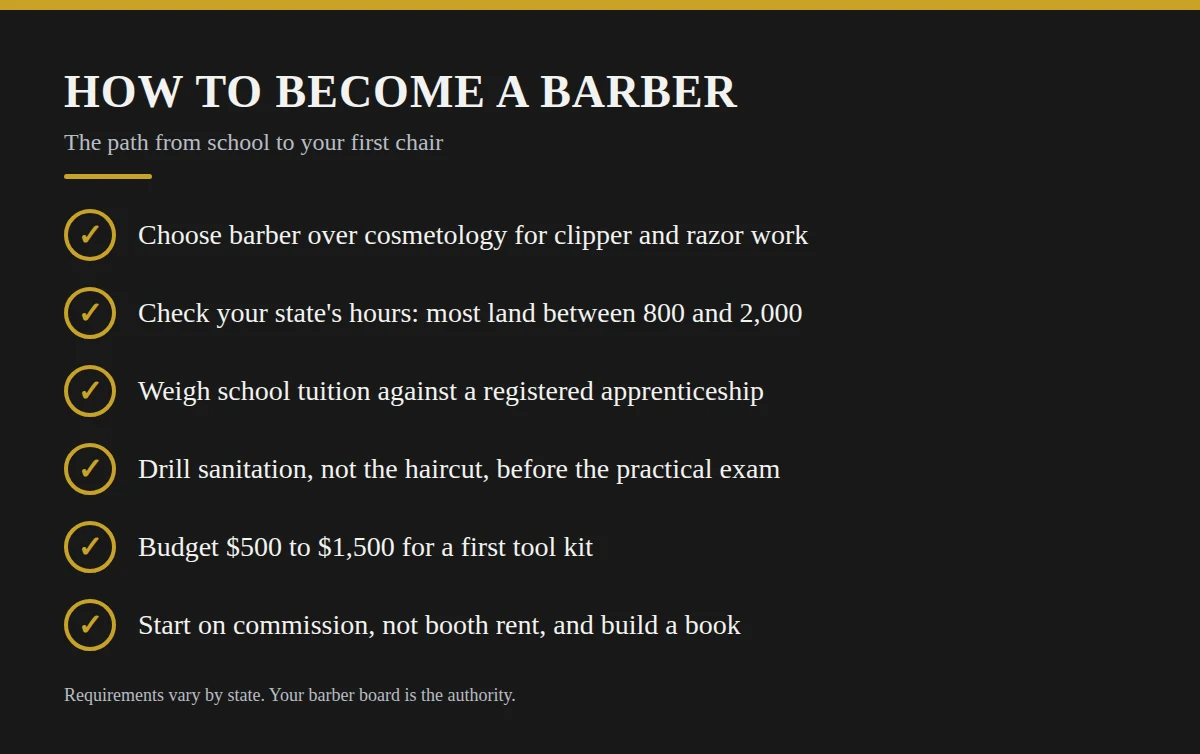
Every state sets its own training hour requirement, and the spread is wide. Most states land somewhere between 800 and 2,000 hours, with roughly 1,500 as the common expectation. Full time, that is usually 6 to 18 months.
Tuition generally runs $10,000 to $20,000, and that is before your kit. Many students borrow it. The Institute for Justice has spent years documenting graduates who carry five figures of debt into a trade where the first year behind the chair is the leanest year of the whole career.
A few things to verify before you sign anything:
- Is the school accredited and state approved? Only hours from an approved program count toward your license. This is the single most expensive mistake a student can make.
- Does it participate in federal financial aid? If it does, you can file a FAFSA. If it does not, you are looking at cash or private loans.
- What is the actual graduation and pass rate? Schools track this. Ask for the numbers, not the brochure.
- Do you get real clients on the floor? The student clinic is where you learn speed, consultation, and how to handle a man who does not like what he sees. Mannequins cannot teach that.
Do not take any national summary, including this one, as the authority on your requirements. Licensing hours, apprenticeship eligibility, and health codes vary substantially by state and change often. Your state barber board’s website is the only source that counts.
The Other Way In: Apprenticeship
Not everyone can stop working for a year to sit in a classroom. Where the state allows it, a registered apprenticeship lets you train inside a working shop under a licensed barber, earning instead of paying.
The trade is time. Apprenticeship hour requirements are typically far higher than school hours in the same state. Alabama asks 2,000 apprenticeship hours against 1,000 in school. Georgia asks 3,000 against 1,500. California asks 3,200 against 1,500. Expect roughly 18 to 36 months rather than 6 to 18.
The catch worth knowing early: several large states, including Texas, Florida, and Illinois, do not offer a barber apprenticeship route at all. If you live in one of those, school is the only door.
Where apprenticeship does exist, it usually has to be registered before your hours start counting. That means paperwork filed with the board, a licensed supervising barber who meets the state’s experience minimum, a supervision ratio, and a logbook. Sweeping hair at your uncle’s shop for two years is a real education, and it is how this trade ran for a century, but it is not a licensable apprenticeship unless the state signed off on it first.
The Board Exam Is Mostly About Sanitation
Once your hours are done, you sit for the state licensing exam. In most states it comes in two parts, and the exams are commonly written by the National-Interstate Council of State Boards of Cosmetology.
The written exam is multiple choice. It covers infection control and sanitation, state law and rules, basic anatomy and physiology of the skin and hair, disorders you must refuse service for, chemistry, and implement safety. It is a knowledge test, not a haircut test.
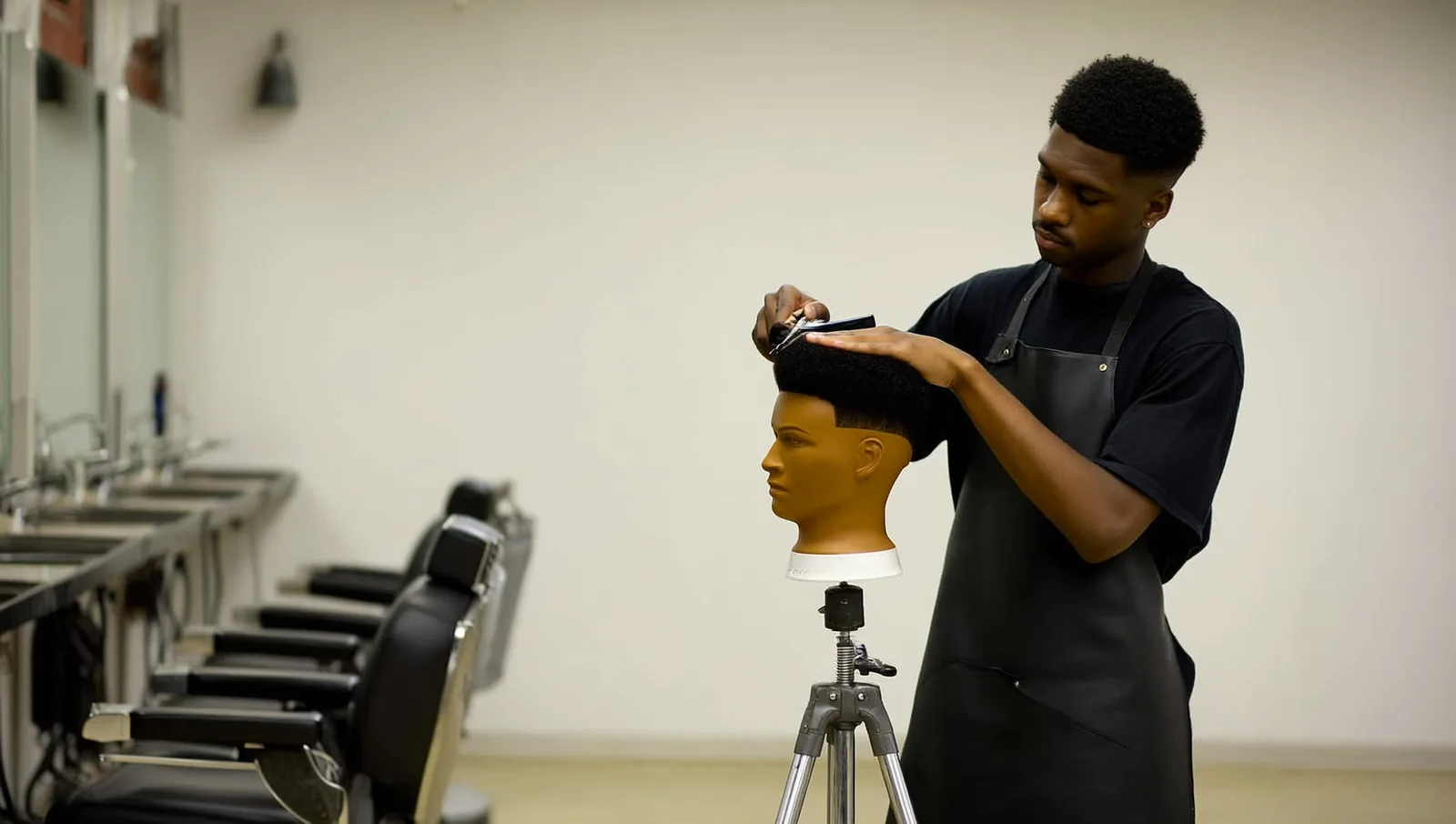
The practical exam is you performing services, usually on a mannequin you bring yourself, on a clock, with an examiner watching. A haircut, a taper, sometimes a shave on a prepared surface, plus setup and sanitation procedures.
Here is what nobody warns candidates about: most people who fail the practical do not fail on the haircut. They fail on procedure. Not disinfecting an implement in front of the examiner, contaminating a clean station, mishandling a used blade, skipping hand washing at the transition, running past the time limit. The haircut is what you have practiced for a year. The sanitation sequence is what you practiced for a week. Flip that ratio in your final month.
And if you fail, you are in good company. Rodrick Samuels failed the state barber exam twice before passing on the third attempt, then went on to become an award winning educator and a member of Michigan’s Board of Barber Examiners. Failing the test says nothing about whether you belong in this trade.
What It Really Costs to Get Started
Tuition is the big number, but the kit is the one people underestimate. Some schools bundle a starter kit into tuition; many do not, and the school kit is rarely what you will still be using in year three.
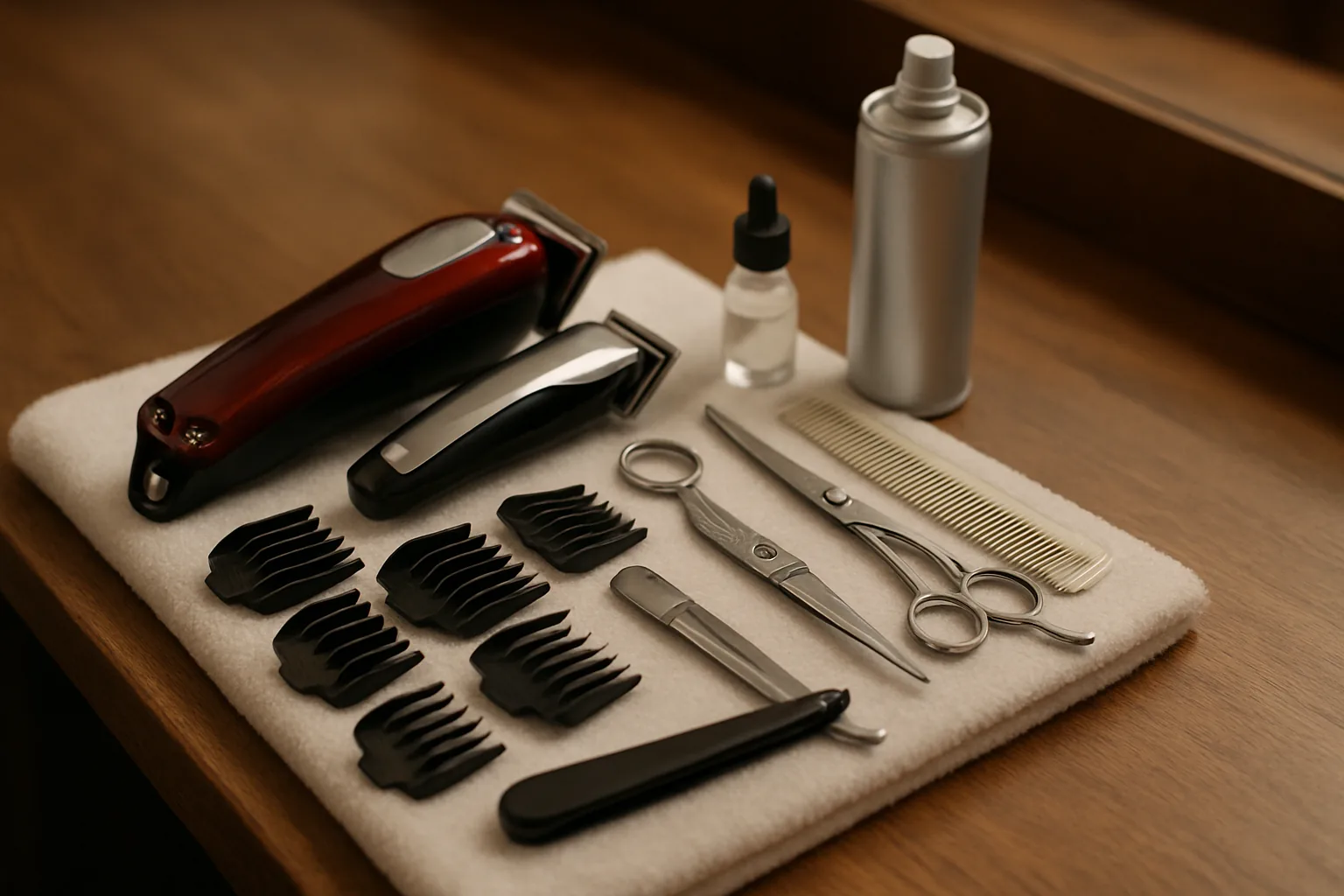
A working first kit runs roughly $500 to $1,500 and covers:
- Clippers and a trimmer. The heart of the kit. Professional clippers that ran as little as $80 in 2019 now cost $150 to $300, and most barbers carry at least two so one is always charged and cool.
- Guards, a full set, plus a lever you trust and spare blades.
- Shears and a texturizing shear. Buy once, buy decent. Cheap shears push hair instead of cutting it.
- A straight or shavette razor and blades.
- Combs, brushes, a duster, capes, and neck strips.
- Blade oil, clipper spray, disinfectant, and a jar. Consumables, and the board cares about them more than you think.
- Mannequin heads for practice and the exam, including textured hair heads.
Then add the fees that surprise people: exam fees, the initial license fee, background checks in some states, and renewal every year or two.
Reciprocity: What Happens When You Move
There is no national barber license. Your license is issued by one state and stops at its border.
Most states offer some form of reciprocity or licensure by endorsement, meaning they will recognize an out of state license if your training and experience meet or exceed their own standard. In practice that usually requires: a license in good standing, proof of your training hours, sometimes a minimum period of documented work experience, an application fee, and in some states a state law exam covering local rules.
The problem case is an hours shortfall. If you trained in a 1,000 hour state and move to a 1,500 hour state, that state may make you complete the difference or re test before it issues you anything. Barbers get caught by this after the moving truck is already loaded.
Two rules save you real money here. Check the destination state’s reciprocity page before you move, not after. And keep your own records permanently: your hour transcript, your original license certificate, and your exam results. Schools close, boards reorganize, and the burden of proof is on you.
This matters beyond the individual barber. Licensing friction is one reason skilled textured hair barbers are so unevenly distributed across the country, a pattern I mapped in the guide to Black hair deserts. A barber who cannot easily carry a license across a state line is a barber who does not move to the town that needs him.
Landing Your First Chair
License in hand, you are qualified and you have no book. Those are different problems.
Take the commission or employee chair first. New barbers rush toward booth rent because keeping every dollar sounds better than splitting. It is not, not yet. Rent is due whether anyone sits in your chair or not, and an empty chair on a $200 week is how promising barbers wash out. A commission shop with walk in traffic feeds you clients while you build speed. Move to booth rent when your book, not your pride, says you are ready. The full breakdown of booth rent, commission, and ownership is worth reading before you sign anything.
Interview the shop as hard as it interviews you. Who is the clientele? Is there walk in traffic or is every barber there on appointment only? Who will correct your work? A first shop with one generous veteran in it is worth more than a fancier shop where nobody teaches.
Bring a portfolio, not a resume. Clean photos of your fades, your lineups, your beard work, consistent lighting, same angles. Shop owners hire hands.
Get fast without getting sloppy. Speed is what separates a barber who earns from one who is merely skilled. A clean 45 minute cut and a clean 30 minute cut are the same cut and very different paychecks. Speed comes from sectioning and sequence, not from rushing.
Then keep the client. Rebook him before he stands up. Learn his name, his job, his kids. That relationship, not the fade, is what makes a client stay with one barber for a decade.
The Part School Cannot Give You
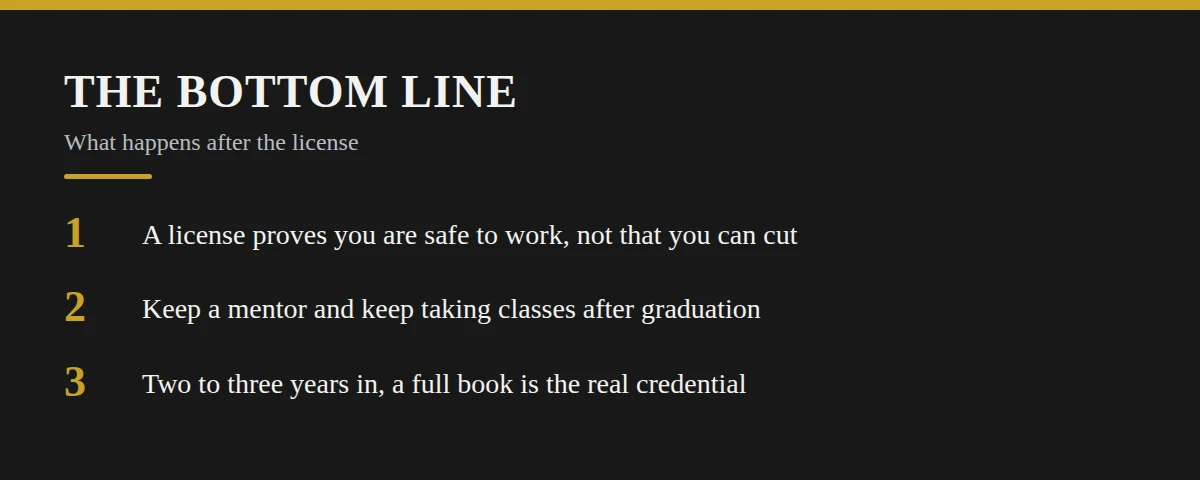
A license means the state has confirmed you will not hurt anybody. It does not mean you can cut. The barbers who go furthest treat graduation as the start of their education: they keep a mentor, they attend trade shows and manufacturer classes, they enter battles, and they study the actual biology of the hair they cut, because understanding why textured hair breaks the way it does is what turns a technique into judgment.
Two to three years in, most barbers who stay have a full book, a rate they set themselves, and a chair that regulars plan their week around. That is the real credential, and no board issues it.
Sources
- Institute for Justice for what barber licensing actually costs the people getting licensed
- Texas Department of Licensing and Regulation on how one state board sets its own barber rules
- Bureau of Labor Statistics with the pay, outlook, and entry requirements for the trade
- NIC Testing covering the exam types and candidate information behind state licensing
- American Salon on the barber educator who failed the exam twice before passing
Further reading
- National Association of Barber Boards of America for the directory of state barber boards and their licensing rules
- Pro Beauty Association on the states now mandating textured hair education
- Apprenticeship.gov with how registered apprenticeships are structured and found
- Bureau of Labor Statistics with the pay, outlook and entry requirements for the trade