Break-Ins, Stray Bullets, and Cash Drawers: Protecting a Neighborhood Barbershop
Published on September 20, 2026
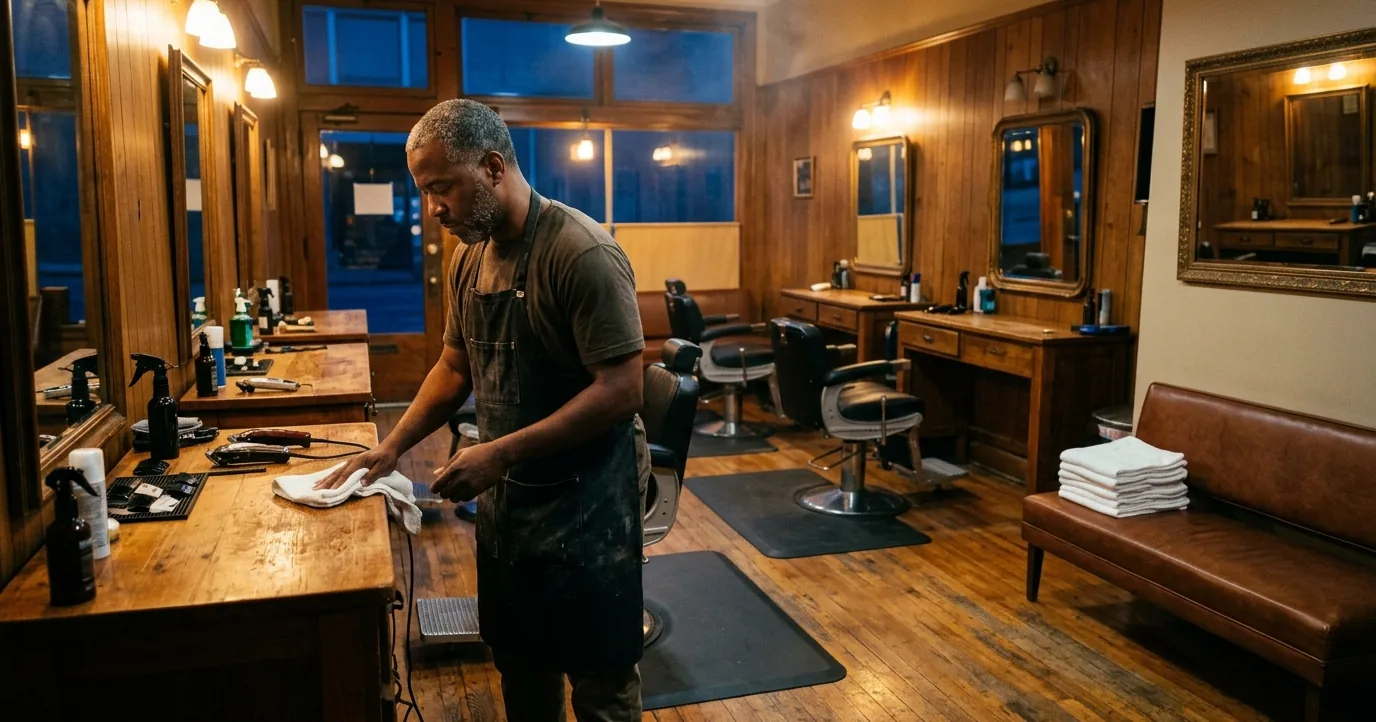
In one week this September, a west Charlotte shop was broken into at three in the morning by a group who put the front glass door in and carried out clippers and sneakers. Across town, another owner was on the news asking for something to change after a stray bullet came through his storefront. In Trenton, New Jersey, two men smashed a glass front door around one o’clock on a Monday morning and left with three to four thousand dollars of equipment and about a thousand dollars of damage behind them.
The detail that travelled furthest was what the Charlotte owner said afterward. The sneakers taken from his shop were not stock. They were what was left over from a free giveaway he had run in June, shoes anybody could walk in and ask for. He did not ask the public to help identify anyone. He asked the people who did it to come in and apologize, and said he would work with them. “The last thing I want to do is see another kid lost in the system.”
That is the knot at the center of shop security, and no operations guide talks about it. A barbershop is not a fortress dropped onto a block. It belongs to the block. The same door that has to stop a burglar at 3 a.m. has to feel open at ten in the morning. Our owner’s guide to pricing, booth rent and retention covers how to make the money. This is the other half: how to keep it, and how to think about the night you lose some.
What a Break-In Actually Takes
Register cash is almost never the prize. Clippers are. A working barber’s kit runs into the hundreds of dollars per barber before you count trimmers, foil shavers, guards and blades, and every item is small, unmarked, instantly resellable and impossible to tell from any other. The Trenton burglars went to the register first, found what registers hold, then worked station to station. That is the normal sequence.
Add up the real bill and the stolen goods are the smaller line. There is the glass, which is a same-day expense because you cannot open a shop with a hole in the front. There is the day or two you are closed. And there is the part nobody insures well: a barber whose kit walked out the door cannot work tomorrow, whether he owns the shop or rents the chair. If three barbers lose their tools, you have not lost a few thousand dollars of equipment. You have lost three books of business for a week. Anyone who has priced out a full clipper, blade and sanitation kit knows how fast that replacement number climbs.
Cameras and Lights, and What They Really Do
Both are worth having. Neither does what the sales pitch says.
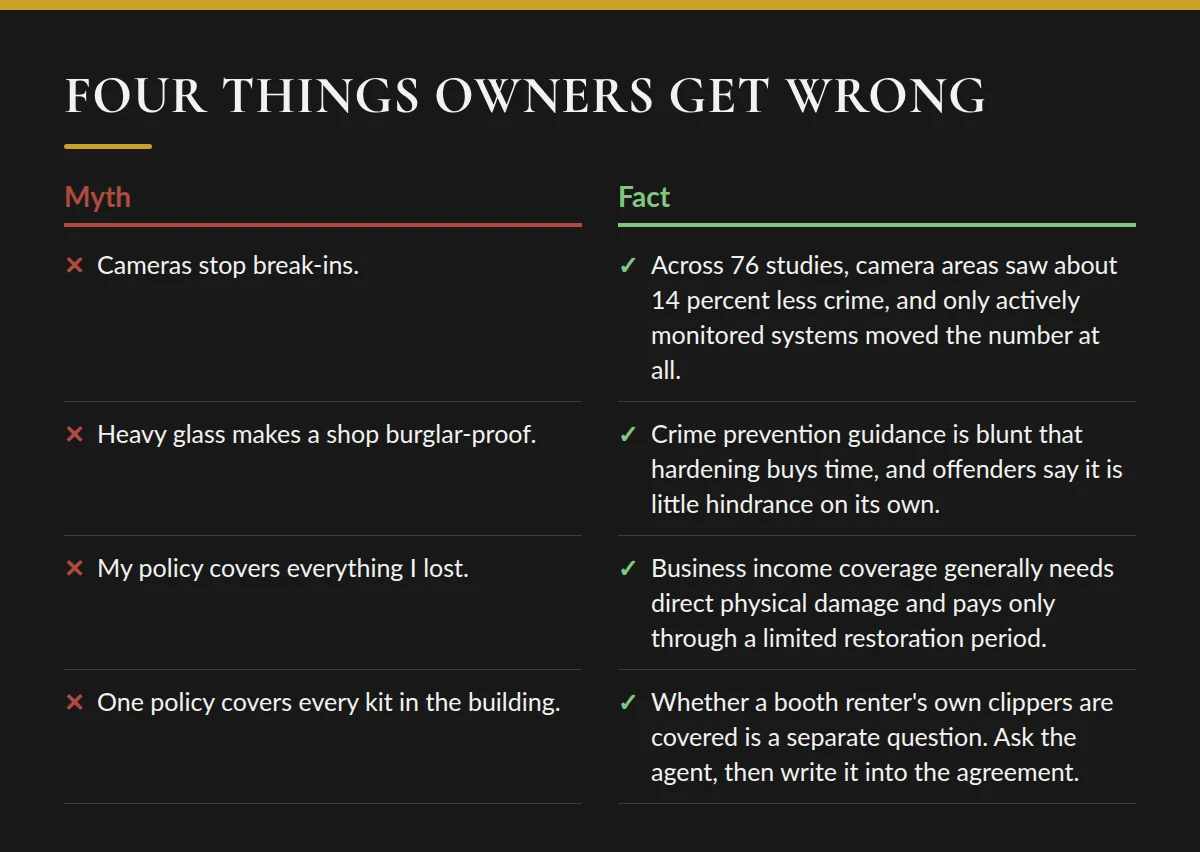
A review of camera systems covering 76 studies from 1978 to 2017 found an overall crime reduction of about 14 percent in camera areas compared with controls, around 16 percent for property offenses, and no statistically significant effect on violent crime. The single biggest finding for a shop owner is buried in the details: actively monitored systems produced significant reductions, while passive record-only systems did not. A camera nobody watches is an evidence device, not a deterrent, and that is still a reason to have one. Footage is what gave both burgled shops a description to hand police.
Lighting looks similar. A review of 13 street lighting studies found crime down about 21 percent in improved-lighting areas, promising for property crime and ineffective against violent crime. One study on a commercial strip in Portland found better lighting produced a significant drop in retail burglaries specifically.
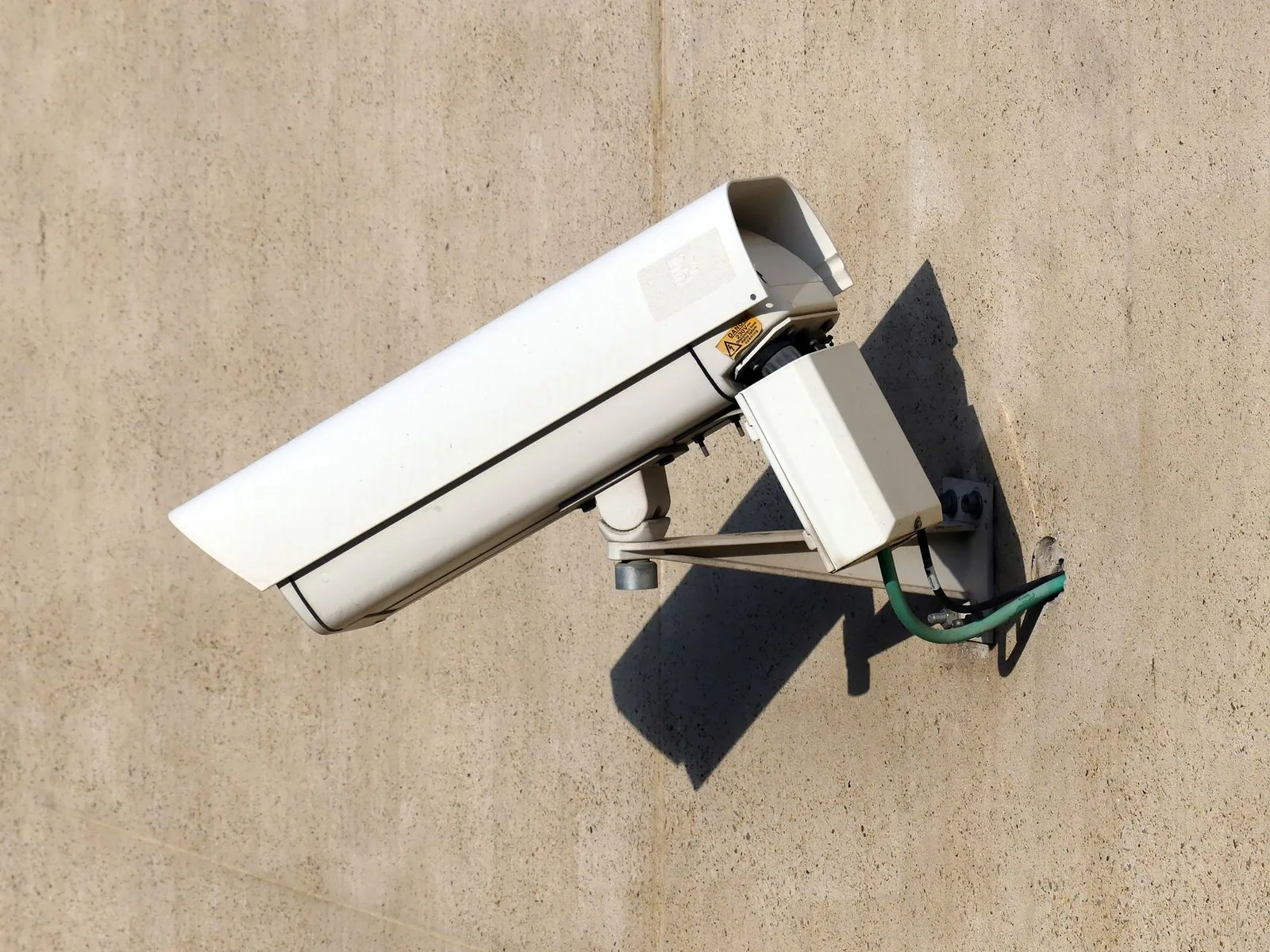
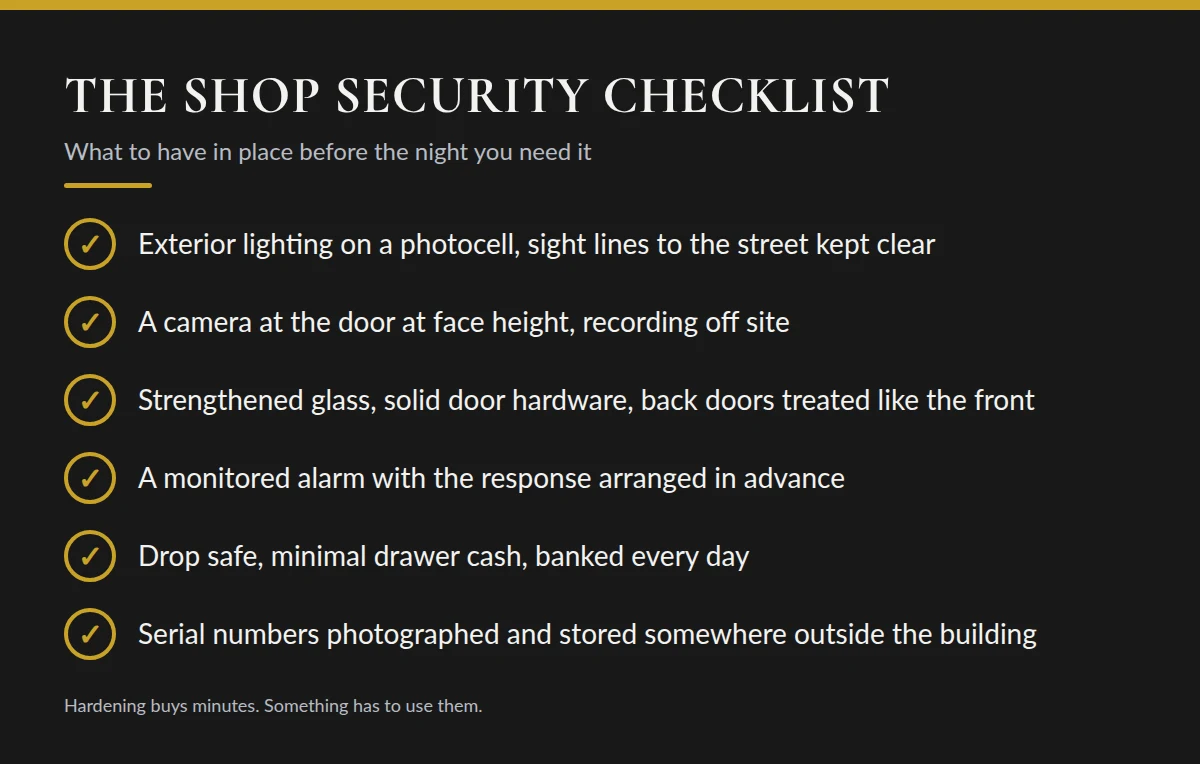
So light the outside of the building, not just the sign. Put the exterior fixtures on a photocell so they are never left off by accident. Aim one camera at the inside of the front door at face height, another across the stations, and a third outside if the landlord allows it. Then do the two things most owners skip. Record off site or to the cloud, because a recorder sitting in the back room gets stolen along with everything else. And once, on a quiet Tuesday, actually export a clip and watch it. Plenty of systems cannot produce a usable file when it matters, and you want to find that out on a Tuesday.
The Door Is the Whole Fight
Retail burglaries happen overwhelmingly at night and on weekends, when the store is closed, and offenders get in through doors and windows: forcing locks, breaking through panels, putting the glass in. That is not a sophisticated crime. It is over in seconds.
Crime prevention guidance for retailers is consistent about what helps at the opening: strengthened glass, shutters or grilles, security lighting at the entry point, cameras covering it, and concrete pillars or heavy planters where a vehicle could be driven at the front. Inside, treat back doors and rear windows as seriously as the front, because an exit that is easy to leave through is a reason to come in.
Be honest about the ceiling on all of it. The same guidance notes that the evidence for external target hardening is inconsistent, and that burglars themselves say these measures are not much of a hindrance. Hardening does not make a shop impossible to enter. It buys time. The value of the time only exists if something is using it, which means a monitored alarm and a response arranged in advance, not just a box that makes noise. Alarms do protect premises, but false alarm rates are a known problem, and a shop with a history of crying wolf should not count on a fast answer.
The Closing Routine
Most of the protection in this article is a habit, not a purchase. Federal workplace guidance for late-night retail is blunt about the essentials: use a drop safe, keep minimal cash in the drawer, post a sign saying so, keep doors locked before and after business hours, schedule deliveries during daylight, and fold a check of the lighting, the locks and the cameras into the daily routine rather than leaving it to whoever remembers. Retail crime prevention adds one more: bank the cash every day.
That last one matters more in this trade than in most, because this trade still runs on cash. Cash payments have fallen a long way, yet the Federal Reserve’s most recent payments diary found four out of five consumers had used cash in the previous 30 days, with about three-quarters carrying some on them, and tips in a barbershop are cash more often than not. A shop can be mostly card on the ticket and still end Saturday with a real stack.
Two habits round it out. Photograph the serial number of every clipper, trimmer and shaver in the building and keep the list somewhere that is not in the building, because a serial number is the difference between a police report and a recovery. And write the rule into the booth rental agreement, since a renter who leaves his own kit on the counter overnight is making a decision that costs the whole shop a morning.
When It Comes Through the Window
Burglary happens to an empty building. The other thing in the news that week did not. A stray round that comes through the front glass while the lights are on is a different category of risk, and no lock addresses it.
What does help is ordinary and worth doing anyway. Keep window signage low or high rather than across the middle so the sight line between the street and the chairs stays open in both directions. Keep the waiting area and the pay point visible from outside. Keep interior and exterior lighting maintained. If you are laying out a new shop, think about which stations sit directly in the window line. And the standing advice for any robbery is the same everywhere: do not resist, money is replaceable.
Afterward, something else is owed. A shop full of men who just watched their barber’s window get shot out will process it in that room, out loud, the way the room processes everything else. That is exactly the work the movement to train barbers as trusted ears for men’s mental health prepares people for, and it applies to the barbers too.
The Claim You Hope You Never File
Most small shops carry a business owners policy, which bundles property coverage on the building and contents, general liability, and business income coverage for revenue lost while you are shut. Worth knowing before you need it: business income coverage generally requires direct physical damage to the property, and it pays only through a defined restoration period with time limits attached. A business owners policy also does not include workers compensation, commercial auto or professional liability, so those are separate conversations.
Four questions are worth asking your agent this month rather than after a break-in:
- Is barber equipment covered as business personal property, and does it pay replacement cost or depreciated value?
- Is glass covered, and what is my deductible against a thousand-dollar door?
- Whose tools are covered, mine or also my booth renters’? Settle this in the rental agreement, because the answer decides who eats the loss.
- What does my business income coverage actually pay for two closed days, and when does the clock start?
When it does happen, build the file the same day: photographs before you clean up, the exported footage before the system overwrites it, the police report number, serial numbers, and receipts for the emergency glass. Claims get slow when the paperwork is thin.
The Owner Who Offers the Second Chance
An owner who answers a burglary with mentorship instead of a manhunt is not being naive, and it helps to know what he is actually reaching for.
Diversion moves a young person away from formal court processing, and it can happen at the very first point of contact, before an arrest is ever booked. Conditions commonly include restitution to the victim, community service, counselling or a mentoring program. Restorative approaches go further and put the two sides in a room. In the federal literature review, family group conferences show promising outcomes and victim-offender mediation produces positive effects for victims and offenders alike.
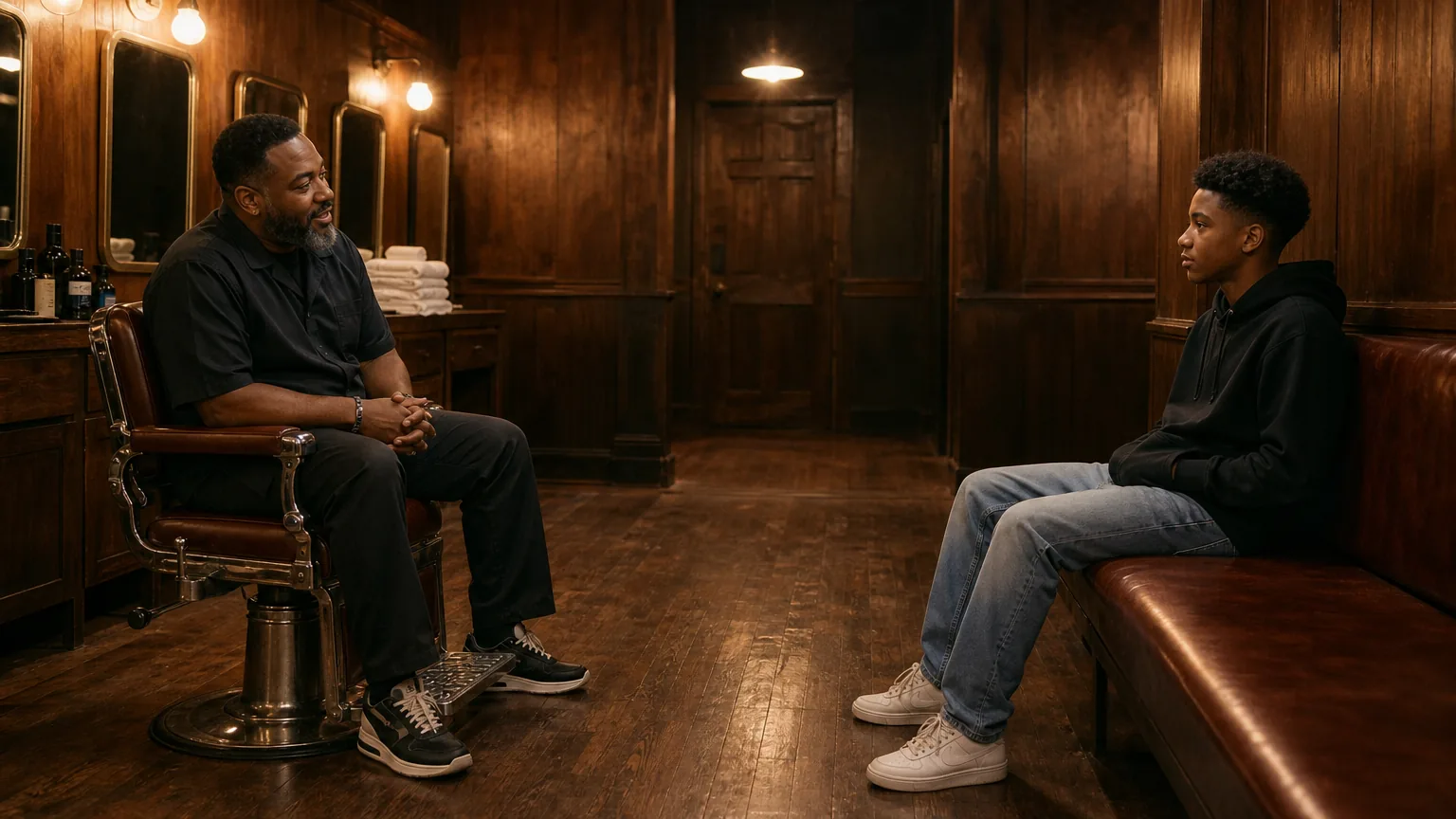
The evidence is genuinely mixed and worth stating plainly. One meta-analysis of 28 experimental studies found diversion no better than traditional processing on repeat offending. Another, covering 45 studies, found recidivism significantly lower among diverted youths. The same review raises a separate point that lands hard in this context: discretion over who gets diverted is inconsistent, and the research it cites has found Black youths subject to higher levels of formal court processing. An owner who says “send him to me” is not softening a fair process. He is stepping into a decision point where the coin was never fair to begin with.
Practically, a victim cannot drop charges. In almost every jurisdiction the decision to charge belongs to the prosecutor, though what the victim wants carries real weight. What an owner can do is ask the detective or the district attorney’s office whether a diversion or restorative option exists locally, say on the record that he supports restitution over prosecution, and offer the thing a court cannot order: a standing invitation, a broom, a chair, somebody who answers the phone. That is not a security measure. It is the reason the barbershop has functioned as a community institution for a hundred and fifty years, and it is why the men who run them keep choosing it.
The Bottom Line
Secure the building like a business and treat the neighborhood like your neighborhood, because both are true at once. Light the outside and keep the sight lines open. Put a camera where it sees faces and record somewhere a burglar cannot reach. Harden the door knowing it buys minutes, not immunity, and make sure a monitored alarm is spending those minutes. Drop the cash, bank it daily, and photograph every serial number tonight. Call your agent before you need them. And keep the door that opens at ten in the morning open, because a shop that shuts itself off from the block has already lost the thing that made it worth protecting.
Further reading (sources)
- WBTV on the Charlotte owner who answered a break-in with an offer of mentorship
- WBTV for the east Charlotte owner calling for change after a stray bullet hit his storefront
- NBC10 Philadelphia with the Trenton shop that lost thousands in equipment through a smashed front door
- ASU Center for Problem-Oriented Policing on when retail burglaries happen and how offenders get in
- ASU Center for Problem-Oriented Policing for which responses to retail burglary have evidence behind them
- National Institute of Justice with what the camera research shows about monitored versus record-only systems
- National Institute of Justice on improved lighting rated against property and violent crime
- OSHA with cash handling, sight lines and closing-time controls for late-night retail
- Federal Reserve Financial Services for how much cash consumers still carry and spend
- Insurance Information Institute on what a business owners policy bundles and leaves out
- Insurance Information Institute for why business income coverage needs physical damage and has a time limit
- OJJDP with how diversion works and what the recidivism meta-analyses actually found
- OJJDP on victim-offender mediation and conferencing as restorative options