Heat Without the Damage: The Complete Guide to Silk Presses, Blow-Outs and Flat Irons on Type 4 Hair
Published on November 2, 2026
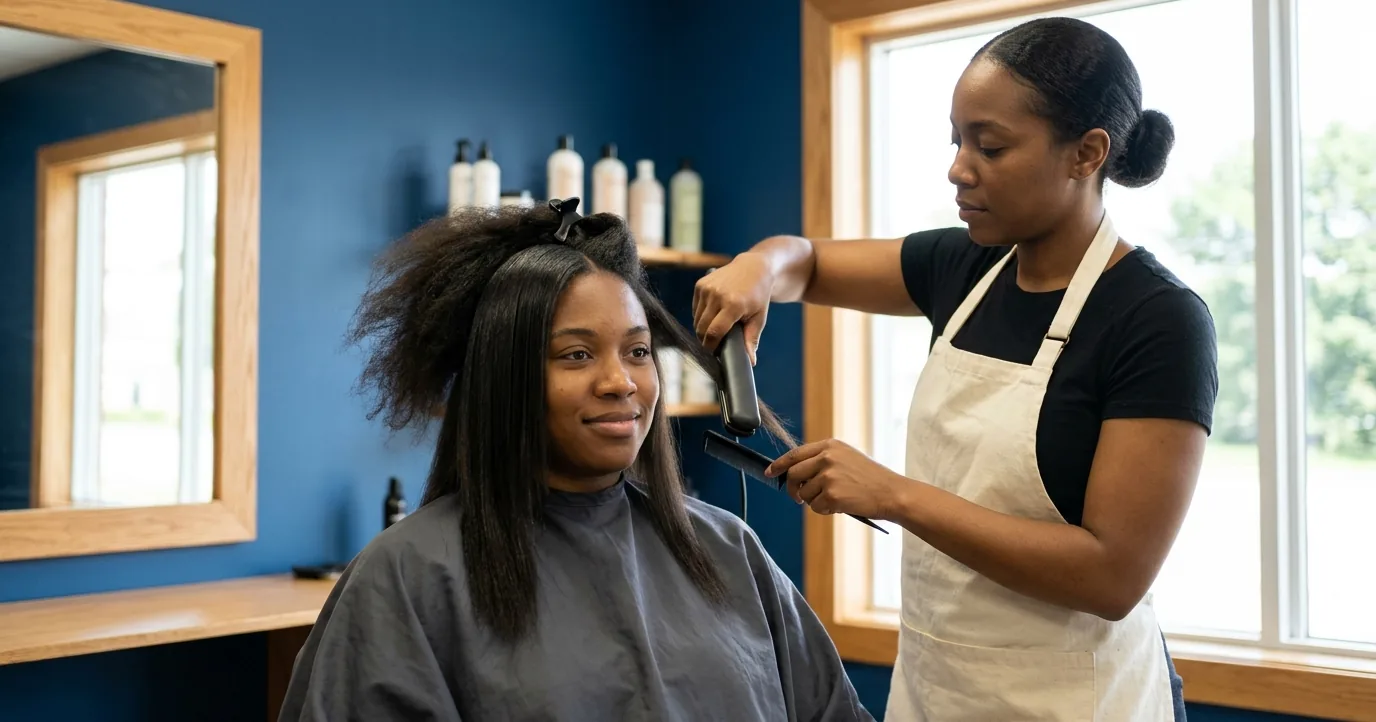
A silk press asks a Type 4 head to do two things it was not built to do at once: lie flat and shine. Done well, it swings for a week, reverts in the first shower, and leaves the curl exactly where it was. Done badly, it leaves a section at the crown that never coils again, and the person in the chair finds out three wash days later when the ends hang straight while the roots spring back.
The difference between those two outcomes is not the tool. It is water, temperature, and how many times the plates touch the same hair. This guide covers what heat does inside a coil, the temperatures and pass counts the research supports, how to stretch with less heat or none, how to tell a heat-damaged section from a thirsty one, and when the question belongs with a dermatologist.
What Heat Does Inside a Coil
A strand of hair is a bundle of keratin proteins in the cortex, wrapped in overlapping cuticle scales. Some of the bonds that hold those proteins in shape are temporary. Hydrogen bonds break with water and reform as the hair dries, which is why a stretched twist-out holds until humidity hits it and why a silk press lasts until the first shower. Heat does the same job faster, by driving the water out while the hair is held straight. That part is reversible, and it is the whole point of a press.
The irreversible part begins at the temperature where the keratin itself starts to unfold. Calorimetry work puts the melting point of the alpha-keratin in dry hair at about 205°C (401°F). Add moisture and that number falls fast: hair holding 23 percent water melted at 155°C (311°F) in the same study. In plain terms, a flat iron set to 325°F is below the melting point of dry hair and above the melting point of damp hair. Dry hair and damp hair are not the same material under the plates.
Water does a second kind of damage when it is trapped. If a strand is still wet inside when the plates close, the water flashes to steam and blows cavities through the cortex. Dermatologists call the result bubble hair: strands that look normal but snap, with hollow bubbles visible under a microscope. A 1994 study reproduced it in the hair of every volunteer tested, using nothing more exotic than an overheating hair dryer, and a 2017 case report traced a woman’s crown breakage to blow drying damp hair with an ordinary dryer. A 2023 review of every published case found that most were middle-aged white women who had styled wet hair, and said plainly that the research on textured hair does not yet exist. No case reports is not the same as no risk.
Then there is the cuticle. The shingled outer layer protects the cortex, and a study of repeated blow drying found that the cortex stayed intact as long as the cuticle held, even at the hottest setting. On a coil the cuticle is already lifted at every bend, which is why textured hair breaks where it does. Heat cracks and lifts the scales further, so the same iron a straight-haired client tolerates for years strips a coil’s protection faster. Heat-damaged hair also holds less water afterward: in a flat iron study, ironed hair regained less moisture after washing than untreated hair, which is why a damaged section feels dry no matter how much conditioner goes on it.
One more finding belongs in the chair. Researchers who ran a curling iron across a range of temperatures found that higher heat did surprisingly little to improve how well a style held, while the onset of damage climbed steeply with temperature. Past a point, turning the dial up buys almost no extra hold and a great deal of extra damage.
Temperatures, Passes, and How Often
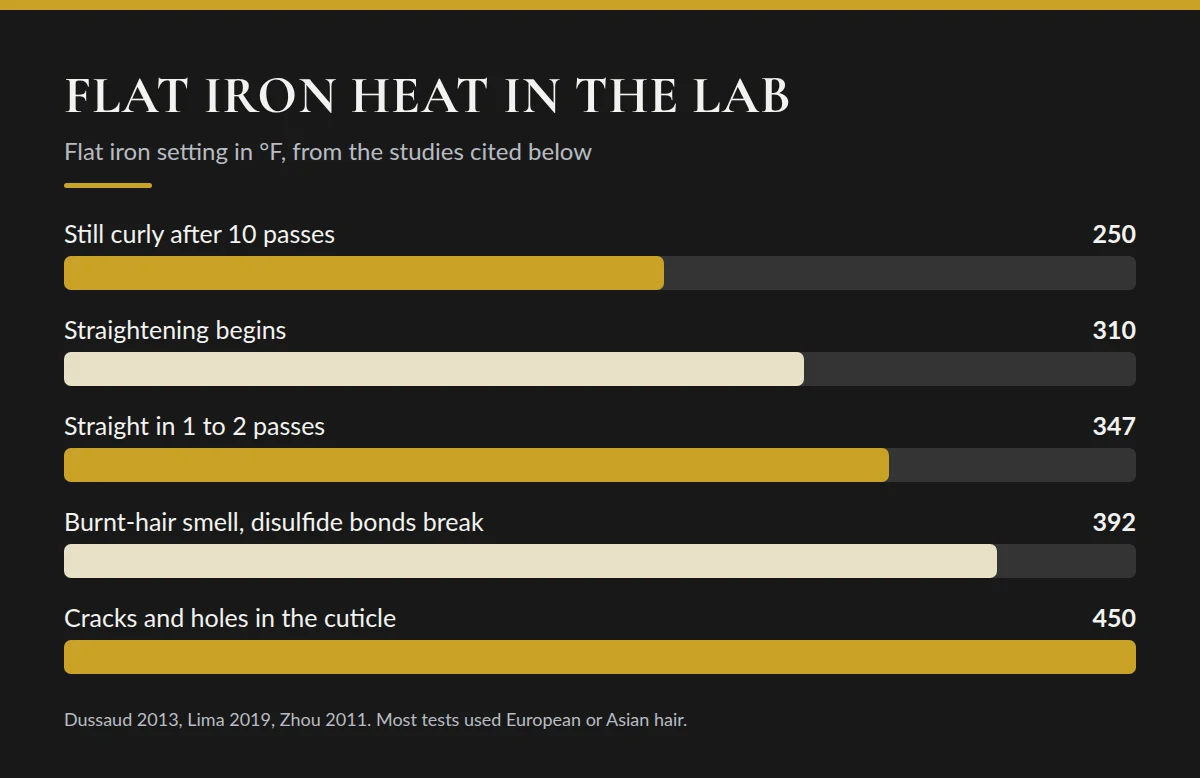
The lab work on flat irons is more specific than most styling advice, and it lines up well with what careful stylists already do. One caution before the numbers: most of these studies used European or Asian hair tresses, and the one that straightened naturally curly and afro-textured swatches was run by a silicone manufacturer. Treat the figures as the shape of the risk, not a dial setting for your head.
- At 122°C (about 250°F), curly tresses were still curly after ten passes. The iron did almost nothing, which is why the lowest settings frustrate people into cranking the dial.
- Around 154°C (about 310°F), straightening began, and the authors called that the best compromise between speed, results and keeping the hair’s cross-links intact.
- At 175°C (about 347°F), hair straightened in one or two passes, but the keratin’s measured melting point had already shifted, a sign that structure was being lost.
- Above 200°C (about 392°F), a separate study detected hair releasing carbon dioxide and sulfur gases, which is the chemistry of disulfide bonds breaking. That is the burnt-hair smell. The same team measured full denaturation at 237°C (459°F).
- At 232°C (450°F), the top of most consumer irons, researchers testing heat protectants described significant damage to hair keratin, with cracks, holes and micropores in the cuticle after ironing.
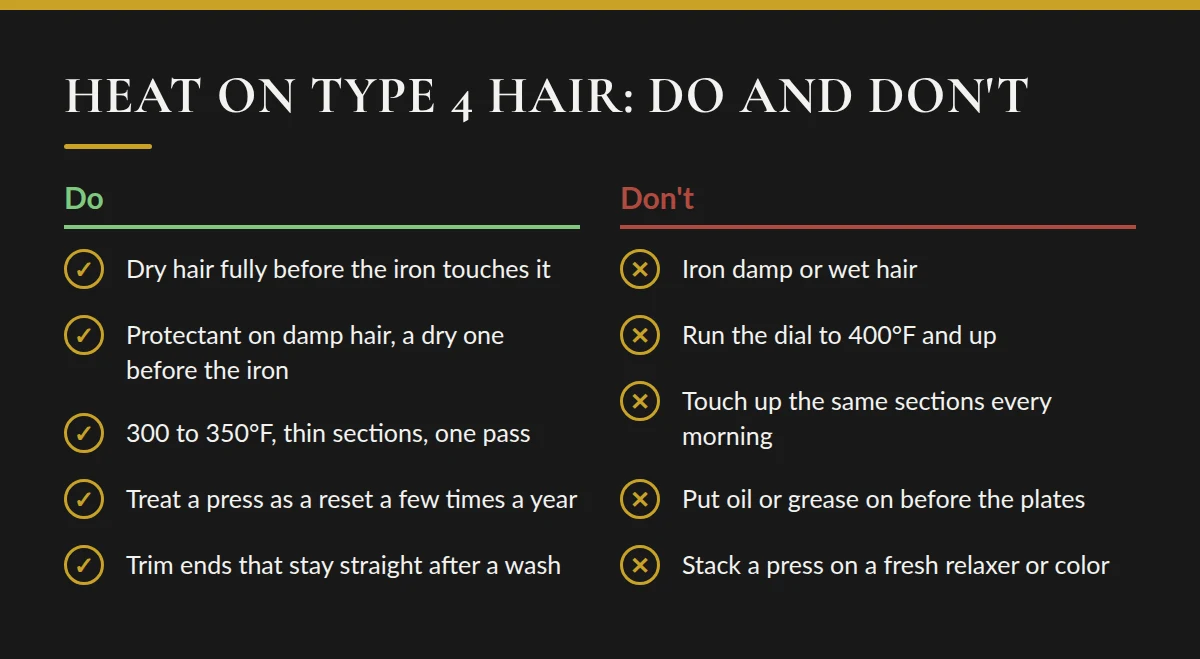
Put together, the window for a Type 4 silk press sits between roughly 300°F and 350°F, with fine, color-treated or already damaged hair at the bottom of that range and dense, coarse, healthy hair at the top. The American Academy of Dermatology’s advice for Black hair is to use a ceramic comb or iron with a dial, start at the lowest temperature that gives you the style, and accept that thicker, coarser hair may need more. Nothing in the evidence supports 400°F and up on natural hair, and the people who swear by it are usually describing hair that has already stopped reverting.
Passes matter as much as the number on the dial. The research straightened hair with repeated cycles, and every cycle is a fresh dose of heat into the same strands. The rule in a good chair is one slow pass per thin section, with a fine-tooth comb gliding just ahead of the plates so the hair is held taut and flat and the iron never has to go back over a section to catch a bump. If a section needs a second pass, the section was too thick or the hair was not dry. Fix that instead of ironing twice.
Frequency is where most damage actually accrues. The AAD puts pressing at once a week at the most, and tells anyone whose hair is already thinning to limit hot tools to a special occasion. In practice, a silk press as a reset every two to three months on otherwise natural hair is a very different thing from a press every two weeks with a flat iron touch-up every morning in between. The daily touch-up is the habit that turns a style into a permanent texture change, because the same front sections get ironed thirty times before the next wash.
The Silk Press, Step by Step
A silk press is a press and curl done with a blow dryer and a flat iron instead of a stovetop pressing comb, with no chemicals, which is why it reverts with water. The order of operations is the whole technique.
- Clarify and deep condition. Product buildup scorches under the plates and leaves a film that stops the hair from moving. Start from a clean, fully conditioned head, following the wash day sequence, and rinse the conditioner out completely.
- Apply a heat protectant to damp hair. The AAD’s advice for Black hair is to add it to wet hair before styling. This is the water-based layer: a leave-in or cream protectant raked through in sections.
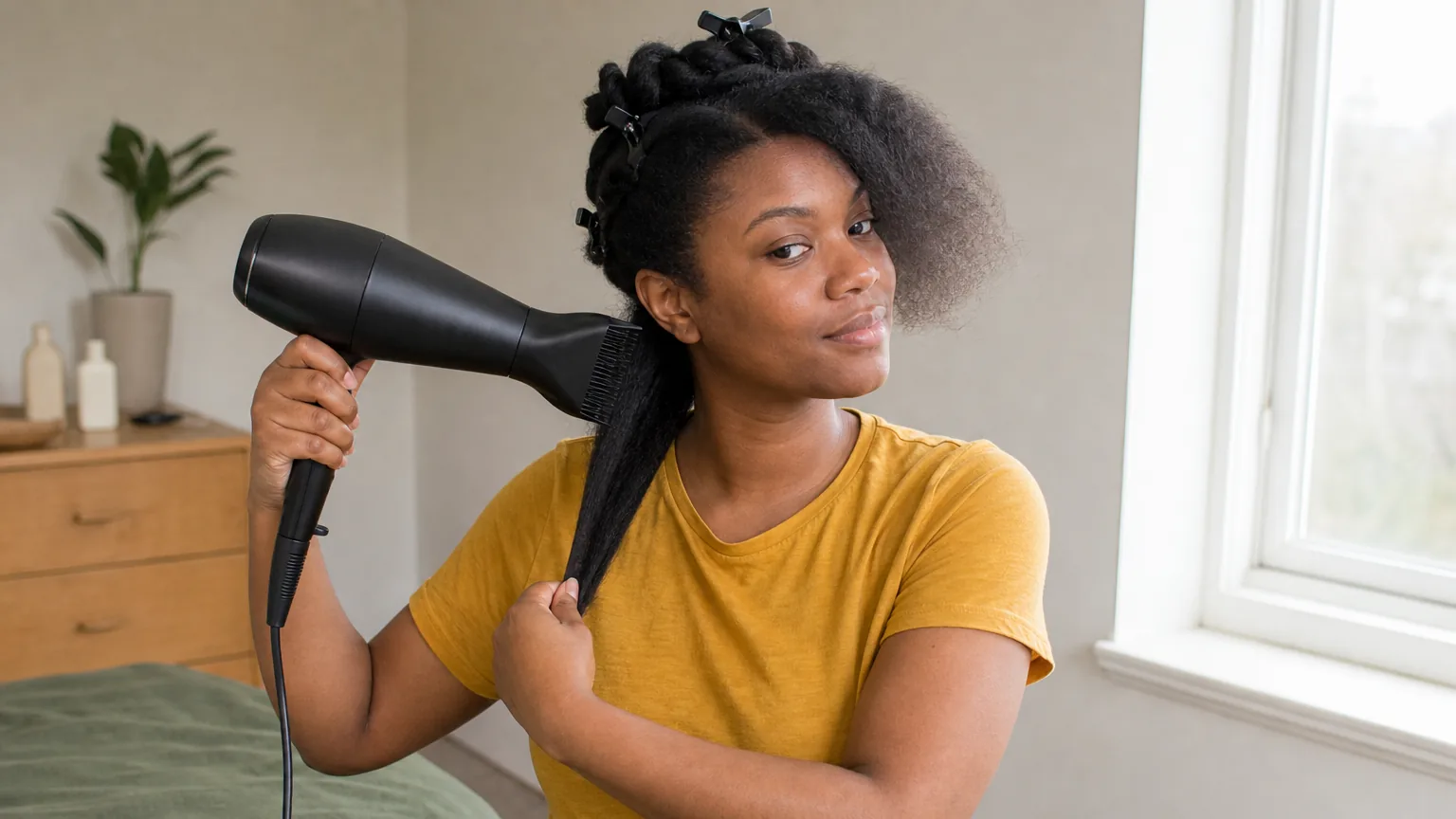
- Blow dry in sections until bone dry. Comb attachment or concentrator, medium heat, the dryer kept moving and about six inches off the hair, each section stretched gently as it dries. This is where the straightening work gets done. If the hair goes under the iron damp, you are pressing a strand whose melting point has dropped by nearly a hundred degrees.
- Switch to a dry protectant. A light serum or a fine spray before the iron, never a cream or an oil at this stage. Water-based products on the hair during ironing produce more structural damage, not less, and oils heat up and cook the cuticle.
- Iron in thin sections, one pass, comb ahead of the plates. Sections no wider than the plates and thin enough to see the comb through. Temperature in the window above. Start at the nape, where the hair is usually strongest, and finish at the hairline and crown, where it is usually finest, often a setting lower.
- Finish and wrap. A drop of serum on the ends, then wrap or pin curl under a satin scarf every night. The press lasts until water or heavy sweat reaches it. Trying to work out around a silk press usually ends in an early re-press, so plan the week before you book.
If your stylist skips the blow dry and irons from wet, passes the plates three and four times over the same hair, or sets the iron by habit rather than by reading your hair, that is the service to walk away from. The press that looks good on the day and shows no damage three months later is the standard.
Blow-Out or Heat-Free Stretch
A blow-out alone, with no iron, stretches the coil without pressing it straight and carries a fraction of the risk. The one hair dryer study that compared temperatures found that drying at about six inches with the dryer in continuous motion did less damage than letting the hair air dry for hours, because hair that stays wet stays swollen, while the hottest setting at two inches cracked and lifted the cuticle and lightened the hair’s color within ten washes. Distance and motion are the technique. A comb attachment on medium heat, a section held at light tension, and the cool shot to set it is the whole blow-out.
Heat-free stretching gets you most of the way to the same place for free:
- Banding. Soft elastics placed every inch or two down a damp, sealed ponytail or section, left until dry, then released. It stretches without pulling, and it is the gentlest method for fine or thinning hair.
- African threading. Thread wrapped tightly down the length of a damp section from root to end. The result is a straighter, sleeker stretch than banding, and it is how a lot of grandmothers got a press-ready base without a dryer.
- Twist-outs and braid-outs. Larger twists or braids on damp hair stretch the coil as they dry and leave a defined pattern. Chunky twists stretch more; small twists define more.
- Roller or twist sets under a hooded dryer. A hooded dryer is still heat, but it is indirect, lower, and spread over the whole head rather than concentrated on one strand. It is the right compromise for someone who wants a sleek stretch and needs it dry tonight.

The practical rule: use the dryer when time demands it and the hair is healthy, use the iron for occasions, and stretch without heat for everyday wear. The hair that gets a silk press twice a year and a banded stretch every wash day is the hair that keeps its curl.
What Heat Protectants Can and Cannot Do
A heat protectant is a film: silicones, polymers or proteins that sit on the cuticle, slow the transfer of heat into the strand, and help the plates glide. The evidence says they work, within limits. In a flat iron study at 205°C (401°F), polymer pretreatments preserved about half of the hair’s native protein structure and significantly reduced breakage on combing afterward; the researchers worked for an ingredient manufacturer, so read the figures as a ceiling rather than a promise. Silicone treatment in the automated iron study did not slow the loss of keratin structure at all, but it improved the quality of the straightening by helping the fibers align, which still matters because better alignment means fewer passes.
Two things a protectant cannot do. It cannot make 450°F safe; the protection study ran its hottest tests at exactly that temperature and still found holes in the cuticle. And it cannot fix wet hair. The study of heat protection sprays found that water-based formulas produced more structural damage under the iron than alcohol-based ones, because the water in the product did the same thing as water left in the hair.
So the layering is: a water-based protectant or leave-in on damp hair before the blow dry, where it has time to dry down into a film, and a dry, light protectant on fully dry hair before the iron. Skip the oil. Coconut, castor and grease have no thermal protection data behind them, they transfer heat efficiently, and they are the usual reason a press smokes.
Heat Damage or Just Dry? How to Tell
Dry hair and heat-damaged hair feel similar in the hand and respond completely differently to water. That is the test.
Dryness reverts. Wet the hair, condition it, and the coil springs back, even if it is rough or frizzy. The cuticle is roughed up, the hair is short of moisture, and the fix is a deep conditioner, less manipulation, and a lighter hand with heat for a while.
Heat damage does not. The strand that has been pressed past its melting point hangs straighter and limper than its neighbors after a wash, often from the mid-length down, with a coily root and a straight end on the same hair. People call this heat training, and the myths article covers why there is no such thing: the follicle still makes a coil, which is why the root is curly, but the length has lost the structure that made it one.
Look for these on top of the lost pattern:
- Ends that fray and fork rather than breaking clean, with white dots along the shaft. The medical term is trichorrhexis nodosa, weak nodes where the strand frays like rope, and blow drying and ironing are among its named triggers. In African American hair the breaks tend to happen close to the scalp, so the hair looks as if it has stopped growing rather than as if it has split.
- Breakage concentrated where the heat went. The front hairline, the crown, and whichever side you iron first each morning. Traction loss has a different map, and so does breakage from a chemical service.
- A section that will not hold moisture. Thermally damaged hair takes up and keeps less water. If one patch feels like straw a day after a deep conditioner while the rest feels fine, that patch is damaged, not dry.
- Hair that snaps when stretched gently while wet. Healthy wet coils stretch and recover. Bubble hair and keratin that has been cooked break instead.
If breakage comes with a scalp that burns, flakes, scars or shows bare skin through the part, it has stopped being a heat question. That list belongs with the conditions in the hair loss guide, and a dermatologist should see it before any more styling decisions are made.
Stacking Heat on Relaxers, Color and Smoothing Treatments
A silk press on virgin hair is one stress. On hair that is also relaxed or colored, the same iron lands on strands that have already given up some of their bonds, and the damage compounds. Dermatologists’ guidance for chemical services is to have one at a time, to relax or perm first and wait two weeks before coloring, and to stretch touch-ups to every eight to ten weeks or longer when the air is dry. Relaxer touch-ups should go only on new growth, never over hair that has already been relaxed, and the AAD puts them at every two to three months. Hair carrying color and a relaxer should sit at the bottom of the temperature window, in thinner sections, and get pressed less often than natural hair. The chemistry behind that is in the relaxer safety guide.
Keratin and other smoothing treatments deserve their own warning, because the flat iron is part of the service. The FDA explains that the solution is sealed in with heat, and that when it is heated, formaldehyde in the product is released into the air as a gas. Formaldehyde is classified as a human carcinogen, and the FDA lists watery eyes, burning in the nose and throat, coughing, headaches, nausea and rashes among the reactions reported to it. If you have one done at all, it should be in a ventilated salon by a stylist who can say what is in the bottle. If you press at home, keep smoothing treatments out of the routine entirely.
When Heat Reaches the Scalp
There is a reason dermatology once called the scarring hair loss of Black women hot comb alopecia. The term was coined in 1968 for a pattern of permanent thinning at the crown that was blamed on hot oil and a heated metal comb running down to the scalp. By 1992, a Walter Reed study of ten affected women found no reliable link between hot comb use and the disease and renamed it follicular degeneration syndrome. It is known today as central centrifugal cicatricial alopecia, with a cause that current research describes as genetic and environmental together. The hot comb was acquitted of starting it. It was never cleared of making an inflamed scalp worse.
The practical lesson survives the name change. Heat on the hair shaft is a hair problem; heat on the skin is a skin problem, and skin that scars does not grow hair again. Keep the plates off the scalp, never drag the first half inch of a section against the skin to get the roots flat, and keep hot grease and hot oil away from the scalp altogether. If the crown is tender, thinning, or dotted with bumps, CCCA is the diagnosis to rule out before another press, because the inflammation behind it is treatable early and permanent late.
When to Trim and When to See a Dermatologist
Heat damage does not repair. A protein treatment can patch a cuticle for a wash or two and a good conditioner can make a damaged section feel better, but the keratin that unfolded stays unfolded, and the section will hang straight until it is cut. So the only question is how fast to cut it.
For a few straight ends, dusting a quarter inch every eight to twelve weeks, done by someone who cuts textured hair in its natural state, removes the damage over a season without a visible change in length. For a whole perimeter or a crown that no longer coils, growing it out means living with two textures for a year and watching the damaged length keep breaking. A one-time cut to the healthy line is usually the faster route back to a full head. A barber or stylist can see the line between damaged and healthy hair more clearly than you can in a mirror, which is a good reason to choose one who works with coils every day.
Breakage from heat answers to less heat. If you have changed the routine, dried fully before the iron, dropped the temperature, stopped the daily touch-ups, and the hair is still breaking after two or three months, the AAD’s advice is to see a board-certified dermatologist, because the hair care may not be the root cause. Go sooner if the part is widening, the scalp shows through, the hairline is moving, or anything on the scalp itches, burns or scars. Those are not heat styling problems, and no change to the iron will fix them. For anyone already living with a hair loss diagnosis, the daily routine while treatment works keeps hot tools for occasions only.
The Bottom Line
Heat is not the enemy of Type 4 hair. Wet hair under hot plates is, and so is the same section ironed every morning. Dry completely before the iron touches anything, keep the dial between 300°F and 350°F, go one pass with a comb ahead of the plates, and treat a silk press as a reset a few times a year rather than a standing appointment. Protectants help within those limits and not beyond them. The curl that does not come back after a wash is not trained; it is gone until it is cut. And a scalp that hurts is a different conversation, one that belongs with a dermatologist.
Further reading (sources)
- American Academy of Dermatology on everyday care for Black hair, including ceramic irons and once-a-week pressing
- American Academy of Dermatology for ten hair-care habits that damage hair and how to change them
- Cao and Leroy on how moisture lowers the melting temperature of hair keratin
- Christian and colleagues with the effects of water on heat-styling damage
- Detwiler and colleagues for bubble hair reproduced in normal hair with heat
- Albers, Maley and MacKelfresh on bubble hair from blow drying damp hair
- Li and colleagues with a review of bubble hair deformity and the gap in textured hair research
- Lee and colleagues on hair shaft damage from hair dryer heat and distance
- Harper, Qi and Kaplan for the efficacy and damage tradeoffs of thermal styling
- Dussaud, Rana and Lam on progressive straightening of curly hair with an automated flat iron
- Zhou and colleagues with how cosmetic pretreatments protect hair from hot flat ironing
- Lima and colleagues on what heat releases from hair and at what temperature
- MedlinePlus for trichorrhexis nodosa, the fraying node breakage triggered by heat
- Sperling and Sau on hot comb alopecia revisited and revised
- George and colleagues with a decade of updates on CCCA beyond the hot comb
- U.S. Food and Drug Administration on hair smoothing products that release formaldehyde when heated