Darker Skin, Different Rules: The Complete Skin Care Guide for Black Men
Published on November 5, 2026

Black men’s skin needs three things every day and one habit every month. The daily three are a gentle, fragrance-free cleanser, a moisturizer with ceramides put on while the skin is still damp, and a tinted broad-spectrum sunscreen with iron oxide and an SPF of 30 or higher. The monthly habit is a look at the places skin cancer hides on darker skin: the palms, the soles and under the nails. Everything else in this guide follows from one fact. Melanin-rich skin answers irritation, injury and inflammation by making more pigment and, in some men, more scar, so the whole game is keeping the skin calm and treating breakouts, bumps and rashes early instead of late.
A barber sees more Black men’s skin in a week than most doctors see in a month: the beard line after a shave, the nape under a guard, the scalp under a skin fade, the ears, the neck, the hands on the armrest. This is the hub for everything we have written about that skin: the dryness that shows up as ash, acne and the conditions that only look like acne, the dark marks that outlast a bump, eczema and the rashes that never turn red, keloids, light spots, and the skin cancers that hide on brown skin. Each section gives you enough to act on and points to the deeper article where we have one, and it ends with a clear line on when a client belongs in a dermatologist’s office rather than a barber’s chair.
The Daily Routine: Three Steps, Not Ten
The American Academy of Dermatology (AAD), whose guidance for darker skin tones runs through this guide, keeps the routine short. Three steps done every day beat a shelf of products used now and then, because each one removes a trigger for the pigment and scarring described below.
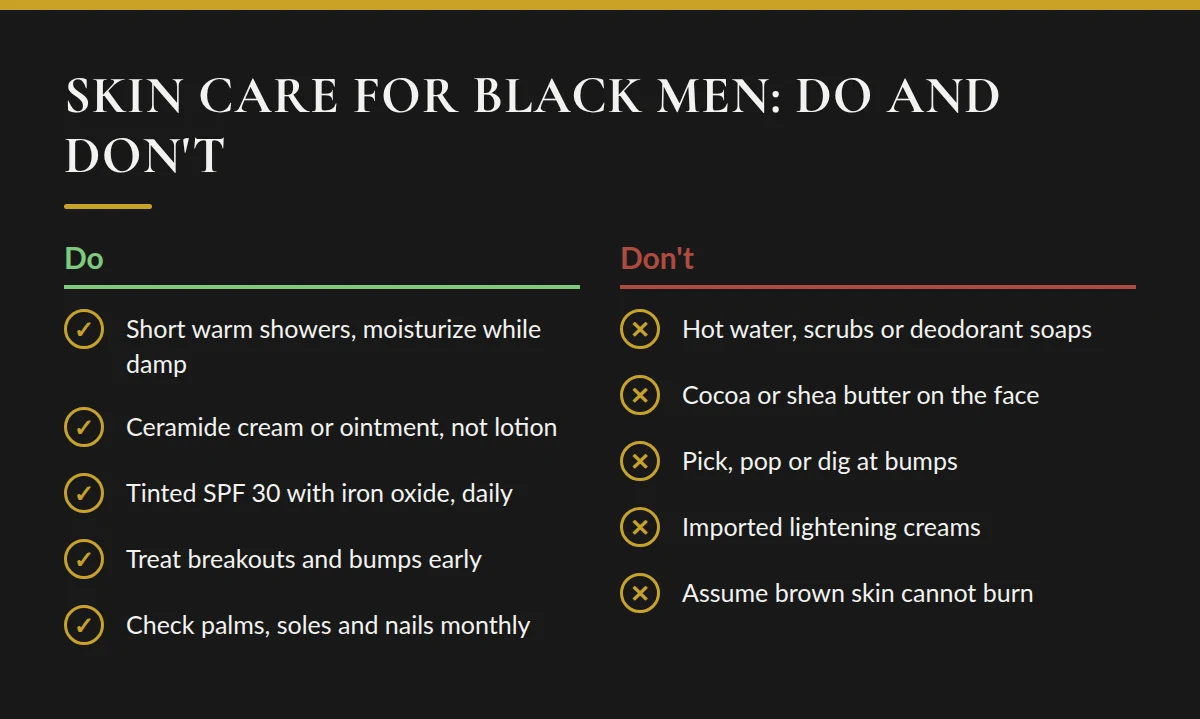
- Cleanse gently. The AAD recommends a mild cleanser labeled non-comedogenic, meaning it won’t clog pores, applied and rinsed with the fingertips only, then patted dry. Scrubbing, strong soaps and squeezing pimples make acne worse, and deodorant soaps, alcohol and fragrance irritate skin that is already dry.
- Moisturize while the skin is damp. Leave a little water on the skin after a shower, then put a fragrance-free moisturizer on straight away to seal it in. Creams and ointments work better than lotions, the AAD says, and a cream with ceramides reduces the whitish, greyish look of dry skin on a dark complexion.
- Sunscreen, and make it tinted. For brown skin the AAD recommends a tinted sunscreen that contains iron oxide, with SPF 30 or higher, broad-spectrum protection, water resistance and a shade that blends with your skin tone. Iron oxide blocks visible light, a cause of dark spots that ultraviolet-only sunscreens do not touch, and it sits in the inactive ingredients. Put it on every patch of skin that clothing won’t cover, and add a wide-brimmed hat.
If you shave, the shave is part of the routine, and it is where most of the trouble starts. The AAD’s advice for men with darker skin tones: a warm compress for five minutes or a shave at the end of the shower, a moisturizing shaving cream left on for a minute or two, a sharp single-blade or electric razor, short strokes in the direction the hair grows, never more than two passes over one spot, no stretching the skin and no close shaving, then a cool compress and an aftershave that does not sting. A single blade is done after five to seven shaves. Our razor bump treatment ladder takes it from there.
Two things to leave off the face: heavy butters and at-home procedures. Cocoa butter and shea butter clog pores, the AAD says, and there is no scientific evidence that cocoa butter evens skin tone. At-home chemical peels, microdermabrasion and laser treatments can leave permanent dark marks and light spots on deeply pigmented skin, so the AAD’s rule is to see a dermatologist before trying any of them. For the products that fill in around these three steps, our grooming guide covers the shelf.
Why Darker Skin Plays by Different Rules
Start with the melanin, because it explains both the strengths and the risks. In a classic study of skin samples from Black and white donors, Kaidbey and colleagues found that on average five times as much ultraviolet light reached the upper dermis of white skin as reached Black skin. Melanin acted as a neutral filter across every wavelength, and the extra protection came not only from the amount of pigment but from how the melanosomes that carry it are packed and distributed, which the authors tied to Black skin’s lower rates of sun damage. Melanin is a real shield. It is not a complete one, as the skin cancer section shows.
The same pigment cells are quick to overreact. People with medium to dark skin tones get dark spots and patches, the AAD explains, because something triggers the skin to make extra melanin, and the triggers are everyday ones: a pimple clearing, a cut healing, a medication, a product that irritates. Scarring runs the same way. If acne becomes moderate or severe before treatment starts, the AAD warns, people of color face a higher risk of dark patches and of keloids, the raised scars that grow beyond the wound, and Black people carry the greatest keloid risk of any group.
The skin barrier is different too. When Muizzuddin and colleagues measured the outer skin layer of African American, white and East Asian volunteers, African American skin stood out for low ceramide levels, which the authors linked to the high rate of dry skin in Black skin. That is why a ceramide moisturizer earns its place in the routine, and why dryness on brown skin is so visible: it flakes white and grey against a dark background.
Then there is the problem of redness that nobody can see. Textbooks describe most skin conditions as red. On dark skin, eczema shows as grey, violet or dark brown, seborrheic dermatitis looks pink, purplish or lighter than the skin around it, and the flush of rosacea is felt as warmth rather than seen, so conditions get missed, misnamed or blamed on dryness. The AAD notes that some people with darker skin tones live for years with an undiagnosed skin condition, believing their skin is simply too dry for any moisturizer to work, and a 2019 review led by Andrew Alexis found rosacea underreported and underdiagnosed in skin of color for the same reason, with delayed diagnosis leading to progressive, sometimes disfiguring disease.
Finally, the people trained to tell the difference are scarce. In a 2016 call to action in the AAD’s own journal, Pandya and colleagues reported that Black dermatologists made up about 3 percent of the specialty while Black Americans were 12.8 percent of the population. The practical answer is in the dermatologist section below: find a practice that treats skin of color, and ask.
Ashy Skin: Dryness You Can See
The AAD’s top tips for dry skin on darker tones are short baths and showers of five to ten minutes in warm water rather than hot, a pat dry that leaves the skin damp, moisturizer slathered on immediately, gentle fragrance-free products throughout, hand cream after every hand washing, and loose cotton over tight clothes and rough wool. Follow all of that and you should see improvement within two weeks.

For very dry skin, the dermatologists the AAD consulted prefer an ointment such as petroleum jelly or a thick cream. Butters and oils tend to liquefy on the skin, one notes, so they are less effective however rich they feel, while petroleum jelly traps the moisture already there, so it goes on damp skin or over a cream. When two weeks of that routine change nothing, the dryness may not be dryness: the AAD lists eczema, ichthyosis and psoriasis among the conditions that cause excessively dry skin and go undiagnosed for years on darker skin. Persistent ash at the hairline, around the ears and down the nape, the places a barber handles every visit, deserves a dermatologist’s look rather than a fourth moisturizer.
Acne, and What Only Looks Like Acne
Acne on brown skin comes with a second problem, the dark mark it leaves behind, and the AAD’s advice is to treat both at once and to treat early, before breakouts turn moderate or severe and the risk of dark patches and keloids climbs. For mild acne it recommends a retinoid paired with benzoyl peroxide, a combination that works well in skin of color; the idea that benzoyl peroxide bleaches dark skin is a myth, the AAD says, though it will bleach towels, so start at 2.5 percent to limit irritation. Adapalene 0.1 percent gel, a retinoid now sold without a prescription, and salicylic acid are the other drugstore options. Breakouts confined to the forehead and temples usually trace back to hair oil, a pattern common enough to have a name, pomade acne, and the fix is a water or glycerin based product or keeping the oil off the hairline. Wash caps and hats often, never pop a pimple, and if the shelf fails, see a dermatologist: with help, the AAD says, virtually every case of acne can be cleared.
A good share of what gets called acne on a Black man’s face and neck is something else, and each needs a different answer.
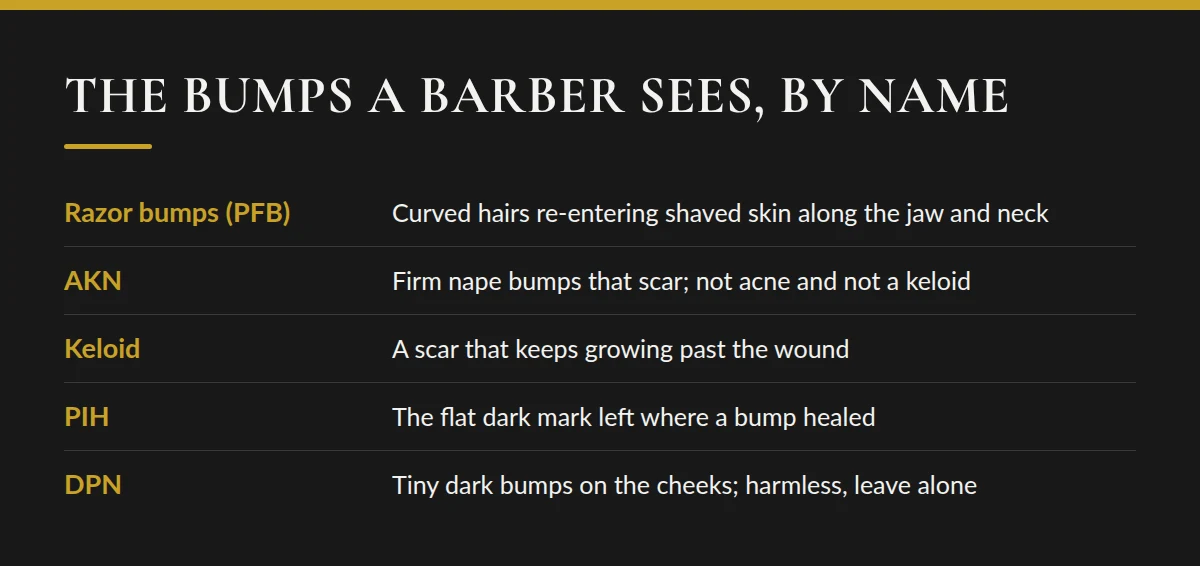
- Razor bumps (pseudofolliculitis barbae). Bumps along the jaw and neck that follow the razor are curved hairs re-entering the skin, not acne. They are especially common in men with darker skin tones, the AAD notes, and a review by Nigerian dermatologist Adebola Ogunbiyi found that a single variant in one hair keratin gene raises the odds sixfold. Growing a beard clears them: fewer bumps within a month and none after three, according to the AAD. For the man whose job demands a clean face, the full treatment ladder is the plan, and our piece on shaving waivers for Black men in uniform covers the paperwork when a workplace will not bend.
- Acne keloidalis nuchae (AKN). Firm bumps clustered across the back of the neck and lower scalp are usually AKN, which the AAD calls common, most often in Black males and typically starting between 14 and 25. The bumps are not acne and the scars are not keloids, but untreated it hardens into raised, hairless scar, and the home remedies sold for nape bumps, including acids and engine oil, cause chemical burns. Our AKN guide covers what the barber should change at the nape and the treatment ladder.
- Hidradenitis suppurativa (HS). Deep, painful lumps where skin rubs skin, in the armpits, groin, buttocks and inner thighs, that look like boils which keep coming back. The AAD says many people live with it for years before a diagnosis, and that in a 2017 study 296 of every 100,000 African Americans had it; that study, by Garg and colleagues, put the rate at more than three times that of white patients. A barber will not see it, but a client who mentions boils that keep returning should hear the name.
- Rosacea. On darker skin the flushing that defines rosacea is easy to miss, the AAD says, so the clues are a face that feels warm most of the time, a dusky brown discoloration, acne-like breakouts that acne treatment will not clear, and burning or stinging whenever a product goes on. Gritty, bloodshot eyes can turn up even when the skin looks mild.
- Dermatosis papulosa nigra (DPN). The scatter of tiny, smooth, dark bumps across the cheeks and forehead of many Black adults is DPN, which DermNet describes as 1 to 5 millimeter papules affecting up to 35 percent of Black Americans, starting in adolescence and multiplying with age. They are harmless, run in families and are best left alone, since removal can cause pigment change, scarring and keloids. A barber’s only job is to keep the blade off them.
Dark Spots and Dark Patches
The flat dark mark left where a bump, pimple or nick healed is post-inflammatory hyperpigmentation, one of the most common reasons people with darker skin tones see a dermatologist. The AAD’s order of operations is to find and stop the cause first, because many marks then clear on their own, then protect the skin with tinted sunscreen, and only then add a fading product. A mark a few shades darker than your natural color usually fades within 6 to 12 months; color that sits deep in the skin, slate blue or grey, can take years. Over the counter, the AAD lists azelaic acid, glycolic acid, kojic acid, retinoids and vitamin C as ingredients that can fade spots, and our guide to fading dark spots on Black skin weighs the evidence for each, including prescription hydroquinone.
One warning belongs in every shop. Researchers have found steroids and mercury, unlisted on the label, in skin care products imported from other countries, and the AAD says the hidden steroids can cause pimples, rashes and, over time, thin skin and permanent discoloration. The U.S. Food and Drug Administration adds that mercury creams are usually made abroad and sold illegally, that the words mercurous chloride, calomel, mercuric, mercurio or mercury on a label give them away, and that the vapor and shared towels expose the whole household. Leave the mystery jars off the retail shelf.
Not every dark patch is a healed bump. A band of darker, thicker skin that feels like velvet on the back and sides of the neck, in the armpits or in the groin is acanthosis nigricans. People try to scrub it off, the AAD says, and it does not scrub off. It is harmless in itself but can be an early warning sign of prediabetes, or a side effect of a medicine, and DermNet puts its estimated prevalence among African Americans at 13.3 percent. The back of the neck is exactly where the clippers run, which makes the barber the person most likely to notice it first. The right response is not a fading cream but a blood sugar check, the kind of screening our guide to health programs in Black barbershops describes shops hosting.
Eczema, Seborrheic Dermatitis and the Rashes That Never Turn Red
Eczema is more common in Black Americans than the textbooks once suggested. In a national survey of more than 100,000 US children, Shaw and colleagues found Black race carried 1.7 times the odds of an eczema diagnosis, and a 2018 review by Kaufman and colleagues reports that atopic dermatitis occurs more often in Black and Asian people than in white people. On darker skin, the AAD says, the bumps tend to be grey to violet-brown and the patches dark brown, grey or purple, on top of extremely dry skin, so the rash reads as ash or dark marks until it itches at night. At the chair it shows up at the hairline, the nape, behind the ears and in the beard, and the products that touch those places are often what flares it. Our article on eczema at the hairline and scalp covers how to tell it from its neighbors and what a dermatologist can offer.
Seborrheic dermatitis is the neighbor a barber sees most. In the United States, the AAD says, Black people are the group most likely to develop it, and men more than women. It lives on the oily zones: scalp, eyebrows, the sides of the nose, the ears, the beard and the back of the head and neck. On darker skin tones the rash looks pink, slightly purple or lighter than the surrounding skin, sometimes with white spots on the scalp, and on the face it leaves darker patches or light spots that early treatment can prevent, the AAD says. When the medicated shampoo stops working, we have a guide to treatment-resistant seborrheic dermatitis, and the scalp health guide covers flaking, buildup and sun on a low cut.
A rash that sits exactly where a product, dye or adhesive touches the skin is contact dermatitis, the type of eczema the AAD says almost everyone gets at least once. Thick, scaly, well-defined plaques that come and go are more likely scalp psoriasis, which on dark skin looks violet or dark brown rather than red.
Keloids and the Scars That Keep Growing
A keloid is a scar that grows much larger than the wound that caused it, and Black people carry the greatest risk of forming one, the AAD says; a third to a half of people who develop a keloid have a blood relative who gets them too. It usually takes months to appear after an injury, then grows slowly for months or years, and unlike an ordinary raised scar it does not fade on its own. For a barber the relevant injuries are small: a nick at the neckline, clipper burn, a piercing, and the razor bumps that Ogunbiyi’s review notes can give rise to extensive keloid scars. No single treatment works for every keloid, so dermatologists combine steroid injections, silicone, pressure, surgery and more, and the earlier a thickening spot is seen, the more options there are. Our guide to keloids and the barber’s chair covers prevention for prone clients, wound care after a nick, and what the treatments involve. Nape bumps are the exception: AKN scars are not true keloids, which is why they get their own article.
Light Spots
Light spots draw the eye on brown skin as much as dark ones. The AAD explains that skin may make less pigment after an injury, from certain topical medications, or after a cosmetic procedure, and that a light patch can also be the sign of a condition: seborrheic dermatitis, tinea versicolor, psoriasis, eczema or lupus. Tinea versicolor is a yeast overgrowth that leaves dry, scaly spots lighter or darker than the skin around them, more noticeable after sun, prone to returning in warm humid weather, and easily mistaken for vitiligo, the loss of pigment cells, which is most visible on dark skin and which treatment may partly reverse. The AAD’s self-care for a new light spot is simple: watch it for a few weeks, protect it from the sun because skin that is busy remaking pigment can overdo it and turn the light spot dark, and skip home treatment, since the right treatment depends on the cause. New, spreading or unchanged light areas after a few weeks are a reason to see a dermatologist.
Sun, Sunscreen and the Skin Cancers That Hide
Melanin lowers the risk of skin cancer. It does not remove it, and the cancers that do develop on Black skin are found late. The AAD puts it bluntly: people with darker skin tones can get skin cancer, and when they do, it is often advanced by the time it is diagnosed. Part of the reason is where it grows. On darker skin, cancer may appear in places that get little or no sun, the AAD says: the palms, the soles, the fingers and toes, the nails, the mouth and lips, the buttocks and the genitals, as well as the face and neck. In their review of skin cancer in skin of color, Gloster and Neal reported that squamous cell carcinoma is the most common skin cancer in dark-skinned groups, that it and melanoma usually arise on sites the sun does not reach, and that ultraviolet light drives only basal cell carcinoma in these groups. Kundu and Patterson add that squamous cell carcinoma in skin of color tends to grow in areas of chronic scarring and inflammation, which puts old keloids, burns and long-running sores on the watch list.

The numbers explain the late diagnoses. Using the federal cancer registry, Culp and Lunsford found melanoma struck 1.0 per 100,000 non-Hispanic Black Americans a year from 2011 through 2015, rising with age, and the most common defined type was acral lentiginous melanoma, the kind that grows on palms, soles and under nails. Rare, then, but deadly: the five-year relative survival rate for Black patients was 66.2 percent. In an earlier registry analysis, Cormier and colleagues found African Americans more than four times as likely as white patients to arrive with stage IV disease, with five-year survival for minority patients of 72 to 81 percent against 89.6 percent for white patients, and Dawes and colleagues, reviewing nearly 97,000 cases, found that even at stage I a Black patient’s hazard of death was about three times a white patient’s. The disease is found late because nobody was looking in the right places.
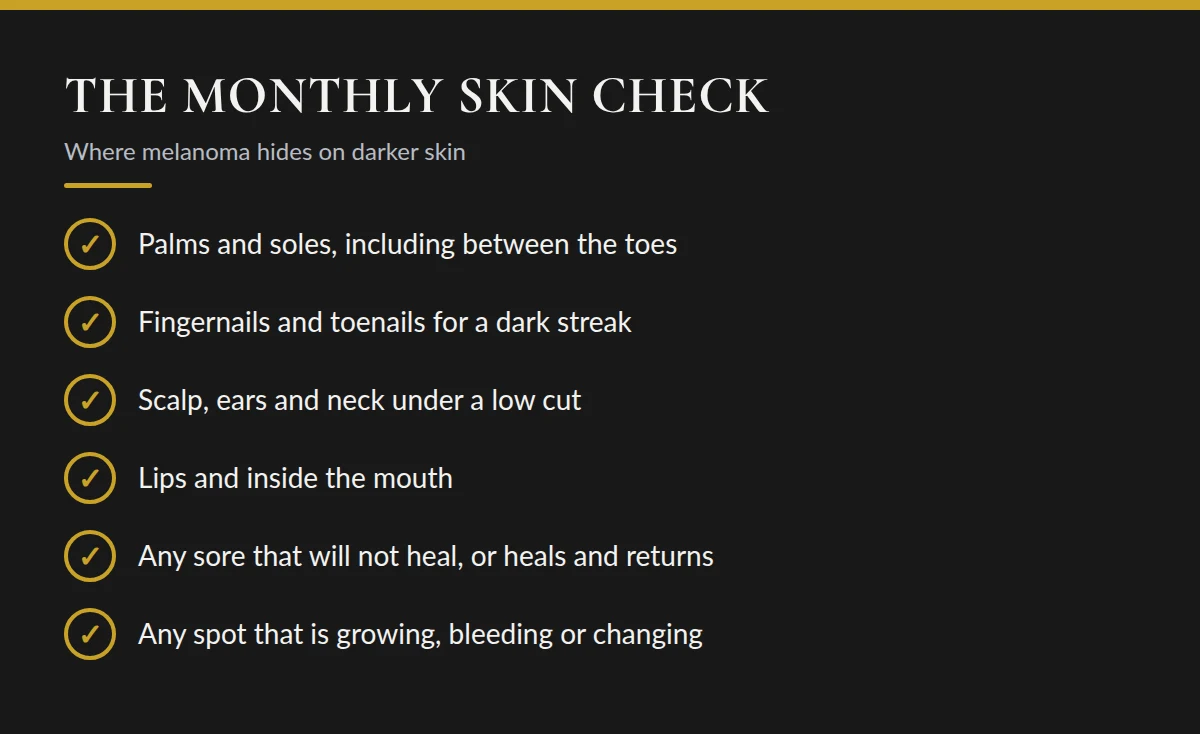
Looking takes five minutes a month. The AAD’s warning signs for darker skin tones are a bump, spot or mole that is growing, bleeding, itching or changing in any way; a color change on the skin, scalp, mouth, lips or genital area, especially darkening; a sore that does not heal, or heals and returns; a dark line or streak in a nail, or a spot under or around the nail that does not heal; and a scaly or rough patch that does not go away. Nail melanoma is more common in people with skin of color and tends to be diagnosed later, the AAD notes; look for a brown or black band, often on the thumb or big toe, and treat darkening of the skin beside the nail as urgent. For people of African ancestry the feet and hands are the most common sites for melanoma, and about as many African Americans as white Americans develop one on a foot, so check the soles, between the toes and anywhere the foot was once injured. Bob Marley’s melanoma began on a foot he had hurt playing soccer.
Sunscreen still matters on brown skin, for two reasons. The ultraviolet that does get through adds up on the face, ears and scalp, and visible light darkens the pigment behind dark spots: in a study of volunteers with skin types IV to VI, Mahmoud and colleagues found visible light produced darker, longer-lasting pigmentation than long-wave UVA, and none at all in fair skin. That is the case for the iron oxide tint, and for sunscreen on a shaved head or a skin fade, where the scalp takes direct sun all day. Sun exposure also flares discoid lupus, whose scarring patches a fresh fade can expose.
The Beard, the Scalp and the Years After 40
The beard concentrates the trouble: razor bumps along the neck, seborrheic dermatitis in the hair, keloids where bumps healed, and the dark marks that follow all three. The habits above are the fix, plus a beard oil or balm chosen for skin rather than scent, as our grooming guide explains. The scalp under a skin fade or a clean shave is skin with the same needs: it dries, it marks, it burns, and a sore up there that will not heal can be a skin cancer. After 40 the rules tighten rather than relax. The skin and scalp get drier and the beard turns grey and wirier, changes we cover in how Black hair changes after 40, DPN multiplies with age, and melanoma incidence in Black Americans rises with age too, so the monthly check matters more each decade, not less.
When to See a Dermatologist
A barber can notice, name and nudge. A dermatologist can diagnose and treat. Book the appointment, or tell your client to, when:
- Dryness has not improved after two weeks of the routine above, or keeps coming back.
- A rash at the hairline, nape, beard or ears is darkening, thickening, oozing or itching at night.
- Bumps along the beard line or nape are spreading, scarring, bleeding or not responding to a changed shave within three months.
- Boils keep returning in the armpits, groin or buttocks.
- A dark mark is blue-grey, raised, or has not faded in 8 to 12 weeks of sunscreen and a fading product.
- Darker, velvety skin has appeared on the neck, armpits or groin.
- Any light spot is new, spreading or unchanged after a few weeks.
- A spot or mole is growing, bleeding, itching or changing, a sore has not healed, or a nail has a new dark streak. Go promptly, not at the next cut.
- You are considering a peel, laser, microdermabrasion or any lightening treatment.
- A scar is thickening, or you have had a keloid before and have a new wound.
Finding the right office matters as much as going. The AAD’s Find a Dermatologist search lets you filter by practice focus and choose Skin of Color, and the AAD’s own advice before any procedure on dark skin is to ask how many patients with skin of color the doctor has treated. Bring photos of a flare, since rashes wax and wane, and a list of everything that touches your face, beard and scalp.
From the Chair
A barber is not a clinician, but the chair is where most of these conditions are seen first, and a few habits make the shop part of the solution.
- Read the skin as you work. Marks that follow the razor’s path mean the shave; bumps clustered at the nape mean AKN until a doctor says otherwise; a velvety band on the neck means a blood sugar question; a sore on the scalp or ear that was there last month too means a dermatologist.
- Keep skin calm on prone clients. A guard over raised scar, a trimmer rather than a razor finish on a neck that scars or bumps, no stretching the skin under a blade, and a fragrance-free finish rather than an aftershave that stings.
- Treat a nick by the book. Stop, clean it, cover it and disinfect the tool before it touches anyone else, as the sanitation rules require, then tell the client, because on keloid-prone skin wound care is where a scar is won or lost.
- Mind the shelf. Stock sunscreen that blends with dark skin, fragrance-free moisturizer and a decent single-blade razor. Leave lightening creams of unknown origin, and anything promising to cure nape bumps, in the distributor’s catalog.
- Say what you see, and where to go. “That spot on your ear has changed since last month, get it looked at” is the most valuable sentence in this guide. Shops that already host blood pressure or diabetes screenings, as described in our health programs guide, have a ready answer for the next question, which is where.
The Bottom Line
Darker skin is better armored against the sun and quicker to mark, scar and dry. The daily routine is short because every step removes a trigger: a gentle cleanser so nothing irritates, a ceramide cream on damp skin so nothing flakes, a tinted sunscreen so nothing darkens. Treat acne, razor bumps and rashes early, before pigment and scar set in, and use the right name for the bump, because razor bumps, AKN, HS, rosacea and DPN each need a different answer. Check the palms, soles and nails once a month, since that is where melanoma hides on brown skin. And when something does not fit the patterns above, send the client to a dermatologist who treats skin of color. The barber’s part is to notice, to keep the blade kind, and to say so out loud.
Further reading (sources)
- American Academy of Dermatology with its darker skin tones resource center, from dry skin and acne to keloids, rosacea and vitiligo
- American Academy of Dermatology on finding skin cancer in darker skin tones
- Kaidbey and colleagues for how much ultraviolet light melanin filters in Black and white skin
- Muizzuddin and colleagues on ceramide levels and barrier differences in African American skin
- Kundu and Patterson with special considerations for common skin disorders in skin of color
- Alexis and colleagues on why rosacea is underdiagnosed in skin of color
- Pandya and colleagues for the 2016 call to action on diversity in dermatology
- Ogunbiyi on razor bumps, the keratin gene variant and the keloids that follow
- Garg and colleagues with prevalence of hidradenitis suppurativa by race in the United States
- DermNet for dermatosis papulosa nigra, the tiny dark bumps on the cheeks
- DermNet on acanthosis nigricans and its link to insulin resistance
- U.S. Food and Drug Administration with how to spot mercury in imported skin creams
- Shaw and colleagues on eczema prevalence among US children by race and region
- Kaufman, Guttman-Yassky and Alexis for atopic dermatitis across racial and ethnic groups
- Gloster and Neal with a review of skin cancer in skin of color
- Culp and Lunsford on melanoma incidence and survival among non-Hispanic Black Americans
- Cormier and colleagues for ethnic differences in melanoma stage and survival
- Dawes and colleagues on racial disparities in melanoma survival by stage
- Mahmoud and colleagues with visible light and pigmentation in skin types IV to VI